Sean Powers
"The physical process is actually the whole vehicle of meaning for me. I don't really see painting as something that can have a predetermined meaning and the end result will remain that way."
Our interview with Sean Powers takes us from the working-class landscapes of Connecticut to the buzzing studios of London. In this conversation, Sean opens up about the physical process of painting as a vehicle for meaning, his fascination with nature as our first nonhuman experience, and the delicate tension between control and chaos that animates his work. From grinding recycled plastics into new textures to chasing that transcendental, dreamlike shift between observation and imagination, Sean offers a thoughtful glimpse into a practice where every mark carries poetic weight.
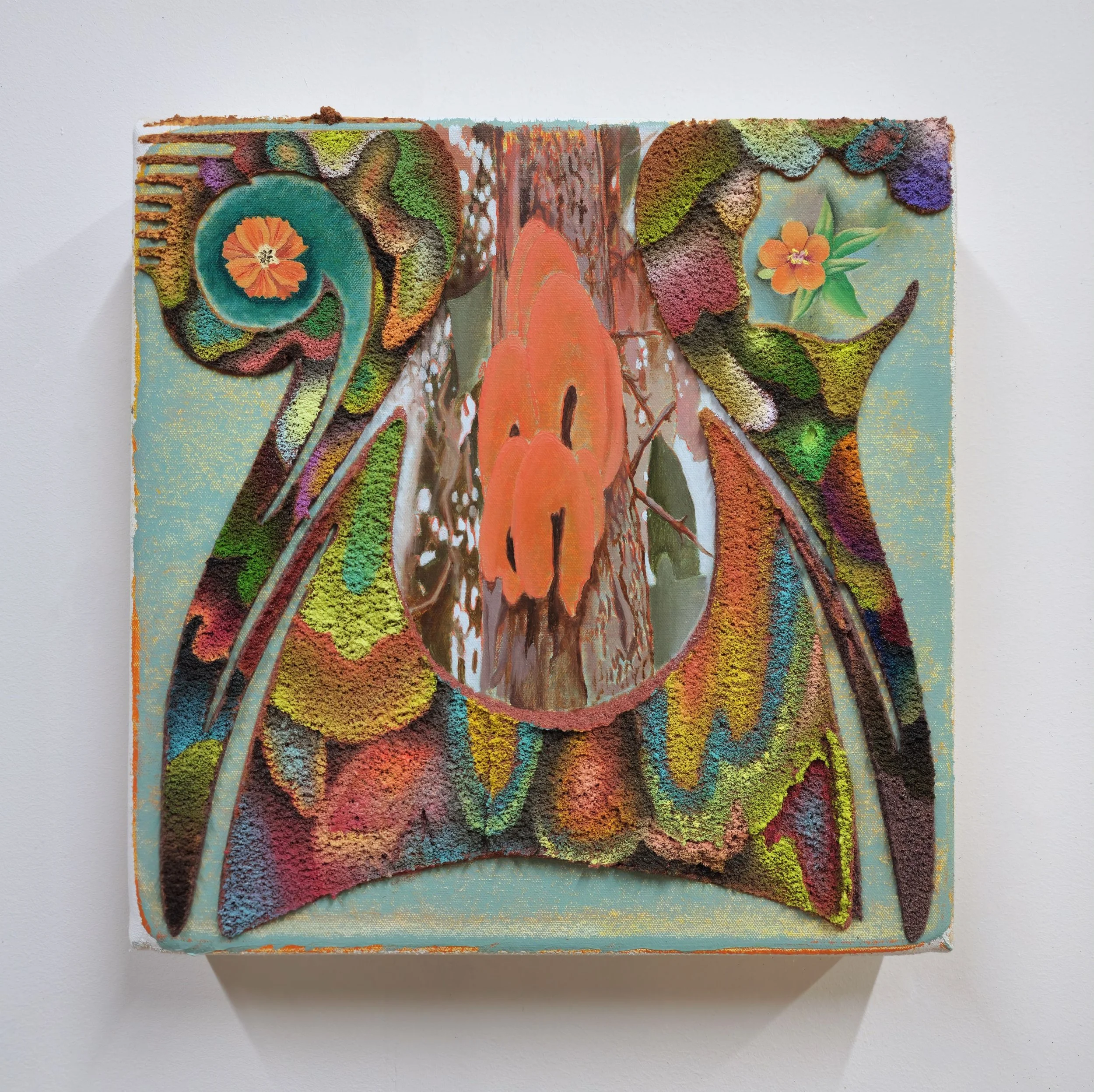
Experimental Democracy, 2026
Could you tell us a bit about yourself and your background?
I was born and raised in Connecticut and have been painting since I was 15. My father is a carpenter and musician, had a couple painters in the family too. So art was always respected as I grew up, even though we were working class. In 2014 I graduated from the School of the Art Institute of Chicago. The painting teachers there introduced me to the Chicago Imagists who heavily influenced me. Actually I was lucky enough to be taught by one of them, Philip Hanson. I’m also grateful for my incredible instruction from Richard Hull, Rebecca Shore and John Corbett. When I graduated I moved to Los Angeles for a bit, then Boulder, Colorado where I lived for 4 years. I never stopped painting but I didn't try to pursue a career as a painter as much, working odd jobs and experiencing the arts in very fringe communities. In 2020 I moved to New Haven, Connecticut and started working for painters Anoka Faruqee and David Driscoll who inspired me to rethink painting in a way I hadn’t for years. I also worked for Sam Groff, Willie Stewart and Joseph Smolinski. Then I went to RCA for painting in 2023. It was a great experience being in a school I always admired. I feel lucky to have been surrounded by such a friendly and talented class that we had, as well as some incredible tutors like Pamela Golden and Phil Allen. I graduated in 2024, and I’m still living and painting in London to this day. London is one of my favorite cities in the world. It's obviously unique, and I just love being surrounded by the wide range of painters and artists here.
Your paintings seem to use a wide range of techniques, from what looks like thick textured surfaces to smooth airbrushed gradients and even sculptural elements that come off the canvas. How do you decide which technique to use for a given piece, and do you see the physical process of making the work as carrying just as much meaning as the final image?
The physical process is actually the whole vehicle of meaning for me. I don't really see painting as something that can have a predetermined meaning and the end result will remain that way. I think it's more likely the kinesthetic process develops meaning along the way. As if every action and strategy is an embodiment of something deeper or poetic in nature. Over time I have found repetitions in my paintings that have given me an idea of archetypes that keep reappearing. These are sort of just natural inclinations that us painters are brought back to again and again. One of the things that sticks out is I'm always interested in observational painting as much as improvisational and imaginative painting. So it dawned on me that often I'm bringing something outside of the painting into the painting and then it changes into a subject that's informed by the internal decisions within. It becomes about the technique, the type of tools that can facilitate technique, the methodology, etc. Painting from observation informs what kind of technique I need to use to see something beyond observation. I find this shift between headspaces kind of fascinating, like entering a dream space from looking at the outside world.
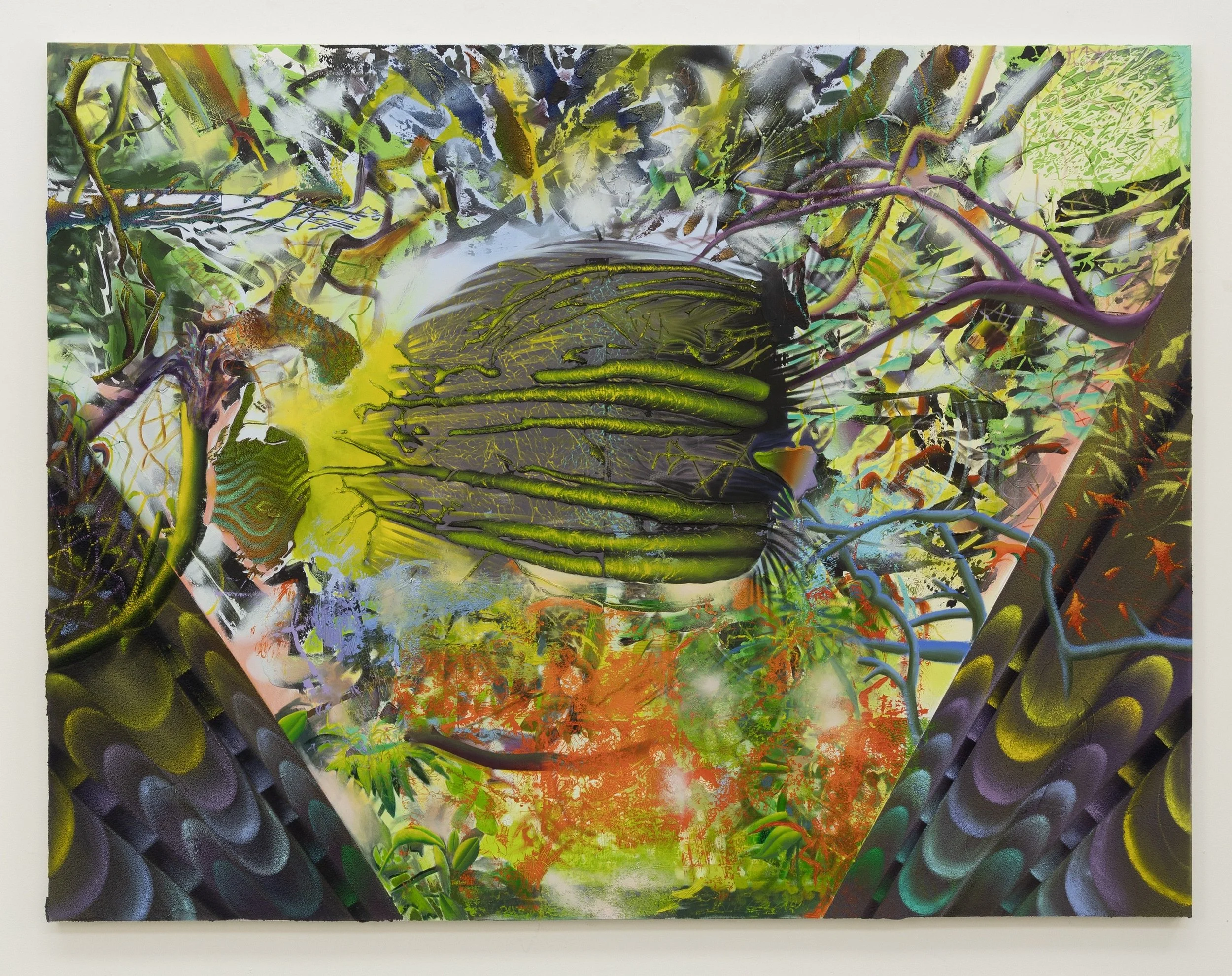
Can't See the Forest for the Trees, 2024
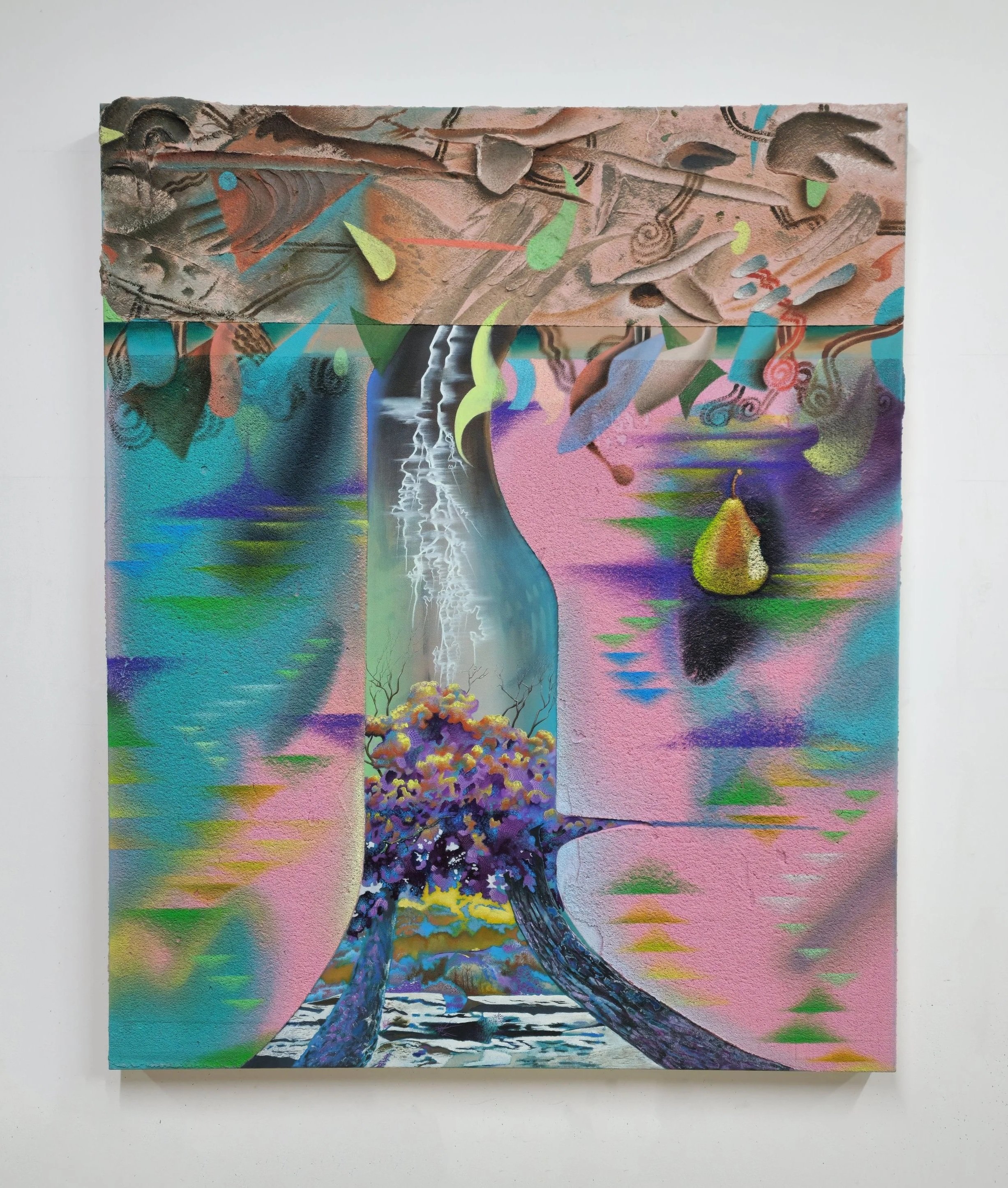
Homesick, 2025
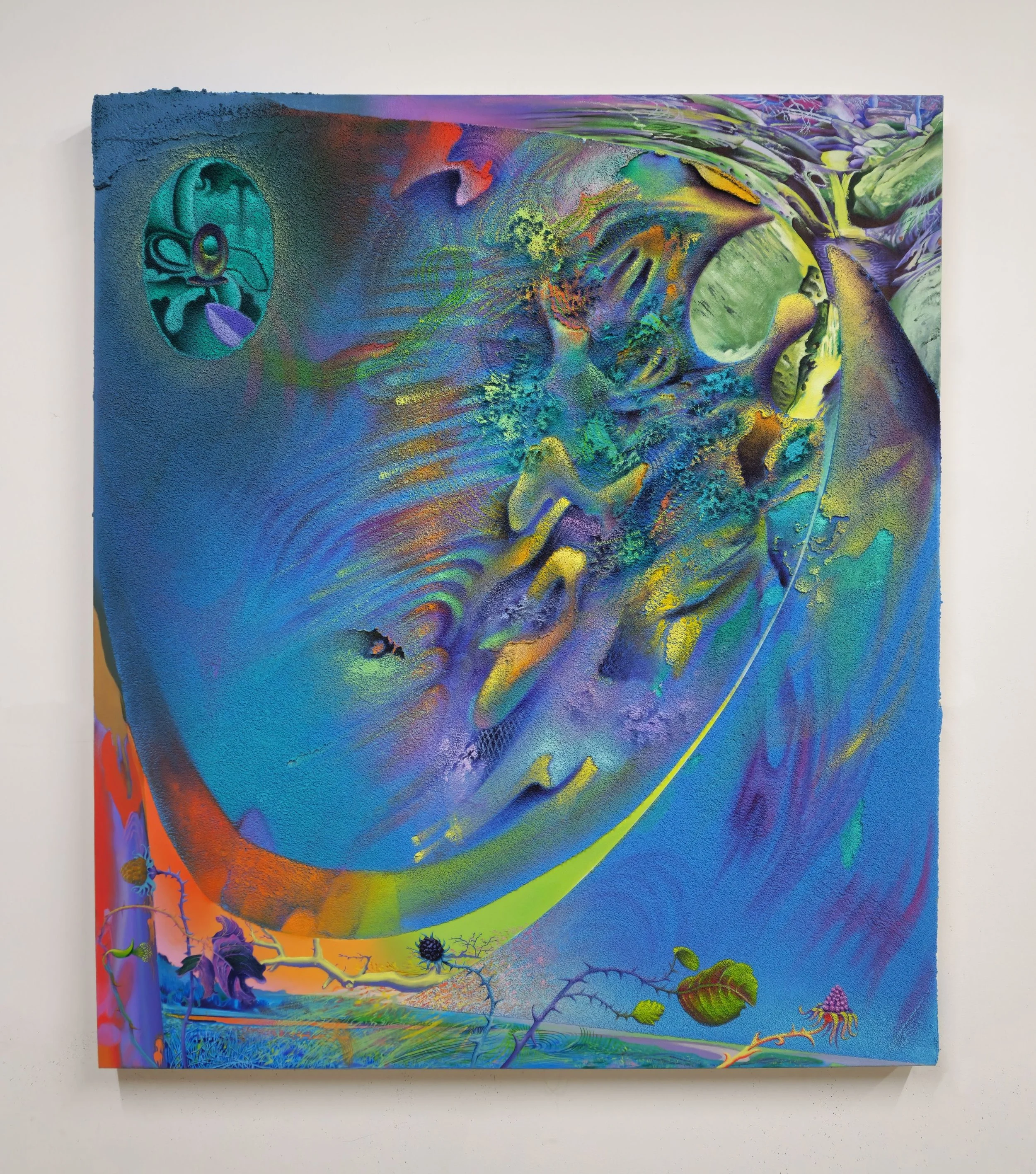
Meet Me on the Hill, 2025
Nature clearly runs through your work, but it never feels like straightforward landscape painting. There is something otherworldly about the way trees, plants, and organic forms appear. What draws you to the natural world as a subject, and how do you push it beyond simple representation into something that feels more uncertain or mysterious?
Nature's always been something that drew me in as a painter. I think it's because in Connecticut where I grew up there is a ton of beautiful nature in New England around there. When I started at RCA I was painting a lot of Surrealist style imagery, and it led me into these futurist science fiction inspired paintings. I was reading a lot of material on ufology and posthumanism, and eventually I realized one of the core concepts of posthumanism and ufology is about our relationship with things nonhuman or beyond humanity. So I started thinking nature is actually one of our first nonhuman experiences, as well as painting which is one of our first experiences with using rudimentary technologies to express ourselves. It kind of made me shiver realizing that for so long our culture has been shaped by nonhuman things, and we've been reacting to that. When I started reading more about the history of landscape painting I found this notion isn't so uncommon. The British Surrealists like John Tunnard and Paul Nash are examples of landscape painters from just a few decades ago that began imagining posthuman perceptions of landscape painting. It's strange how certain aesthetics feel otherworldly. There's clear influences in our lives that develop these feelings in us; think of things like religious paintings, occultism, or science fiction. I let these intuitively come through in my process, but I also try to find something unique that triggers a transcendental feeling in me. I find pareidolia, psychedelic color spaces, distortion and working from multiple perspectives to give me this feeling.
There is a real tension in your paintings between control and chaos, between carefully rendered details and moments where the surface seems to take on a life of its own. How do you navigate that balance while working, and is there a point during the process where you feel the painting starts telling you what it needs rather than the other way around?
Absolutely, the painting almost always tells me what I need. I had many teachers that used to tell me to let the materials speak for themselves. That always pops in my head as I'm painting something with too much contrivance. Intention really does feel like it's everything, and it speeds up the painting process quite a bit when you know exactly what you want to paint and how you want to do it. So often when things are controlled it's because I'm focused on observationally painting, paying careful attention to the form and finding the right balance of economy and almost hyper detail. Then the obsession of detail can kind of open up a portal in the painting that leads to this abstract buzz of marks, shapes and textures. Finding the flow between spaces that are heavily concentrated on is important. I have a tendency to over concentrate on one area versus the whole picture, so I have to carve out these paths that flow into each dense area of the picture to create a harmony or at least some breath and movement.
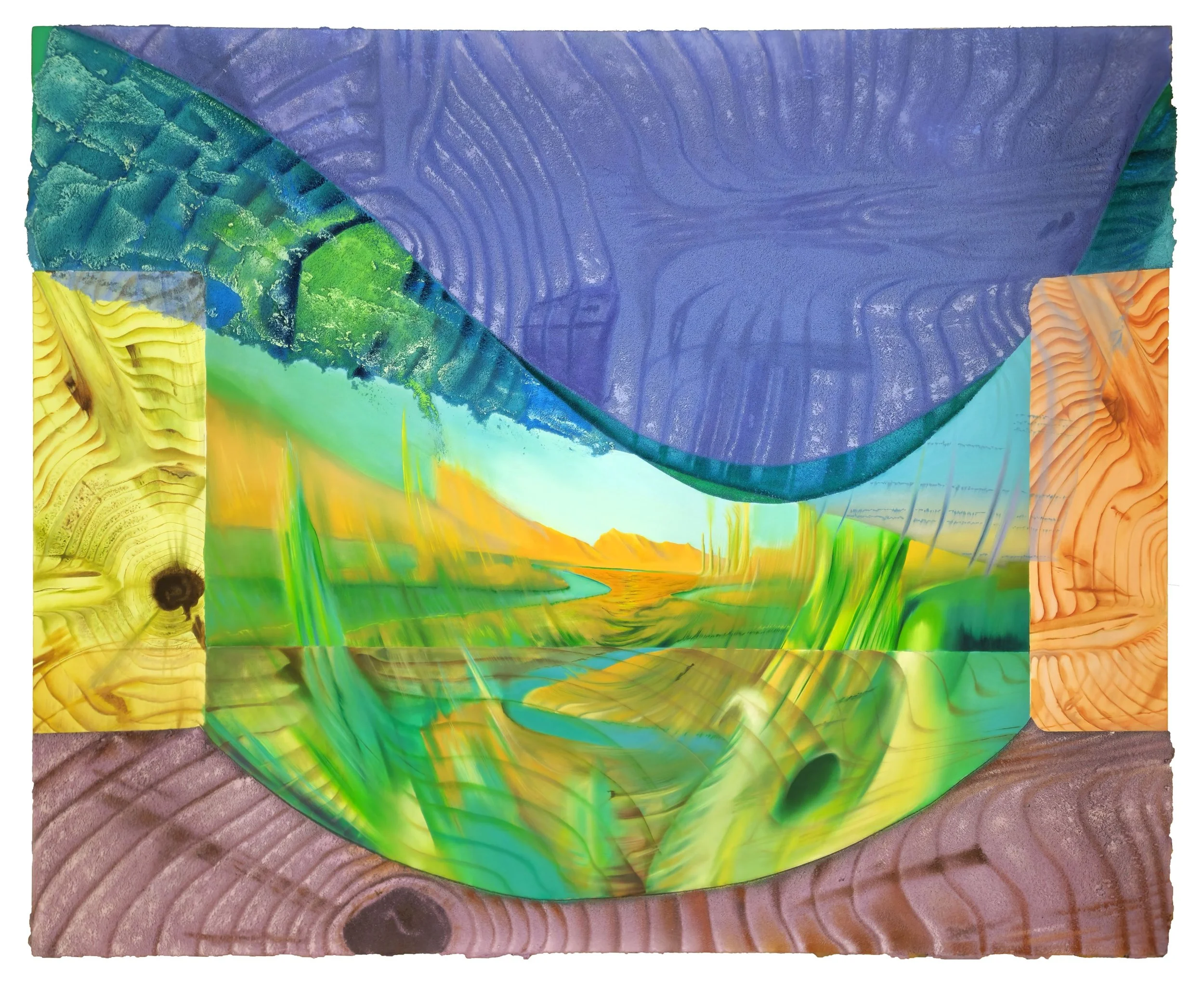
The Colonization of Technics, 2024
Tell us a bit about how you spend your day / studio routine? What is your studio like?
The train or tube has become an important part of my day. When I travel to the studio I use this time to read what I wrote about painting from the day before and I write some more. This helps create a conversation in myself that gears me up to step right into that headspace and know where I want to head that day. I'm very busy with working on multiple paintings as once, so I just get right into it as I enter the studio. I'm lucky to have three amazing studio mates and friends who I've known for the last three years. Our conversations help keep things loose and inspiring in the studio. We're very natural just working, talking and getting in the zone when we have to. I really appreciate their friendship and bond as painters. When I feel stuck on a painting I'll do some reading, watch some videos, write about the painting or take a long time looking at it. I do quite a bit of sketching too, but often I do this outside of studio time. This helps me plan a lot. I used to use Photoshop as a way to "sketch" but more recently I've become committed to this idea of practicing and developing manual ways of painting so sketching has taken front seat. My studio is quite small, so I'm always very cramped in there. I think this lends to the detail I put into my work, it's easier to cram it with detail than it is to step back and see what's going on. It's funny how much space impacts your work. The other thing that excites me in the studio is making my materials. I started making my own textures out of recycled plastics that I mix with strong acrylic mediums. This has become a meditative process, grinding up trashed plastic into bits and sorting them by color.
What artwork have you seen recently that has resonated with you?
There's a few artists that really stick with me. I'm a big fan of John Martin, you can see him in the Tate. He has these very bizarre paintings that feel like early versions of fantasy film posters. I absolutely love the material poeticism and experimentation of Max Ernst. There's a work called "The Entire City" which I keep going back to see at the Tate. Recently I saw an incredible exhibition at a gallery called Robilant. It's a group exhibition with a very clean and thoughtful presentation of work that deals with light, materiality and process. Vittorio Marella is a new painter I saw there, very compelling stuff.
I also loved Shao Fan's recent show at White Cube. Also I discovered a sci-fi illustrator, Jim Burns. He has some mindbending work everyone should check out. Also love "Agony in the Garden" by Andrea Mantegna. It's in the National Gallery of London, I can't get enough of that weird painting. There's so many interesting perspectives and textures in it, he was a maverick of this lucid dreamy painting in the Renaissance period. Always a big fan of Serolod's work, Xing Hao, Georgia Ghaznavi, Billy Crosby, Tobias Francis, Gavin Gleeson, Dien Berziga, Gordon Cheung, Angela De La Cruz, Filip Lav. Also I think it's worth checking out Final Hot Desert, Elias Tsiofas Gallery and Chilli Gallery. They're emerging galleries with very compelling work they're doing. Sorry this is a chaotic list, that's pretty much the order of how I'm seeing different artists these days.
Is there anything new and exciting in the pipeline you would like to tell us about?
I'm finishing up a whole new body of work that I'm very excited to share. Keep looking for updates on my instagram page, @seanpowerz. I've also got some new upcoming shows in the works, can't say any more but the information will be available soon on my instagram page as well : )
All images courtesy of the artist
Interview publish date: 09/06/2026
Interview by Richard Starbuck