Nicolaas van de Lande
"It becomes soft, touchable, almost teddy-bear-like, but at the same time unmistakably artificial. It has the quality of a copy of a copy. That contradiction is important to me."
Our interview with Nicolaas van de Lande, a London-based artist whose abstract works hover intriguingly between painting and sculpture. Drawing on synthetic fibres, flocking techniques and oil paint, Nicolaas builds tactile, almost cartoon-like landscapes that feel at once soft and unmistakably artificial. Raised in the Netherlands amid his father's abstract expressionist paintings, he found his way to London to pursue an art practice defined by a fascination with human-made materials and the strange wonder they can hold. In this conversation, we talk about his path to flocking, the tension between simplicity and complexity in his compositions, his studio routine, and the game-like artificial worlds he continues to construct.
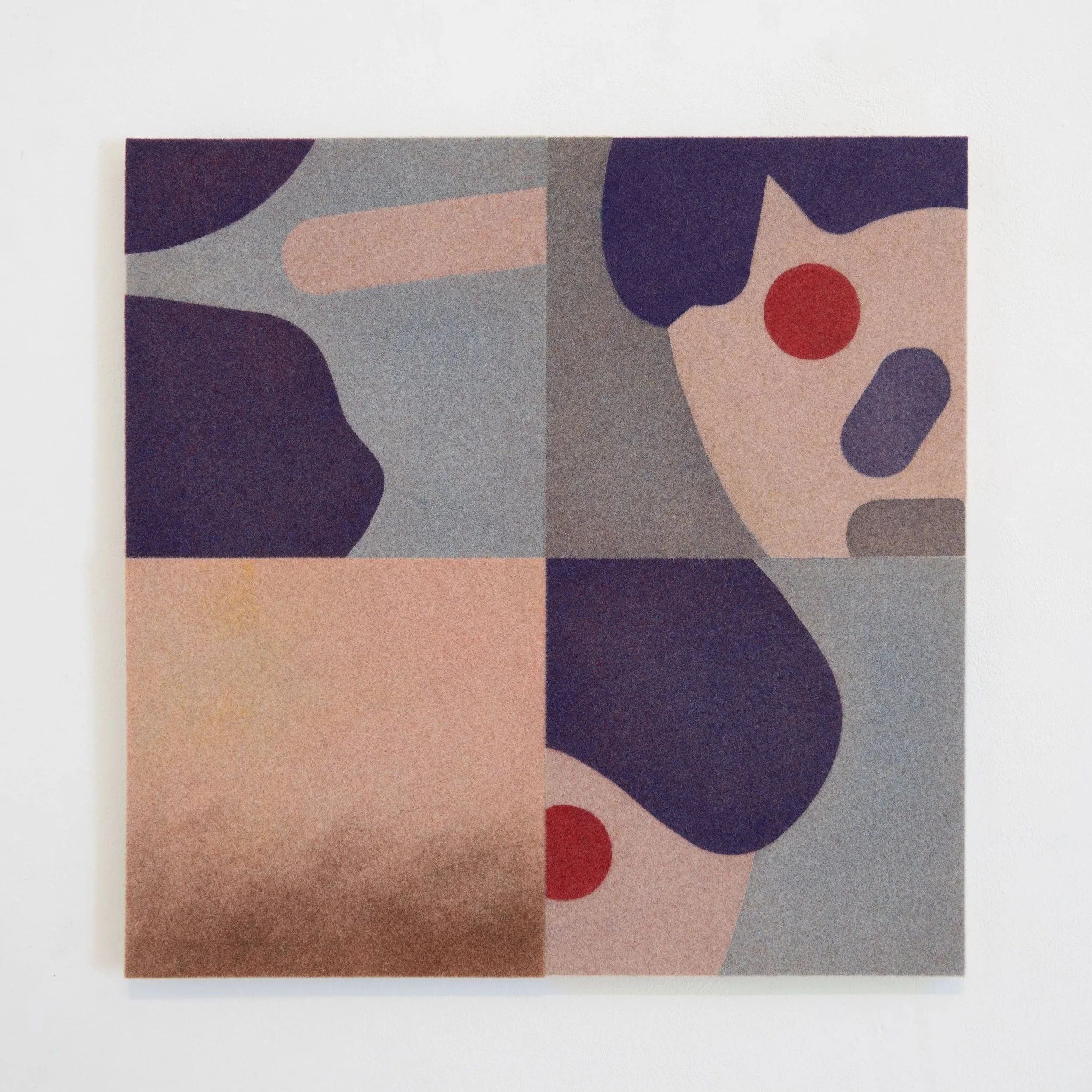
Exploring Who I Am Inside (2025). Photograph by @mitsimoulson.
Could you tell us a bit about yourself and your background?
I am an artist based in London making abstract works with both sculptural and painting techniques. Synthetic fibre surfaces, combed with oil paint to highlight their plasticky nature, are currently an important material in my visual language. I grew up in the Netherlands, near the Belgian border, in a large family surrounded by my father’s abstract expressionist paintings. It was not until my late twenties that I found my way to London, initially to study art. London gave me the opportunities to explore what an art practice could mean for me. One of the first works I made after graduating, for a group exhibition with Jerwood Arts that my former tutor Tai Shani helped me get involved with, was a sculptural installation that was rich in atmosphere but almost impossible for me to explain. It featured a workbench, meticulously crafted miniature beds complete with bedding, and a larger-than-life wooden door that, on closer inspection, was covered in a dense, dark fur of nylon fibre. Looking back, I think that work already contained something I have continued to pursue: a desire to find wonder in materials that are thoroughly human-made. A kind of human nature, perhaps, equally artificial and equally miraculous.
Your surfaces have this really distinctive soft, velvety quality that makes the work feel almost touchable even from a distance. How did you arrive at using flocking as a material, and what role does that tactile element play in how you want people to experience the work?
The first time I encountered flocking was through a tiny deer figurine on my mother's Christmas table. It was a cheap little object, completely mass-produced yet somehow bearing a magically soft, furry coat that seemed almost animated. Once I discovered how it was made, I became obsessed with the technique. I spent some time watching YouTube tutorials before building my own flocking device. What still captivates me is that flocking gives any surface an instantly recognisable character. It becomes soft, touchable, almost teddy-bear-like, but at the same time unmistakably artificial. It has the quality of a copy of a copy. That contradiction is important to me. Flocking allows me to work with a visual language that feels close to comfort design: toys, IKEA corners, cartoon worlds. The fibres I use are among the most synthetic materials imaginable, yet they produce an intensely tactile experience. Because of that, flocking has also become my way of approaching nature. I'm not interested in presenting nature as something pure, wild or untouched. The landscapes and forms in my work are already filtered through design, animation and human imagination. They sit somewhere between a remembered landscape and a cartoon of one.
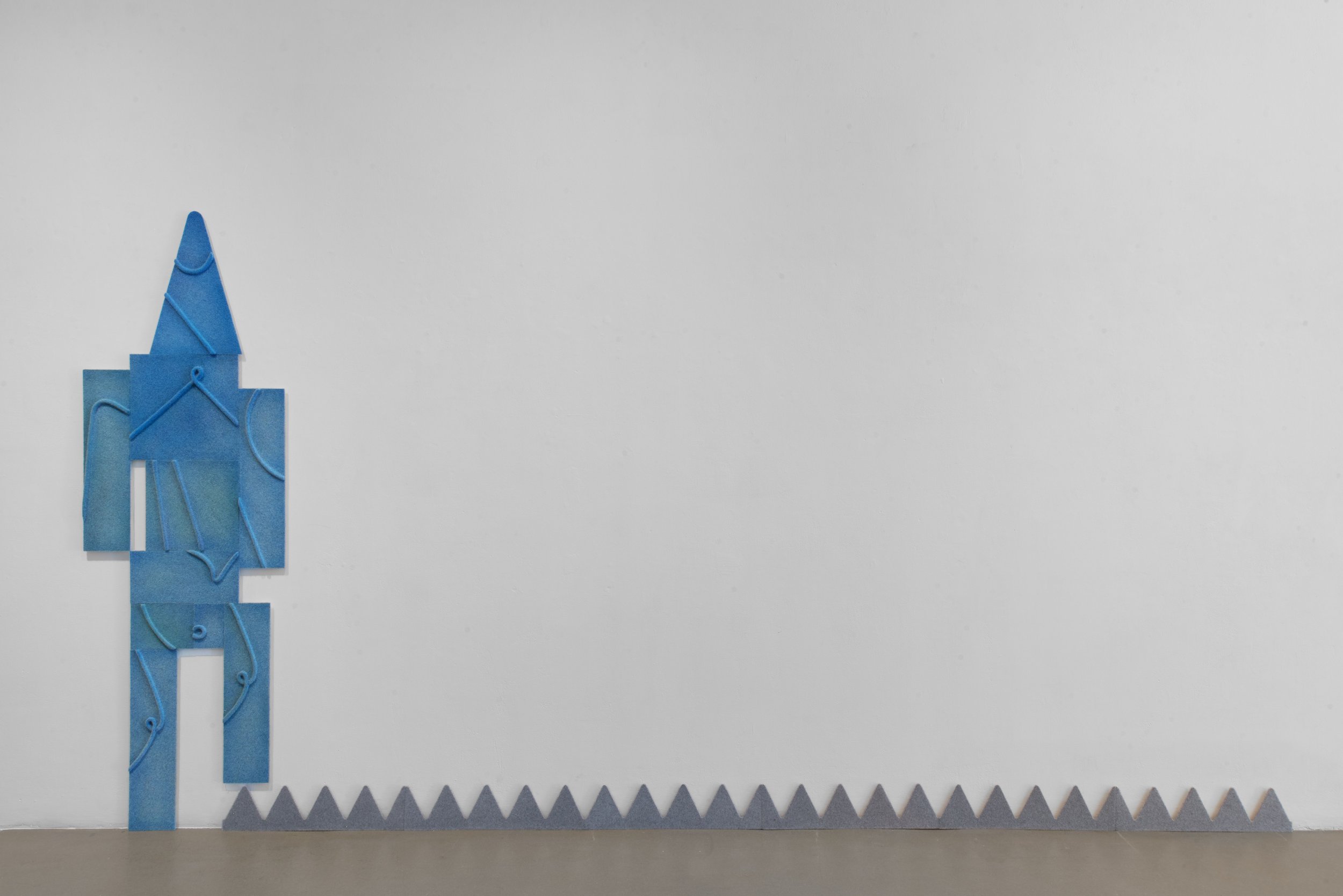
How We All Fit Together (2025). Photograph by @mitsimoulson.
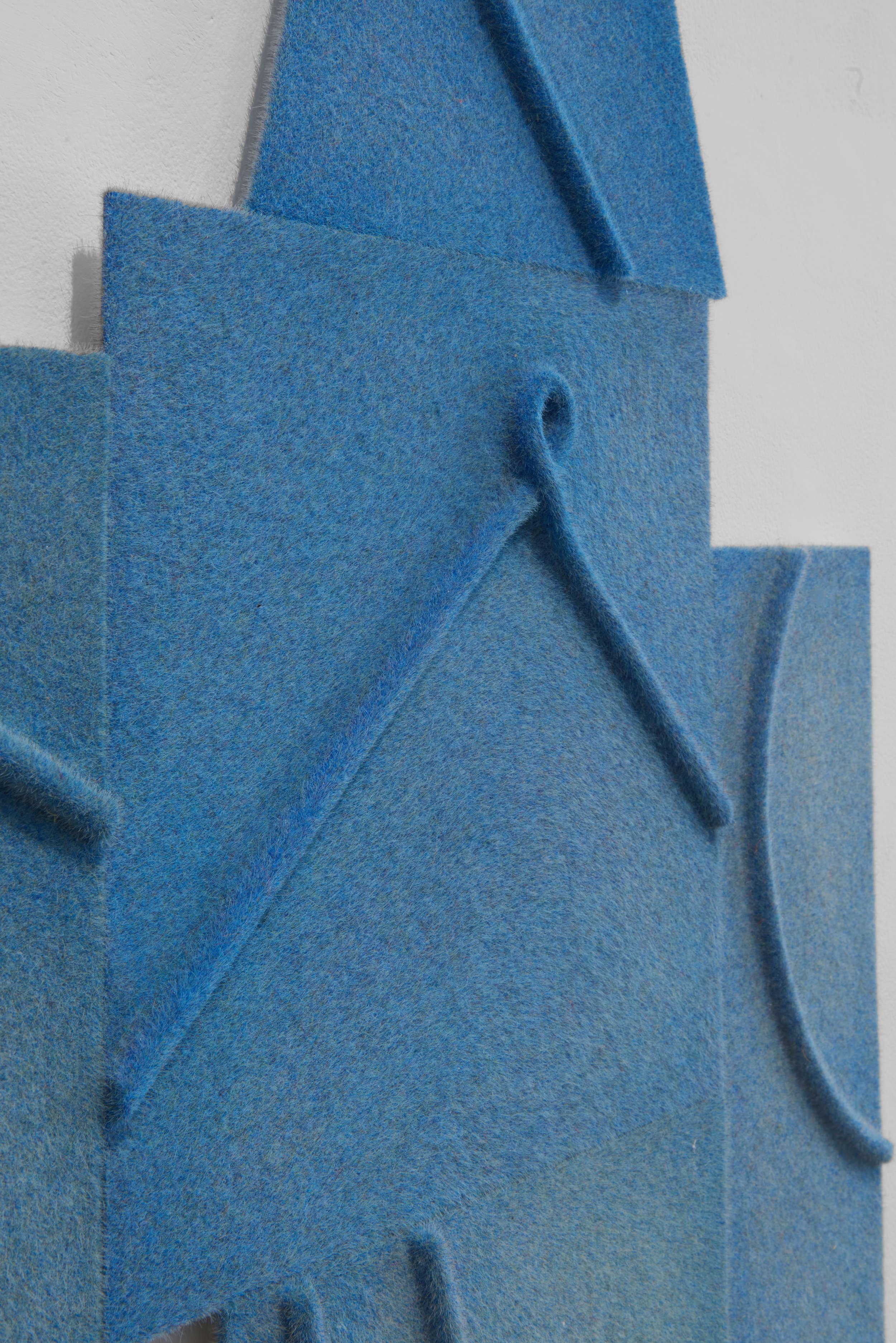
How We All Fit Together (2025), detail. Photograph by @mitsimoulson.
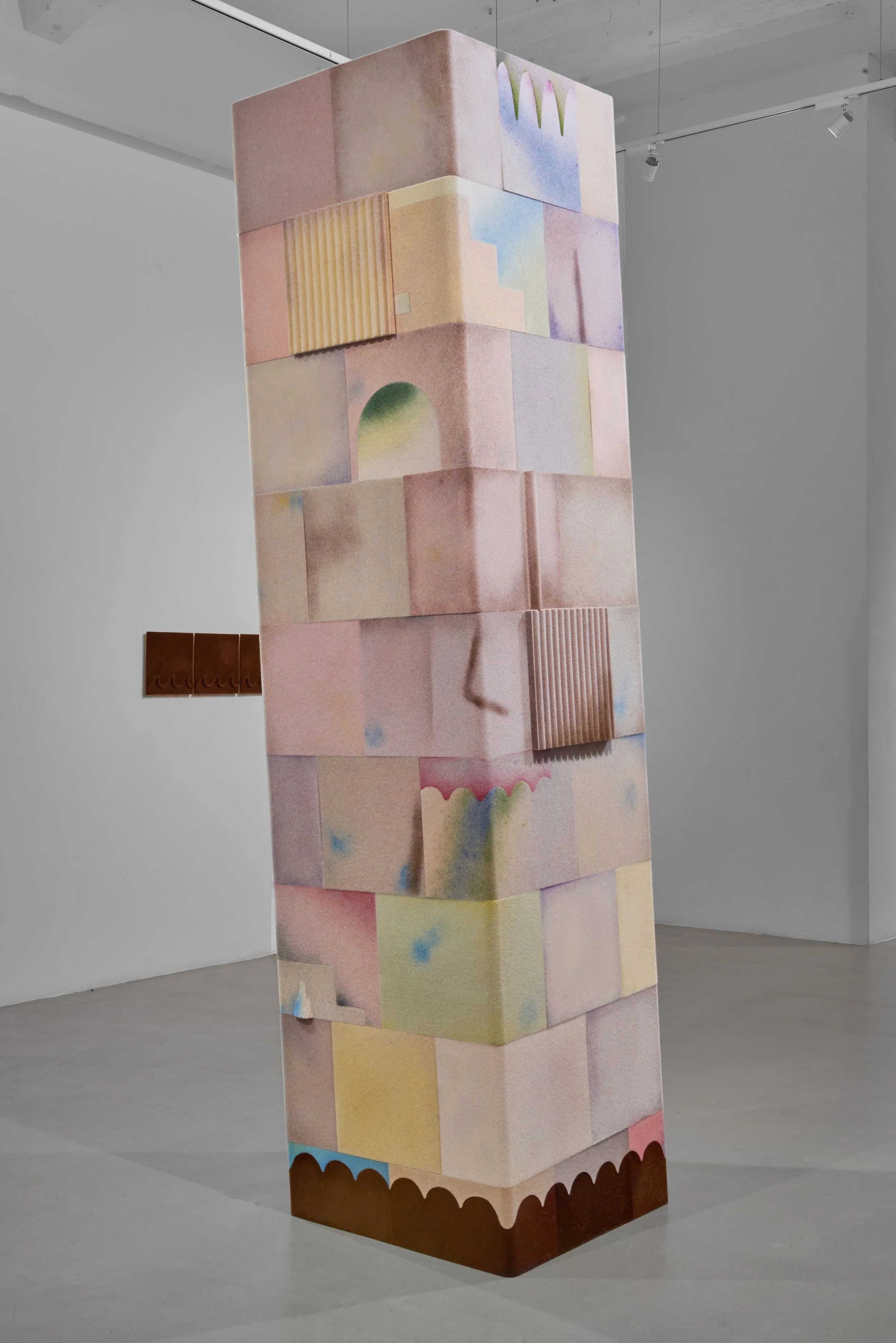
Stories About Being Brave (2025). Photograph by @mitsimoulson.
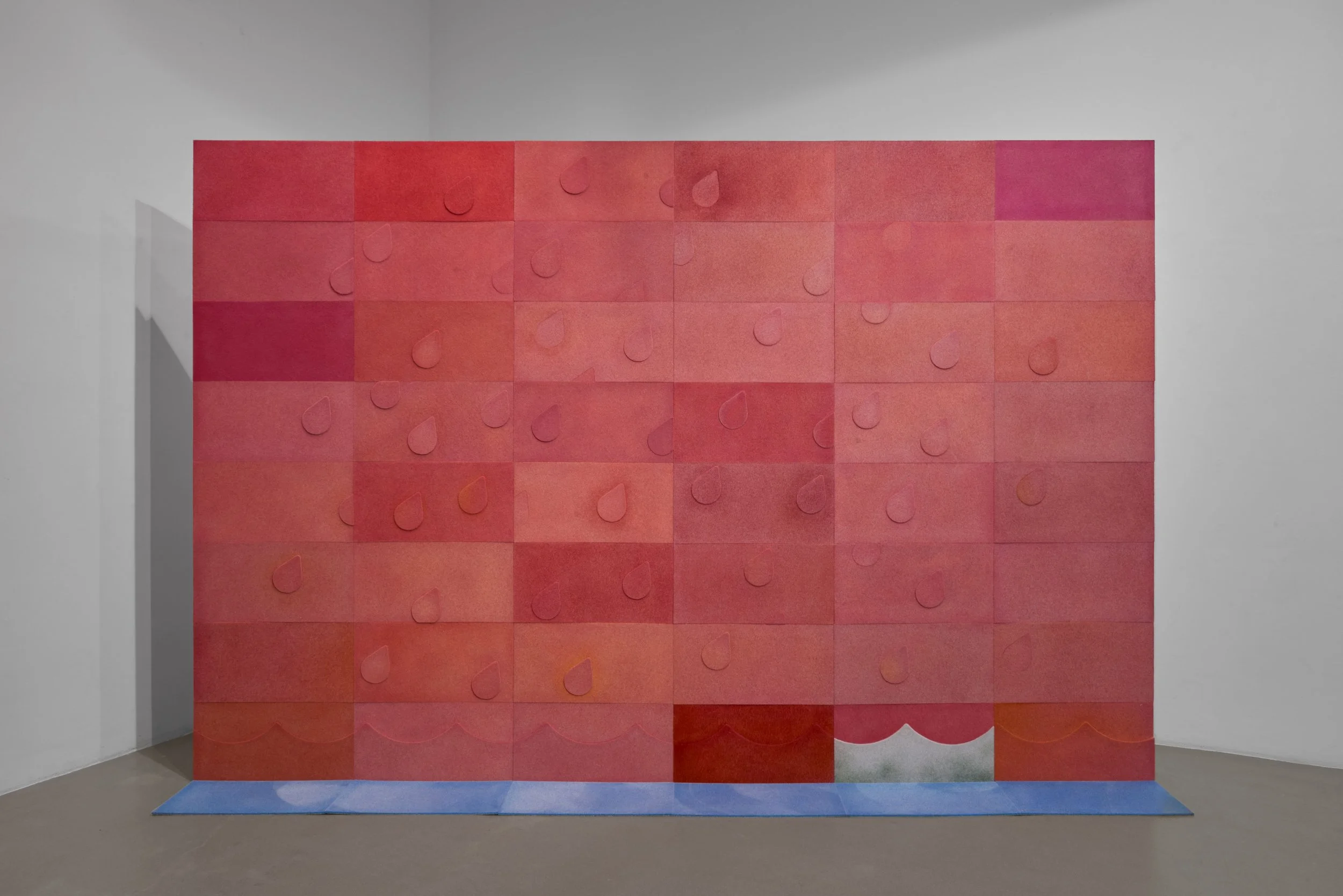
How the Sea Got Made (2025). Photograph by @mitsimoulson.
There seems to be a real tension in your pieces between simplification and complexity, the shapes and colours feel approachable, almost like symbols or icons, but the compositions themselves are layered and carefully constructed. How do you decide when something has been distilled enough, and when does stripping back go too far?
I suppose simplicity attracts me for the same reason artificiality attracts me. I enjoy reducing an image until it no longer depicts a specific thing, but instead becomes a detached, more universal version of it. While reduction in art is nothing new, my route there is probably shaped less by art history than by cartoons and early PC games. I rarely played those games myself. I mostly watched my brother. What fascinated me was the strange experience of inhabiting these simplified worlds. Some seemed endless, while others were bounded by invisible walls, crude coastlines or forests that revealed the limits of their own construction. There was something satisfying about them, but also something uncanny. I am drawn to the clarity of heavily simplified forms, yet that clarity can easily become sterile. I think I am deliberately trying to position the work on that edge. The complexity enters through structure. I work with tiles and modules assembled into larger compositions, often thinking of them as a kind of architecture. Ideally, the eye can move through a work in multiple directions. There is a system, but it never fully closes in on itself. My works often feel like stackable information piles that could be rearranged, expanded or recombined. I have a strong desire for clarity and control, but an equally strong aversion to both. The artificial landscapes I make should carry that tension: structured and limited by their own logic, yet still open to the possibility that something unexpected might emerge from within them.
Your work moves between flat wall-based pieces and freestanding sculptural forms, sometimes combining both in one installation. How do you think about the relationship between these different formats, and does a piece tend to tell you early on whether it wants to exist on a wall or occupy space in a room?
If people ask, I usually describe the work as existing somewhere between painting and sculpture. The substrates often contain three-dimensional elements, but even the flocked surfaces themselves are not really flat. They absorb light, soften sound and have a physical presence that extends into the room. At the same time, I do not want to place too much emphasis on the fibres themselves. What interests me is their effect. In that sense, flocking is simply one way of altering how a surface behaves and is experienced. Usually a work knows quite early whether it wants to occupy a wall or a room. The decision tends to arrive together with the initial idea. At the moment, though, I find myself increasingly drawn towards wall-based and architectural applications. The modular, tile-like character of the work lends itself naturally to that direction. I really like the idea of one day collaborating with architects or designers to explore how this visual language might operate across larger spaces. Increasingly, I think of the work as a kind of artificial landscape: a system of forms through which the eye, and perhaps even the body, might move.
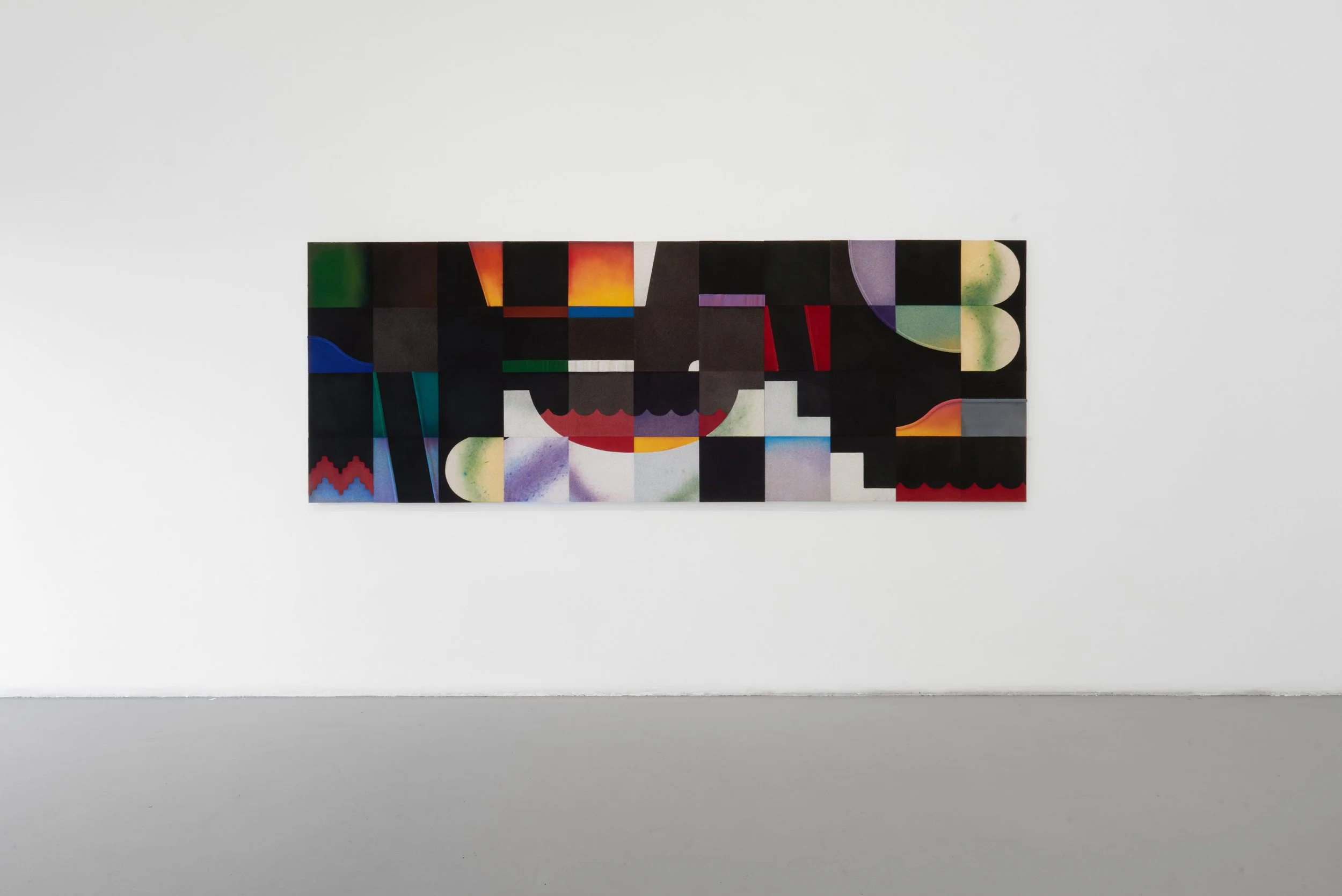
Stories About Being Careful (2026). Photography by @mitsimoulson

Not Scary, but Soft, exhibition overview, APT Gallery, 2026. Photograph by @mitsimoulson.
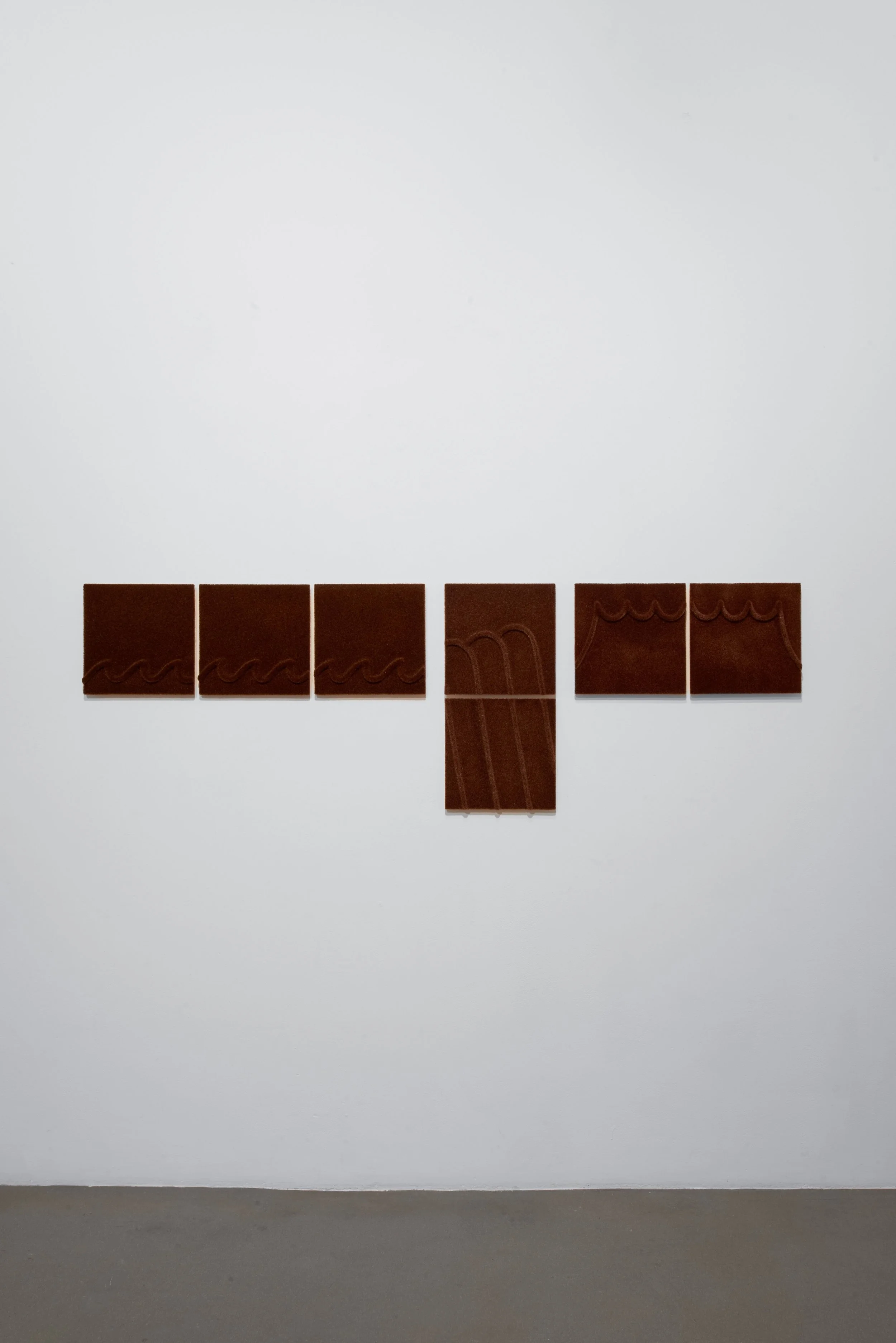
Clear Bits (2026). Photograph by @mitsimoulson.
Tell us a bit about how you spend your day / studio routine? What is your studio like?
My studio is heavily packed with materials and tools, including a flocking station and many bags of fibre that I meticulously keep contained and away from the rest of my living space. When I'm there, it's usually to execute a production process that has already been carefully planned. There is a lot of technical stuff involved in what I do, and the studio is really about that. The critical zone of creative thinking, designing, dreaming and worrying really, happens elsewhere: between notebooks, a WhatsApp conversation with myself, and the software I use to sketch. The things me and myself discuss on my phone range from snapshots of things I encounter during the day to little reminders of conversations I've had with friends while hanging out in London's most beautiful cruising graveyard. Sometimes a studio space can also be a residency. Right now, I'm a resident at Shipton Gallery in Hackney Wick. Being there helps because it places my work next to other things and other people. I think this idea of existing in proximity to something is often how I make progress. Much like the game narratives I sometimes use to understand my work, these things do not explain the work itself. They are simply useful because they exist alongside it.
What artwork have you seen recently that has resonated with you?
Over the last couple of years, three artists have stayed with me. I admire their work, but I also find myself returning to it as a way of understanding what has already been discovered and explored before me. Two of them, Julien Ceccaldi and Julian Opie, I encountered while visiting New York City for the first time, at MoMA PS1 and Lisson Gallery. The third is Gabriela Giroletti, whose work I saw online first, but after finding out she works in London I contacted her and had a really nice studio visit with her. All three artists share a graphic, almost cartoon-like quality in their language. It is slightly strange, because I never considered myself particularly drawn to that visual language. If anything, I seem to have gradually grown towards it. I still haven't entirely figured out why certain visual qualities resonate with me so strongly, but these artists have become important reference points.
Is there anything new and exciting in the pipeline you would like to tell us about?
I’ll conclude my current residency at Shipton Gallery with a show titled People Make Plans for the Land. The works are game-like landscapes composed of simple, almost silly forms. Some suggest water, others land. Everything remains abstract, but the title hints at a promise of clarity and logic, almost like explaining a complicated world to a child. There is something political suggested by the title, but my interest is not in what plans are being made. Rather, it is in the act of planning itself, and in our remarkable ability to reduce complexity into something that appears simple and sensible. This is something we often do when speaking to children, and it is also present in the visual language of the works. During the residency I’ve been pushing the idea of modular tiles that can extend across different works and perhaps one day into larger worlds. I’m interested in how softness, colour and arrangement can remain abstract while still suggesting a navigable world constructed from fragments, decisions and shared assumptions.
All images courtesy of the artist
Interview publish date: 09/06/2026
Interview by Richard Starbuck