Augusta Lardy Micheli
“It’s ultimately about grieving for landscapes, a feeling that exists strongly in me.”
Our interview with Augusta Lardy Micheli takes us into a world where memory, landscape, and emotion collide on the surface of the canvas. Swiss-born but shaped by years abroad, Augusta came to painting in 2018 after studying Philosophy at Kings College London and working in the culinary world, and she has never looked back. Her work explores the shifting notion of the Sublime, moving from the pristine alpine landscapes of Romanticism toward the uncertain terrain of our anthropocenic present. Through a restricted, emotionally charged palette and veils of thinly layered oil and ink, she paints places that grieve, dissolve, and reinvent themselves, inviting viewers to complete the image within their own imagination. In this conversation, she opens up about colour as a universal language, the ache of Solastalgia, her studio life between vision and urgency, and the new body of work she is bringing to New York this September.
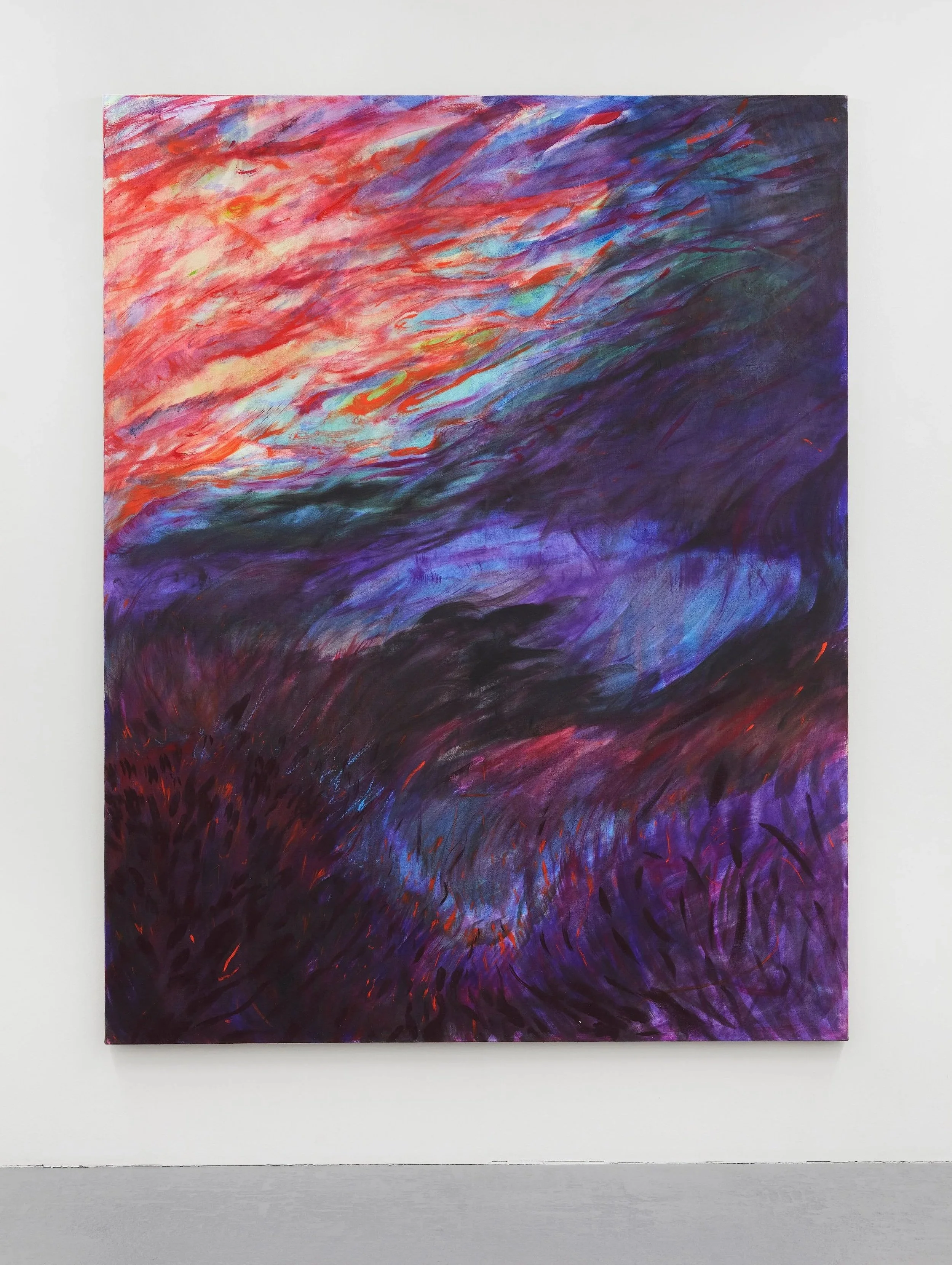
Fire, 2026. Photo: Sully Balmassière
Could you tell us a bit about yourself and your background?
I am Swiss but grew up abroad. Every summer visiting my family, I would watch the eternal snows on the peaks disappear, the seasons growing dryer and warmer, violent storms becoming recurrent. Those emotions would stay with me as I headed home, visions of pristine alpine landscapes blurring into strange climatic events. That tension is at the root of my practice. I studied Philosophy at Kings College London while venturing into the culinary world as a private chef and consultant. For a long time I felt torn between two worlds that couldn't quite meet, until painting erupted into my life in 2018, when I became a student at City and Guilds in London. I held a paintbrush for the first time and never stopped. Painting became the necessary alchemy between the world of ideas and the physicality of praxis, an intoxicating evidence that spoke to me immediately.
Your paintings carry an intense emotional charge through color alone. Reds that feel like they are burning, blues that seem to swallow everything around them, greens that shimmer and shift. Can you talk about how you arrive at a particular palette for a painting, and whether color is something you plan in advance or something that emerges in response to what you are feeling or processing at the time?
The human mind is not a screen, and the eye isn't a camera. We remember things through the distortion of emotion, which often arrives with a specific impression of colour, and that is why I choose the colours I do. I work with a restricted palette of two or three colours that create a tension together. I feel close to the Renaissance technique of Cangiante, where instead of describing light with white or shadow with black, a different hue takes their place. A green becomes the shadow of a pink, a magenta the shadow of a blue. Hitchcock's Vertigo has been a major reference in that sense, and I keep Albers' Interaction of Colour close in the studio. I am fascinated by the history of the Sublime in painting from romanticism until today, and that includes how it has been considered by painters such as Newman or Rothko. I believe in the power of colour as a universal language, as a way to express things through the silence of words and through the strength of a lived experience.
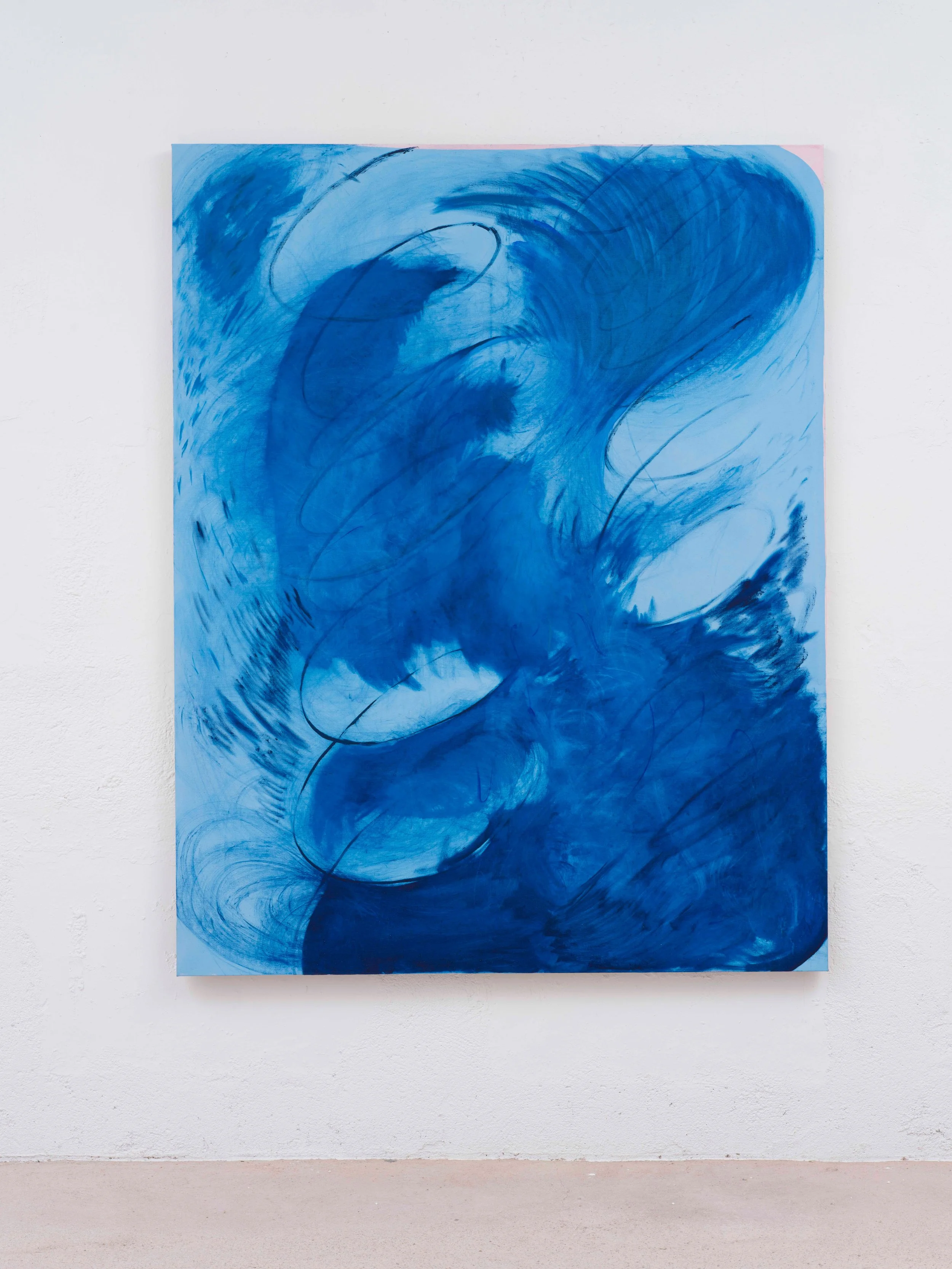
Grand bleu et barbelés, 2025.
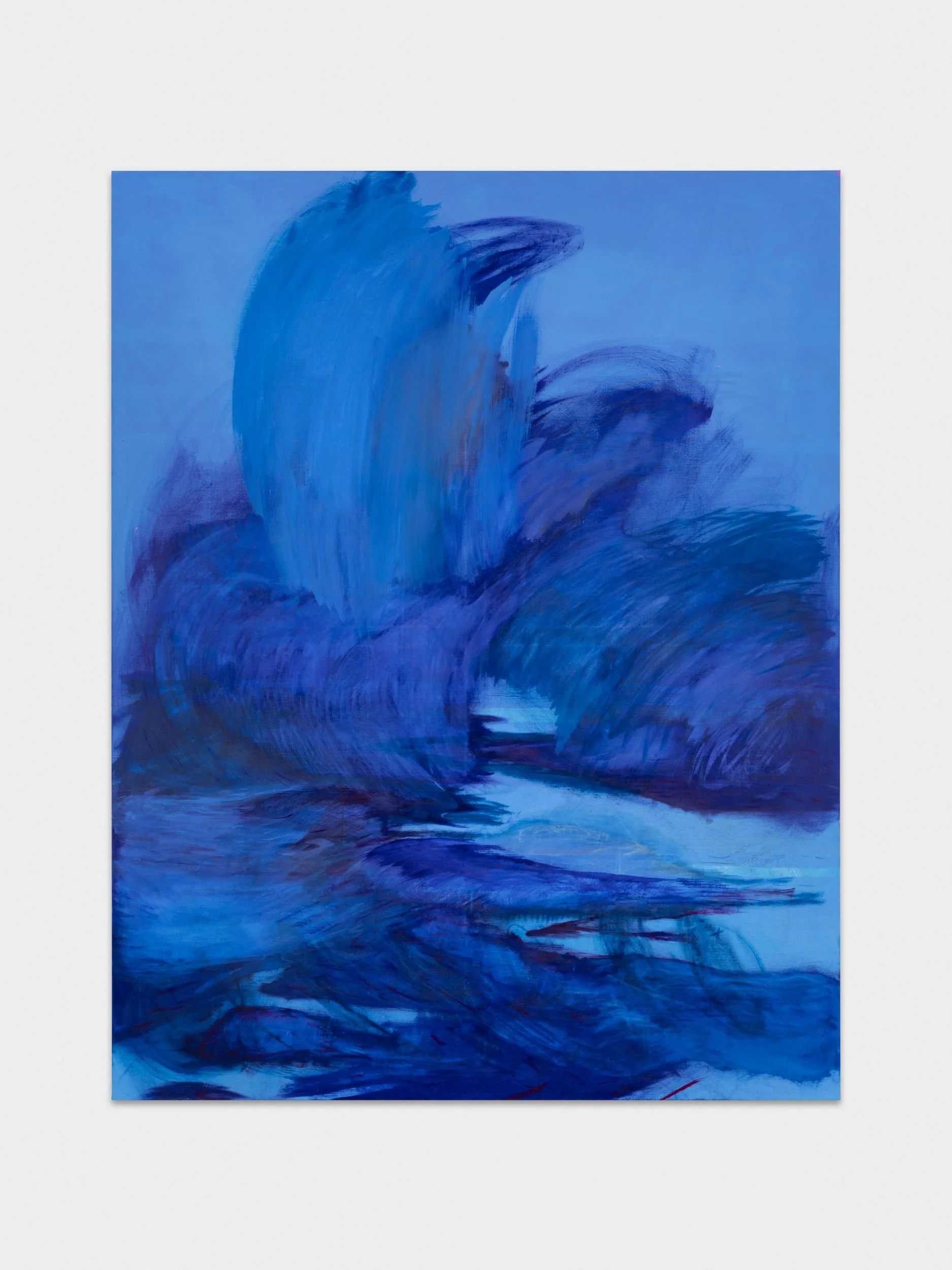
Blind spot, sweet spot, night gesture, 2025. Photo by Julien Gremaud
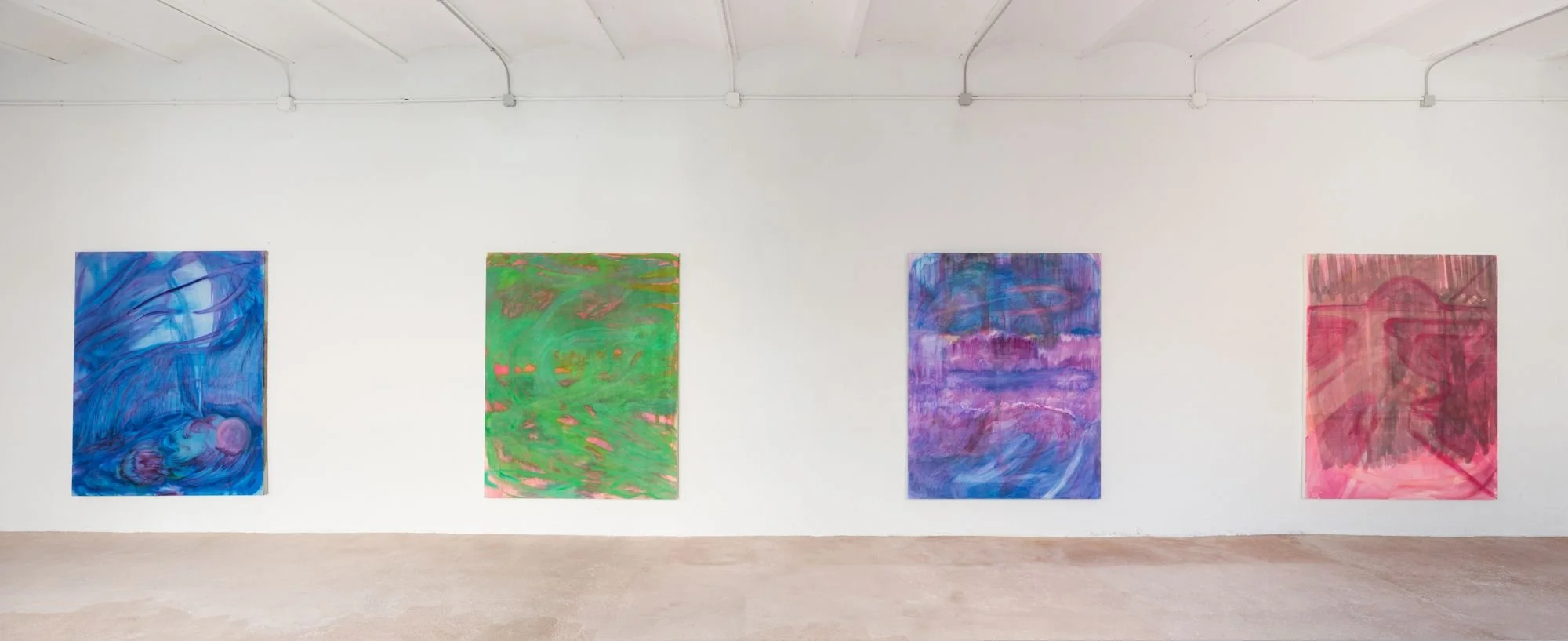
“Kérosène”, Solo show, Galeria Belmonte, Madrid. Photo by Pablo Gómes Ogando
There is a strong sense of landscape running through your work, but it never feels like a straightforward depiction of a place. It seems more like the memory or the feeling of a place, or maybe even a place that does not exist yet. How do you think about the natural world in relation to your painting, and does the current state of environmental change influence what appears on your canvases?
It all started with an etching of a glacier, a place that no longer exists. It had been depicted countless times during the Romantic era, and realising it was now gone, just a ghost of somewhere that once held deep meaning, frightened me to my core. Where was I going to place all these emotions? What are the flowers of tomorrow? Where are the glaciers that are no more? My practice examines how the Sublime has evolved from Romantic depictions of pristine landscapes to a contemporary anthropocenic reality. It's ultimately about grieving for landscapes, a feeling that exists strongly in me. Painting becomes the letting go of these places that no longer exist, and a way to create a fantasy of those that will replace them. I'm quite interested in the idea of Solastalgia, a sort of environmental melancholy related to the loss of the familiar in one’s own home. There are very few places in this world where strong emotions around climate change and eco-anxiety can be held, and I hope painting can be that place for viewers. It is for me.
Your paintings seem to exist in a space where things are almost recognizable but never fully land as one thing or another. Forms dissolve, surfaces blur, and the viewer is left filling in gaps on their own. How important is it to you that your work stays in that unresolved territory, and what role does the viewer play in completing what a painting ultimately becomes?
I paint in thin layers of oil and ink, scrubbing back much of what I apply. The layers become like veils of memory; the linen is stained with oil and petroleum-based spirits, and the more I try to catch a composition, the more it becomes painting. It is a cathartic process. This connects to a deeper curiosity about how objects, images, and spaces transform through time. How much can an environment, a landscape, a painting alter itself before it becomes something else entirely? At what point does change become erasure? Keep subtracting until what remains feels essential, that is the painting. It might be my only rule. I aim to show just enough to express the idea, and little enough that the viewer keeps building the composition in their own imagination, even after the painting is finished. I usually keep my works empty of the human figure, so they can englobe the viewer within the scale of the painting as they make it their own. I try not to over-describe, letting the painting carry the energy of the moment it was made. Abstract expressionism fascinates me for that reason, paintings that hold a tension between silence and assertion.
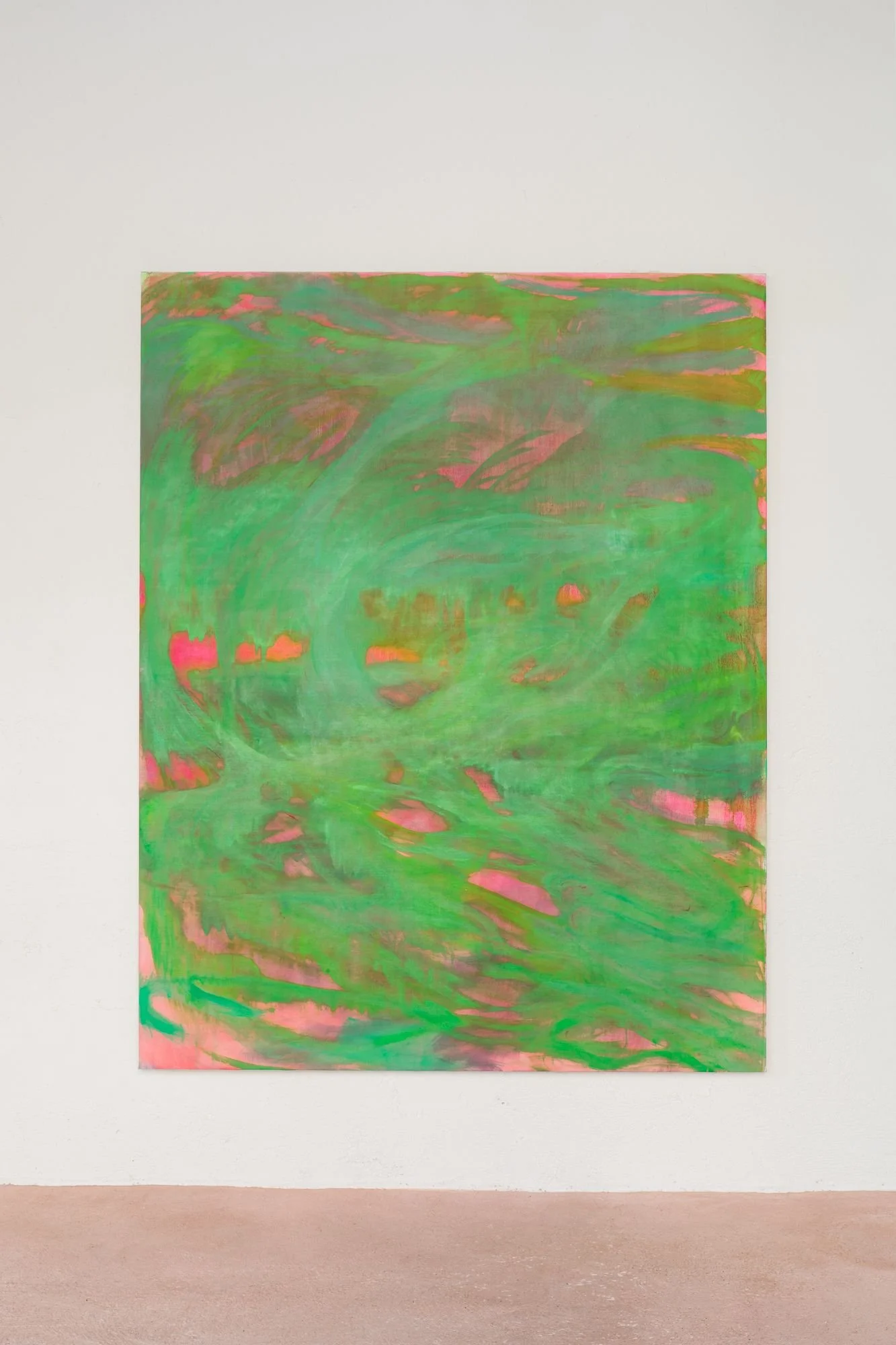
Extreme heat mixes with the light, 2023. Photo by Pablo Gómes Ogando
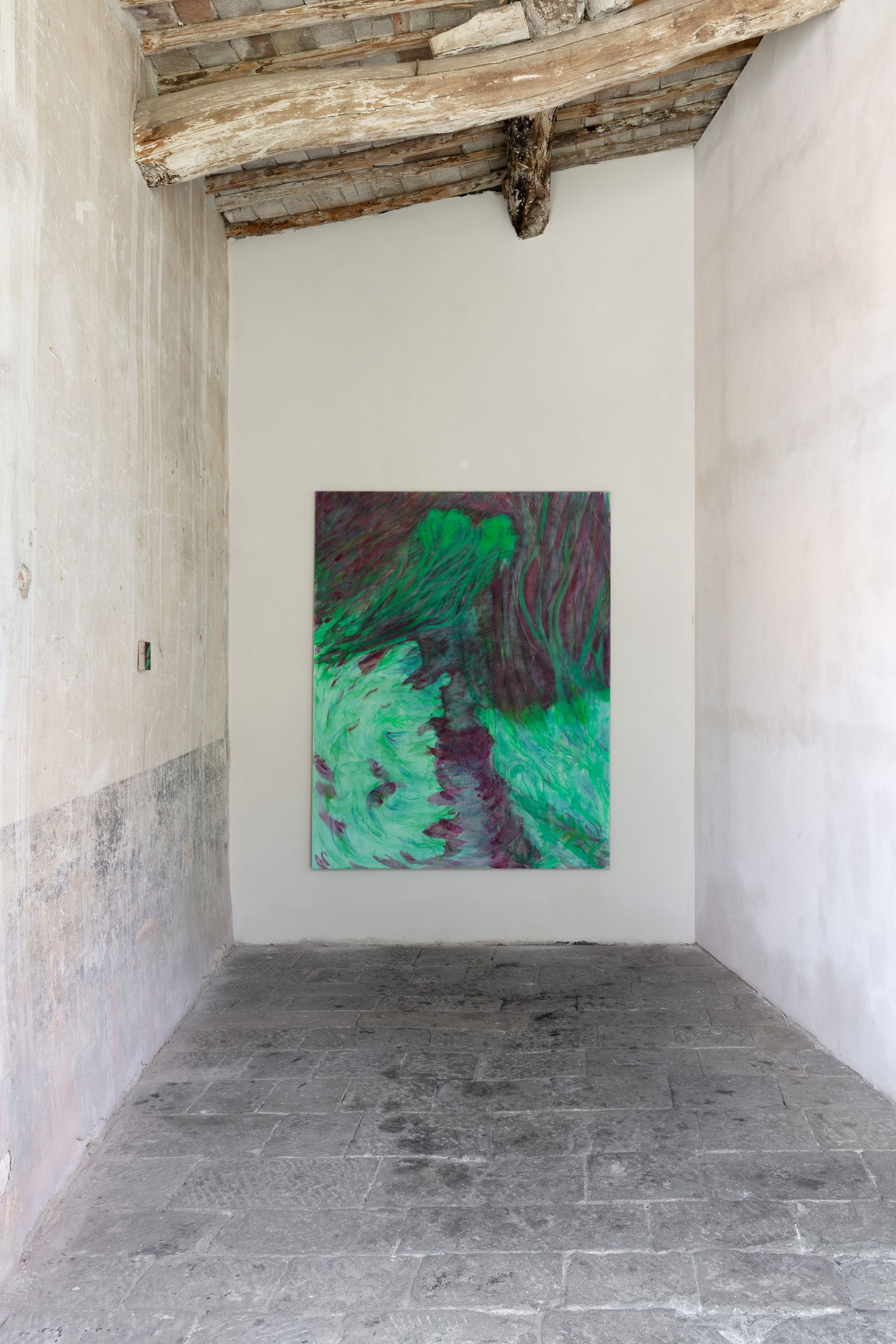
Locus Amoenus, C.G. Williams Gallery, 2023.
Tell us a bit about how you spend your day / studio routine? What is your studio like?
I don't oversacralize the physical studio itself, it is simply a place where things get dirty and where the act of painting can happen. The studio can also be a notebook, a conversation, a dream. This is why my day splits in two, regardless of where I paint. The first part is about being in the world of visions, letting the mind wander through uninterrupted trails of thought that stay open to the daily sublime. The second part, and through the night, is about catching the power of the now through the immediacy of painting. It has a sense of urgency. I like to keep my decision making bold, not lingering too long on being seduced by what is already there, but always moving forward. Two years ago I relocated from Ridley Road in East London to a rural area of Switzerland. From my studio I see the mountains, and everywhere around me the landscape is shaped by human activity on earth. I found myself immersed in the very subject that had defined my practice from the city: the anthropocene. It feels like living inside the work itself.
What artwork have you seen recently that has resonated with you?
I was recently moved by Eventual Horizons, a video work by Elise Guillaume shown in Paris in a show curated by Lorraine de Thibault. She filmed the grieving of landscapes, icescapes, in the arctic as they melt and disappear, and wove into that something entirely personal, her own grieving of a friend. The way she held both together, the intimate and the universal, really struck me.
Is there anything new and exciting in the pipeline you would like to tell us about?
Yes! I’m opening a show in New York on September 9th! The show will take place at Slip House Gallery, in the East Village, which is run by Ingrid Lundgren, and is being curated by Emma Loy. I am making a new body of paintings in dialogue with works by Sean Scully, Julie Mehretu, Per Kirkeby and Harold Ancart. See you there!
All images courtesy of the artist and Galeria Belmonte, C.G. Williams, Galerie Lange+Pult
Interview publish date: 09/06/2026
Interview by Richard Starbuck