Qin Tan
“It is the place where the fast, glowing, digital image slows down and becomes material. That transformation is still the part of painting that feels most meaningful to me.”
Our interview with Qin Tan takes us into a world where classical training and digital sensibility quietly collide. Born in Beijing and later immigrating to the U.S. as a teenager, Qin discovered painting in the most unexpected of places, an early formative encounter with Renaissance masters that would shape a lifelong dialogue between the handmade and the virtual. Today, Qin's paintings feel at once digitally rendered and deeply tactile, building landscapes that seem half-remembered, filtered through screens, memory, and lived experience.
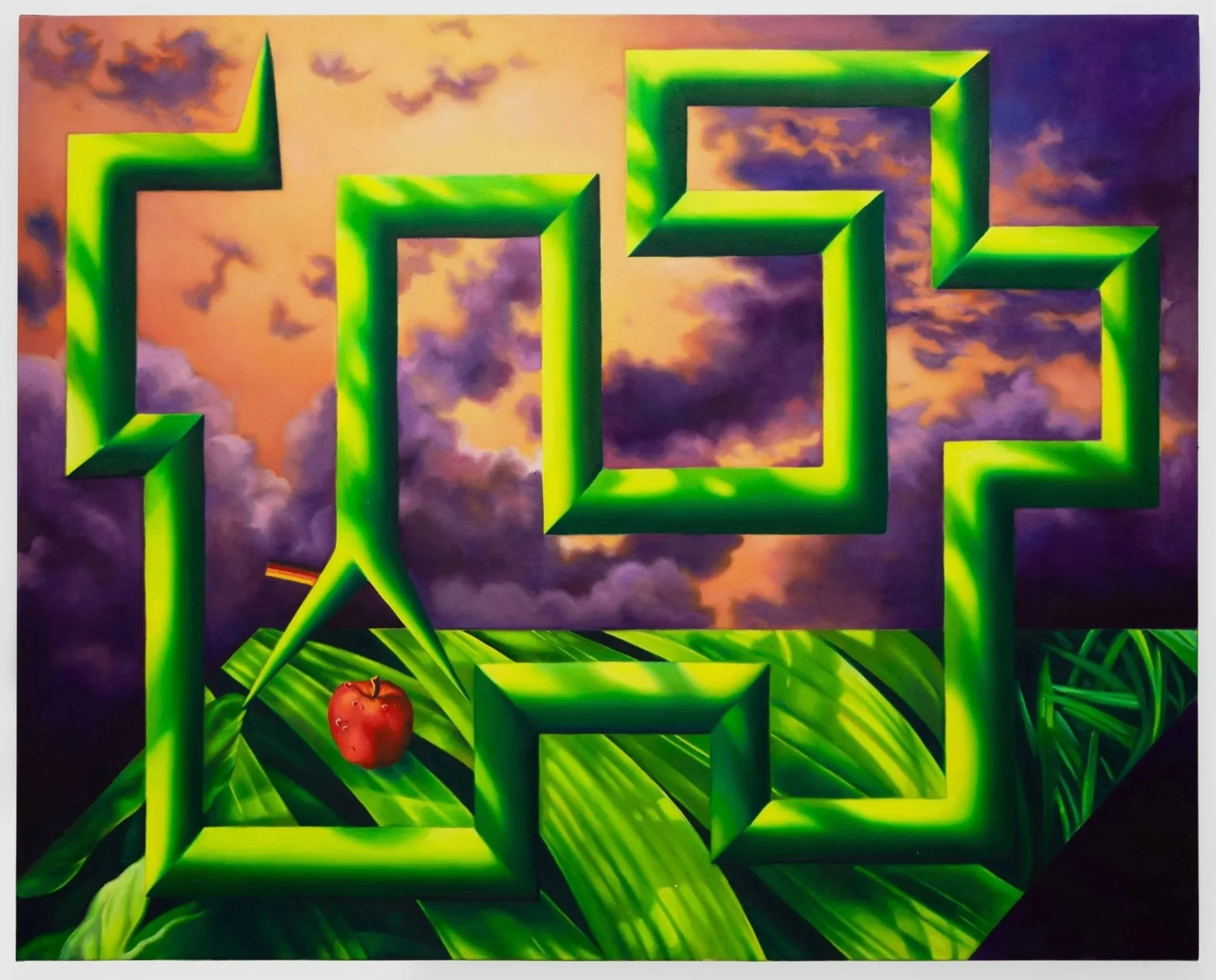
The Last One Left, 2024
Could you tell us a bit about yourself and your background?
I was born in Beijing and immigrated to the U.S. with my family as a teenager. My first exposure to art took place in the dimly lit basement of a Chinese scientist’s home, where a group of us kids were introduced to the splendor and history of Renaissance painting. We studied the classical techniques of masters like Leonardo da Vinci, Caravaggio, Pontormo, and others. Looking back, it was a very unusual but formative beginning. There was something almost secretive and magical about learning painting in that basement, being introduced to dramatic light, anatomy, religious imagery, and the idea that an image could hold an entire world inside it. At the same time, I grew up surrounded by a very different culture. After moving to the U.S., I was experiencing a new language, a new environment, and a new sense of identity. The internet, video games, and digital images became part of the way I understood the world. I think being between cultures also made me more sensitive to being between visual languages. Painting gave me a place where all of those experiences could coexist. I didn’t fully realize that I wanted to become an artist until after college. I had explored different creative paths, but I kept returning to painting because it felt like the most open and personal way to express myself. It allowed me to make sense of memory, identity, humor, loneliness, and the strange feeling of living partly through screens. My current work brings together my classical training with the visual language of digital spaces, virtual environments, and personal memory. I often think of the paintings as places where the handmade and the virtual meet, and where something artificial can still feel emotional and alive.
Your paintings have this quality where they feel both digitally rendered and deeply handmade at the same time. How do you balance those two sensibilities when you're actually at the canvas, and at what point in the process does a painting start to feel like it belongs to both worlds?
I usually begin with a small sketch or a digital composition. Sometimes the starting point is very simple, like a view from my balcony, a landscape I saw during a long drive, a color combination from a sunset, or a small emotional moment that stayed with me. From there, I often collage different references together, including photos from my phone, screenshots from games, fragments of landscapes, or images I’ve collected over time. That part of the process feels very fluid and fast. I can move things around, flatten space, exaggerate color, and build a scene that feels almost like a virtual stage. Once I bring the image onto canvas, the painting has to become physical. That is where the balance really begins. I’m not interested in simply reproducing a digital image. I want the painting to hold onto the speed and clarity of digital composition, while becoming slower, more tactile, and more human through paint. Some areas are smooth and controlled, almost like digital rendering or light coming from a screen. Other areas are more textured, layered, or imperfect. I like when those two ways of making interrupt and soften each other. A painting starts to feel like it belongs to both worlds when the digital influence becomes integrated into the larger world I’m creating, rather than sitting on the surface as an effect. From far away, the image might feel clean, graphic, or slightly synthetic. Up close, you can see the brushwork, the thickness of paint, the small shifts in color, and the places where the hand disrupted the original plan. That tension is very important to me. I want the paintings to feel influenced by digital space, but not trapped inside it. They still come from real experience, from places I’ve lived, landscapes I’ve moved through, memories, emotions, and small moments from daily life. The digital sensibility becomes part of the world’s atmosphere, but the painting itself has to feel bodily, vulnerable, and alive.
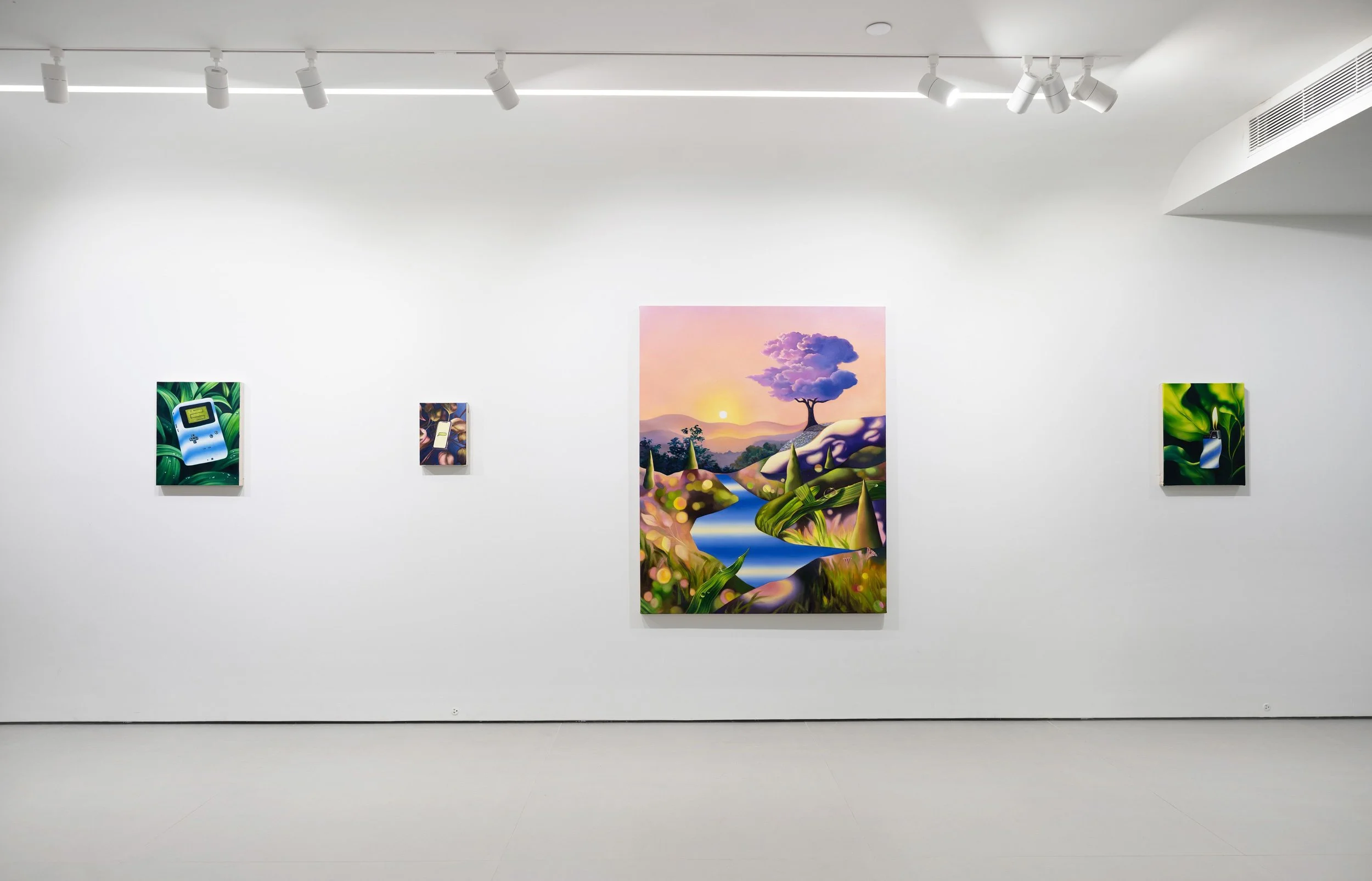
Cache Memory, The Blanc, New York, 2026
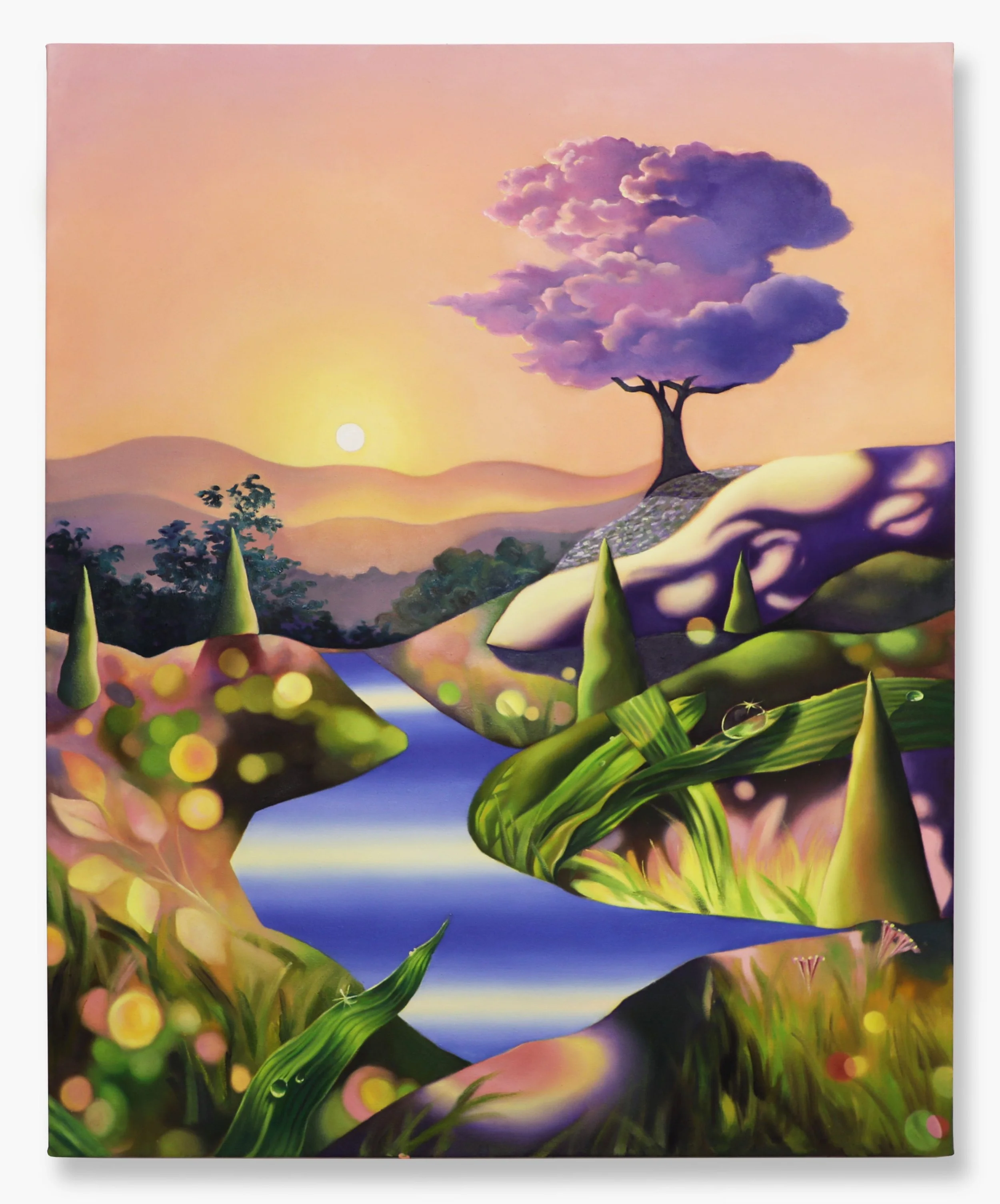
Dreaming of a New Sun, 2025
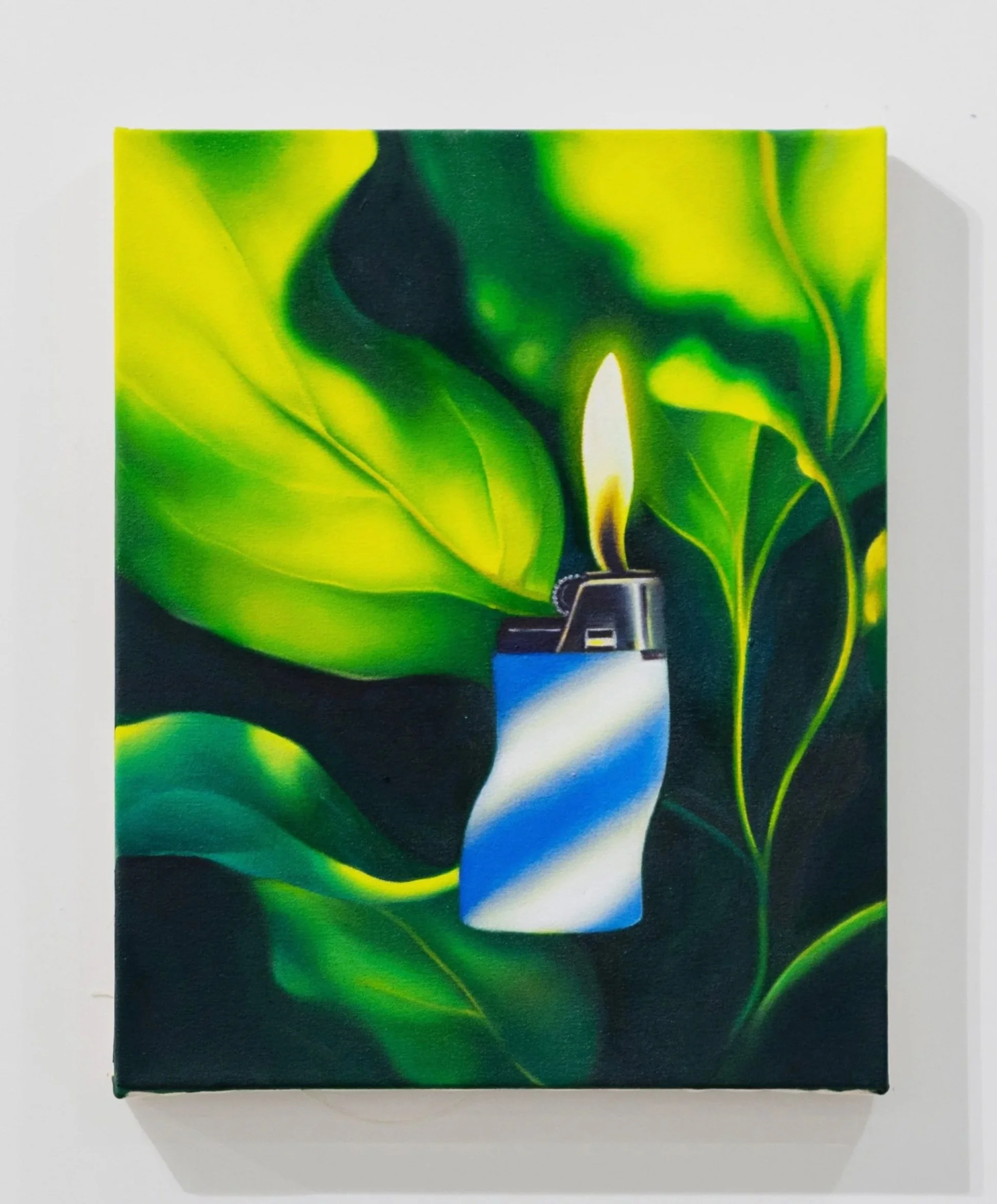
See Your Light, 2025
There's a recurring sense of place in your work, these landscapes that feel familiar but not quite real, almost like half-remembered locations filtered through a screen. How do you go about building these environments, and what role does personal memory or lived experience play versus pure invention?
The places in my paintings usually begin with something real, but they rarely stay that way. A lot of them come from small moments that stay with me, like the color of the sky during a drive, the view outside my balcony, a road, a beach, or a landscape passing by while I’m listening to music. I’m especially drawn to moments when I’m moving through a place, like skating, skiing, or driving, because there is this feeling of being both inside the landscape and slightly removed from it. Those moments often become emotional before they become visual. Recently, I’ve been thinking more about the environments I grew up in, especially what it felt like to live in Beijing. I’m interested in the density, the colors, the buildings, and the feeling of moving through those surroundings as a child. I’m not trying to recreate Beijing literally, but I think those memories live somewhere inside the paintings. They mix with memories of the homes I’ve had in the U.S., the places I pass through now, and the digital images I absorb every day. When I build these environments, I think of them almost like dreams made from real things. A dream that is not completely invented. It is made from fragments of lived experience, images, feelings, and memories that the subconscious pieces together in strange ways. That is close to how I approach painting. A real landscape might become flatter, brighter, more compressed, or more surreal. A natural space might start to feel like a chapter in a video game, a childhood memory, or a place I almost recognize but can’t fully return to. I want the paintings to hold both recognizability and hyperreality, like a distant memory caught for a second before it disappears. The landscapes are partly lived, partly remembered, and partly invented. They are emotional places more than literal ones.
We had the chance to interview you back in 2023, and looking at your work now, there's clearly been a shift in how you build these worlds on canvas. How do you feel your practice has evolved since then, both technically and in terms of the ideas you're drawn to?
Since 2023, I think the work has become more spacious, more atmospheric, and more personal. At that time, I was very focused on the figures and symbols themselves, including stick figures, anthropomorphic tools, and simplified forms that could represent a kind of universal human experience. Those elements are still present in my work, but now I’m more interested in the worlds they live in and the emotional atmosphere surrounding them. Technically, the paintings have become much more invested in light, space, and surface. I’ve been working mostly in oil, and I think the work has softened through that process. The edges, transitions, and atmosphere have become more gradual and more sensitive. I spend a lot of time thinking about how light moves through a landscape, how it creates depth, and how it can make a scene feel tender, distant, lonely, or dreamlike. I’m also paying more attention to the relationship between flat graphic areas and more dimensional painted passages, and how those shifts can make the image feel like it is moving between different realities. Conceptually, I think the work has shifted from focusing mainly on the figures and their experiences within the fictional realities I create, to thinking more about the emotional atmosphere of those worlds. I’m still interested in digital mediation, virtual environments, and perception, but the newer paintings feel more connected to memory, longing, and lived experience. The stories behind the paintings have become more intimate, and many of the images come from personal moments, remembered places, or landscapes I’ve moved through.
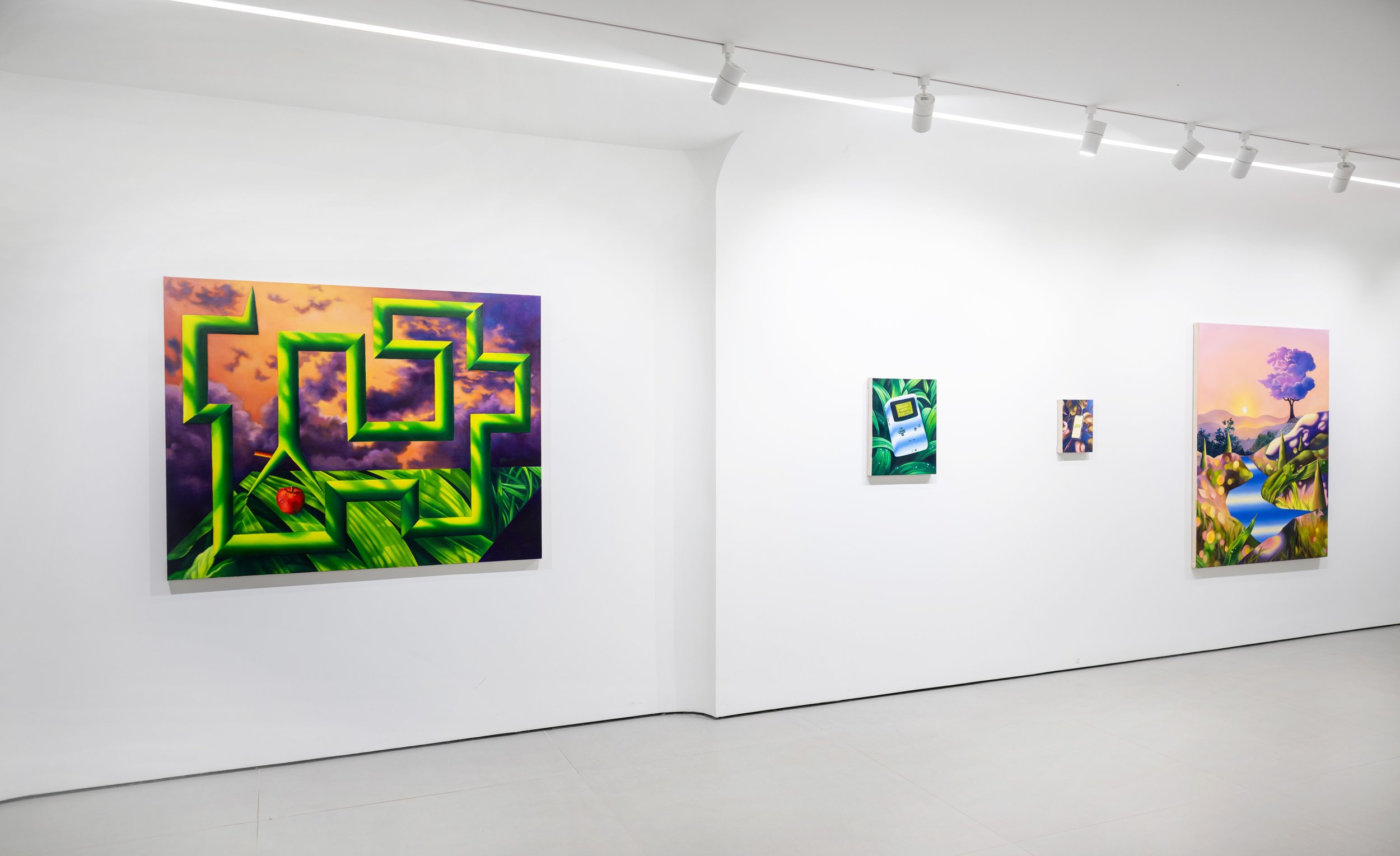
Cache Memory, The Blanc, New York, 2026
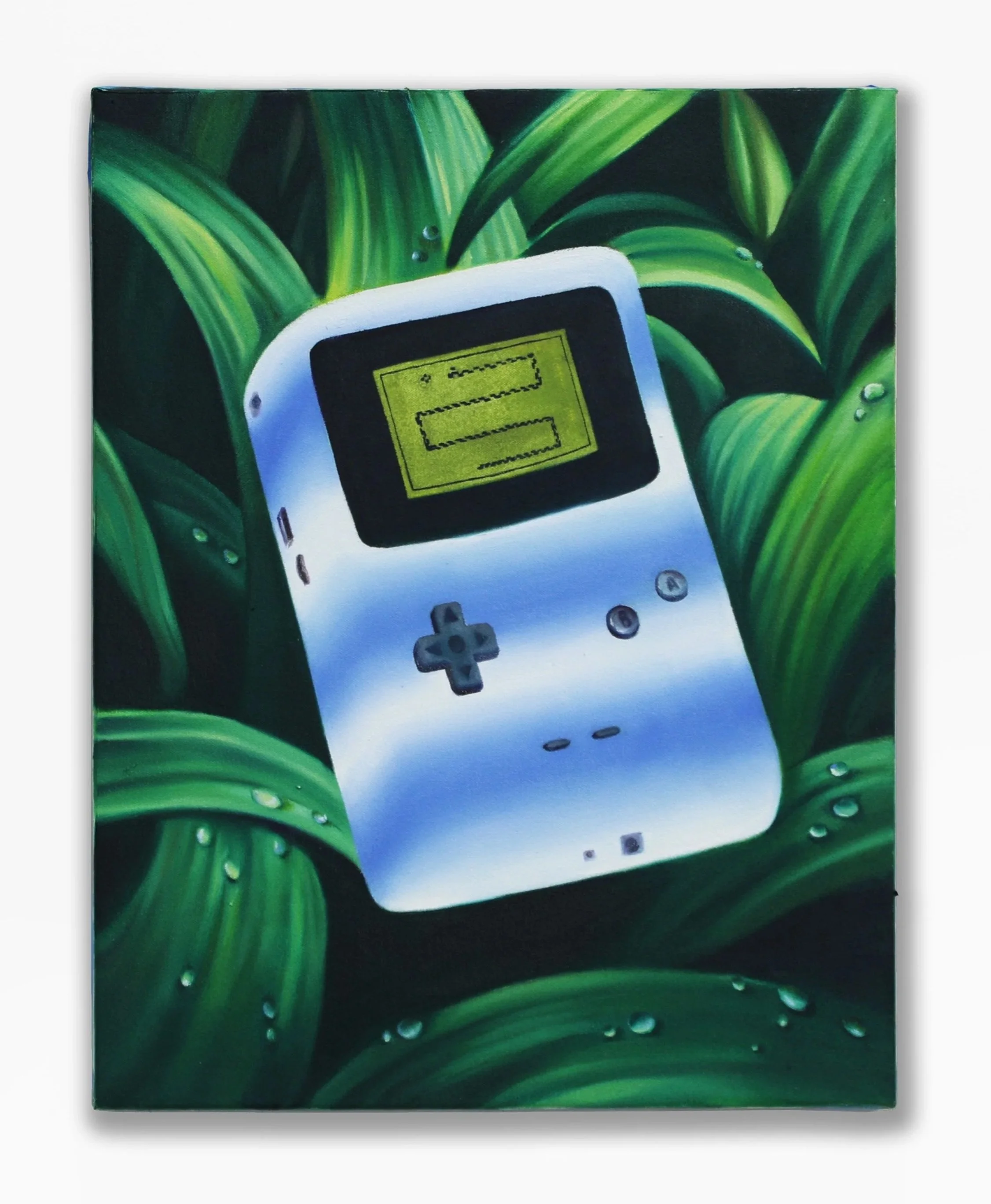
Hidden Games, 2025
Tell us a bit about how you spend your day / studio routine? What is your studio like?
My studio routine depends a lot on where I am in the process. In the beginning, I spend a lot of time sketching, looking at references, and slowly building the idea. It can take me a while to feel ready to paint. I’ll look through photos on my phone, screenshots, old sketches, or small visual fragments I’ve saved. Sometimes I’m not looking for a specific image, but for a feeling, a certain kind of light, a color relationship, or the memory of being in a place. Once I start painting, I tend to work in long, focused sessions. I’m usually most productive in the late afternoon and evening, when everything feels quieter. I like that time of day because the studio starts to feel separate from the rest of the world. I often listen to music while I paint, but I also listen to podcasts about technology, AI, archaeology, or other subjects that let my mind wander while my body is working. Painting can be repetitive and physical, so I like having something in the background that opens up another channel of thought. My studio has a mix of things happening at once: paintings in progress, digital sketches, reference images, tools, paint, and small experiments. I like having multiple works around me because they start to speak to each other. Sometimes one painting teaches me what another painting needs. The studio is not always perfectly organized, but it has its own rhythm. It is the place where the fast, glowing, digital image slows down and becomes material. That transformation is still the part of painting that feels most meaningful to me.
What artwork have you seen recently that has resonated with you?
Recently, I’ve been really moved by my studio neighbor Nianxin Li’s paintings. I’ve had the chance to visit her studio often and see how her paintings develop over time, which has been a very special experience. There is something fascinating and beautiful about the abstract shell-like forms she creates. Even though they suggest inanimate objects, they carry a very intimate and mysterious presence. I’m drawn to the way the forms seem translucent, almost as if light is passing through them from the inside. They feel delicate but also bodily, quiet but emotionally charged. Watching her build those surfaces slowly has made me think about how an object can hold feeling without becoming overly narrative. Her paintings have this strange balance between softness, tension, and interiority that I find really compelling.
Is there anything new and exciting in the pipeline you would like to tell us about?
I'm excited to be doing a residency this winter with CCA Andratx in Spain!
All images courtesy of the artist
Interview publish date: 09/06/2026
Interview by Richard Starbuck