Yixuan Wu
“I’ve always been intrigued by things that are soothing and disquieting at the same time.”
Our interview with Yixuan Wu explores a practice that transforms familiar domestic objects into quietly disorienting sculptural installations. Based in New York, the work spans glass, ceramics, wood, and found materials, examining how spaces of care and comfort can also carry tension, control, and emotional ambiguity. The conversation addresses material processes, sensory experience, and the influence of caregiving on a body of work that navigates memory, perception, and the fragile boundaries between comfort and unease.
Could you tell us a bit about yourself and your background?
My name is Yixuan Wu. I grew up in Dalian, China, and I am currently living and working in New York. I work across glassblowing, woodworking, painting, ceramics, and the incorporation of ready-made objects. My practice centers on domesticity—the elusive, restrained, and sometimes unsettling emotional responses tied to intimate spaces. I am particularly intrigued by things that appear one way while being quite another, especially things that satisfy our needs for comfort, care, affirmation, and protection. Through sculptural arrangements, I recontextualize these often-overlooked moments of everyday life—moments that have the ability to foster a sense of strangeness through the simplest human interactions.
Many of the sculptures resemble fragments of familiar interior spaces, objects such as lamps, radiators, or furniture that appear slightly altered or out of place. What interests you about using these kinds of domestic forms as the starting point for your installations?
I’ve always been intrigued by things that are soothing and disquieting at the same time. The domestic care infrastructures thus become the starting point for most of my works. This interest also partly comes from my experience observing caregiving environments, where interiors are carefully staged to appear comforting and familiar. Objects in these spaces often carry a dual role: they provide support and imply safety, but also meant to regulate behavior and control how our bodies move through intimate spaces. By reworking these domestic forms, I’m looking to reveal that tension between comfort and resistance.
Your works bring together a wide range of materials including blown glass, ceramics, wood, and found domestic objects. What draws you to working across these different materials, and how do you decide which combinations belong together in a piece?
I studied photography during my undergraduate years, but later shifted my focus toward sculpture and installation-based work. Because I did not have the opportunity to receive formal training in many sculptural techniques, I began experimenting broadly with materials, testing different processes as a way of developing a sculptural language that could resonate more closely with my ideas. I now realize how fundamental those open-ended explorations were to the work I make today. Not limiting myself to a single material or process helped me develop a way of working in which different elements can come together with a sense of cohesion. When it comes to deciding how materials are integrated, I often think about how an arrangement might intensify the emotional charge embedded in familiar objects. In my work, I incorporate recurring elements and motifs reminiscent of environmental enhancements often found in senior care facilities, transforming them through shifts in material, placement, scale, and juxtaposition. Each work develops through a slightly different process, but I am generally interested in moments when seemingly contradictory materials meet and interact.
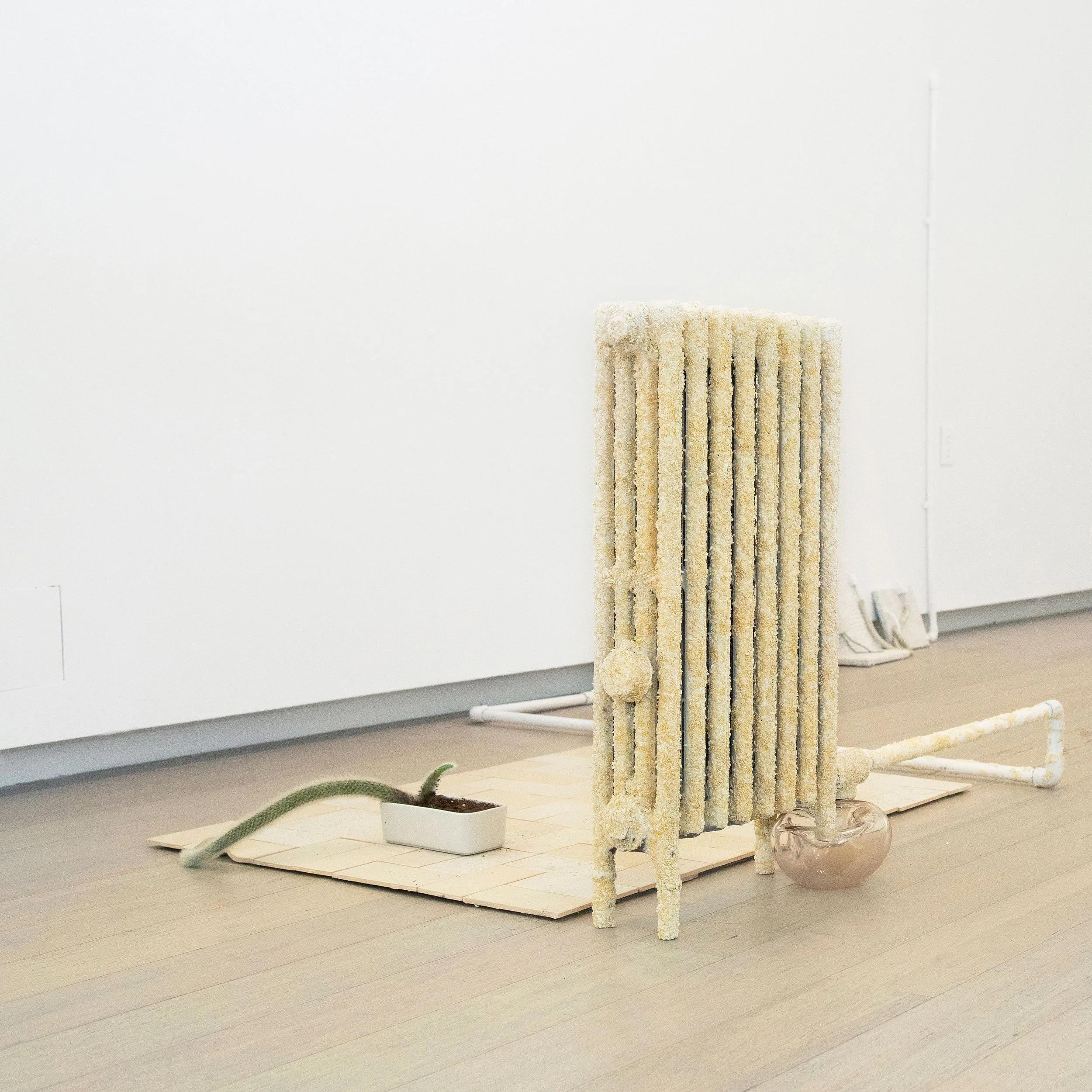
soft congee, still waters, 2022
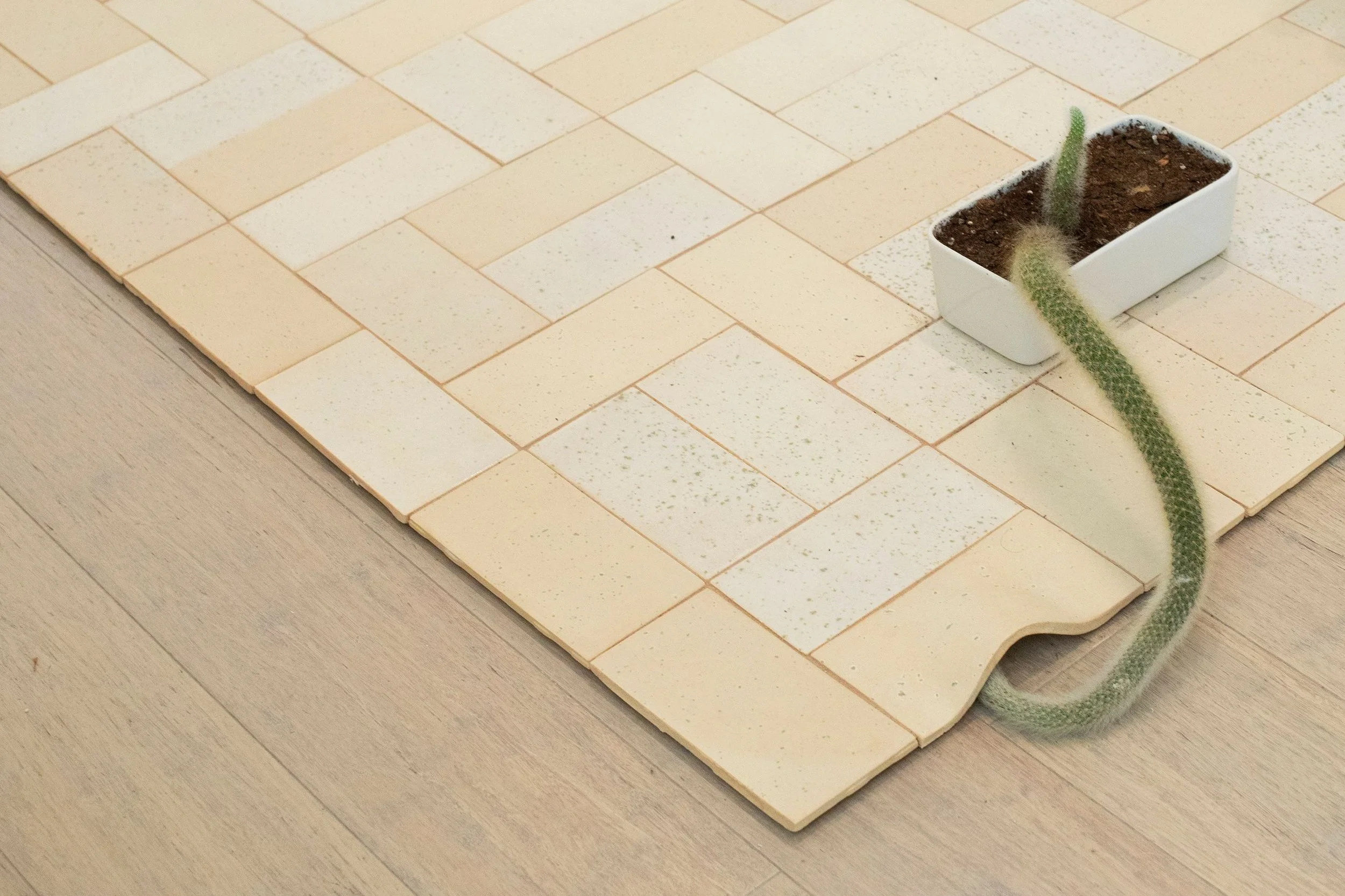
soft congee, still waters, 2022 (detail)
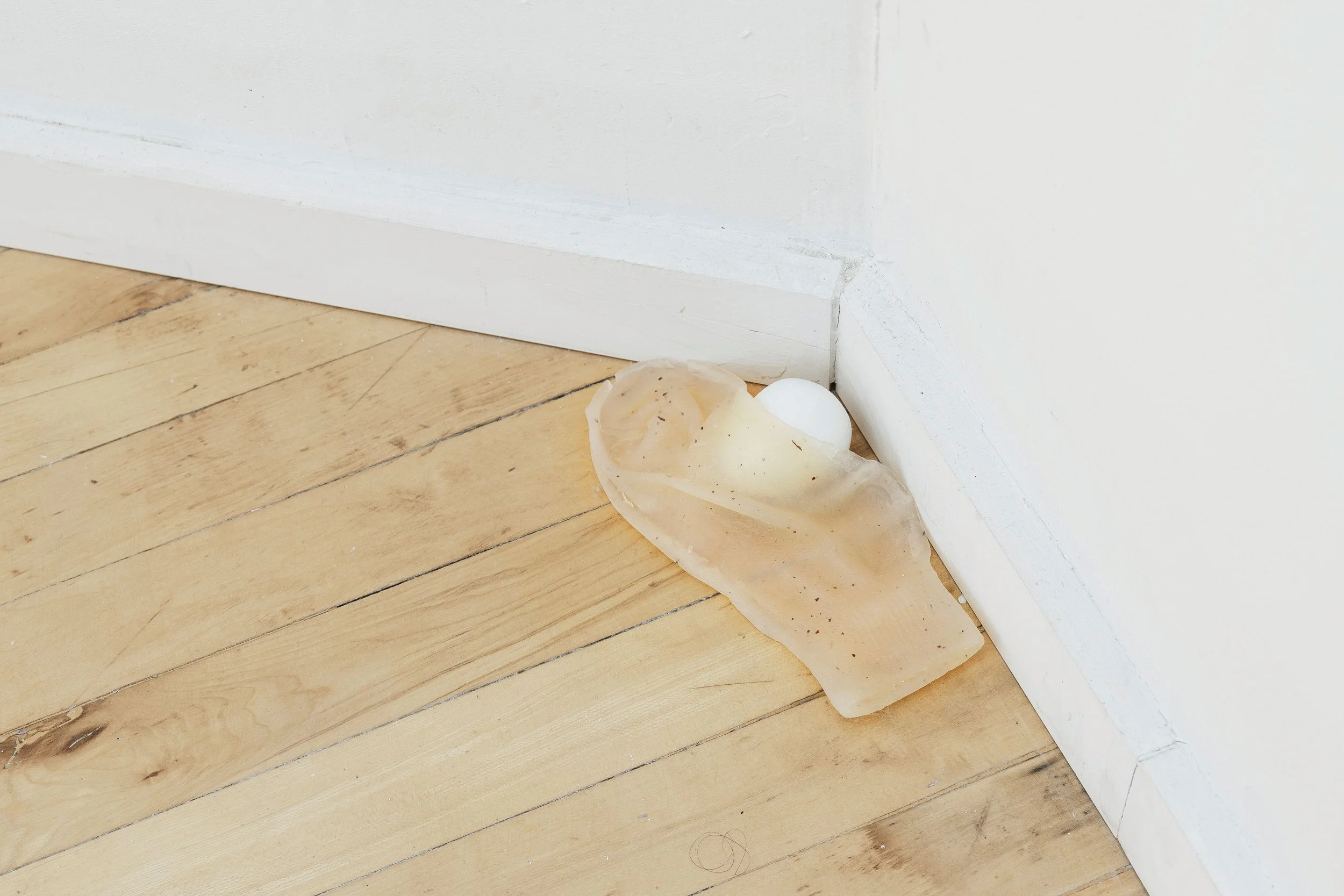
untitled, 2023
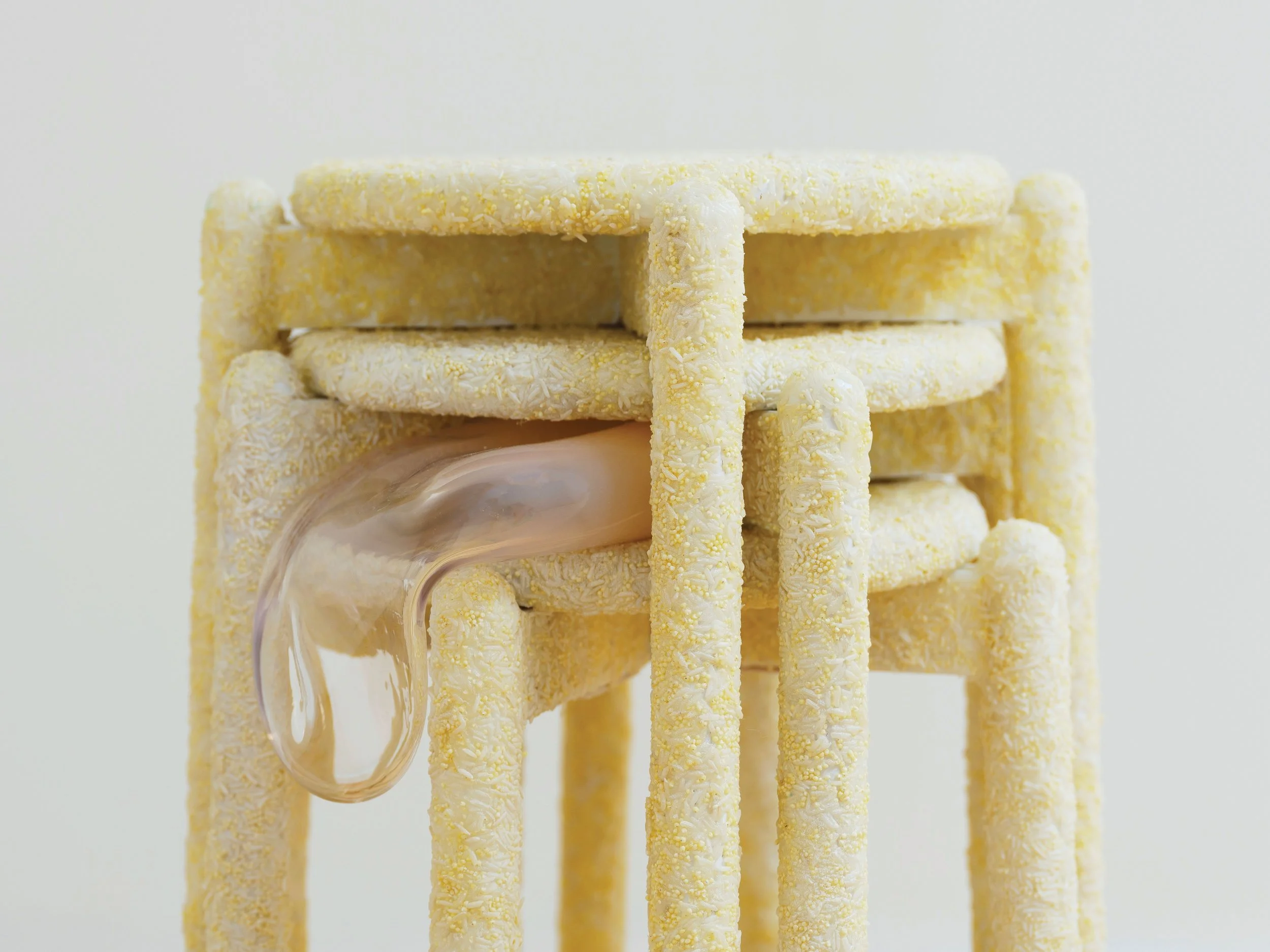
the entwined, 2023
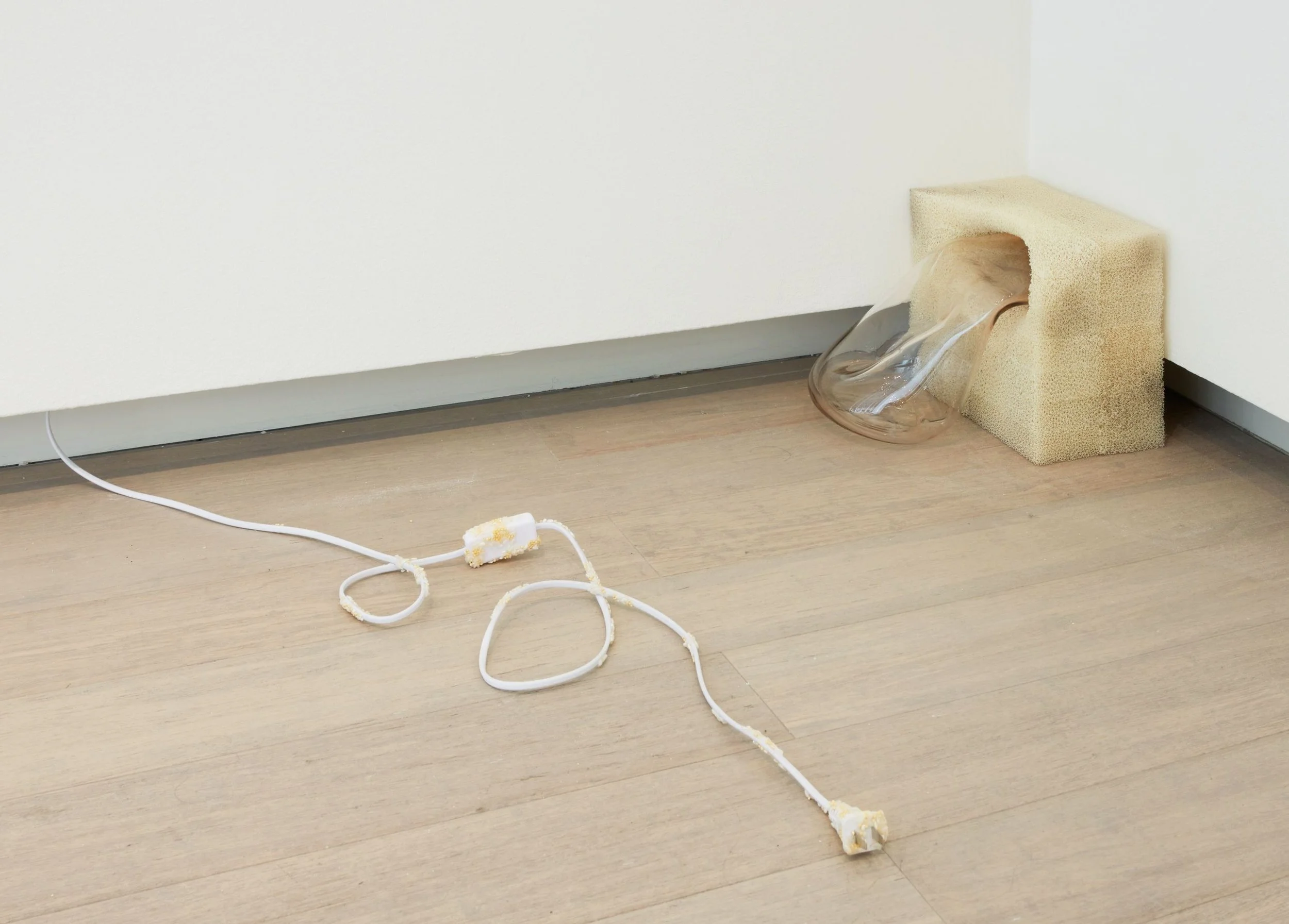
isle II, 2022
Your recent work has been influenced by your experience as a caregiver for a family member. In what ways has that experience shaped the environments or sensory qualities you create within the work?
It was during this time that I began paying closer attention to care objects—objects designed to support memory care, as well as those meant to assist with physical limitations. I became particularly interested in the overlap between objects designed for elderly care and those created for children. Many of them serve dual purposes, supporting both the acquisition of new knowledge and the ability to remember. I started thinking about how the physical actions of learning and forgetting can overlap, and how the intuitive gestures of children’s play can also resemble acts of remembering. This overlap has informed many of the decisions I make in my process. The multisensory potential inherent in my chosen materials is central to the environments I hope to create. I am interested in how visual, tactile, and olfactory experiences shape the way we perceive an environment. In many ways, I hope my work can convey the frustrations caused by the inability to interpret and assign meaning to familiar surroundings. I also use food and related materials as key elements, including ingredients such as rice, millet, enoki mushrooms, and brisket noodle soup. This process is inherently time-based, as I experiment with ways to transform and integrate food into semi-permanent, constructible materials, allowing the work to engage more closely with the sensory dimensions of caregiving.
Tell us a bit about how you spend your day / studio routine? What is your studio like?
I am a morning person, so my studio days usually begin with a cup of coffee. I tend to work on multiple pieces at the same time, as this allows me to observe how the works interact with one another spatially as they gradually unfold. I work relatively slowly, which gives me time to revisit and adjust things over an extended period. It is important for me to have the opportunity to process the work carefully and to ensure that the choices I make feel precise rather than redundant.
What artwork have you seen recently that has resonated with you?
I have an extremely long list of artistic influences, but when I am actively in the process of making, I tend to avoid looking at visual art. It can easily seep into my decision-making, and I prefer the work to develop more intuitively rather than through direct visual references. That said, Camille Henrot’s exhibition A Number of Things at Hauser & Wirth last year was a project I found particularly compelling. She is an artist I truly admire and have followed for many years.
Is there anything new and exciting in the pipeline you would like to tell us about?
I recently started an artist residency at Triangle Arts Association in Dumbo, New York City, which I am very excited about. The dedicated space and time provided by the residency offer important support as I prepare for an upcoming duo exhibition in April. The exhibition will be presented at the gallery space managed by the Chinese American Arts Council, and I am currently in full production mode, finalizing the works for the show.
All images courtesy of the artist
Interview publish date: 26/03/2026
Interview by Richard Starbuck