Linn Phyllis Seeger
“the act of scrolling suggests forward movement while, in fact, leading nowhere.”
Our interview with Linn Phyllis Seeger explores a practice shaped by moving image, digital archives, and the infrastructures of online media. Based in London, Seeger works across installation, video, and research, examining how technologies of communication and data circulation reshape perception, memory, and historical understanding. The conversation addresses the use of personal archives as deindividualised material, the translation of digital video into physical space, and an ongoing investigation into systems of navigation, control, and the illusions of movement within contemporary technological environments.
Could you tell us a bit about yourself and your background?
I’m an artist and researcher based in London, examining the biopolitical power of Silicon Valley technologies through moving image, installation, and online media. Since finishing my PhD at the Royal College of Art this past January, I’ve spent a lot of time in the studio at Shipton Gallery where I’ve been artist in residence the past few months. I’m currently developing a series of video sculptures for a few upcoming shows in 2026. With a background in photography, I only started working with the medium of moving image when Instagram launched Stories almost ten years ago. I’ve been interested in the way moving image formats operate within online environments ever since. This has entirely transformed my artistic practice, starting with two artist books I published with the independent publishing house Skinnerboox: You I Everything Else in 2020, and 0N0E in 2022. Both books are comprised entirely of screenshots from Instagram Stories and other moving image-based forms of communication unfolding on smartphone interfaces. I began thinking of screenshots as film stills, considering how the phone screen instantly mediates everything from private chats to news reports into an animated and interactive, post-cinematic experience. While my recent works no longer focus on reproducing the explicit aesthetics of social media and digital interfaces, my practice is still developed out of a continuous thinking about, and engaging with, moving image media online.
You draw from footage recorded on your iPhone, moments such as watching the news, the weather, or wandering through the city. What interests you about working with personal archival material as a way to approach events that feel historically significant yet strangely distant?
My moving image works are assembled from material I extract from my iCloud Library and Instagram Stories archive, reappropriating personal videos taken throughout the last decade as a form of faux found footage. As mentioned above, I began shifting my practice towards moving image through a lingering fascination with the specific narrative structure of Instagram Stories: relentlessly sequenced in self-extinguishing, 24-hour cycles of the everyday, the format’s diaristic gesture appears innocuous. Yet in reality, its performative candor and virality have long been used at both ends of the political spectrum, allowing for an unprecedented reach of citizen journalism while at the same time, being weaponised as an instrument of political propaganda and governmental control. Today, as public social media posts are routinely incorporated in data sets used to train various AI systems, personal accounts proliferating via short-form videos can no longer be understood as ordinary testaments of individual experience. In fact, they redefine how events are historicised. I’m interested in working with my digital archival as online circulation has turned it into an almost deindividualised material, devoid of its introspective connotations.
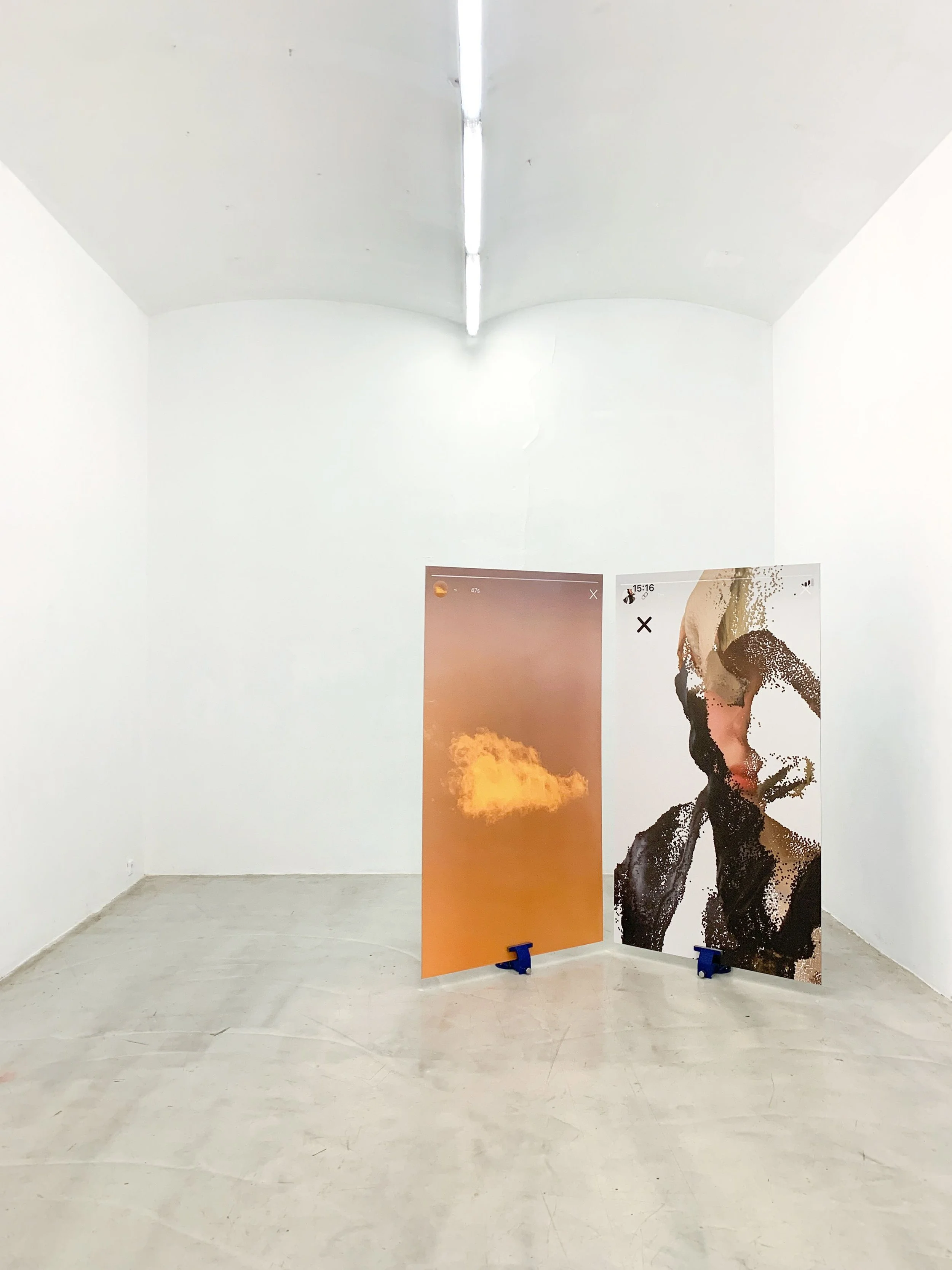
0N0E, WAF Gallery, 2022
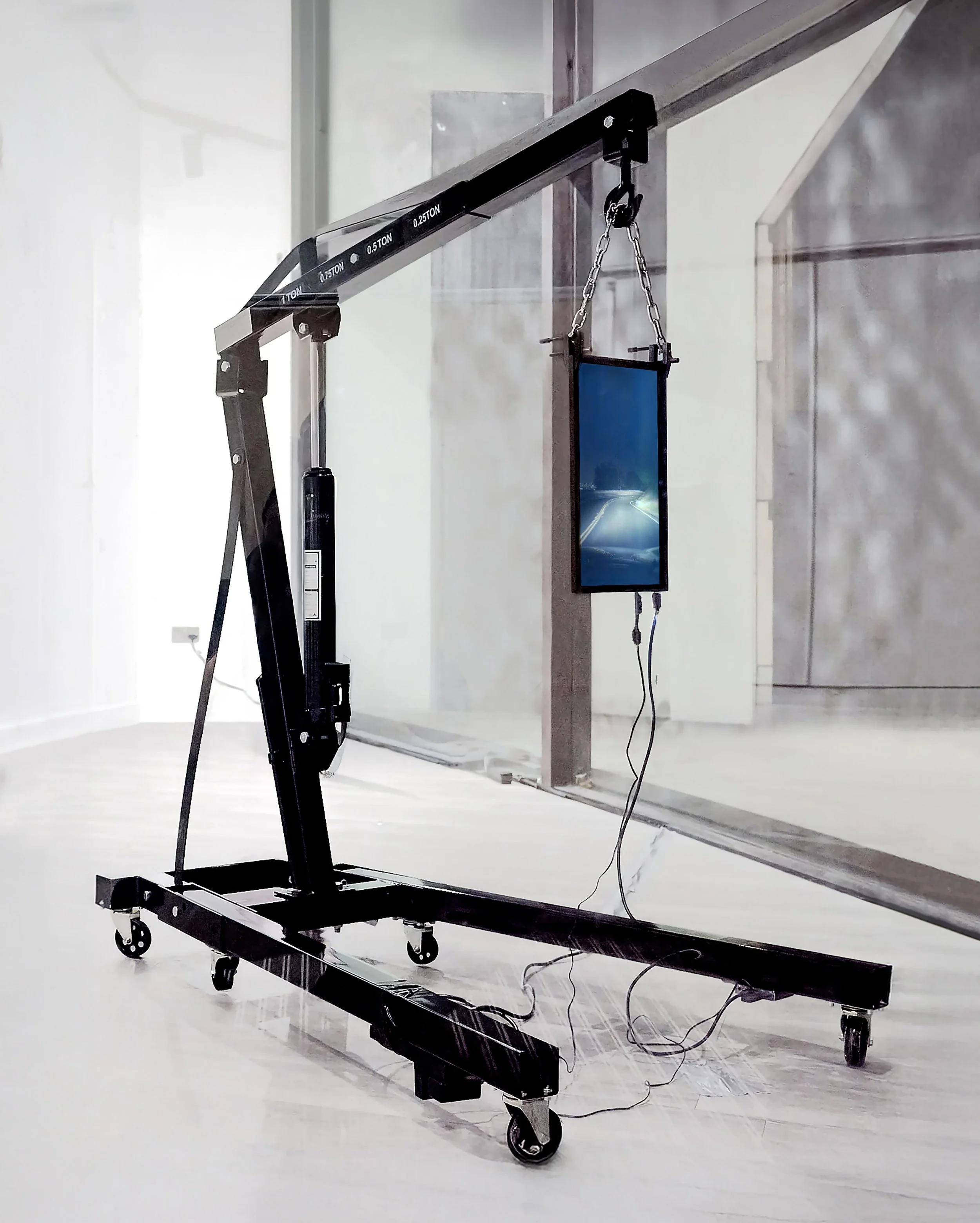
no ideas but in things, Hypha Gallery, 2025
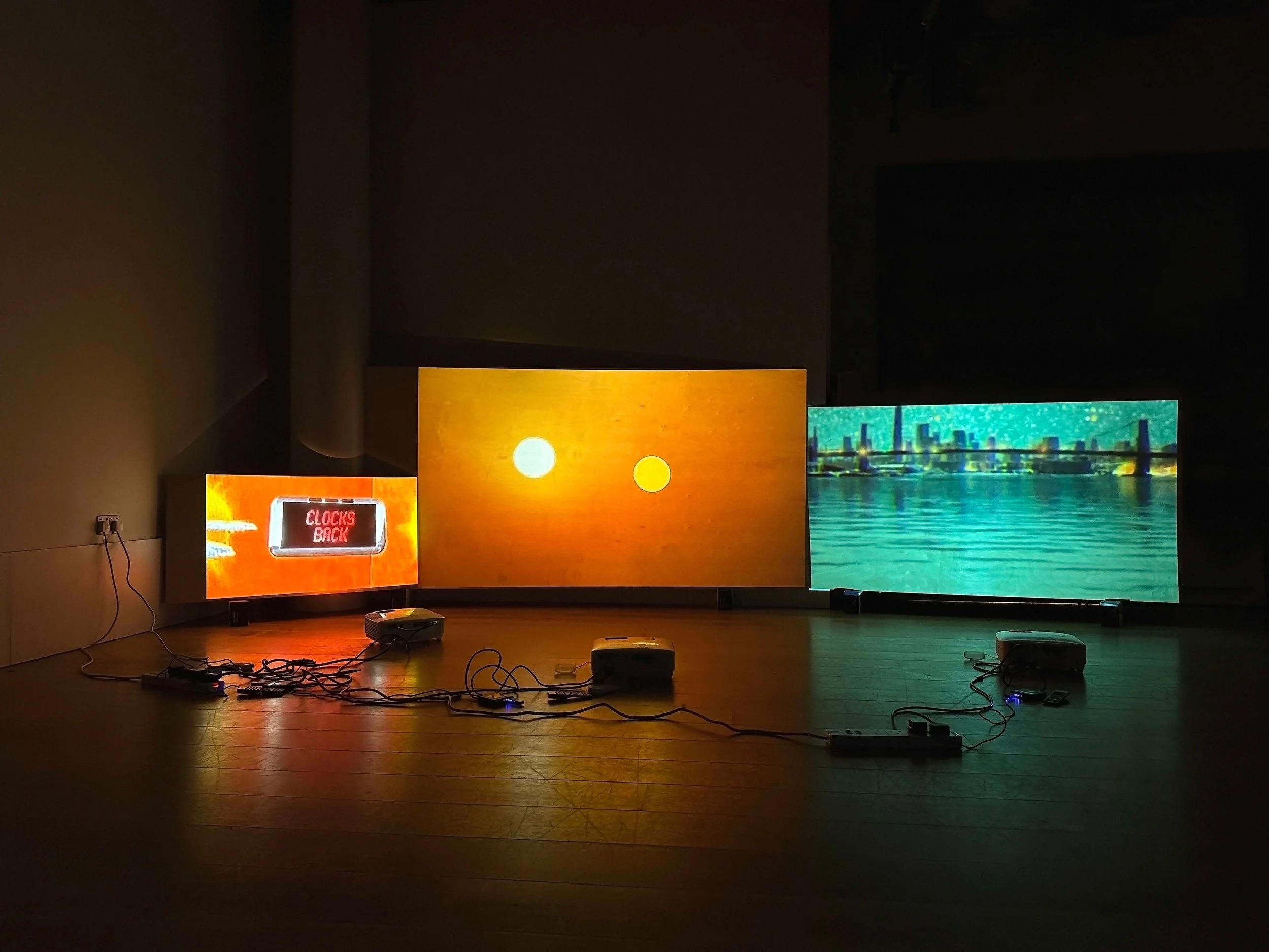
The (Un)event, sketch for upcoming solo exhibition, 2026
Several of your works combine moving image with sculptural structures, such as screens mounted on cranes or angled display systems. How does the physical framing of the video shape the way viewers encounter the work?
Recently, I’ve been exploring how digital-born moving image works can exist within the medium of sculpture. I’m interested in translocating short-form videos from the ephemeral, incorporeal environment of online media and digital archives, and embedding them within physical structures. Routinely swiping between the same set of apps, and scrolling the same, ever-refreshing algorithmic streams on personalised interfaces, constitutes an incredibly addictive comfort zone. The consumption of moving image content becomes an almost disembodied process, operated via minuscule physical gestures. In my work, I’m interested in disrupting this comfort zone, and turning the experience of watching videos that would naturally be scrolled past, viewed on palm-sized screens, into something potentially visceral, ineluctable, where viewers and videos now occupy the same physical space.
Across your projects, technologies of transport, communication, and media appear as recurring motifs. What draws you to these systems as a way of thinking about time, movement, and contemporary crisis?
Since the introduction of the Internet as a vernacular tool within corporate and domestic environments, online communication has been metaphorized as a means of individualized transport, where users can venture off to go wherever they want, whenever they want. With reference to specific technologies of transport, such as the railroad in my piece Jupiter, or automobility in more recent works, I’ve been interested in the deceptive character of navigational gestures prevalent within online media. For instance, the act of scrolling suggests forward movement while, in fact, leading nowhere. Interfaces and streams appear to be manoeuvrable at the user’s own discretion, but actually constitute predesigned and confined spaces that may allow customization, but no real operational agency. I’ve been investigating the architectures of smartphone interfaces and cartographical renderings on platforms such as Google Maps, as navigable territories that defy conventional spatial logics. Reflecting on the specific spatial parameters of online environments, I’ve been developing works that constantly renegotiate the role of the driver, and question the underlying driving forces of movement and progress. At the core, these works try to articulate deviations from default trajectories towards a singular, imperial, capital F-future, commonly understood to be unlocked and perpetuated by technologies of transport and communication.
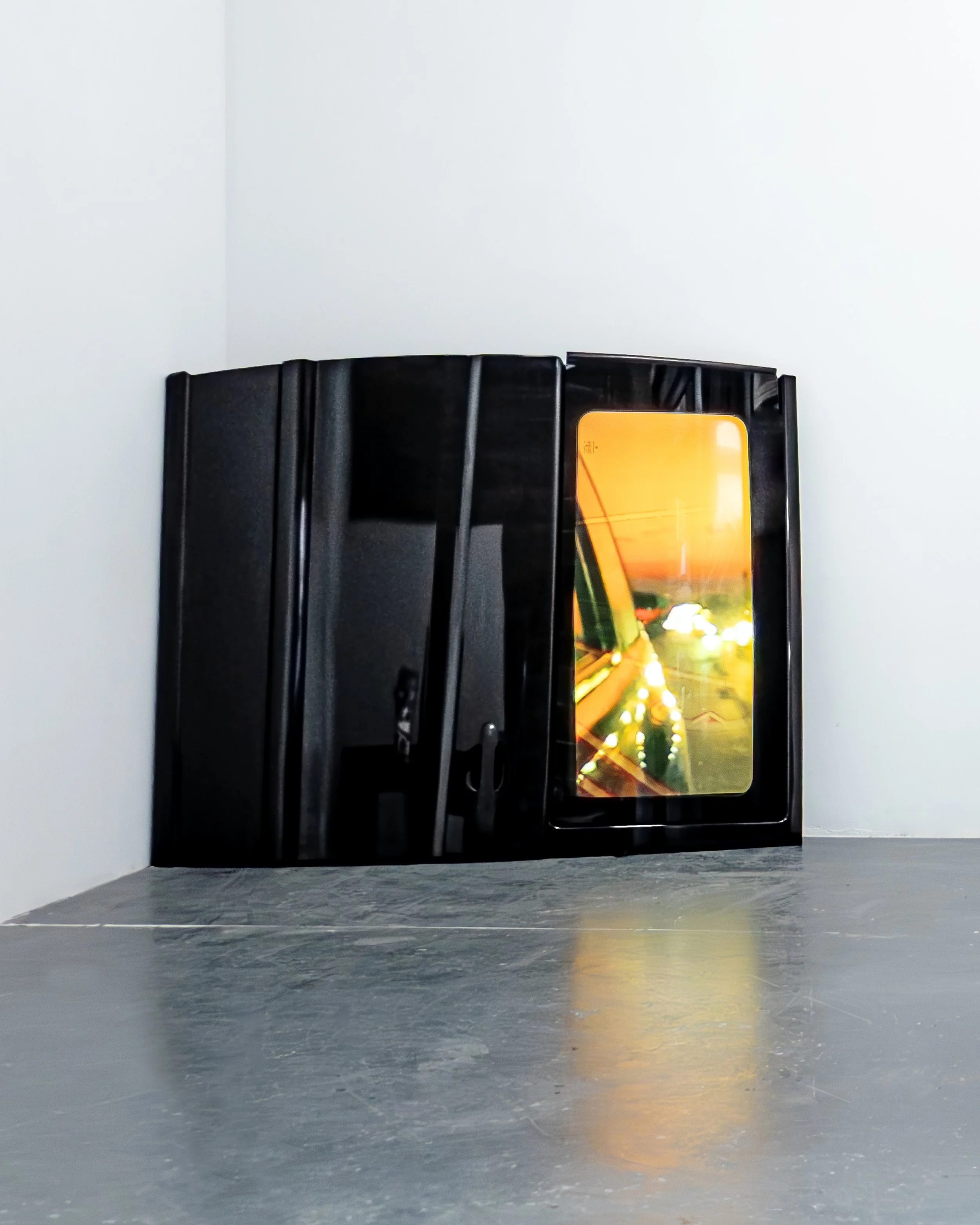
true idle, Shipton Gallery, 2026
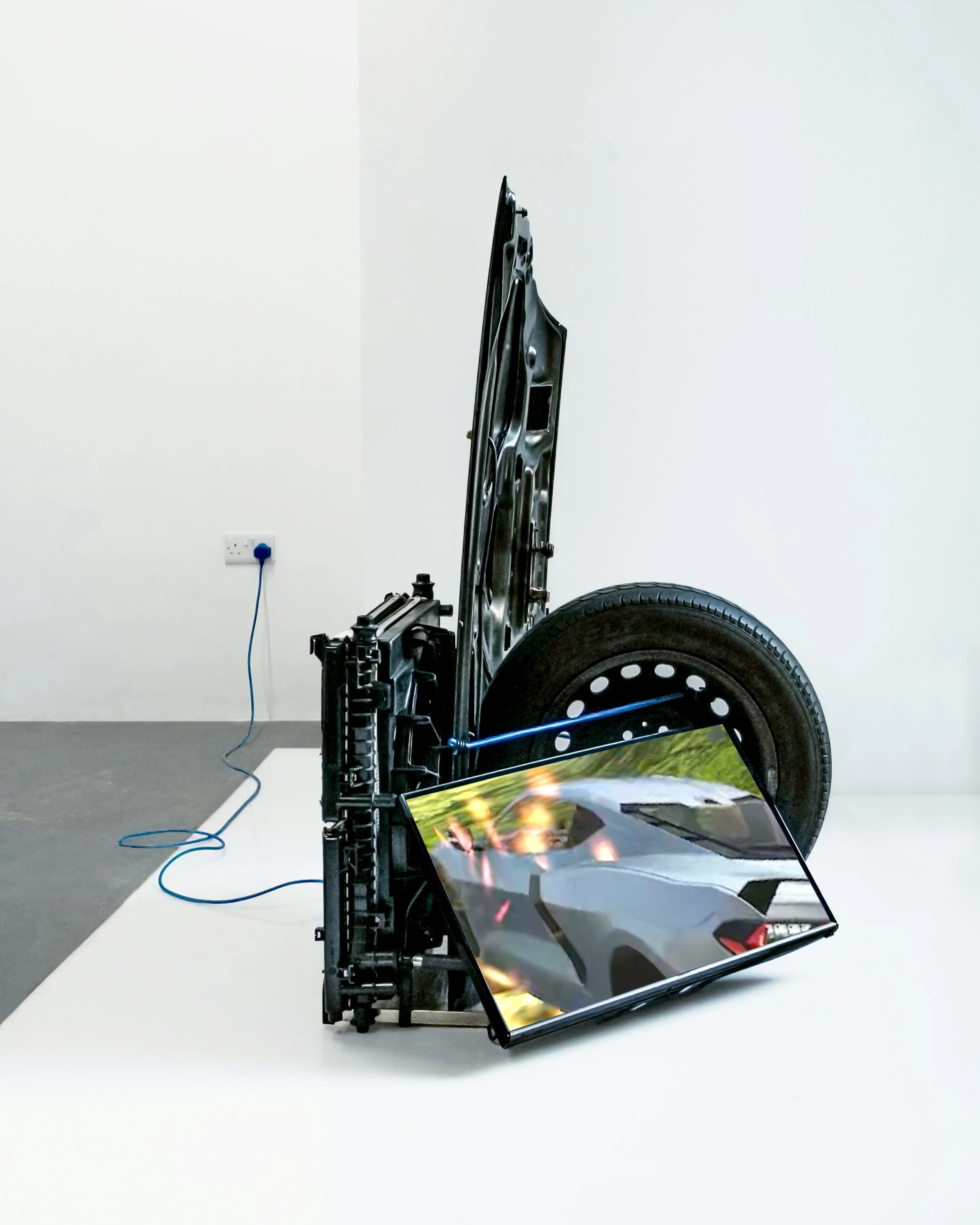
true idle, Shipton Gallery, 2026
Tell us a bit about how you spend your day / studio routine? What is your studio like?
As artist in residence at Shipton Gallery these last three months, I was very excited to have access to a physical studio space for the duration of the residency. But prior to my time at Shipton I’ve been working from home, as renting a studio space in London has not really been within my budget just yet. For a long time, I used a private Instagram account as a studio of sorts, where I would edit videos and test out sequencing to an audience of none. Even now that I’m working with sculptural renderings of my work, I’ve been sketching and drafting everything on my phone: arranging 3d scans and cut-outs from photos and specific materials I’m using on apps like Freeform, long before assembling the sculptures in physical space. As I’m always working on multiple projects simultaneously, preparing for different exhibitions, deadlines, interviews, applications, and commissions, while also teaching at the Royal College of Art, my day-to-day doesn’t usually follow the same consistent structures or routines.
What artwork have you seen recently that has resonated with you?
Works I’ve seen recently, both in the flesh and online, that resonated with me, for varied reasons: Tolia Astakhishvili's 'a wound on my plate' at Emalin Gallery, Allen-Golder Carpenter’s 'Sojourn' at TickTack, Yasmine Anlan Huang’s artist books that were on display at Nicoletti Gallery, Montana Simone’s sculptures I’ve seen online.
Is there anything new and exciting in the pipeline you would like to tell us about?
Definitely my show 'true idle,' currently on view at Shipton Gallery, which is going to be running until 4 April. Then I’m very excited to be showing my 3-channel installation 'The (Un)event' at the ICA on 29 + 30 April. After screening the films separately at film festivals in the past year, I’m now super happy to finally exhibit the work for the first time in its intended 3-channel format. There will be an artist talk on the evening of the 29th of April as well.
All images courtesy of the artist
Interview publish date: 26/03/2026
Interview by Richard Starbuck