Edy Fung
“Sound penetrates directly beyond (rational) interpretation; it is experiential, self-narrating, and largely self-explanatory.”
Our interview with Edy Fung explores a practice that engages with invisible systems, sound, and the structures that shape how information is perceived and understood. Based in Stockholm, Fung works across installation, text, and transmission, drawing from the history of science and information theory to examine the limits of knowledge and interpretation. The conversation addresses the translation of abstract processes into physical form, the role of sound and notation as distinct modes of communication, and an ongoing interest in the unseen forces that underpin everyday experience.
Could you tell us a bit about yourself and your background?
I make art and do various things. As of 2026, I am digging into the philosophy of science, including mathematics and computation. I work with sound, text, installation, video, radio transmissions and archival materials. Currently I’m based in Stockholm.
Much of your work translates abstract systems such as data, signals, or information structures into physical installations. What interests you about making these invisible processes visible or tangible?
Do you know the expression in Japanese, “to read the air (空気を読む)”? The ability to interpret the atmosphere, the unsaid, or to read between the lines. I don’t see myself to have this ability, not to a satisfying extent at least. Is it really just the weather they are talking about? Or are they referring to something right here between us? Are we in the same system or do we need some translations? What kind of information am I missing, or signalling though not intending? Whether it’s casual, symbolic or literal. Ironically, our lives are mostly shaped by invisible processes more than what we know. I am interested in tracing how certain things are founded and what earlier states determined them. I am clumsy at getting signs or hints so it is perhaps an act of overcompensating through my art, because often when things are finally visible on the surface or declared, it is too late to do anything about it.
Sound seems to play an important role in your practice, sometimes appearing through scores, instruments, or mechanisms within the work. How do you think about the relationship between sound, notation, and visual form?
90% of the time I do use sound, as a medium as well as its embodied forms. I relate with sound, notation and visual form for their very different functions and communications. Sound is primal in a way that connects our physical present and distant human beginnings; when I use electronic sounds I also think of the birth of circuits and the machines that precede the technological blackbox. Sound penetrates directly beyond (rational) interpretation; it is experiential, self-narrating, and largely self-explanatory. Notations on the contrary ask of one to maximise their capabilities to interpret and imagine, for example, in ‘Negotiating Laplace’s Demon’ are situations where I don’t want you to settle for and fixate on merely what the senses present. Instead, I want you to work a bit harder on finding out what it means to you. Notations prompt more indeterminate forms. It is also highly distributable, able to extend beyond the gallery space. Visual form is often the organic product and the frozen state after all the driving forces have been negotiated between concept, medium, and making, where they finally come into view.
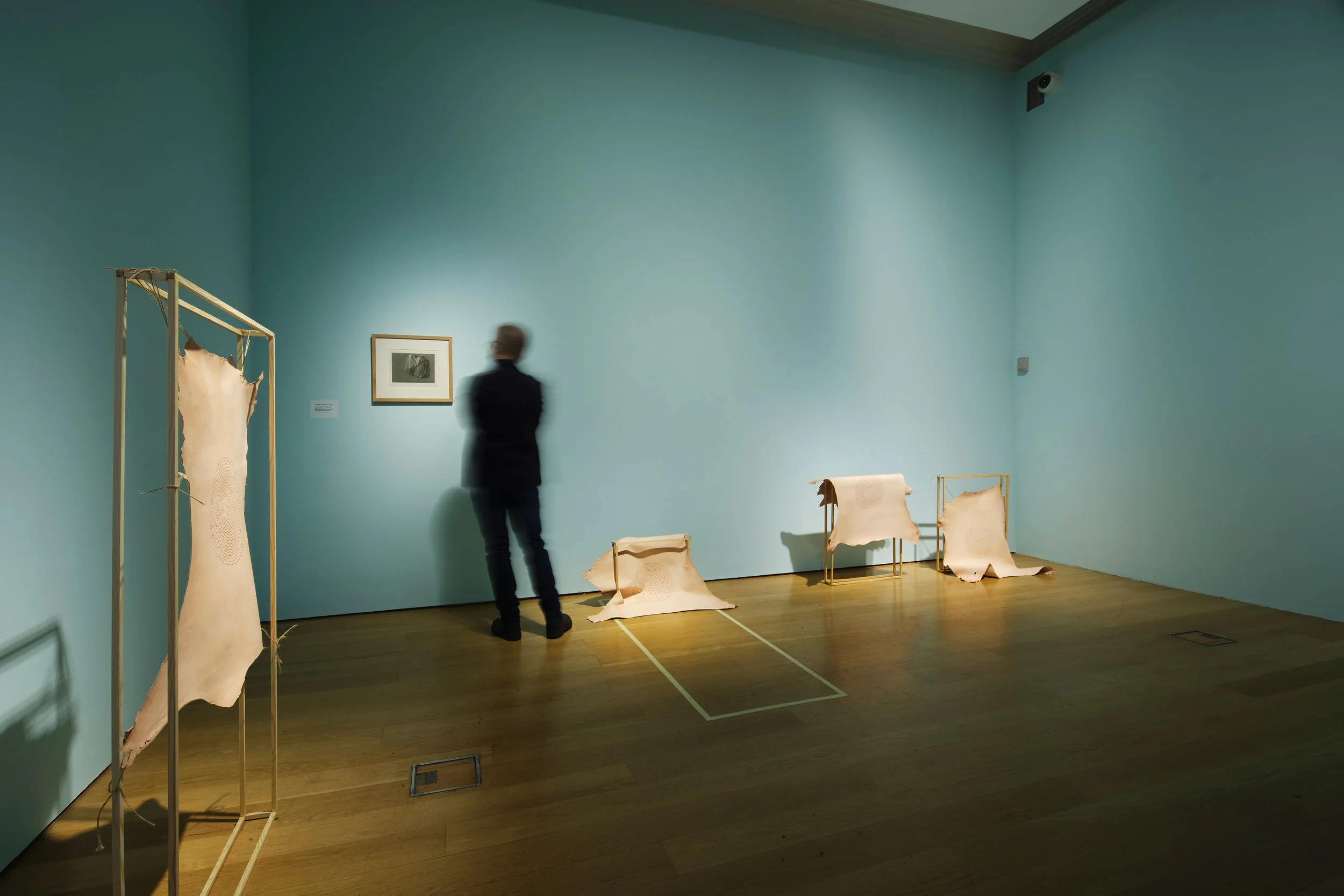
'Diaries. Monuments. Memory. Documentation. Event. Pandemic. Archive. Digital identity. Encoding. Decoding. Commemoration. Deja-vu. Always-already. Burying shame. Treehole. Winter counts.', 2020 At The Irish Museum of the Modern Art, 2021-2022, Photo by Ros Kavanagh
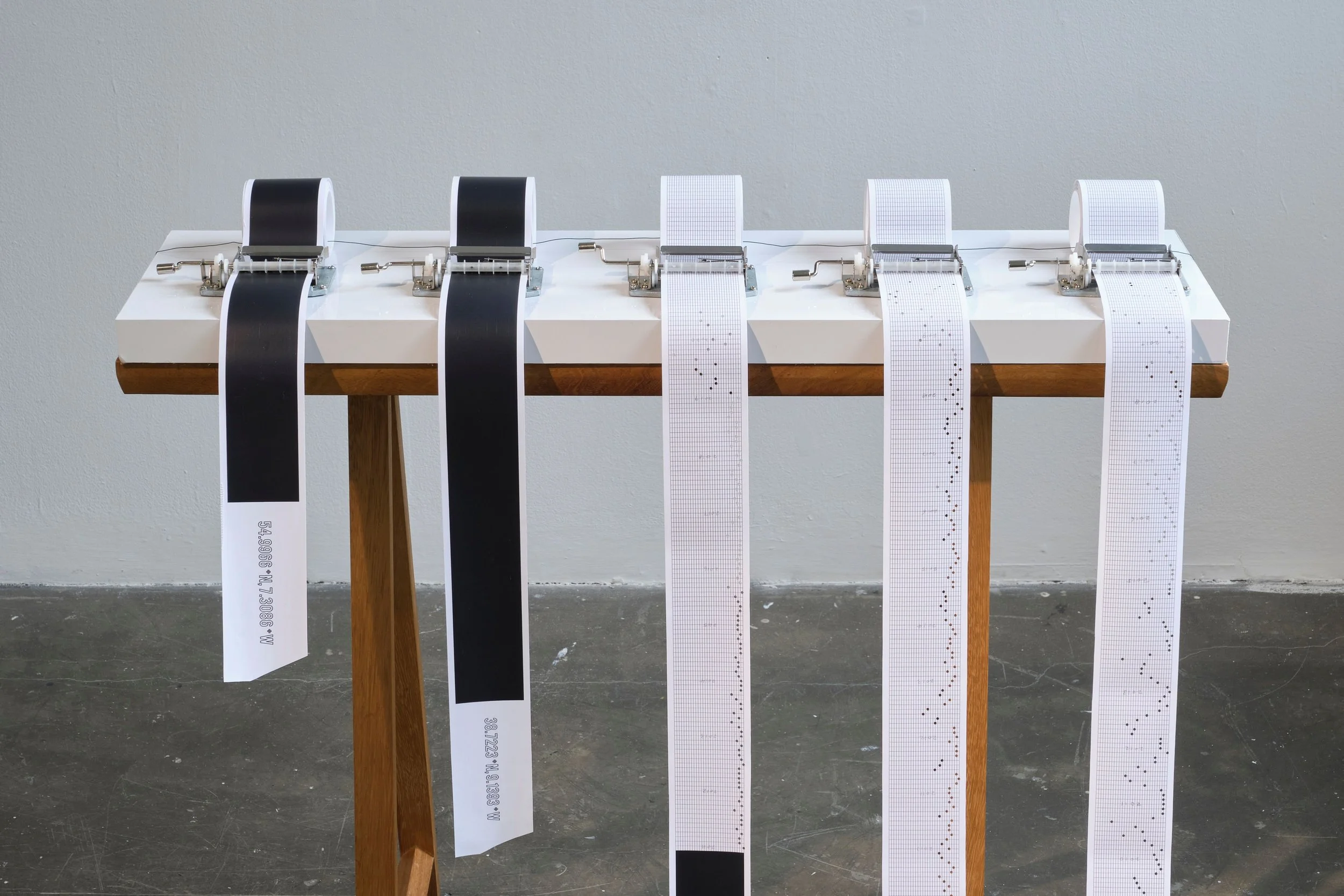
'Parallel Rainverse', 2020 At Golden Thread Gallery, Belfast, 2022 Photo by Simon Mills
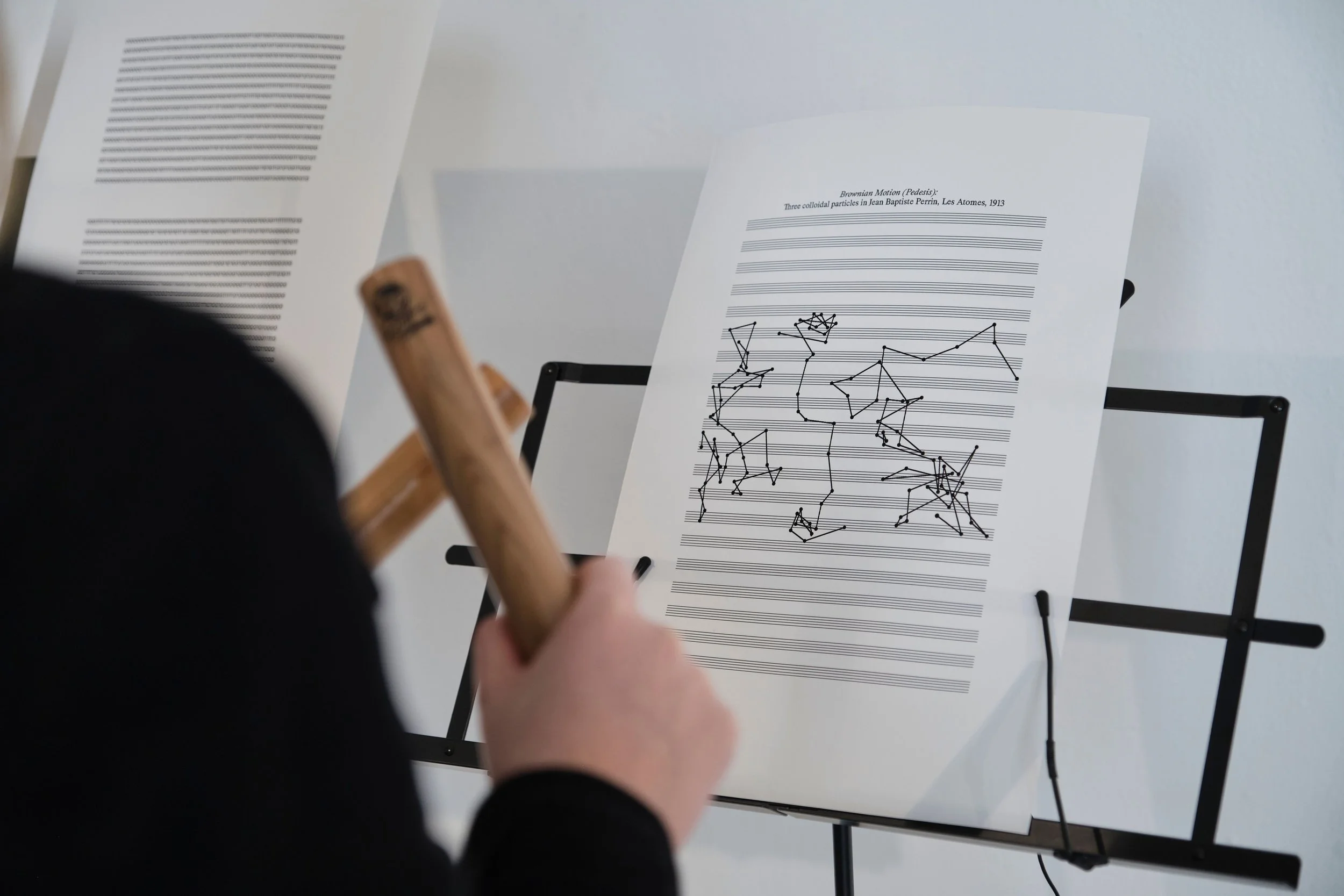
'Negotiating Laplace's Demon', 2022 At Golden Thread Gallery, Belfast, 2022 Photo by Simon Mills
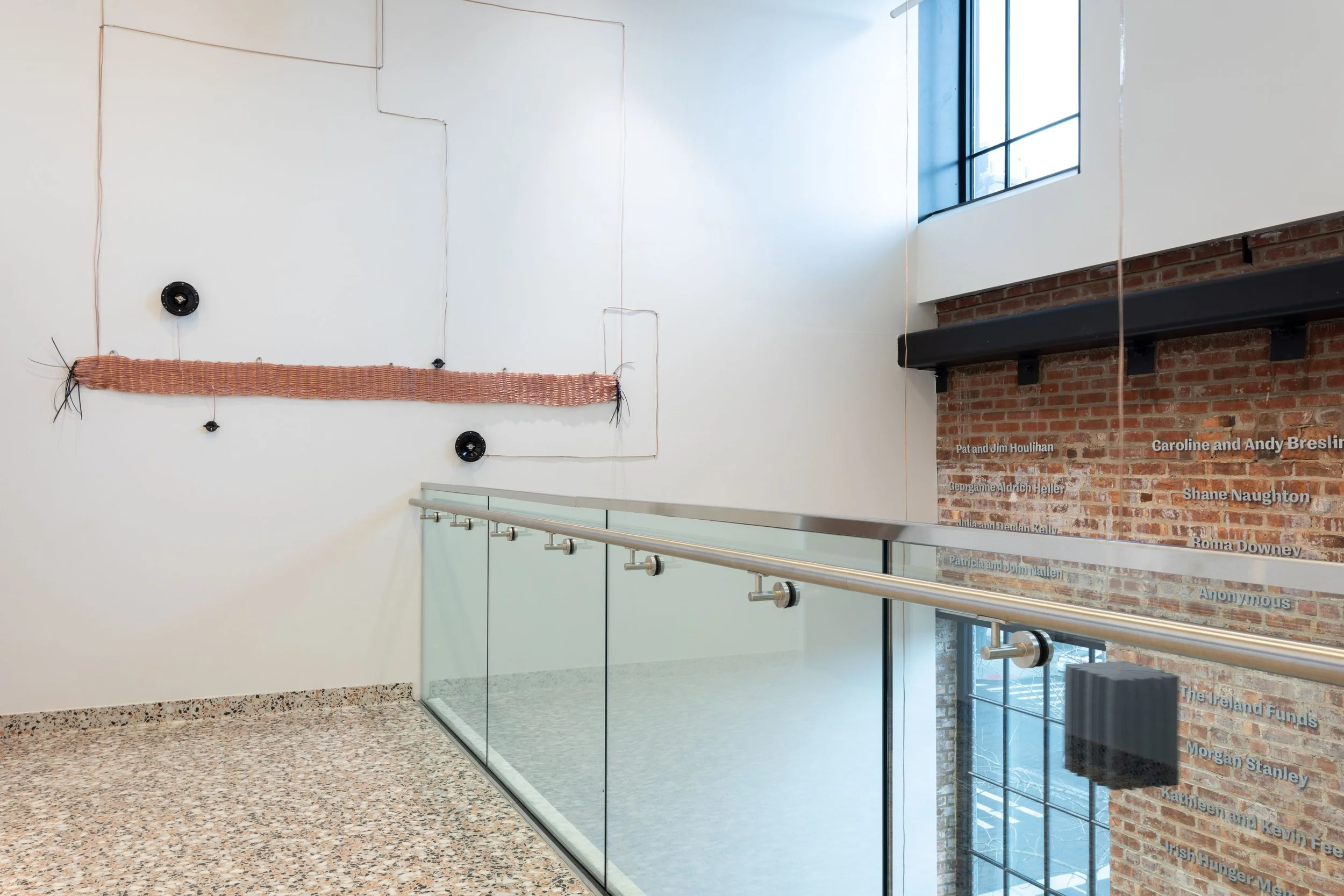
'Of Other Spaces', 2022 At Irish Art Center, New York, 2022 Photo by Julia Gillard
Your projects often draw from the history of science and information theory. How do these fields influence the way you think about knowledge, technology, and the limits of what we can understand or measure?
Yes, because science and technology infiltrate every corner in our daily lives at this point it is almost an obligation to understand it. The question for me is this: if one of the many capacities of art is to draw attention to what urgently demands it, then that attention to me is the history of science and information theory. These fields hold numerous possibilities for alternate realities and maintain our humanity. It is so interesting to trace how an idea took off and snowballed in the history of science, while many others, existing in parallel, were not so lucky to gain momentum, for reasons unrelated to the objective merit of the idea itself. It does not mean those ideas were less valid or would not become a seed for something else in the future. This is also where I understand that knowledge, including scientific knowledge, is shaped by paradigms, by a critical mass agreeing upon certain theories and rules. If, historically, new forms of art are contingent on technē, the development of the tools we use, I'm thinking from the perspective of information theory we may already be operating at the limits of what the deterministic Turing machine can offer, treating simulated probabilities as our latest paintbrush. I like to think that we are empowered enough to find other things to agree upon, perhaps ideas that were left behind for no good reason, and to cultivate new trajectories and knowledge along different lineages.
Tell us a bit about how you spend your day / studio routine? What is your studio like?
Usually I wake up and go out towards the east for sunlight, as it’s so dark in the winters here. Then I take the train to the studio. One side of the studio are all music instruments and unboxed works sent back from previous exhibitions. The other side I use for making messes and soldering and so on. There's also an area where I keep the artworks that other artists have given me. I spend a lot of time reading and when I need to do sound recording and mixing I go to Elektronmusikstudion in town.
What artwork have you seen recently that has resonated with you?
I actually have Ragnar Kjartansson’s A Lot of Sorrow’s still image as my phone’s wallpaper, does that count? I resonate with the work because I’m not able to let myself be caught in a loop like that, though in a way I secretly aspired to. Otherwise, I could mention the recent exhibition by Lina Selander, One Is Equal to One at Marabouparken. It captures the topic of visibility so well; I constantly felt that I was bearing the shadow of not seeing something, or of not having seen it earlier.
Is there anything new and exciting in the pipeline you would like to tell us about?
I am very excited to present a new work 'Lost Ether', a radio transmitter installation within the site of the former Swedish nuclear reactor hall, KTH R1. In a month’s time, my work 'Picocosmos' will travel to Austria for esc medien kunst labor in Graz. Additionally, I composed a piece last year based on Ulla Wiggen’s 'TRASK', performed at her solo exhibition Passage at Västerås Konstmuseum and Mjellby Art Museum, which I am now developing into an EP.
All images courtesy of the artist
Interview publish date: 26/03/2026
Interview by Richard Starbuck