Holly Herndon & Mat Dryhurst
"AI is just us, in aggregate—it is beautiful and requires rethinking how we arrange life."
Our interview with Holly Herndon & Mat Dryhurst about The Call, their show at the Serpentine Gallery (ends this Sunday 2nd February).
Interview by Richard Starbuck.
Could you tell us a bit about yourselves and your background? How did you two meet?
We have been married for nearly 20 years and initially met when Holly wrote an email to the label Mat was working for in London, asking why their podcast was so late. We have been living together since the second time we met!
In The Call at the Serpentine Gallery, you present AI as an extension of choral traditions rather than a replacement for human voices. The installation includes detailed relief sculptures, suspended structures, and immersive spatial audio, creating a sense of ritual and collective experience. How do you see this approach contributing to the wider conversation about AI’s role in creativity and social connection?
We are trying to position AI as a monumental collective accomplishment and coordination technology, part of a lineage that goes back to group singing rituals that predate language, and religious protocols that emphasize participation in something greater than the sum of its parts. We feel this is a more interesting framework for approaching the subject and can also be instructive for policy moving forward. AI is just us, in aggregate—it is beautiful and requires rethinking how we arrange life.
AI is becoming more present in artistic practices, sparking discussions about whether it expands creative possibilities or diminishes human authorship. In your work, do you see AI as more of a tool, a collaborator, or something else?
It is both. We intervene in every step of the AI model creation process, from deliberately producing training data, to captioning, and setting the protocol for how to interact with them. As such we see a lot of potential for models, and protocols, to be considered their own medium. The authorship question is complicated, every new technology faces accusations of dehumanization. Many physical artworks in major exhibitions could be understood as detailed prompts sent to fabricators, and most people don’t really know about the 16 writers behind their favourite songs. Our position is to try and be as open and celebratory of the complexities of what it takes to make ambitious art happen, and AI tools offer new capacity to achieve remarkable things. We view things as positive sum.
© Leon Chew, The Call, Holly Herndon and Mat Dryhurst with sub, Serpentine, 2024
Holly Herndon and Mat Dryhurst conducting a recording session with London Contemporary Voices in London, 2024. Courtesy: Foreign Body Productions.
Sound has always played an important role in rituals, gatherings, and cultural traditions. How do you think about the connection between sound and space in your work, and how does that influence the way people experience it?
We are particularly interested in how religious architecture was often designed to create a sense of contributing to something greater than oneself. Church architects were the original Phil Spector. It has been a great pleasure to work with the architecture studio sub on this show, thinking about how physical space might encourage a spirit of contemplative contribution to the human archive.
Tell us a bit about how you spend your day/studio routine. What is your studio like?
We always have at least five projects going at once, and between art, our tech work, and parenting, we basically share a brain at this point. The week is a blur, yet somehow things still happen. We couldn’t accomplish all that we do without close relationships with brilliant collaborators. Our studio is essentially countless communication channels.
What artwork have you seen recently that has resonated with you?
We recently revisited Mitchell Chan’s The Boys of Summer, which is a beautiful and complex example of communicating a perspective subtly through a video game.
Is there anything new and exciting in the pipeline you would like to tell us about?
With our collaborators at Spawning, we are currently in the process of training Public Diffusion, a foundational text-to-image model trained only on data that nobody owns.
All images courtesy of the artists and Serpentine Gallery
Interview publish date: 27/01/2025
Angela Santana
"I see the female form as powerful in its own right, not there to merely please or serve an aesthetic ideal. It’s about moving beyond objectification"
Our interview with Angela Santana about the artist’s solo show at Saatchi Yates. (Ends 22nd February)
Interview by Richard Starbuck.
Could you tell us a bit about yourself and your background?
I grew up in Switzerland. After my formative year in art school followed by a degree in graphic design, I wanted to gain international work experience. For a few years, I immersed myself in the creative environments of Paris and London as Creative Director, and eventually moved to New York to focus on my art.
I’ve always been experimenting with the combination of different techniques, manual and digital brushstrokes for example, with the goal to achieve my own distinct visual and artistic language.
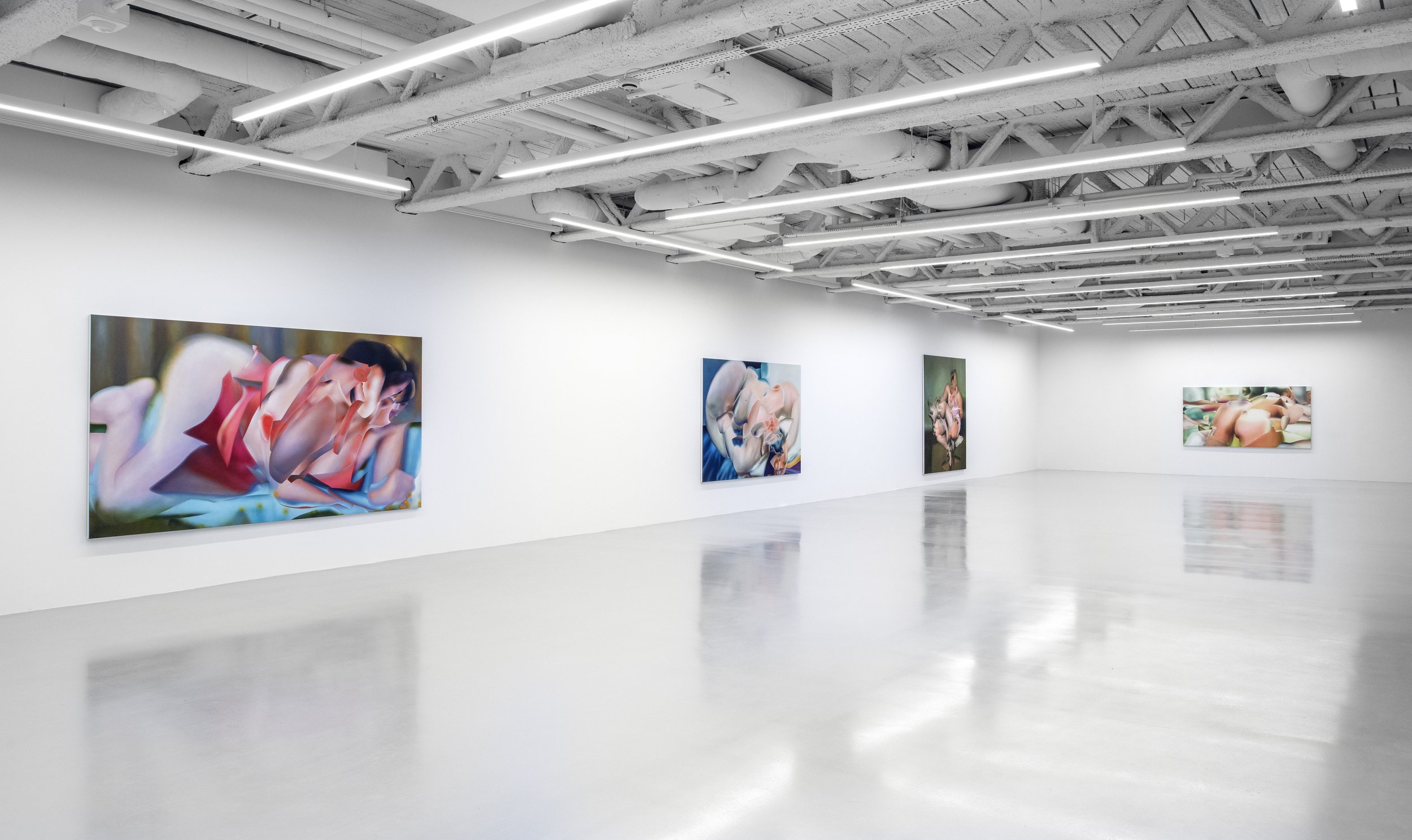
I've always been drawn to depicting the female form, but the results often felt predictable. This led me to challenge myself to break free from that and create something spontaneous—something not influenced by the familiar images we've all absorbed over time. I developed a process that allows new, unexpected creations to emerge, effectively clearing away the subconscious biases shaped by history. It all starts with a found image, a digital thumbnail that captures my attention, often sourced from the internet. These images vary widely—anything from makeup ads to erotica—representing the wide range of products, ideals, and fleeting pleasures we're constantly sold, often discarded and forgotten.
I created my own technique as a way to break free from predictable outcomes and challenge the traditional ways the female form. Has been depicted. I wanted to move beyond the influence of historical biases and familiar imagery that had shaped my subconscious. By developing a new process, I was able to create something spontaneous and unexpected, allowing to erase ingrained biases and question this collective consciousness - untainted by previous cultural conditioning.
In your solo show at Saatchi Yates, your paintings break away from traditional depictions of the female form, pushing it toward abstraction. What drew you to this approach, and how do you think it changes the way people see and interpret the body in your work?
My attraction to pushing the female form toward abstraction stems from a desire to rethink the traditional, historically ingrained ways in which the female body has been represented.
There’s a direct line from ancient religious iconography, classical nudes, to contemporary media including the images were inundated everyday today and how they reinforce societal ideals of beauty and power.
I aim to break free from this narrow lens. By moving toward abstraction, I eliminate those limitations. Abstraction creates space for ambiguity—where the body is not confined to one set of rules, but can shift, dissolve, and transform, dynamic, raw, and alive rather than idealized or passive. By challenging the ingrained narratives that shape how we perceive the female form, I seek to transcend historical constructs.
I see the female form as powerful in its own right, not there to merely please or serve an aesthetic ideal. It’s about moving beyond objectification. This shift allows me to depict the body as something that is alive, dynamic, and unapologetically unrefined, rather than idealised or passive. Disrupting the ingrained narratives that have shaped our perceptions - these power structures have permeated everything around us, influencing art, culture, and the very images we consume daily. I aim to break free from those constructs, creating a new, multifaceted understanding of the female form - one that reflects its true complexity and resilience rather than fitting neatly into the frameworks handed down by history.
The body oscillates between recognizable form and abstraction, never fully one or the other. This constant shifting allows for exploration beyond the surface, breaking free from prescribed expectations and opening up new possibilities. Through this act of radical reclamation, my work doesn’t just reframe the body—it redefines it as a catalyst for rethinking the world around us.
Install shot, Saatchi Yates, January 2025
The Rapture, 2024
Untitled, 2024
Amorphous, 2024
Your work reflects the fast-paced nature of digital imagery, yet you use oil paint—a medium known for its permanence. What interests you about this contrast, and how does it influence the way you approach your paintings?
There’s something incredibly powerful about working with oil paint in this context, especially when you consider how deeply ingrained it is in the depiction of women by the great masters throughout history; I feel like I’m tapping into this rich tradition, but at the same time, I’m pulling it forward into the present moment, using a medium that has stood the test of time to question and dissect the very legacy it carries. In doing so, I’m not only exploring the timelessness of oil paint, but also highlighting the stark contrast it offers to the world of digital imagery, where everything is consumed at an overwhelming pace, fleeting and disposable, each image disappearing almost as quickly as it appears on our screens. This immediacy of the digital world, with its ephemeral nature, is a constant reminder of how little we allow ourselves to linger or reflect. Oil paint, in its slowness and permanence, offers the exact opposite—an invitation to pause, and to create something that holds weight beyond the moment. In this way, I feel the medium almost naturally lends itself to translating the impermanence of the digital realm into something that endures, a conversation that speaks to the very essence of how we interact with images today.
Tell us a bit about how you spend your day / studio routine? What is your studio like?
I paint every day in my studio in New York. My studio routine is marked by experimenting with new compositions or rearranging forms to capture that initial spark of movement. I like to stay open to surprises, allowing the work to evolve naturally as I go. Nothing can be forced, every composition is a true collaboration between me and whatever the image wants to become. I never know how the finished work will look, I am fully immersed in this intuitive process. I don’t even judge my works for months in a row. I then get to look at all compositions I have created with a completely fresh eye, and recognise a sense of shared power that some works have developed. These are the ones I would then paint in oil.
My artistic process begins with a found image, a digital thumbnail that resonates with me that I collect from the internet. The source ranges from makeup ads to erotica, anything that's out there to sell us something — a product, an ideal, an ideology, a short-lived pleasure - all silently being discarded or swept away.
From there, inspired by a certain pose or colour palette, I paint digitally in hundreds of fragmented layers and begin to shift and turn those layers, experimenting with the composition and colours. This allows me to break with reality and create anew - playing with the reconstructed, exaggerated, distorted and the dissolved. You can sense the figure oscillating towards abstraction in this stage, and with every shifting layer, something new is revealed.
The work then enters what I refer to as a phase of permanence, through translating the final digital composition onto large-scale canvases in oil paint. The shift from fleeting digital thumbnails to the tactile, enduring nature of oil paint creates a stark contrast—an antagonism that highlights the transitory nature of digital imagery versus the lasting weight of the traditional medium.
Pussyfooting, 2024
Install shot, Saatchi Yates, January 2025
What artwork have you seen recently that has resonated with you?
Umberto Boccioni's Unique Forms of Continuity in Space
For some reason it’s very present and relevant whenever I visit the Metropolitan Museum of Art and the MoMA here in New York, where it’s part of both their permanent collections. Though I haven’t seen it in a while, the piece has always resonated and lingered with me—not just for the radical shift it represented in sculpture, but also for its multifaceted form that continues to captivate.
When I recently stood in front of a new work of mine and realised the shape of the figure, though oscillating into abstraction, reminded me very much of Boccioni's striding bronze sculpture. So I named it “Ode to Boccioni”.
The way Boccioni exaggerated the figure—specifically the legs and shoes—or the way I transform a heel into a mere gradient, speaks to breaking down the elements to their purest essence, something I relate to in my own approach to art. I never set out for this resemblance to occur; it all came about quite fortuitously, and I couldn’t have planned it even if I tried. Sometimes, my compositions take months or even years to reach their final form, but I’ve learned not to overthink the process. Flow is essential—I can’t force anything, the work must evolve naturally. It’s an intuitive, collaborative process between me and the image, allowing it to become whatever it desires. In a way, I merge the subconscious and conscious as I paint, giving the work space to breathe and unfold on its own.
Is there anything new and exciting in the pipeline you would like to tell us about?
There’s a lot of exciting projects and opportunities on the horizon that I’m really looking forward to sharing. Another highlight is my current solo exhibition at Saatchi Yates in London, where I'm unveiling a brand-new series of oil paintings. I’m thrilled for people to experience these paintings in person, as there’s a depth and subtlety to them that can’t quite be conveyed through photos or screens. Each work has layers and nuances that reveal themselves the more you engage with them, making the experience of seeing them live incredibly immersive.
It’s this kind of irreverence and tension that they aim to infuse, creating an experience where the viewer can’t simply settle into the familiar, but must engage with the painting in an active, maybe even uncomfortable, unfamiliar way. A dynamic, sensuous, and fearless encounter—one that is both joyful and subversive. It draws the viewer in with its beauty and vibrancy of colors, while quietly challenging them to reconsider their relationship with the images and the world around them. It offers an opportunity to see things from a different perspective, to break through the surface, and discover new meanings.
Aside from the exhibition, I’m continuing to explore new avenues within my oscillation of abstraction and figuration. I'm constantly experimenting, whether I’m blending traditional and digital methods or pushing the boundaries of different mediums, I’m always looking to evolve the process and allow the work to evolve.
All images courtesy of the artist and Saatchi Yates
Interview publish date: 19/02/25