
Flora Yukhnovich
“Although my work draws on Art History, the issues I’m interested in are generally rooted in the present.”
“Although my work draws on Art History, the issues I’m interested in are generally rooted in the present.”
Interview by Natalia Gonzalez Martin
Could you tell us a bit about yourself and your background? Where did you study?
I went to Kingston University for my foundation year, where I ended up specialising in graphic design. I really enjoyed the research and the very precise way of looking at language, however, I missed painting and the physical act of using my hands to make something. I enrolled on a portraiture course which seemed like a good way to indulge in that for a while. Progressively, the paint itself began to interest me more than the portraits. So rather than painting commissions when I graduated, I decided to do an MA at City and Guilds of London Art School. It was a really challenging and exciting year, which for me felt like a crash course in Art Theory. I had so much to catch up on after my craft-based training, which I was quite self-conscious about. I think that insecurity ultimately led me to look at the rococo, which has in part been a way for me to explore the distinction between high and low art, and the relationship between material and meaning. Rococo painting and design has been at the centre of my research and painting since then.
Tell us a bit about how you spend your day/studio routine? What is your studio like?
My studio is on the top floor of an old medical centre between Borough and Elephant and Castle. It’s quite an odd office-like space, but it has beautiful big windows and it’s really bright because it’s so high up. Daylight is really important to me when I’m painting. I used to be quite sporadic with my hours in the studio, only working when I felt the urge, but I now really value routine and arrive fairly early in the morning. I like to work quite long days because I’m most productive in the morning but my way of painting feels more intuitive and free in the evening, and I think both gears are really important.

Fantasia 2019
Last year, in collaboration with Victoria Miro, you completed a residency in Venice. The work that resulted from this has very defined references that include literature, music and art – how do you go on about selecting your sources and what do you look for in these?
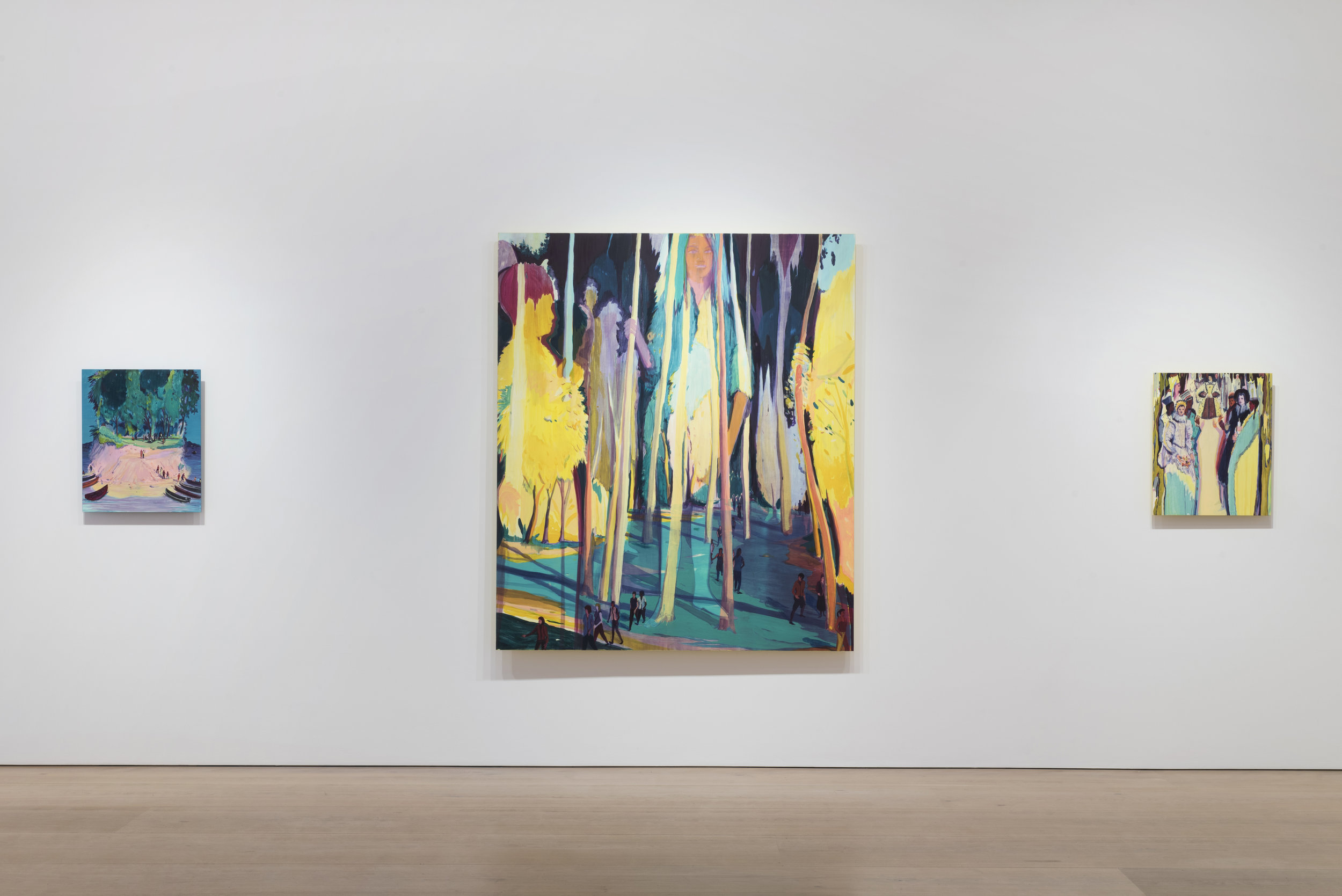
Typically, I’m looking for a commonality between the rococo style and something I’ve seen in an advert, on TV or in a shop etc. Making the work is often about trying to understand why they are similar – why the present-day imagery has been influenced by that particular moment in art history. In Venice, however, it was a little different because unlike London there isn’t much contemporary imagery around. It’s really like a time capsule. So the work I made there is less about the influence of the rococo on contemporary aesthetics and more to do with researching the rococo and its 18th-century context, as it existed in Venice. I have been drawn to Tiepolo’s work and the Italian rococo for a while, but have always found it difficult to understand how it fits with the French paintings from the same period. So choosing the sources was really about choosing strong examples, which felt distinctly part of the Italian rococo aesthetic. I was then using my paintings as a way to unpick them - to understand their colours, and construction. I ended up concentrating on the theatricality which is shared by both the French and Italian rococo albeit in quite different ways. In French rococo, this is clear in the subject matter, which is all excess and frivolity, whereas in the Italian paintings and frescos it seems to manifests as dance-like movement in the composition and the play of light.
Rococo is your main influence, a period that is sometimes looked at with humour and not taken as seriously as its big brother the Baroque. This humour comes across in your work while being able to talk about more serious subjects, touching on feminist and class issues. What are the main issues your work addresses?
Looking around the shops in London or at advertising campaigns, It’s clear to me that the rococo, with its associations of materialism, ornamentation and frivolity, has become a signifier for femininity. It’s strange that something symbolising an archaic, negative and falsely simplistic view of women has now become a tool to gender things in order to then market them to women and girls. It’s as though we are still, on some level, encouraged to identify with an idea of ourselves which society outwardly rejects as old-fashioned. Part of what I do is trace the present day rococo-inspired imagery back to its origin, where I can try to disrupt some of those associations and reconfigure the aesthetic. I’m also looking at the representation of women in the art of the era, considering their agency or objectification, looking for ways to subvert or perhaps mock the male gaze. Although my work draws on Art History, the issues I’m interested in are generally rooted in the present. The rococo has really become a vehicle for me to reflect on my experience of being a woman.

Capriccio, 2019
In previous interviews, you have stated that ‘appropriation feels natural', what is it about the transcription process that you are fascinated with?
There’s a brilliant scene in the film The Devil Wears Prada where Miranda Priestly explains the significance of the particular shade of blue that Andy is wearing. She traces the many moments in history which have built the particular nuanced meaning that accompanies cerulean. For me there is really nothing more fascinating than mining the history of a piece of language or imagery like that, trying to understand why and how it feels the way it does. I think that’s what appeals to me most about transcription, the ability to deep dive into a painting and the many other artworks it may have inspired and in some way get a more concrete grasp on the subtler connotations.
Historically, what is your favourite transcription example and why?
I don’t think I have one particular work in mind. I get most excited by paintings which seem to evoke multiple different sources, feeling like a painting or paintings from history because of something to do with colour or the overall language, rather than a reimagining of a single composition. An example would be Dorothea Tanning’s amazing painting, Dogs of Cythera (1963). It feels as though she’s stitching together and unifying lots of different art historical references. The initial source falls away, leaving behind an elusive sense of familiarly. It feels like a historical painting, but one I can only half remember. I love the openness of that, it morphs into something new every time I look at it.
What artwork have you seen recently that has resonated with you?
There is a very beautiful watery blue and gold fresco by Tiepolo on the ceiling of The Church of the Pieta in Venice. The church is part of the Ospedale della Pietà which is an orphanage and music school where Vivaldi taught and composed. Tiepolo’s ceiling is made in response to that and is partly a celebration of music. When I saw it for the first time on my residency there, Tiepolo’s paintings and their relationship to the rococo suddenly made sense to me. My eye seemed to ping around the painting as I moved underneath it, and with the help of the music, I began to understand it as choreography as much as composition. It made me think more about the role of the viewer and the way the eye travels around a painting. I had mostly dwelt on my own body when I had thought about the gesture and about action in painting but that fresco opened up quite a different perspective for me.
How do you go about naming your work?
Sometimes a phrase or a song lyric will float around in my head as I’m making the painting, but mostly I title a work when it’s finished. My starting point for my work is often contemporary so I like it when a title can help pull the historical elements back into the present day. I usually use existing phrases or words which refer to something else, like a song or a film – it’s always a bonus if google can connect the two. It’s a nice way to weave in another reference.
Due to the pandemic, Yukhnovich’s show will no longer be taking place in Victoria Miro’s Venice Gallery as originally planned. Instead Victoria Miro in association with Parafin is delighted to present an extended reality (XR) exhibition of new paintings by Flora Yukhnovich, created during a residency with the gallery in Venice in the autumn of 2019 and completed in her London studio in April 2020. The exhibition is available exclusively online in our new virtual gallery on Vortic. Vortic Collect is available to download from the App Store.
florayukhnovich.com
@flora_yukhnovich
victoria-miro.com
parafin.co.uk
All images courtesy the artist, Parafin and Victoria Miro
Jules de Balincourt
"I am not sure how the Trump phenomenon will manifest in my work but I do know it is impossible for anyone to negate it and its ability to submerge into our subconscious.."
"I am not sure how the Trump phenomenon will manifest in my work but I do know it is impossible for anyone to negate it and its ability to submerge into our subconscious.."
Could you tell us a bit about yourself and your background. Where did you study?
I was born in Paris France in 1972 and between then and 1980 had brief stints living in different places in Europe from France to Switzerland and Ibiza before permanently settling in Los Angeles in 1980. I spent my childhood following my mother’s impulses to chase love or shelter in different parts of the world, never really settling into one place until 5th and 6th grade, the first two consecutive years I spent in one school. I was constantly adapting to different settings and perpetually experiencing the new kid or outsider experience especially coming to American public school after having had a formative Waldorf school experience in France.
I spent most of my adolescence being a Southern California surf rat and it wasn't until taking classes at SBCC that I rediscovered art and a conviction of that being what I wanted to do. I then proceeded to spend 1995-2000 studying at CCAC majoring in ceramics studying with the legendary Viola Frey and making a side income building (beat legend) Michael McClure’s studio. I then headed east to NYC in 2000 in my little pick-up truck and sleeping bag, some tools, cooking and art supplies and dreams of the big city.

"They Cast Long Shadows " Install shot Victoria Miro Mayfair 2018
You are quoted saying: "Currently, making work and living in America is beyond words, but maybe not beyond images.” With 20 January 2018 being the one year anniversary of Trump’s inauguration, how do you feel being an artist in Trump's America? Has this affected your work?
"They Cast Long Shadows" is in a sense about this binary of opposing forces we are currently witnessing in America. They being either the Trump freaks or the anti-Trump camp because essentially it has become that simplified or divisive now, you are either 100 percent for or against him and there is no middle ground, no negotiating the extremes. Never since the Civil War has America been on such a profound brink of ideological rupture.
Whether its the neo-fascist Trump ideologue or the left fighting for equality, environmental sustainability and all the other causes that are under serious threat, historical moments like these leave big shadows as different ideologies clash for the light. I am not sure how the Trump phenomenon will manifest in my work but I do know it is impossible for anyone to negate it and its ability to submerge into our subconscious and how it manifests will unfold accordingly....either as act of resistant cooperation or complacency. The long shadows symbolize the trails or the remnants, the positive or negative effects of people’s actions or beliefs.

"They Cast Long Shadows " Install shot Victoria Miro Mayfair 2018
"Cave Country", 2017
"If Queens Ruled", 2017
Tell us a bit about how you spend your day/studio routine? What is your studio like?
Studio routine is not so routine – it has in past either been nocturnal or from 10-6 but there is no real schedule aside from a day or two with my studio manager in the office and one studio helper. For the most part I have kept it a small operation, still making my own paintings but facilitated by my two wonderful assistants. I like the idea of still being able to maintain a nomadic transient element. I think routine as an artist can kill creativity, one still needs to explore, wander, delve into the unknown, be surprised and awed. I sometimes attribute this to my first ten years living out of a suitcase but nonetheless I know it fuels me to travel and discover alternative realities. In that sense part of my routine is occasionally traveling, most of which at the moment is based in Costa Rica where I am currently building a studio and small residency to invite friends, artists, dreamers, whoever it may be that is seeking escape to come and visit. I spent so much time painting these Edenic spaces of escape, now I am going to seek and live it.
How do you begin a painting? I hear you don’t use images as a reference, could you tell us more about this?
This is true I very rarely begin with an initial image, since my work is essentially representation/narratively based. I prefer to begin the painting from a purely abstract intuitive process strictly based on color and form delving into a subconscious process before eventually finding, or "mining out" in a sense, the figurative elements. I like this process of seeking or searching through painting and layering of color in order to construct a narrative based both in primitive abstract space as well as a logical narrative painting space and how these two states of mind can cohabit.
"Troubled Eden", 2017
"Big Little Monsters", 2017
How do you go about naming your work?
That process is as intuitive as my process of working. Sometimes the titles precede the painting and then a painting is made in relationship to the title. Other times the title surfaces when a work is near completion. Very rarely some pieces take up to a year to title.
Is there anything new and exciting in the pipeline you would like to tell us about?
I am working on building my jungle art studio residence in Costa Rica and preparing a solo exhibition this October in Copenhagen at Galerie Bo Bjerggaard, in addition to participating in several group exhibitions that are in the works.
Jules de Balincourt, They Cast Long Shadows at Victoria Miro Mayfair, until 24 March 2o18
www.victoria-miro.com
All images courtesy of the artist and Victoria Miro Gallery
Interview publish date: 15/02/2018