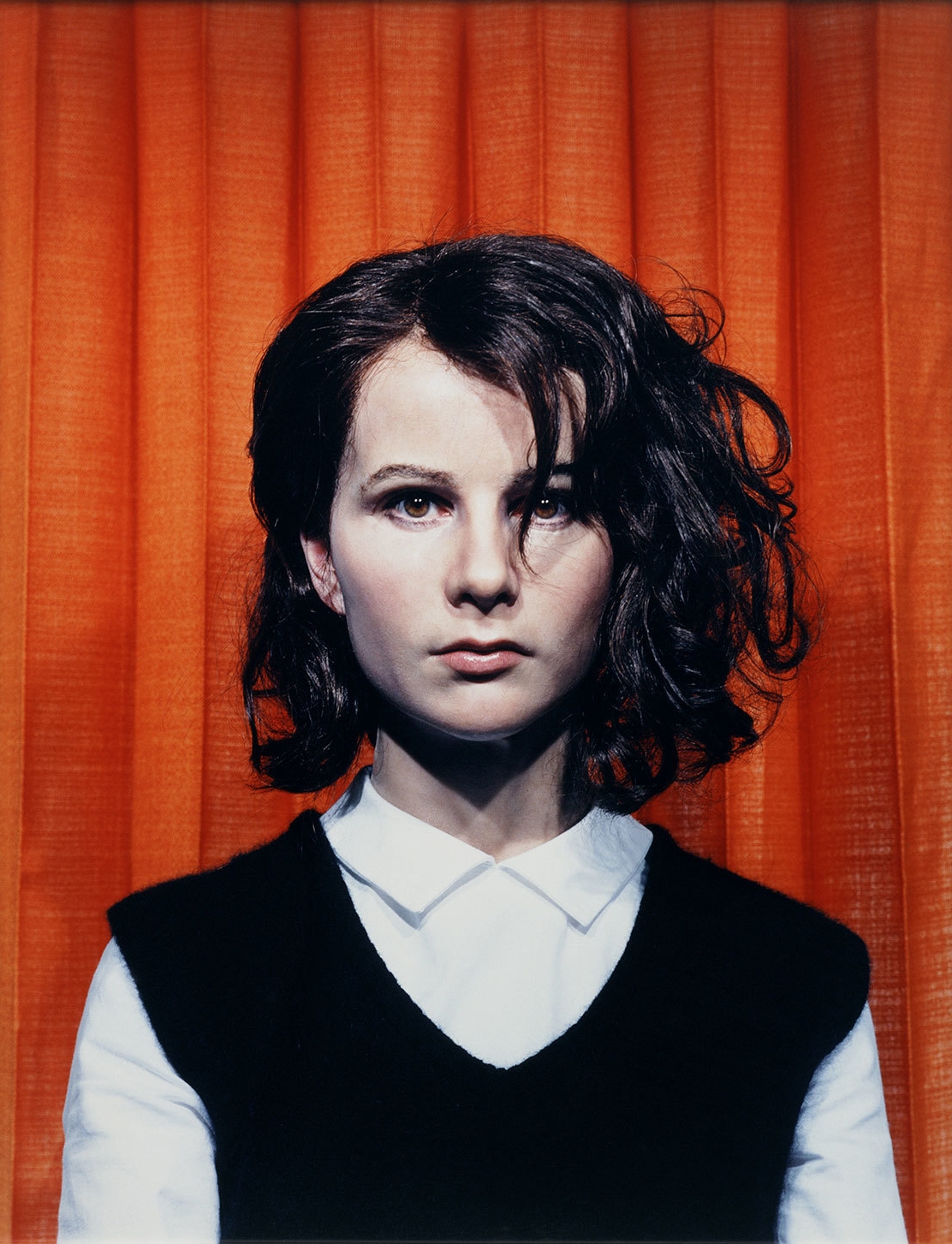
Gillian Wearing
"It really opened up to me how much my thinking of the world was so narrow, and that any view of someone else changes when you give them the openness that the sign series was able to offer."
"It really opened up to me how much my thinking of the world was so narrow, and that any view of someone else changes when you give them the openness that the sign series was able to offer."
Our interview with Turner Prize winner Gillian Wearing OBE.
Hello Gillian, thank you for taking the time to talk to us. You won the Turner Prize in 1997, looking back how do you feel winning the prize has effected you and your work?
It did feel like a seal of approval, a recognition of the work I have done, which is really wonderful, but it is hard to know if it has an impact or not in terms of work. I was already showing internationally and the biggest change at the time was the media interest.
The prize was much more debated in the 90’s than it is now, so there would be a lot of press in tabloids and broad sheets. The art world was also a lot smaller and so if you were in the news it felt magnified. But since then contemporary art in the UK has grown exponentially - gallery wise, museum wise and many more artists, there is more voices and visibility and less of focus on one event.
"Signs that say what you want them to say, and not Signs that say what someone else wants you to say" 1992-3
Your well known series of works called: "Signs that say what you want them to say, and not Signs that say what someone else wants you to say" is still very impactful. Could you tell us about these works, did you find that people were willing to share their thoughts/anxieties/feelings?
This was the early 90’s and I wasn’t expecting the full depth and breath of confession, emotion, thoughts or opinions. It really opened up to me how much my thinking of the world was so narrow, and that any view of someone else changes when you give them the openness that the sign series was able to offer. The simple instruction that I asked passers-by was to “write anything they wanted to on an A3 sheet of paper”. I didn’t have to coax any of the comments, people just wrote very honestly about themselves. I also think the purity of the project was one of the reasons for it’s success as well as a lot of participants really loved the idea.
Your work explores the boundaries between the public and private self with the use of disguises, how did the idea of using masks come about? Did you find that people opened up more easily?
The signs series gave me the idea of doing confessional films, since some of the signs themselves were confessions. I realised that most people would probably want to be anonymous if recounting a particular story or event and that’s why I came up with the idea of using a mask. The mask takes on it’s own identity in the film and I can’t remember how the people looked underneath and therefore relate each story to the individual masks. In the 90’s there was much text on this work being very much how people started to relate to the internet, the hiding of identities and being able to say things other situations wouldn’t allow.
Do you feel that the use of social media is an extension of the mask? Another layer to hide behind, with the potential to be anonymous or someone else?
Yes it does. Although I was much more aware of that in the mid 90’s than now. I think many more people are now posting as themselves, since social media has become a very visual space. So instagram is like curating an ideal identity. In the less visual online presence of the 90’s where everyone was a bit scared in revealing their true identities, there was a sense that no one was who they said they were. There is much more online policing now, or people being called out if someone believes they are fake. In my youth no one would consider someone a fake, but in the internet era it seems there is more doubt in what people believe to be real.
Self Portrait at 17 Years Old, 2003
Self Portrait as my Father Brian Wearing, 2003
Rock 'n' Roll 70, 2015
You were recently a judge for the #SelfExpression competition, organised by Saatchi Gallery and Huawei. Where artists are invited to enter images only using their smartphones. How did you find the process of judging these works? Was it enjoyable?
I enjoy judging because you get to see work before someone else will judge or make a comment, so you have to rely on instinct. One thing to learn in art there is no right and no wrong, no good or bad. An opinion is very subjective. One can pull apart anything in a negative way or raise it up positively.
On the short list of images there were some photographs I would not have chosen and were picked by other judges, their choices make me think OK I didn’t see that in the same way and you do remember that. Of course someone’s judgement isn’t the be all and end all of anything, certain art just will resonate with more people than others and sometimes something comes along that gets a unanimous vote.
'Daydream in Blue' Paola Ismene (WINNER of #SelfExpression competition)
'London Bus' Denis Cherim (shortlisted Artist)
Tell us a bit about how you spend your day/studio routine? What is your studio like?
My studio is like an office, but it is large enough to make art. Michael Landy my partner has a larger space below and I do a lot of photo shoots there. There is quite a lot of administration in my work, and I do spend quite a lot doing emails and/or doing drawings of ideas on Photoshop etc.
Is there anything new and exciting in the pipeline you would like to tell us about?
I have a solo show opening up in SMK Copenhagen in October, as well as unveiling a public sculpture there and I am creating a statue of Millicent Fawcett for Parliament Square next year.
Images © Gillian Wearing, courtesy Maureen Paley, London, Tanya Bonakdar Gallery, New York and Regen Projects, Los Angeles.
#SelfExpression images courtesy of Saatchi Gallery
Publish date: 28/09/2017

Ragnar Kjartansson
"I was lucky to be raised in the darkness of the theatre."
"I was lucky to be raised in the darkness of the theatre."
Our interview with Icelandic performance artist Ragnar Kjartansson
Could you tell us a bit about yourself and your background? Your parents are both actors, right? Where did you study art?
Yes, they're both actors, I was lucky to be raised in the darkness of the theatre. And to be around chain-smoking people in costumes and makeup, its a pretty cool memory. I studied art at the Iceland Academy of the Arts, which is a school here in Reykjavík. I graduated in 2001.
You have an exciting new performance at the National Museum in Cardiff, with a series of revolving organists performing the 1959 hit song, "The Sky in a Room". Can you tell us a bit about this piece? And why you chose that song?
It's basically a song I've really, really loved for years. It's a beautiful Italian song by Gino Paoli, It's a love song and it's about how space transforms when you're in love. Visual art has always been about transformation of space and this is the only song I know that addresses this concept directly.
He wrote it in 1959, in bed with a prostitute, feeling the love in this weird space, in a brothel. And he starts thinking, you are here with me, the walls, the endless woods, the violet ceiling becomes a starry sky. And the harmonica, I hear, sounds like an organ. Reality changes and space transforms. There's this beautiful version of the song which he recorded, where it's just an organ. And when I was doing Artes Mundi in Cardiff a few years ago, I thought, how cool it would be to do a performance in that space with just that song and being performed on repeat. I think the idea for this piece just came from always having this song in my subconsciousness and listening to it a lot. And then just coming into this space in Cardiff with its– light blue, velvety– damask wallpaper, with light's coming in from the ceiling with this 18th-century gorgeous organ in the middle of the floor. I've always said– The space just asked for this performance to happen. And now weirdly it's happening, and I'm crazy excited about that.

"The Sky in a Room", National Museum Cardiff 2018 (c) Hugo Glendinning
1774 Sir Watkin Williams Wynn chamber organ at National Museum Cardiff (c) National Museum Wales
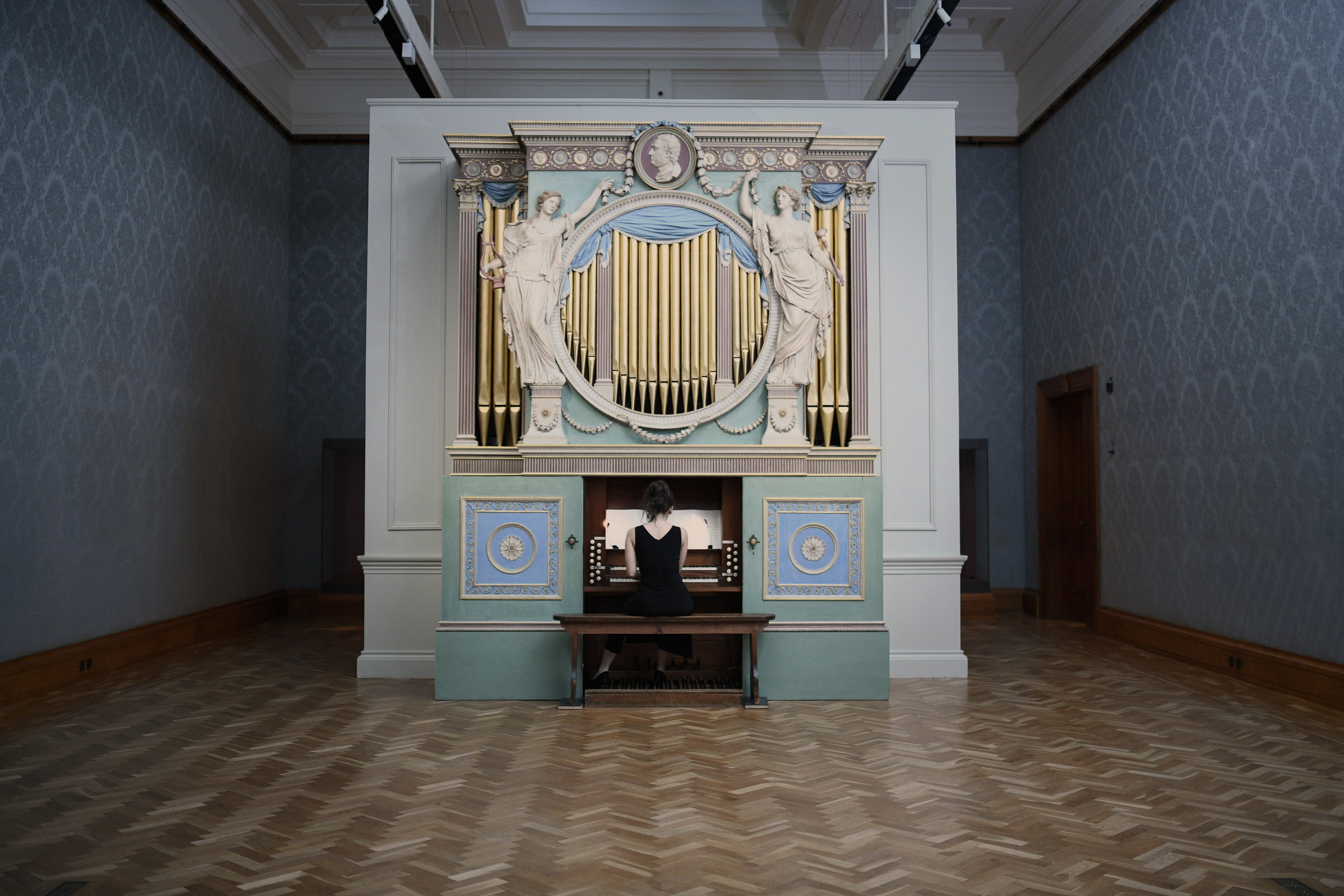
"The Sky in a Room" National Museum Cardiff 2018 (c) Polly Thomas
The gallery is full of 18th-century British paintings but all the works will be removed, leaving the room empty. Could you tell us what's behind that decision?
When you take the paintings out of the room, it just becomes a space with that song in it. If you have the paintings there, then the song will be accompanying you watching the paintings. I think it's also great for people who love these paintings and love this place. It's like when the paintings go away for a bit, you start missing them and you become really happy when they come back. But the main reason is if you have the paintings in there then the piece would not work.
Your ongoing piece called "Me and My Mother", is a video of your mum spitting on you for several minutes. You both do this every five years. Can you tell us a bit about this work, and has it affected your relationship with your mother at all?
Its become a really nice kind of gory family thing to do. It tells a mysterious story about our bond and about parent-child relationships too. And yes, I think it is actually good for our relationship, to do this every five years. I mean, it's a piece that my mother has become really proud of, and that makes me very happy. It's crafted out of an art school thing and it's just grown with time, and by repeating it, it becomes more and more important for us. It kind of gains weight as a work of art, I think.

Me and My Mother (2015)
There's a lot of repetition in your work. Do you feel by repeating something enough times it can change its meaning and also, with repetition it can be quite comforting as well?
Yes, I think it can be singularly, weirdly comforting. That's why we like habits, traditions, and comforting repetitions. Also by repeating something enough times can change its meaning. This idea of repetition makes a narrative or performative thing something that you can really look at, and I really like that. I like this idea of a song like Il Cielo In Una Stanza becoming a portrait of the song. Suddenly, it's "look at that song. Is that song as an art piece. A sculpture" But then it's a song also that can just come and go. I find that fascinating. I've worked a lot with repetition, I look at it as a tool of artistic expression, like yellow. It is like drawing something and when you draw it again and again and again, this kind of repetition of the drawing somehow gives it some weight and becomes interesting to look at.
Has there been any artwork you've seen recently that has resonated with you?
Yes, I'm always seeing something that I really like. All the time. One of my favorite pieces I've seen recently was in a show here in Reykjavík by this artist called Huginn Þór Arason. It was a great piece. It was called "Current". It's just a video of him and a really beautiful young man Posing like Brooke Shields in that famous Calvin Klein ad. They were reading Icelandic mid 20th-century poetry. This piece sort of blew my mind. The most recent one to blow my mind anyway.

"The Visitors" (still) 2012
"God" (still) 2007
Ragnar Kjartansson by Elisabet Davids
Could you tell us a bit about how you spend your day? Like studio routine? What's your studio like?
My studio is a concrete bunker by the sea where they used to store fishing nets and equipment. I work here with my studio manager Lilja and my wife Ingibjörg. We collaborate a lot. As for studio routine, I'm not one of those artists who just go to the studio at o'clock, has a cigarette and watches the empty canvas. It's more just like the life and art mix into each other constantly. So like today I did not go to the studio, I went to the swimming pool and was just chatting with people. The swimming pools in Iceland are sort of like a pub in England. You just meet people and chat. But chatting and socoalizing is really important for my practice.
Apart from the Cardiff show, is there anything new and exciting in the pipeline you would like to tell us about?
In the fall there will be a performance in San Francisco called "Romantic Songs of the Patriarchy" which I'm quite excited about. And then I'm doing a sad awful epic opera here in Reykjavík called "War" with the composer Kjartan Sveinsson.
Ragnar's "The Sky in a Room" will be on show from 3 February–11 March 2018 at the National Museum Cardiff.
Banner image: "The Sky in a Room" by Ragnar Kjartansson (c) Polly Thomas
All images courtesy of the artist, National Museum Cardiff and Artes Mundi
Interview publish date: 15/02/2018
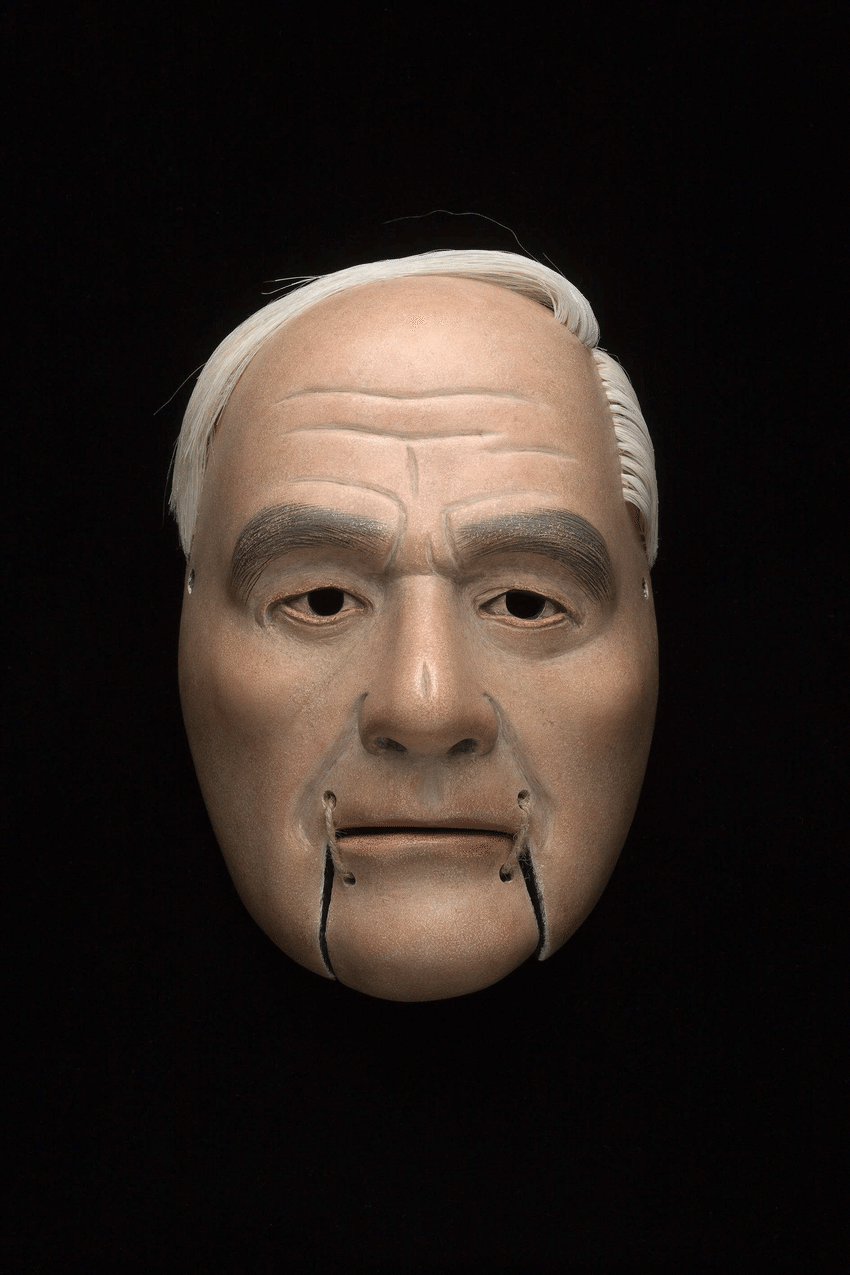
Simon Starling
“A-A’, B-B’, which will take place both in Glasgow and Turin, feels very much like a project for the age of Brexit – a divided painting, a divided car, two venues bridging an imminent divide.”
“A-A’, B-B’, which will take place both in Glasgow and Turin, feels very much like a project for the age of Brexit – a divided painting, a divided car, two venues bridging an imminent divide.”
Our interview with the 2005 Turner Prize winner Simon Starling. Interview by: Natalia Gonzalez Martin
Your work often scapes the unidirectional gallery setting, your upcoming exhibition will take place in several locations simultaneously and you will be exhibiting one piece across those locations. The object, although divided into parts, remains one, your work then, becomes a whole form by different components? How do you tackle the physical and conceptual journey that a piece undertakes?
One of the things about working in Glasgow at that moment was this heightened sense of your own geography and its relationship to the art world as it then was. Because of Glasgow’s peripheral position there was a sense of needing to be proactive in establishing your own networks, etc. and that became very present in my work. The work began to map its own making in very clear ways. I’ve spent many happy years criss-crossing Europe and beyond in different forms of transport, trying to connect places, materials, histories, in new ways. While this is not the first time I have connected exhibitions in this way, A-A’, B-B’, which will take place both in Glasgow and Turin, feels very much like a project for the age of Brexit – a divided painting, a divided car, two venues bridging an imminent divide. It has a certain drama to it because of that political reality. I fear that by the time the two exhibitions close, Europe will be a rather different place. Sadly, more divided.
Could you tell us a bit about yourself and your background? Where did you study?
I studied photography in Nottingham in the late ‘80s and then moved to Glasgow in 1990 for an MFA. It was the best move I ever made! I found an amazing community of young artists in Glasgow, artists who’d decided to try to build a vital scene in the city. After leaving art school I started working at the artist-run space Transmission Gallery. That was also hugely important to my development as an artist. I learnt so much about exhibition-making and how to work with institutions. We were somehow fearless, or naïve, and would call up really well known artists and invite them to come and make exhibitions. They usually said yes. That was very empowering. From there I slowly began to build my own career. Later in the ‘90s The Modern Institute began – initially as a project space and finally as a full-blown commercial gallery and that opened up a lot of possibilities for me too.

'A-A' B-B' 2019 Screenprinted poster designed by Norm. Exhibiting in A-A', B-B'

'Hand of the Artist's Father, Hand of the Artist, Hand of the Artist's Son' (detail) 2019 Daguerreotype on silver-plated copper. Exhibiting in A-A', B-B
Some of your pieces gravitate around the subject of transportation (cars, boats) alluding perhaps to human's nomadic nature, however, these are interwoven with a strong aspect of identity through location and settlement, like when you turned a house into a boat and then again into a house or your upcoming exhibition referencing the Fiat company and its Italian nature. Could you talk about this constant shift between movement and stillness?
I think what I have tried to do is to confuse travels in time with travels in space. To revisit a particular moment in the past has often involved travel. For example, the first exhibition I made with Galleria Franco Noero in Turin in 2002, Flaga (1972 – 2000), looked back to the beginnings of globalisation and outsourced manufacture in relation to the Turin car industry. In the 1970s Fiat started to produce cars in Poland as it could be done more cheaply under communism. For Flaga a Fiat 126 produced in Turin in 1974 was customised using parts manufactured and fitted in Poland, following a journey of 1290km from Turin to Cieszyn. On its return to Turin the customised, hybrid, red-and-white Fiat sporting its new Polish doors, bonnet and boot was hung on the wall like a painting or, more appropriately, a flag. The car became a time machine of sorts. The simple act of hanging the car on the wall somehow seemed to heighten that sense of confusion between time and space, process and product.
That work is certainly one of the starting points for the new work for Glasgow and Turin but in that case the frame of reference is more intricate, more convoluted. Two seemingly unconnected objects from different historical moments collide, two stories about negotiating and exercising power are overlaid, one on top of the other. The logic, or perhaps madness, of cutting a painting into two pieces, as happened to Tiepolo’s The Finding of Moses in the 19th century has been applied to a blue Fiat 125S of the type owned by the former Fiat boss Gianni Agnelli, who became the owner of the small part of the painting. The car becomes the painting, the painting the car. Dividing the work between the two galleries in Italy and Scotland, just as the Tiepolo painting is now divided between Italy and Scotland means that what’s not there becomes as significant as what is there.
Tell us a bit about how you spend your day / studio routine? What is your studio like?
The studio occupies the ground floor of a back house in Copenhagen’s NØrrebro neighbourhood. The building used to be part of an old foundry where they cast monumental bronze sculpture – the Little Mermaid was poured just next door. It’s a constantly changing space depending on what’s being worked on at any one time. We recently dismantled a plastic tent which was used for polishing silver plates for making daguerreotypes – a very dusty job. For a while we had a beautiful 1960s Heidelberg Press in there, while we worked on cutting it into two pieces. Every few months it’s a new situation. So much of the work I make is made in very particular contexts, with particular craftspeople or what have you, so the studio-proper is mostly a headquarters, an organisational hub, for planning and logistics. I have an “old-school” black and white darkroom to escape into from time to time.
During the day I try to mix things up so I don’t find myself working all day at one thing. Multi-tasking is a skill I’m still having to learn – I tend to be a bit too focused on one thing and that in the end is untenable, as there are always a few different projects or exhibitions on the go at once. Importantly I’ve always tried to keep the studio very small, only working with one full-time studio manager and a part-time assistant. That way I’m free to constantly shift the means of production and work in new ways and with new people.

'Flaga (1972-2000)' 2002 Fiat 126, steel frame, bolts At MAC VAL, Vitry-sur-Seine, 2009, photo Marc Domage
'Red, Green, Blue, Loom Music' (detail) 2015-16 Weber Duo-Art pianola, pianola roll, string curtain, projection screen, sound equipment, CRT video projector, plinth, HD video loop At Galleria Franco Noero, Turin, 2016, photo Sebastiano Pellion di Persano

'Nine Feet Later' 2015 At The Modern Institute, Glasgow, 2015, photo Ruth Clark

'At Twilight' 2014-16 At The Common Guild, Glasgow, 2016, photo Ruth Clark
'At Twilight' (detail) mask of W. B. Yeats 2014-16
'At Twilight' (detail) mask of Nancy Cunard (After Brancusi) 2014-16
'At Twilight' (detail) mask of Michio Ito (After Isamu Noguchi) 2014-16

'Autoxylopyrocycloboros' (still) 2006, 38 colour transparencies (6 x 7), Götschmann medium format slide projector, flight case
What artwork have you seen recently that has resonated with you?
Everyone has their own experience of this – a moment when you feel that a song, a novel, an exhibition, or what have you, has been created just for you. I recently discovered Sudden Death, a book by Mexican/American writer Álvaro Enrigue about Michelangelo Meresi da Caravaggio and tennis which seemed to have been clearly written just for me – a tennis player with an mild Caravaggio obsession. I felt the same earlier this summer entering Mike Nelson’s exhibition The Asset Strippers in Tate Britain’s Duveen Galleries. This is in some ways Nelson’s most conventional exhibition of sculpture to date. A real sculpture gallery, filled with a series of stand-alone works raised on something approximating plinths – low concrete slabs. These plinths support further makeshift plinths – cabinets, trestles – the auctioned-off detritus of a once-productive nation co-opted into elegant stacks. Brancusi for the early 21st century. An endless column of ‘stillages’, largely empty storage units, reaching towards the light. The means are, in many ways, modest – sculpture is reduced to a very few simple manoeuvres; stacking, propping, juxtaposing, little else. The magic of this exhibition is that Mike seems able to let these machines be themselves while simultaneously charging them, in their newly manipulated forms, with a deep sense of connection to the history of sculpture. The Duveens are always something of a temporal echo chamber and The Asset Strippers taps into their resonances to wonderful effect.
How do you go about naming your work?
The titles of the works are often rather long – closer to recipes than names. They try to map the making – its history and geography. In general, it's a rather pragmatic process. Informational. For a work like Autoxylopyrocycloboros I consulted a classics scholar to collage together a word with Greek roots that described a self-defeating journey made on a steamboat that essentially ate itself as the boiler burnt the wood that kept the boat afloat, piece by piece. A-A’, B-B’ is named after two cuts made in two objects 200 years apart – the formulation being taken from engineering or architecture and describes a plane or cut defined by two points on a diagram, A and A’ etc. All the individual works in the exhibition will have their own long, informational titles. For example, one sculpture in the exhibition, a figure of sorts, is titled: The artist, wearing a mask of the former Fiat supremo Giovanni Agnelli, reads an aside from Dario Fo’s political satire Trumpets and Raspberries (1974) in which a disfigured Angelli has his face reconstructed in the image of a Fiat worker in whose jacket he is found following a near-fatal kidnapping attempt.
Apart from the show with The Modern Institute, is there anything new and exciting in the pipeline you would like to tell us about?
I’m in the process of developing a new film that I hope to produce in Malta next spring. The film will be structured around the re-creation of Caravaggio’s epic painting The Beheading of John the Baptist (1608) in the context of the Malta film industry and will culminate in a recreation of the frozen moment depicted in the painting. As well as telling the story of the events surrounding the realisation of Caravaggio’s Maltese masterpiece, a torrid tale of political intrigue, professional rivalry, and murder –the film will also focus on the machinations of cinema itself. It’s something of a larger production than I’ve attempted before – usually I make films with a handful of people – but using the Maltese film industry as a backdrop for the film means working with a bigger cast and crew. It’s a new challenge.
Starling’s A-A’ B-B’ will be on view at The Modern Institute, Glasgow from 6.9.2019 - 26.10.2019 and Galleria Franco Noero, Torino, From 15.10.2019 - 11.1.2020
themoderninstitute.com
thecommonguild.org.uk
nottinghamcontemporary.org
franconoero.com
All images: Courtesy of the Artist, The Modern Institute/Toby Webster Ltd, Glasgow
Publish date: 21/08/19
Banner image: Pedigree English Greyhound, Valldemossa dell’Attimo Fuggente (Vera) photographed at FourStudio, Mirafiori Car Plant, Turin, 2019 Silver gelatin type LE/Selenium toned print.
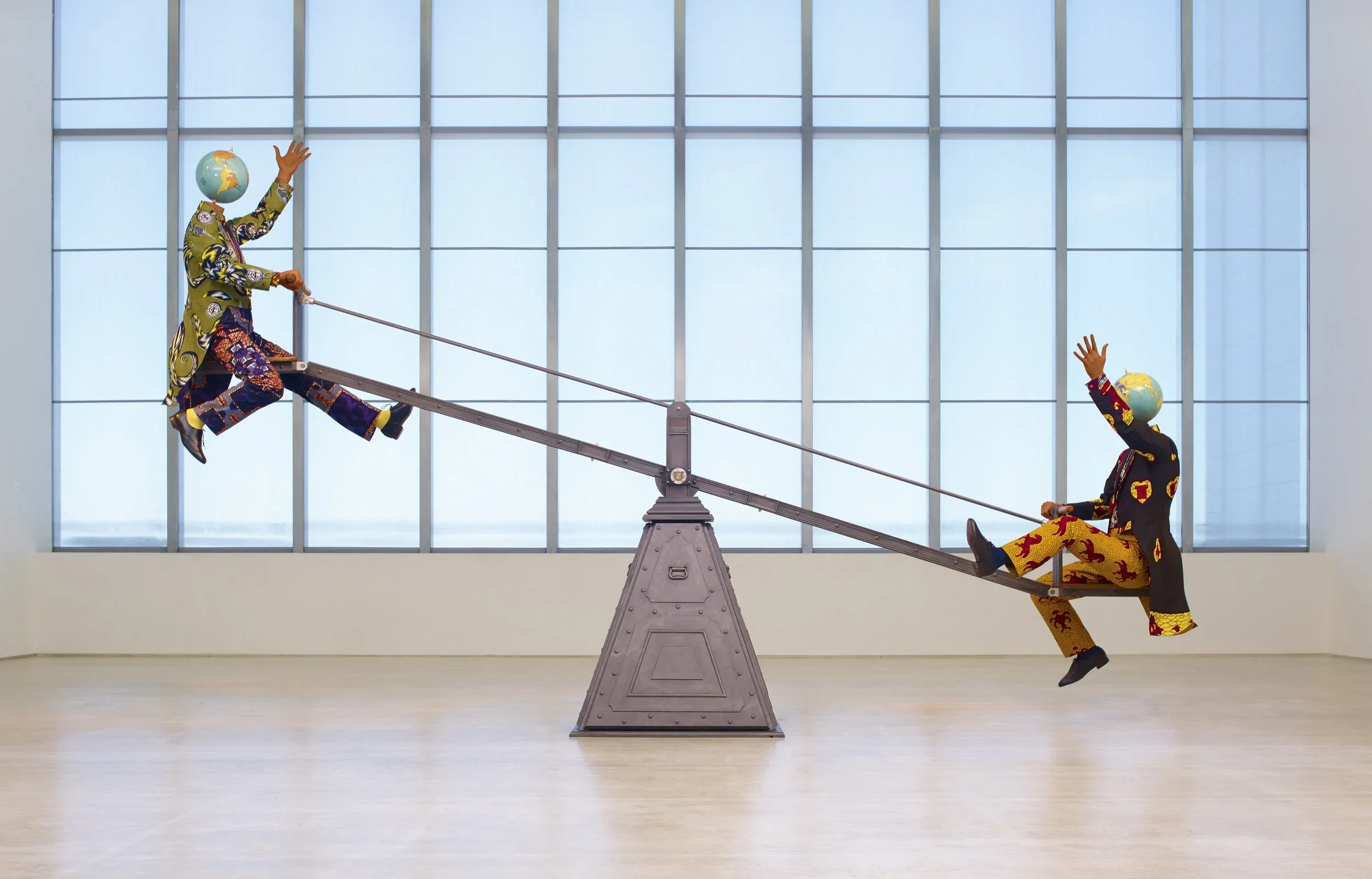
Yinka Shonibare
"They are hybrid figures. They are part Victorian, part African, part Dutch. They are an expression of the identity of a contemporary post-colonial birth."
"They are hybrid figures. They are part Victorian, part African, part Dutch. They are an expression of the identity of a contemporary post-colonial birth."
Our interview with Turner Prize nominee and MBE Yinka Shonibare
Could you tell us a bit about your background? Where did you study?
I was born in London but grew up in Nigeria. I came back to London when I was 17 and studied art.
Art X Lagos is West Africa's first international art fair. Could you talk about the art fair a bit and the work you have on show there?
I'm going to be showing a screen print, which is a self-portrait based on Warhol self-portraits. And then I will have a couple of other prints based on the myths surrounding twins in Nigeria.

THE GHOST OF ELIZA JUMEL 2015
APOLLO OF THE BELVEDERE (AFTER LEOCHARES), 2017
APHRODITE OF KNIDOS (AFTER PRAXITELES), 2017
Could you also tell us a bit about the guest projects? How did that start?
Yes, the guest projects. It's a project base for emerging artists. It's an experimental space that's part of my studio. An artist sends in proposals and the successful applicants get a month to use the space. They can either make work in the space or show their work. At the end of that, it's up to them. Some just want to put exhibitions, some want to use it for both. And next year it's going to be 10 years old. But as you know in London, it's very hard for the emerging artist to find spaces to show their work so I wanted to offer that.
Can you tell us a bit about how you spend your day and your studio routine? What's your studio like?
I work across many studios. A studio in my garden, which is where I do my drawings. I also have a larger studio with about five other people working it. And the studio where the projects base is. So that one is more of a social studio, where meetings take place. And then there are other affiliated studios where really big things get made as well. And there's a painting studio. But the big studio is mainly where the project space is. That's mainly the design studio, really.
With Brexit and Trump and the general feeling of things kind of going backwards, do you feel artists have a role to play? Can art help in any way, you think?
I mean not directly in politics or within culture– of course an artist can work to challenge the kind of nationalist development. Curious people, anyway. So I don't think that those nationalist views are very creative. They're kind of separatist and rigid in a way, and so I think that's where art can actually counter that. Through their own curiosity, really.
BUTTERFLY KID (GIRL) IV, 2017
BOY BALANCING KNOWLEDGE 2015
Print on show for Art X Lagos
Could you tell us a bit about the figures you make. Where the fabric's from and why do they have globes on them?
Well those figures have a relationship to my own background. They are hybrid figures. They are part Victorian, part African, part Dutch. They are an expression, if you like, of the identity of a contemporary post-colonial birth.
What artwork can we see recently that has resonated with you at all?
I saw a show that I really liked which was the Giacometti show. I loved the way his work has evolved over time.
Is there anything new and exciting in the pipeline you would like to tell us about?
Anything new and exciting. Yes. There is a public sculpture I'm going to be installing at Central Park in New York in March next year.
Photographer credit, image courtesy: Courtesy the artist, Goodman Gallery, Johannesburg, Stephen Friedman Gallery, London and Pearl Lam Galleries, Hong Kong, Shanghai and Singapore, James Cohan Gallery, New York.Photographer: Stephen White
Publish Date: 23/11/17

Conrad Shawcross
“The more the Artist loses control of its meaning the better the art is.”
“The more the Artist loses control of its meaning the better the art is.”
Interview by: Natalia Gonzalez Martin
Could you tell us a bit about yourself and your background? Where did you study?
I am an abstract artist working with geometry, mathematics, and philosophy. I studied at Chelsea School of Art, London, the Ruskin School of Art in Oxford, and the Slade at UCL in London.
Your work is often site-specific, what are the main differences in producing this type of work?
It can be site-specific but I work in many different ways. When working to commission the space, the context and material juxtaposition all play a big role in the evolution of an idea. Also, the relationship between the patron and their desires should not be underestimated.

Tell us a bit about how you spend your day/studio routine? What is your studio like?
It's basically a factory in which I try to conceive, design, engineer and then make as much as possible in-house. We have welders, lathes, mills, and overhead cranes. I'm hoping to be able to buy a Cnc laser cutter soon to add to our in house potential. I'm a great believer in linguistic determinism but also tool determinism. Learning a new word or a new tool expands the way we can think.
What have been the pivotal moments that have led you to where you are today?
Visiting the Science Museum in London, particularly the old maths Gallery, led to many pivotal moments and some major epiphanies. Whenever I needed inspiration I would visit this place and it was an immensely rich vein for me.

Paradigm B chamfer structural 4m, Eye Of The Huntress 2020

Formation Study I (The Dappled Light of The Sun) 2016

The Interpretation of Movement (a 9:8 in blue) 2017
Highly scientific, your practice can be disseminated into hundreds of different layers of meaning, what are your main sources of inspiration?
I adore the conversation around an object, the ambiguity of its meaning, and the poetic potential. The more possible interpretations an object has the more successful it is as an artwork. The more the Artist loses control of its meaning the better the art is.
How do you go about naming your work?
Sometimes this happens incredibly naturally and easily - like The Dappled Light of the Sun. Other times I really struggle and it goes down to the wire. The piece I had at St Pancras International - called The Interpretation of Movement -was an example of this as it was only named the day before it opened.
We all have had to adapt to new ways of showing work, allowing us to explore the digital realm to do this. The Eye of The Huntress provides an immersive experience as an alternative to visiting an exhibition in real life. How do you feel this affects the way in which people interact with your work?
I hope the physical experience of enjoying an artwork is never completely replaced by the virtual but I think in this crisis moment it is a great way to access art.
You are the youngest member at the RA, how has this position affected your career and what have you learned from it?
It's a bit embarrassing that they still wheel me out as this, as I’m 43 now and have been the youngest member for 8 years! It's high time we elect someone younger!
And the other way around? How do you feel your position as a young artist impacts a historical institution like the RA?
I hope I bring a different perspective but my time as a Royal Academician has made me very respectful of my elder peers. The most important thing that has been accelerated since I joined is the urgent emphasis on electing more diverse artists and of course more women.
Is there anything else in the pipeline?
We are building a new Rope Machine this year that I have been developing for ten years now. It's a highly complex vast 12 metre wide machine with a-symmetry as its key dogma. Every arm is a different length, each spool a different thickness and all the gearing is aperiodic. Suspended from the ceiling it will incrementally make an umbilical cord-like rope when it is finally permanently installed in MONA in Tasmania.
Banner image: Fracture (R24W4) [2018]
All images are courtesy of the artist and Eye Of The Huntress
Date of publication: 21/01/21

Flora Yukhnovich
“Although my work draws on Art History, the issues I’m interested in are generally rooted in the present.”
“Although my work draws on Art History, the issues I’m interested in are generally rooted in the present.”
Interview by Natalia Gonzalez Martin
Could you tell us a bit about yourself and your background? Where did you study?
I went to Kingston University for my foundation year, where I ended up specialising in graphic design. I really enjoyed the research and the very precise way of looking at language, however, I missed painting and the physical act of using my hands to make something. I enrolled on a portraiture course which seemed like a good way to indulge in that for a while. Progressively, the paint itself began to interest me more than the portraits. So rather than painting commissions when I graduated, I decided to do an MA at City and Guilds of London Art School. It was a really challenging and exciting year, which for me felt like a crash course in Art Theory. I had so much to catch up on after my craft-based training, which I was quite self-conscious about. I think that insecurity ultimately led me to look at the rococo, which has in part been a way for me to explore the distinction between high and low art, and the relationship between material and meaning. Rococo painting and design has been at the centre of my research and painting since then.
Tell us a bit about how you spend your day/studio routine? What is your studio like?
My studio is on the top floor of an old medical centre between Borough and Elephant and Castle. It’s quite an odd office-like space, but it has beautiful big windows and it’s really bright because it’s so high up. Daylight is really important to me when I’m painting. I used to be quite sporadic with my hours in the studio, only working when I felt the urge, but I now really value routine and arrive fairly early in the morning. I like to work quite long days because I’m most productive in the morning but my way of painting feels more intuitive and free in the evening, and I think both gears are really important.

Fantasia 2019
Last year, in collaboration with Victoria Miro, you completed a residency in Venice. The work that resulted from this has very defined references that include literature, music and art – how do you go on about selecting your sources and what do you look for in these?
Typically, I’m looking for a commonality between the rococo style and something I’ve seen in an advert, on TV or in a shop etc. Making the work is often about trying to understand why they are similar – why the present-day imagery has been influenced by that particular moment in art history. In Venice, however, it was a little different because unlike London there isn’t much contemporary imagery around. It’s really like a time capsule. So the work I made there is less about the influence of the rococo on contemporary aesthetics and more to do with researching the rococo and its 18th-century context, as it existed in Venice. I have been drawn to Tiepolo’s work and the Italian rococo for a while, but have always found it difficult to understand how it fits with the French paintings from the same period. So choosing the sources was really about choosing strong examples, which felt distinctly part of the Italian rococo aesthetic. I was then using my paintings as a way to unpick them - to understand their colours, and construction. I ended up concentrating on the theatricality which is shared by both the French and Italian rococo albeit in quite different ways. In French rococo, this is clear in the subject matter, which is all excess and frivolity, whereas in the Italian paintings and frescos it seems to manifests as dance-like movement in the composition and the play of light.
Rococo is your main influence, a period that is sometimes looked at with humour and not taken as seriously as its big brother the Baroque. This humour comes across in your work while being able to talk about more serious subjects, touching on feminist and class issues. What are the main issues your work addresses?
Looking around the shops in London or at advertising campaigns, It’s clear to me that the rococo, with its associations of materialism, ornamentation and frivolity, has become a signifier for femininity. It’s strange that something symbolising an archaic, negative and falsely simplistic view of women has now become a tool to gender things in order to then market them to women and girls. It’s as though we are still, on some level, encouraged to identify with an idea of ourselves which society outwardly rejects as old-fashioned. Part of what I do is trace the present day rococo-inspired imagery back to its origin, where I can try to disrupt some of those associations and reconfigure the aesthetic. I’m also looking at the representation of women in the art of the era, considering their agency or objectification, looking for ways to subvert or perhaps mock the male gaze. Although my work draws on Art History, the issues I’m interested in are generally rooted in the present. The rococo has really become a vehicle for me to reflect on my experience of being a woman.

Capriccio, 2019
In previous interviews, you have stated that ‘appropriation feels natural', what is it about the transcription process that you are fascinated with?
There’s a brilliant scene in the film The Devil Wears Prada where Miranda Priestly explains the significance of the particular shade of blue that Andy is wearing. She traces the many moments in history which have built the particular nuanced meaning that accompanies cerulean. For me there is really nothing more fascinating than mining the history of a piece of language or imagery like that, trying to understand why and how it feels the way it does. I think that’s what appeals to me most about transcription, the ability to deep dive into a painting and the many other artworks it may have inspired and in some way get a more concrete grasp on the subtler connotations.
Historically, what is your favourite transcription example and why?
I don’t think I have one particular work in mind. I get most excited by paintings which seem to evoke multiple different sources, feeling like a painting or paintings from history because of something to do with colour or the overall language, rather than a reimagining of a single composition. An example would be Dorothea Tanning’s amazing painting, Dogs of Cythera (1963). It feels as though she’s stitching together and unifying lots of different art historical references. The initial source falls away, leaving behind an elusive sense of familiarly. It feels like a historical painting, but one I can only half remember. I love the openness of that, it morphs into something new every time I look at it.
What artwork have you seen recently that has resonated with you?
There is a very beautiful watery blue and gold fresco by Tiepolo on the ceiling of The Church of the Pieta in Venice. The church is part of the Ospedale della Pietà which is an orphanage and music school where Vivaldi taught and composed. Tiepolo’s ceiling is made in response to that and is partly a celebration of music. When I saw it for the first time on my residency there, Tiepolo’s paintings and their relationship to the rococo suddenly made sense to me. My eye seemed to ping around the painting as I moved underneath it, and with the help of the music, I began to understand it as choreography as much as composition. It made me think more about the role of the viewer and the way the eye travels around a painting. I had mostly dwelt on my own body when I had thought about the gesture and about action in painting but that fresco opened up quite a different perspective for me.
How do you go about naming your work?
Sometimes a phrase or a song lyric will float around in my head as I’m making the painting, but mostly I title a work when it’s finished. My starting point for my work is often contemporary so I like it when a title can help pull the historical elements back into the present day. I usually use existing phrases or words which refer to something else, like a song or a film – it’s always a bonus if google can connect the two. It’s a nice way to weave in another reference.
Due to the pandemic, Yukhnovich’s show will no longer be taking place in Victoria Miro’s Venice Gallery as originally planned. Instead Victoria Miro in association with Parafin is delighted to present an extended reality (XR) exhibition of new paintings by Flora Yukhnovich, created during a residency with the gallery in Venice in the autumn of 2019 and completed in her London studio in April 2020. The exhibition is available exclusively online in our new virtual gallery on Vortic. Vortic Collect is available to download from the App Store.
florayukhnovich.com
@flora_yukhnovich
victoria-miro.com
parafin.co.uk
All images courtesy the artist, Parafin and Victoria Miro

Richard Patterson
“The YBA thing wasn’t exactly a movement, but it was the last and closest thing we’ve had to a movement in recent times where a whole crop of artists emerged together apparently responding to a mood and sequence of events.”
“The YBA thing wasn’t exactly a movement, but it was the last and closest thing we’ve had to a movement in recent times where a whole crop of artists emerged together apparently responding to a mood and sequence of events.”
Interview by: Natalia Gonzalez Martin
Could you tell us a bit about yourself and your background? Where did you study?
I grew up in Hertfordshire, England with my mum, dad, and three brothers. My father worked in London as the pensions’ manager for GEC-Marconi – my mother had been a teacher before having children and then devoted her life to the family– Of my brothers, two are involved in writing – Philip is a literary agent, Julian is a journalist/PR person and Simon is an artist as well.
After leaving school, I went to Watford College of Art for a one-year foundation course, before going to Goldsmiths’ in London.
I’d say I learned most of what I needed to know about art in terms of how to actually paint and how to look at things prior to going to art school, with much of it coming from my junior school experiences.
No one taught me how to paint at Goldsmiths’. It wasn’t that sort of place. The tutors were professional artists and by being around them, you picked up how to develop and work through ideas. It accelerated what might have taken nine years to learn in the outside world into a three-year course. A kind of lifemanship for artists, if you like.
Perhaps the main thing I took from Goldsmiths’ was from Michael Craig-Martin – which was the importance of trusting intuition and his feeling that the unique talent that any given artist has is often innate, so much so that it becomes invisible to themself. In this regard, the importance of having smart and creative people around you that value what you do but you sometimes can’t see is paramount.

That sunny dome! those caves of ice, 2015
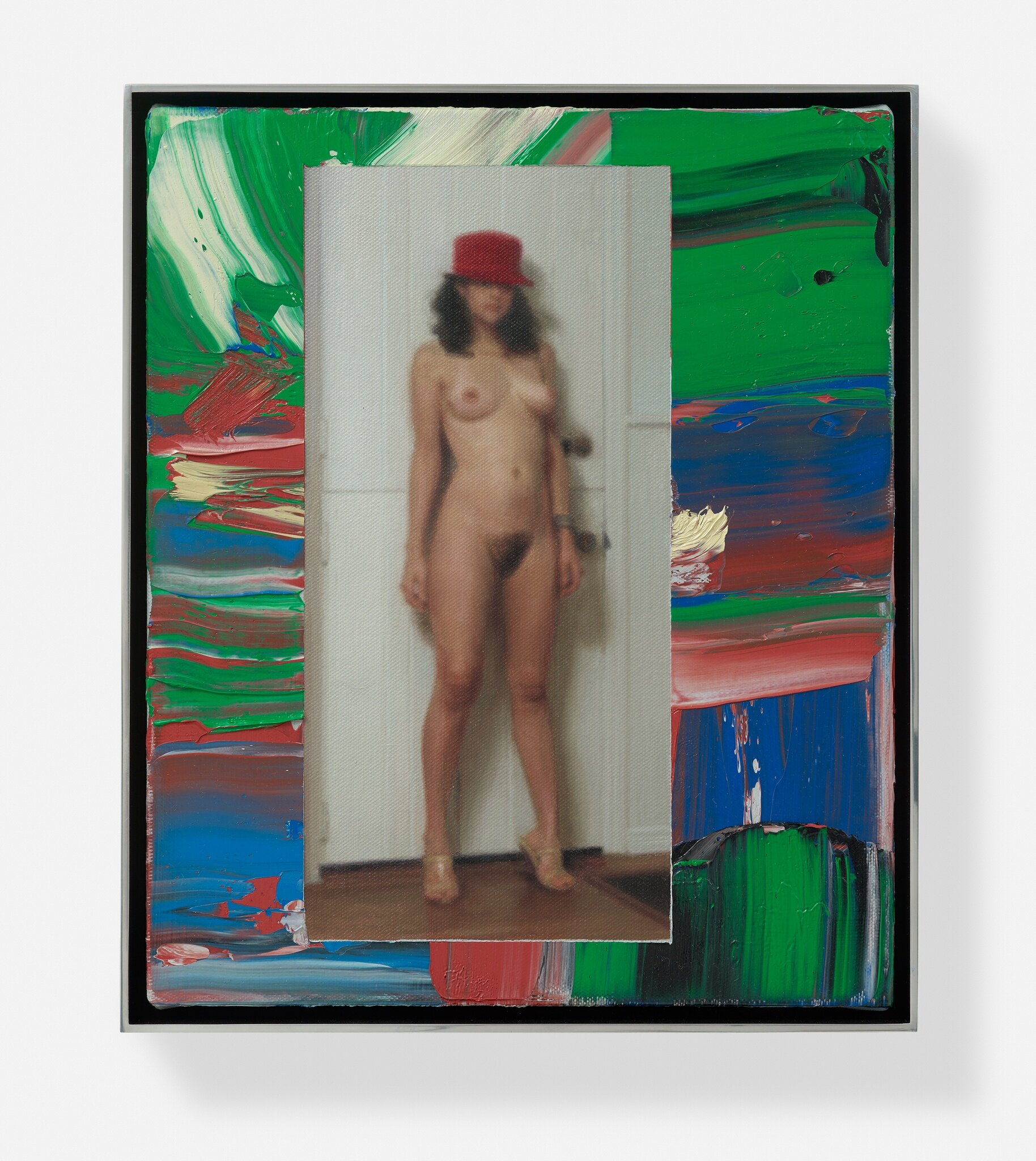
Christina with Dutch Door, 2015
There is a layering aspect in your work that is inherently digital, how does technology influence your work?
I think mostly this comes from being steeped in music early in life. My father had an incredible collection of classical records and music was always in the house. I like the aspect of music that it can have many voices that come together to make a whole but that can still be heard separately. Painting can’t really do this – although cubism tried to achieve this, but it doesn’t mean it’s not always at the forefront of the mind as a paradigm for an ideal painting.
I wish I could banish digital technology from my work process altogether. It’s not how the work came about initially. My work was entirely analogue – the only technology involved was photography. Other than that, it was glue and scissors, paint and canvas, but it was suggestive of the technology that was about to be upon us. Now I use photoshop to compose in, and some of the imagery I use comes off the internet – but digitalization has its issues; it’s an affliction almost. I want my paintings to be of the “wind-down windows” variety, not the “Sat-Nav” screen variety. Eventually, there will be the equivalent of the slow food movement where people learn not to use their computers and throw their i-phones down the garbage disposal unit. Hopefully. More likely we’re destined to have our brains hard-wired to computers.
The problem for me with the digital tech is that it has no natural limits and no natural dynamics. As a tool, it has no character. Many people like its scope and flexibility, but for me, it’s too infinite. Michael Craig-Martin once said to me as a student at Goldsmiths’ “Your problem is, you don’t have a problem”. Nothing is problematic on a computer. It risks being inert, therefore. My student problem of not having a problem is now everyone-who-has-a-computer’s problem. Making a painting has physical limits – drying times of paint, for instance. It’s an organic thing that you have to keep alive while you’re making it.
The paintings that I first showed in London were layered in one of two ways: either I was distorting or covering a small object of figure with globs of paint that changed the objects form as well as its colour, then scaling it up and making it into a large-scale rendering of that object; or it was a collaged image made old-school with scissors and glue. These have their roots in Kurt Schwitters, Rauschenberg, Picabia, Picasso, Braque, late de Chirico, Dieter Roth, and others rather than any new technology.
Your technique has strong classical and traditional elements, what artists and imagery do you find inspiration in?
My parents hung those somewhat expensive reproductions of well-known artworks mounted onto a type of black particle board in their house when I was growing up. I remember them all vividly – a Picasso gouache of his son Paulo as Pierrot leaning on a chair, a Turner riverscape, a Turner seascape, the Renoir Boating Party, a Vlaminck landscape, a Hogarth etching reproduced on a silver plate. Meanwhile, I was at a progressive junior school which elevated art, music, and creative writing to the same levels of importance as maths, history, science, languages, and so on. The school also had similar reproductions dotted around the common areas, Van Gogh sunflowers, a Picasso still life with candle, a Brueghel snowscape. I guess these reproductions had a bigger influence on me than I might have realized at the time. Of the paintings at the school, the Breughel and the Picasso were the most compelling.
Inevitably Richter has been a huge and unavoidable influence.
I’ve always admired de Kooning and his whole position. So many painters have tried to emulate him, but none get close. Then many of the usual greats: Bellini, Vermeer, Velasquez. Picasso, Rembrandt, Caravaggio, Manet, Monet. I like painters that have incredible touch, and/or invention, and/or light and/or psychological presence. When I visit somewhere like the National Gallery, it’s these painters that endure and that I tend to come back to. It’s not that I prefer older paintings, it’s just that contemporary painters can age quite rapidly - they’re not always as great as you thought they were ten years on.
In terms of imagery, I don’t have any imagery that is a particular source of inspiration although I do return to certain subjects. The human form is constantly a source of fascination, although I allude to it as much as I directly paint it.

Solo show, Timothy Taylor Gallery 2014

Solo show, Timothy Taylor Gallery 2014
Tell us a bit about how you spend your day/studio routine? What is your studio like?
My day varies depending on whether I’m mid-painting or not. If I’m mid-painting, I arrive, I may check my emails and then I start painting and probably break every ninety minutes or so. Painting requires a lot of focus. It’s physically very tiring. Some days are standard length working days, some can be much longer since I often need to get to a certain point before I stop so that I can continue easily the next day since I paint wet into wet. Often if my working days are overlong, they slip around the clock, but I’m too old to do this now.
If I’m not mid-painting then it’s less routine. Sometimes I already know what the next painting is going to be and sometimes I don’t. Some of the better things I’ve made, I kind of arrive at them with a degree of chance. I hate being in between paintings.
My studio is a unit in the old railway offices of one of the big Texas-Pacific railroads that ran nearby. It’s a grand building probably dating from about 1900. The studio is quite large and with a high tinned ceiling. I live nearby so I can walk to work. I’m very studio-centric. If I’m not there, I don’t always feel like I know who I am. I feel like my paintings look best in my studio. I’m often horrified to see one in someone else’s house or a gallery or wherever. I feel like I’ve been robbed or like I’ve overstayed my welcome. It feels like a bit of a violation.
The art world has had to adapt the ways in which we show work, allowing us to explore the digital realm to do this. ‘The Eye of The Huntress’ provides an immersive experience as an alternative to visiting an exhibition in real life. How do you feel this affects the way in which people interact with your work?
I think I’ll have to wait and see. Much of my earlier work utilized shifts in scale and deceptive or mysterious image quality. The challenge of the virtual realm is indicating the levels of realness and the nuance of surface. Even online, people mistake some of my paintings for photographs of sculptures. I’m thankful to have an outlet in these difficult times, however. It’s interesting that the virtual space is so neutral. It also allows my work to be seen alongside other artists I might not have shown with otherwise. In Eye of the Huntress, for example, my painting is next to a piece by Jim Lambie, whose work I like a lot. Proximity is a fundamental of context.

‘The Eye of The Huntress’ Online Exhibition 2020
You are part of the YBA, what are the main changes you have noticed in the art world from the time when the group was created compared to now?
A massive question that I’m not sure I can answer except in an obvious way – e.g. far more artists than ever before, more galleries, more collectors, more art fairs, more media coverage, but I’m not sure any of this is actually an advancement. As Richter says, art has become entertainment now. I think there’s been a profound change in our culture since the mid-1990s and the YBA period.
It’s very difficult to say whether art has been directly affected by the cultural changes or whether art was on a separate path of change in any case. I think both are true and not mutually exclusive possibilities. I think we’re in an extended period of mannerism. To me - and this is a massive generalization - art now feels more compromised and inevitably repetitious. It’s far more like fashion now. Partly this is the effect of art fairs, partly it’s because of the art itself. Where people used to question something that was deeply derivative as entirely reactionary or stupid, now the recycling of older or redundant forms is like when flares come back into fashion, or high-waisted 1980s jeans. There is much more acceptance now which might almost feel like indifference.
Timelines and historical sequence seem to be more irrelevant now, in a manner that can make art feel detached from a sense of place. The YBA thing wasn’t exactly a movement, but it was the last and closest thing we’ve had to a movement in recent times where a whole crop of artists emerged together apparently responding to a mood and sequence of events.
Clearly, IT has changed the culture as profoundly as the steam engine did in the industrial revolution. The last 30 years have seen massive change, but it’s a kind of soft change, soft revolutions are taking place all around us in insidious ways.
The art world in London was much smaller back in the 1990s during the YBA time, and yet paradoxically it was probably felt larger in a sense, or certainly more potent because I think it was more cohesive. Access was more limited. If you wanted to seek out the art world you had to be very interested in art otherwise the art world was almost invisible.
Access to the art world is maybe different now because the art world is a different thing. Now you just need an app to get in. It also means you have no commitment to it if you don’t want to. It’s like watching tv and flipping channels. I sense there is less of the energy of small knots of artists and creative people that together make up scenes and subsets. I miss the interaction of how it used to be. At every level, you had to make more of an effort and be more ingenious.
Even though contemporary art is everywhere, it feels more decorative at present – some of its purpose; to communicate and bond people in common spaces where they can collectively experience beauty or calmness has been replaced by technological platforms. Art competes with Instagram now.
On the positive side, art feels more democratic than ever before and it comes from everywhere.

The Birth of Jan, 2013

Dr. Soaper, 2016
Why did you move to America and what are the main differences between being an artist there and in the UK?
I moved to America because that’s where I met my wife, Christina Rees. I’d had a fantasy about living in NY or LA since I was about 15 but I never actually thought I’d end up there. We did live in NY for a few years, but we arrived there barely a few weeks after 9-11 and the city was in a state of shock. Too much snow as well, so we moved to Dallas. Everyone thought I was crazy to do it and some tried to make interventions. Even people in Dallas thought I was crazy to move there. I think Dallas is a quintessential and rapidly growing US city, however, and I think it points the way forward for a lot of America.
In terms of being an artist in London vs Dallas, it’s quite different in one important respect – when asked what my job was in Dallas, and I’d say I’m an artist – they’d say, “That’s great - I love art. What’s your day job?” The concept of the professional artist barely existed here when I first arrived. That’s not true of NY. The perception is that important art comes from the outside and is imported in. When I lived in London and showed in Dallas I had a different status to when I moved here full time. You become what’s called a local artist. No one calls you a local artist if you work in NY, even if you’ve never shown your work. It demonstrates a problematic schism in the aspirations of the society here.
Texas has incredible private and public collections, not such great art schools (although, does anywhere have good schools anymore?)
Every day of my life I feel conspicuously British. A shrink told me once that I needed to adapt. And I thought, oh no, I’m going to have to adopt the accent and wear cowboy boots. As it happens, the Texan accent is the nicest on the ear of all of the American accents. But I can’t say sidewalk and trashcan and so on. Actually, I do say trashcan. No one knows what ‘dust bin’ is here.
One of the main themes around your work is painting itself and questioning it as a medium to perceive reality, could you describe some other themes that are relevant in your practice?
I don’t know if it’s a theme exactly, but there is a sense of displacement. This has probably got stronger since I moved to the US, and it’s to do with finding difficulty in being grounded in the culture here. When I first moved to the US I began to realize that despite the fact we speak the same language and Europeans speak different languages to each other, I often felt more affinity with fellow Europeans. I still feel a sense of estrangement here. I think this has been a constant theme, but it’s hard to say how it plays out in the work. There is, for example, a different understanding of the term “irony” in the two countries.
I like what I like to call half-spaces – which is to say, stuff that is either literally or metaphorically in a type of half-shadow. Sometimes these half-spaces are to do with colliding two things that shouldn’t or can’t exist together physically in the real world. I often juxtapose differing painting languages in order to create a duality.
I like the idea of form as colour – like in my paintings that feature globs of coloured paint. Other themes that have cropped up are an expression of various political or social issues, like materialism as expressed in advertising: desire vs sex vs pornography, vs the erotic; masculinity and its debunking in the Minotaurs: the mother/matriarch/sphinx in the various cheerleaders – the cheerleaders were antithetical muses since the culture of cheerleaders seemed foreign to me and very American (I mostly stopped using them once I arrived in the US); golems in the soldier series. I’ve painted Christina quite a few times.
How do you go about naming your work?
Titles just come to me as I’m working since there are all sorts of narratives swirling around my head. If I don’t have a title before the painting is finished, then I sometimes struggle and just call it whatever it is – like, ‘Minotaur’ or something. Quite often, I’m trying to suggest that the painting’s real subject may not be as literal as it appears on the canvas.
What artwork have you seen recently that has resonated with you?
I haven’t seen any art for ages. I like George Condo’s recent paintings a lot. I’ve been looking again at Richter, Vermeer, and Bellini.
Is there anything else in the pipeline?
An exhibition in Dallas next year.
All images are courtesy of the artist, Eye Of The Huntress and Timothy Taylor
Date of publication: 21/01/21

Holly Herndon & Mat Dryhurst
"AI is just us, in aggregate—it is beautiful and requires rethinking how we arrange life."
"AI is just us, in aggregate—it is beautiful and requires rethinking how we arrange life."
Our interview with Holly Herndon & Mat Dryhurst about The Call, their show at the Serpentine Gallery (ends this Sunday 2nd February).
Interview by Richard Starbuck.
Could you tell us a bit about yourselves and your background? How did you two meet?
We have been married for nearly 20 years and initially met when Holly wrote an email to the label Mat was working for in London, asking why their podcast was so late. We have been living together since the second time we met!
In The Call at the Serpentine Gallery, you present AI as an extension of choral traditions rather than a replacement for human voices. The installation includes detailed relief sculptures, suspended structures, and immersive spatial audio, creating a sense of ritual and collective experience. How do you see this approach contributing to the wider conversation about AI’s role in creativity and social connection?
We are trying to position AI as a monumental collective accomplishment and coordination technology, part of a lineage that goes back to group singing rituals that predate language, and religious protocols that emphasize participation in something greater than the sum of its parts. We feel this is a more interesting framework for approaching the subject and can also be instructive for policy moving forward. AI is just us, in aggregate—it is beautiful and requires rethinking how we arrange life.
AI is becoming more present in artistic practices, sparking discussions about whether it expands creative possibilities or diminishes human authorship. In your work, do you see AI as more of a tool, a collaborator, or something else?
It is both. We intervene in every step of the AI model creation process, from deliberately producing training data, to captioning, and setting the protocol for how to interact with them. As such we see a lot of potential for models, and protocols, to be considered their own medium. The authorship question is complicated, every new technology faces accusations of dehumanization. Many physical artworks in major exhibitions could be understood as detailed prompts sent to fabricators, and most people don’t really know about the 16 writers behind their favourite songs. Our position is to try and be as open and celebratory of the complexities of what it takes to make ambitious art happen, and AI tools offer new capacity to achieve remarkable things. We view things as positive sum.

© Leon Chew, The Call, Holly Herndon and Mat Dryhurst with sub, Serpentine, 2024
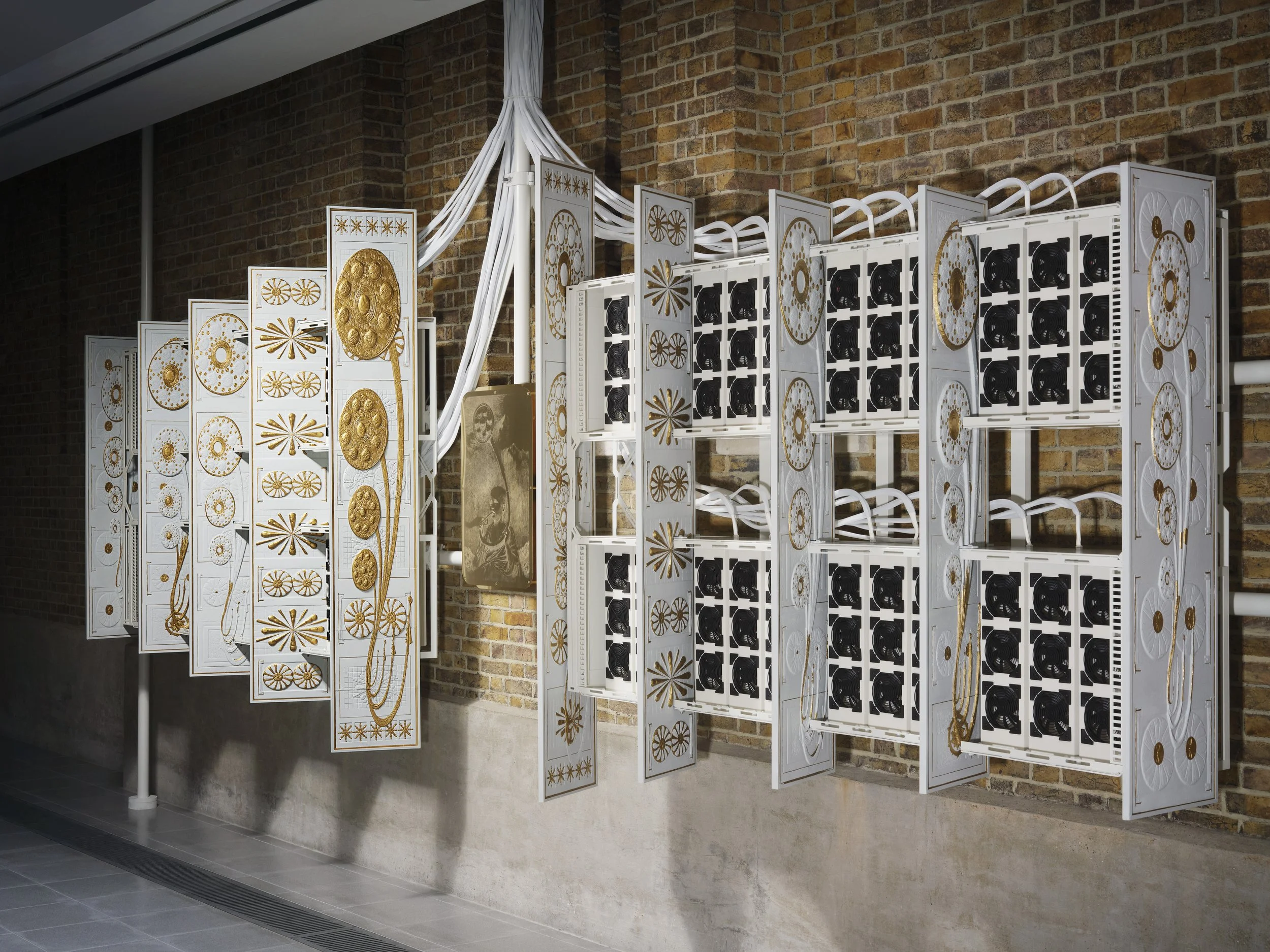
© Leon Chew, The Call, Holly Herndon and Mat Dryhurst with sub, Serpentine, 2024

© Leon Chew, The Call, Holly Herndon and Mat Dryhurst with sub, Serpentine, 2024

© Leon Chew, The Call, Holly Herndon and Mat Dryhurst with sub, Serpentine, 2024

© Leon Chew, The Call, Holly Herndon and Mat Dryhurst with sub, Serpentine, 2024

© Leon Chew, The Call, Holly Herndon and Mat Dryhurst with sub, Serpentine, 2024

Holly Herndon and Mat Dryhurst conducting a recording session with London Contemporary Voices in London, 2024. Courtesy: Foreign Body Productions.

Holly Herndon and Mat Dryhurst conducting a recording session with London Contemporary Voices in London, 2024. Courtesy: Foreign Body Productions.
Sound has always played an important role in rituals, gatherings, and cultural traditions. How do you think about the connection between sound and space in your work, and how does that influence the way people experience it?
We are particularly interested in how religious architecture was often designed to create a sense of contributing to something greater than oneself. Church architects were the original Phil Spector. It has been a great pleasure to work with the architecture studio sub on this show, thinking about how physical space might encourage a spirit of contemplative contribution to the human archive.
Tell us a bit about how you spend your day/studio routine. What is your studio like?
We always have at least five projects going at once, and between art, our tech work, and parenting, we basically share a brain at this point. The week is a blur, yet somehow things still happen. We couldn’t accomplish all that we do without close relationships with brilliant collaborators. Our studio is essentially countless communication channels.
What artwork have you seen recently that has resonated with you?
We recently revisited Mitchell Chan’s The Boys of Summer, which is a beautiful and complex example of communicating a perspective subtly through a video game.
Is there anything new and exciting in the pipeline you would like to tell us about?
With our collaborators at Spawning, we are currently in the process of training Public Diffusion, a foundational text-to-image model trained only on data that nobody owns.
All images courtesy of the artists and Serpentine Gallery
Interview publish date: 27/01/2025
Jim Lambie
“The rhythm of the colours seemed to pulse and move, creating a visual beat through the space.”
“The rhythm of the colours seemed to pulse and move, creating a visual beat through the space.”
Interview by Natalia Gonzalez Martin
Could you tell us a bit about yourself and your background? Where did you study?
I studied at the Glasgow School of Art. Graduated in 1994. I spent my youth and early 20s playing in bands, doing gigs and small tours around Scotland and England. I think the biggest gig we were involved in was supporting Dinosaur Jr. and Primal Scream at London ULU. I had some great times being in a band, but I was never a dedicated musician. I never had the skills or desire to be around the band thing long term. Dropping out of that scene and going to art school was a much better option for me.
What is the impact Glasgow has had on you as an artist?
I think it had a massive initial impact. The music and art scene was and is very strong. Back then I found it very exciting. I had so much energy and desire at that time to be around creative folk. Everything seemed to crossover, artists were also musicians who knew contemporary dancers who were involved in performance and theatre. It was such a broad landscape. Everything, the people, the clubs, and the exhibitions were great social gatherings, fantastic and life-affirming. Everyone seemed to be pulling in the same direction, no one had anything to lose.
We all have had to adapt to new ways of showing work, allowing us to explore the digital realm to do this. The Eye of The Huntress provides an immersive experience as an alternative to visiting an exhibition in real life. How do you feel this affects the way in which people interact with your work?
It is always better to physically experience work of course, however, at this time, the digital realm is an important space to allow folk to keep in touch with some great gallery programs and artists.

“The Eye of The Huntress” Online Exhibition 2020

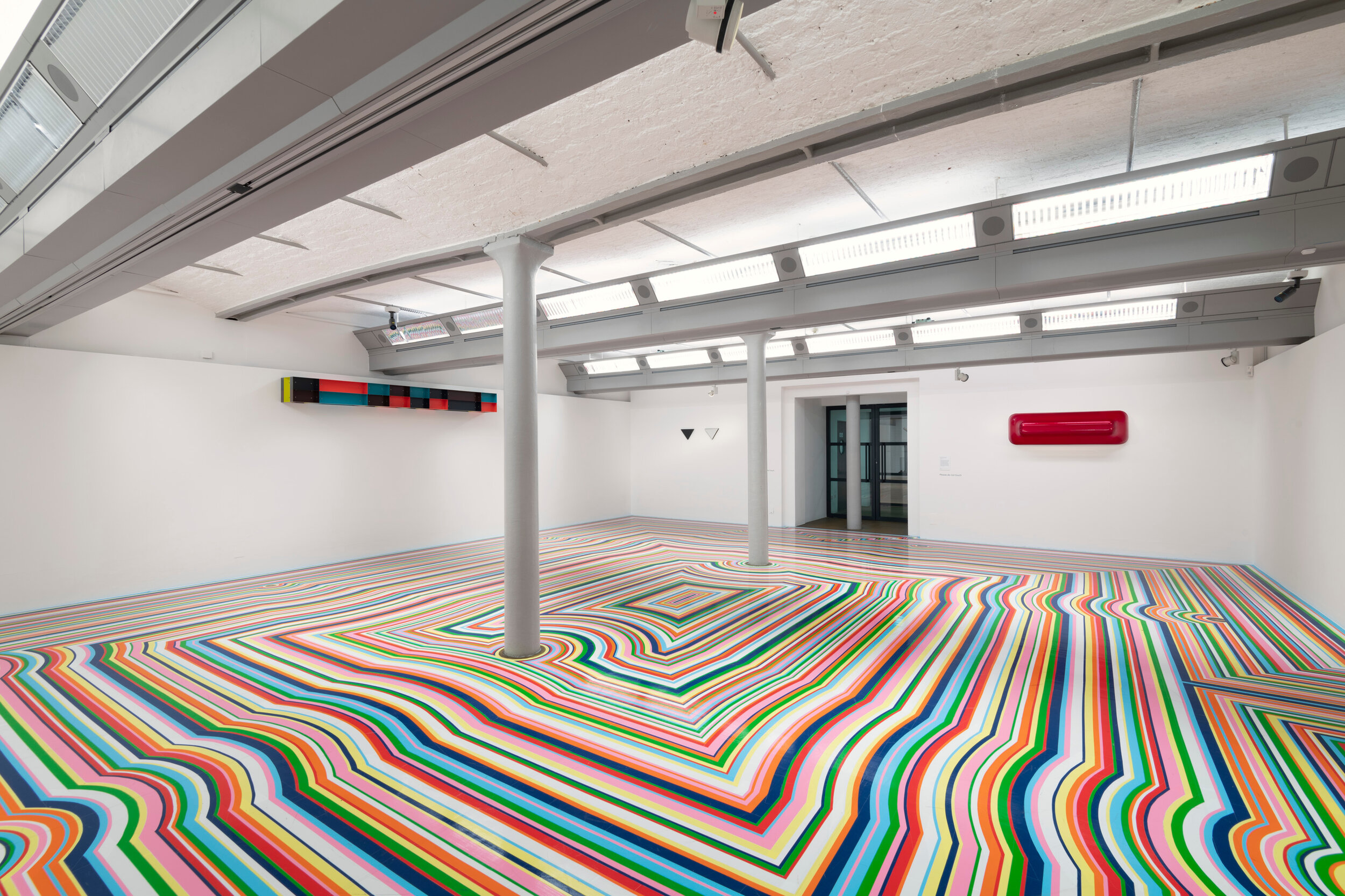
Installation view, The Fruitmarket Gallery, Edinburgh, 2014

Installation view, The Fruitmarket Gallery, Edinburgh, 2014

Installation view, Op Art in Focus, Tate Liverpool
When did this all begin and how did you arrive to develop this work?
I studied in the Environmental Art Department at GSA. Where we were encouraged to explore the surrounding context to help draw out ideas and also investigate material, any materials which may help open discussion within the work. As time went on, the department became more like a conceptual art department whilst maintaining its core value, that context produced a percentage of the work. We didn’t spend much time discussing the ‘quality of paint’ GSA had built its reputation on such notions, so we felt like outsiders. There were only 12 folk in my study year. So the tutoring was very focused. After art school, I spent most of my time working on art installation teams in the more public-funded spaces like Tramway and the Centre for Contemporary Art. I was still making work, smaller sculptures, which resonated a more D.I.Y. approach, using materials to hand. Stuff that you could find in junk shops and flea markets. I found a box of aluminium tape at a car boot sale, which resulted in me making some of my first works using sticky tape. I had also been participating in some smaller group shows in and around Glasgow.
As I mentioned earlier, there wasn’t much of a commercial gallery scene in Glasgow, so we would clear out a room in someone’s house and turn it into a gallery space for a few days, give out invites and have some great openings with lots of folk hanging out together. Around that time I was offered my first solo show at the previously mentioned Transmission Gallery. And that was where I conceived the first-floor work titled ZOBOP. I was working with sticky tape at the time and had been resurfacing household and personal clothing with it. Couple that with consideration of the gallery space itself, the architecture of the space, and how to fill and empty the space at the same time. The floor became the focus. A work which covered the entire space and yet at the same time, leaving it empty. Initially negotiating the edge of the room with a colour and bandwidth of tape, repeating this until the tape met in the middle. The rhythm of the colours seemed to pulse and move, creating a visual beat through the space. It took just over a week to install, the work didn’t just arrive and get presented. It was made in the space, In the run-up to the opening, and you could feel the energy and industry which went into producing it.
Your career has been one of great success, what have been the pivotal moments that have led you where you are today?
In my late teens and early twenties, being around musicians and going to clubs was very influential. Folk around me were generous with their knowledge and putting me onto great music. I was going out a lot and that meant going to some great gigs. I’ve seen so many great bands during those years. Everyone from The Fall to The Jesus and Mary Chain, The Cramps to New Order, And everything else in-between. During this time, some of the great Glasgow bands like Orange Juice, The Pastels, Primal Scream, to name a few, were also heavily influenced by the NYC punk scene. Bands like the New York Dolls, The Ramones, Television, Richard hell, and the Voidoids and the godfathers of all that, The Velvet Underground.
I can’t emphasise just how much influence The Velvet Underground had on Glasgow subculture at that time. I was also heavily into reading about art, and although there wasn’t much of a gallery scene in Glasgow, I would spend my days between junk and record shops, to wandering through the museums. Around this time I discovered a wonderful artist-run space called Transmission Gallery, which had great openings and after-parties. When I went to art school, I began to meet and hang out with such wonderful folk like Jonathan Monk, David Shrigley, Christine Boreland, Eddie Stewart and Stephanie Smith, Martin Boyce, Douglas Gordon. The list goes on. However, the most influential catalyst for me was Toby Webster with whom I shared (with others) a large studio area in the Environmental Department at GSA. When Toby later started The Modern Institute, he introduced me to Sadie Coles, Pauline Daly, and Anton Kern. These galleries have given me great support and guidance throughout the years.

Installation view, NORTHERN SOUL, Sadie Coles HQ, London, 2020

Harlem River Drive, 2020

Sunset Boulevard, 2020

Metal Box, 2019
Tell us a bit about how you spend your day/studio routine? What is your studio like?
I wouldn’t say I have a regular routine. Some weeks can be very disjointed. Exhibitions and projects tend to dictate my pace more than any disciplined routine. The studio is a much calmer working environment than it was 10 years ago. I enjoy it like this now. I have a larger area for producing and viewing works and a smaller studio space for messing around, trying things out, reading, and listening to music. Installation based, your work doesn’t just sit in gallery walls, instead, it takes over spaces completely, from floor to ceiling, quite literally.
You combine your work as a fine artist with music, how do these two modalities affect each other?
So many of my works exist for different reasons and have different starting points which I may be interested in at any given time. Music has played its part, no doubt about that, but possibly more as an orchestration of material and colour. I have never started a work trying to describe music. Music describes itself very well.
How do you go about naming your work?
I enjoy titling work. like using words as another material to hand. Some titles can reference the work directly like ’18 Carrots’ for example. Which was exactly that, 18 carrots, dipped in paint then thrown onto a shelf. Other works, however, may have no direct reference but like material, add another layer for consideration. I have also used city and street names, words and phrases I have read, street graffiti tags, shop livery, and of course, band names and song titles. I find titling work is such a great moment, as it can turn a work on its head, just when you think you know everything about it.
Your work has been categorised as highly accessible for all kinds of audiences, is this something you have always intended to achieve with it?
I wouldn’t know where to start making a work on that basis. My best wish for the work is that it opens up discussion. The more people who feel they have a voice in that discussion the better. Colour can be a great starting point for this, and also familiar objects and materials help ease folk into that discussion. So possibly those two elements help folk find a comfortable entry point when talking about the work.
What artwork have you seen recently that has resonated with you?
MATTHEW MONAHAN, “Notes on the Crowd (Hell or High Water)” 2020. WALTER PRICE, “Trimming #2” 2017-2019. PAULA GARCIA, “Corpa Ruindi” 2015.
Is there anything else in the pipeline?
The Modern Institute (solo show) March 5th, 2021. Mori Museum, Tokyo (group show) May.
A number of shows TBC due to the current situation with the pandemic and travel.
All images are courtesy of the artist and Eye Of The Huntress
Date of publication: 21/01/21
Jules de Balincourt
"I am not sure how the Trump phenomenon will manifest in my work but I do know it is impossible for anyone to negate it and its ability to submerge into our subconscious.."
"I am not sure how the Trump phenomenon will manifest in my work but I do know it is impossible for anyone to negate it and its ability to submerge into our subconscious.."
Could you tell us a bit about yourself and your background. Where did you study?
I was born in Paris France in 1972 and between then and 1980 had brief stints living in different places in Europe from France to Switzerland and Ibiza before permanently settling in Los Angeles in 1980. I spent my childhood following my mother’s impulses to chase love or shelter in different parts of the world, never really settling into one place until 5th and 6th grade, the first two consecutive years I spent in one school. I was constantly adapting to different settings and perpetually experiencing the new kid or outsider experience especially coming to American public school after having had a formative Waldorf school experience in France.
I spent most of my adolescence being a Southern California surf rat and it wasn't until taking classes at SBCC that I rediscovered art and a conviction of that being what I wanted to do. I then proceeded to spend 1995-2000 studying at CCAC majoring in ceramics studying with the legendary Viola Frey and making a side income building (beat legend) Michael McClure’s studio. I then headed east to NYC in 2000 in my little pick-up truck and sleeping bag, some tools, cooking and art supplies and dreams of the big city.

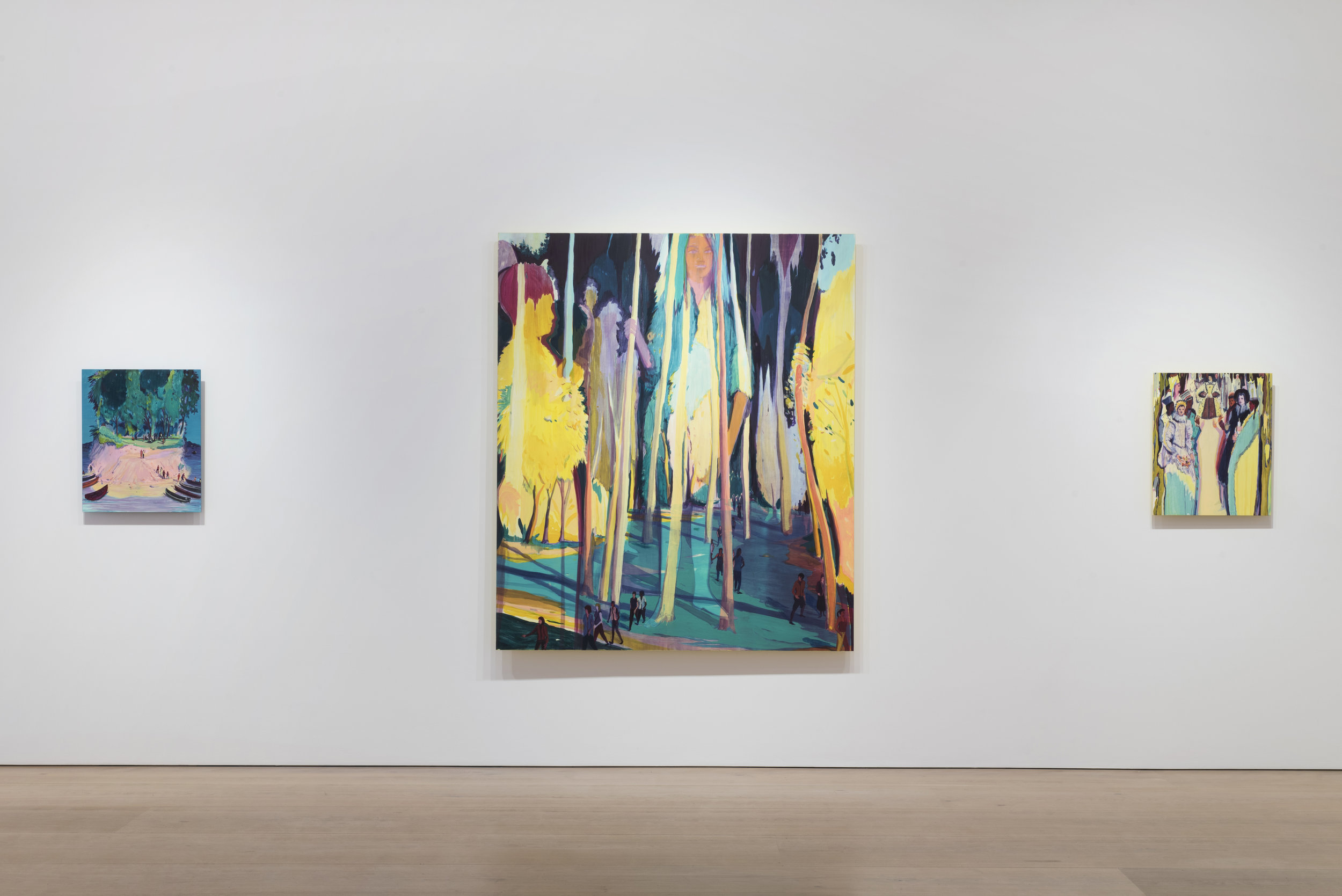
"They Cast Long Shadows " Install shot Victoria Miro Mayfair 2018
You are quoted saying: "Currently, making work and living in America is beyond words, but maybe not beyond images.” With 20 January 2018 being the one year anniversary of Trump’s inauguration, how do you feel being an artist in Trump's America? Has this affected your work?
"They Cast Long Shadows" is in a sense about this binary of opposing forces we are currently witnessing in America. They being either the Trump freaks or the anti-Trump camp because essentially it has become that simplified or divisive now, you are either 100 percent for or against him and there is no middle ground, no negotiating the extremes. Never since the Civil War has America been on such a profound brink of ideological rupture.
Whether its the neo-fascist Trump ideologue or the left fighting for equality, environmental sustainability and all the other causes that are under serious threat, historical moments like these leave big shadows as different ideologies clash for the light. I am not sure how the Trump phenomenon will manifest in my work but I do know it is impossible for anyone to negate it and its ability to submerge into our subconscious and how it manifests will unfold accordingly....either as act of resistant cooperation or complacency. The long shadows symbolize the trails or the remnants, the positive or negative effects of people’s actions or beliefs.

"They Cast Long Shadows " Install shot Victoria Miro Mayfair 2018
"Cave Country", 2017
"If Queens Ruled", 2017
Tell us a bit about how you spend your day/studio routine? What is your studio like?
Studio routine is not so routine – it has in past either been nocturnal or from 10-6 but there is no real schedule aside from a day or two with my studio manager in the office and one studio helper. For the most part I have kept it a small operation, still making my own paintings but facilitated by my two wonderful assistants. I like the idea of still being able to maintain a nomadic transient element. I think routine as an artist can kill creativity, one still needs to explore, wander, delve into the unknown, be surprised and awed. I sometimes attribute this to my first ten years living out of a suitcase but nonetheless I know it fuels me to travel and discover alternative realities. In that sense part of my routine is occasionally traveling, most of which at the moment is based in Costa Rica where I am currently building a studio and small residency to invite friends, artists, dreamers, whoever it may be that is seeking escape to come and visit. I spent so much time painting these Edenic spaces of escape, now I am going to seek and live it.
How do you begin a painting? I hear you don’t use images as a reference, could you tell us more about this?
This is true I very rarely begin with an initial image, since my work is essentially representation/narratively based. I prefer to begin the painting from a purely abstract intuitive process strictly based on color and form delving into a subconscious process before eventually finding, or "mining out" in a sense, the figurative elements. I like this process of seeking or searching through painting and layering of color in order to construct a narrative based both in primitive abstract space as well as a logical narrative painting space and how these two states of mind can cohabit.
"Troubled Eden", 2017
"Big Little Monsters", 2017
How do you go about naming your work?
That process is as intuitive as my process of working. Sometimes the titles precede the painting and then a painting is made in relationship to the title. Other times the title surfaces when a work is near completion. Very rarely some pieces take up to a year to title.
Is there anything new and exciting in the pipeline you would like to tell us about?
I am working on building my jungle art studio residence in Costa Rica and preparing a solo exhibition this October in Copenhagen at Galerie Bo Bjerggaard, in addition to participating in several group exhibitions that are in the works.
Jules de Balincourt, They Cast Long Shadows at Victoria Miro Mayfair, until 24 March 2o18
www.victoria-miro.com
All images courtesy of the artist and Victoria Miro Gallery
Interview publish date: 15/02/2018