James Capper
"MOST PEOPLE LOOK INTO MY STUDIO AND CONSIDER IT A WELDING OR FABRICATION WORKSHOP"
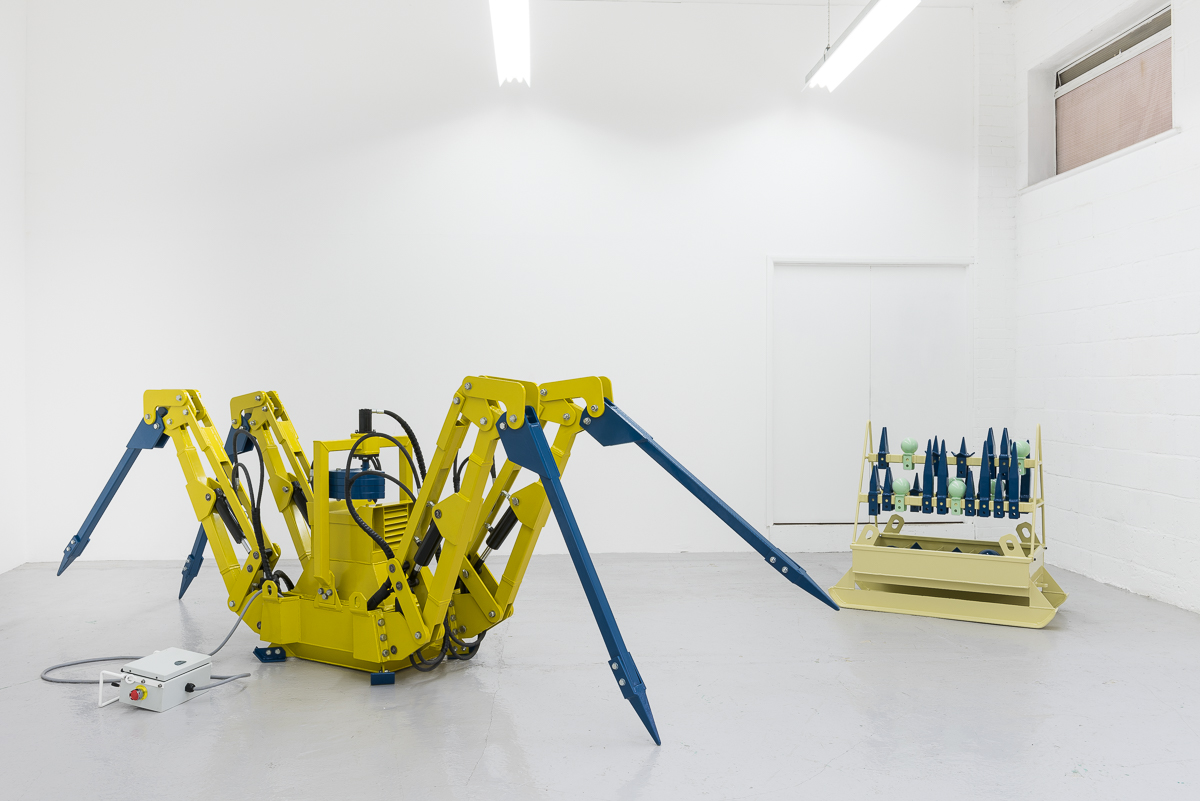
As these mechanical sculptures walk they scarify the earth, leaving marks/footprints. Would you say that your work addresses mark making as well as performance and sculpture?
Its important to point out that the EARTH MARKING DIVISION is an evolving experiment in the radical methods of walking locomotion in mobile hydraulic systems and therefore one element of the expansion of mobile sculpture. Of course these mobile sculptures leave marks in their path which along with the process of mark making is fundamentally important in progressing the evolution of future works.
However, after the fabrication of a new work is complete, it is the extensive testing and subsequent understanding of the full scope or capacity of the sculpture for carrying out its intended purpose (in the case of sculptures in this Division, mark marking) after it is fabricated that concerns me, rather than the particular documentation or preservation of the marks themselves.
That's why the documentary medium that suits me best is film-making: documentation of the marks left by for instance the RIPPER TEETH can be seen in the film RIPPER TEETH IN ACTION, a public project commissioned in 2011 by Modern Art Oxford.
Following the testing phase, ongoing demonstrations of the sculpture in action is an important part of the work. They allow the viewer to survey the sculptures fully operational in an environment - whether this be a gallery space or area of land or particular terrain. In the process of these field demonstrations I am constantly undertaking vital research and gathering new understandings of the mobile process and capacity.
It is important to understand that my mobile sculpture works are not robots - each hydraulic cylinder / motor is operated by a joystick or lever valve. Because of their mechanical uniqueness I tend to be the sole operator.
Could you tell us a bit about yourself. How long have you been a practicing artist and where did you study?
Lots of people have asked me if I studied engineering, I went and studied sculpture at Chelsea School of Art and graduated from the RCA in 2010. I was taught welding, steel fabrication, hydraulic, electric and mechanical engineering by the many characters I worked with on jobs with before art school - on farms and in mechanics workshops close to home in Kent.
What do you hope the viewer gains/reacts from looking at your work?
I hope to think they consider there is still room for innovation in the language of sculpture, that skill-based practice still exists and that the sculptor produces an unregulated number of raw ideas that are made manifest in the works.
EARTH MARKING EXPEDITION, Hannah Barry Gallery, 2016
Could you tell us about the process of making these machines, from the drawings to the actual engineering and assembly?
Drawing is the one area in the practice that doesn't have any restrictions. It's an enjoyable part of the work, recovering raw ideas and making them a reality on paper. Engineering is often seen as a rigid subject where there may only be a limited number of methods to solve a problem. Involving engineering with sculpture makes an interesting and very creative method of problem solving.
Most people look into my studio and consider it a welding or fabrication workshop. The tools and equipment I use to make the sculpture is all industrial, which I bought second hand, but it makes a massive difference to have well-made tools. For many years I just slaved away with equipment that would pack in right when you would need it most. Now for example I have a machine called an ironworker that can shear and punch holes through 15mm steel plate!
Using this equipment in the studio allows me to produce my sculptures independently of any steel fabricators or technicians. The engineering techniques in welding and hydraulics are only known to a handful of fabricators so for me it is much better that I can build my own work.
Next to my studio is a powder coating factory. Powder coating is a fantastic method of painting block colour on large surface areas of mild steel through a baking process. When the sculptures come out of the oven I often feel they were made by someone else due to the slick colour finish!
Could you tell us about the names of these machines?
A name is usually based on the sculpture's anatomy, I sometimes get words stuck in my head, sometimes they are humorous combinations and often they reference the organic world - insects, birds, etc.
Tell us a bit about how you spend your day/studio routine, what is your studio like?
I have over the years adopted the working day of a tradesman or building contractor, only because my studios have always been situated around light industrial sites in London! I started this morning, with finishing the sanding of a small maquette that will be powder coated this afternoon. I like having interactions with all sorts of different people, from the powder coaters, welders to the gallery and artists in the area. The studio allows all these people to cross paths - it's more than just a roof and walls. The studio is also a fabrication workshop, that's constantly changing depending on what's getting built. I often imagine it being a ship I have to sail through good and bad seas!
EARTH MARKING EXPEDITION, Hannah Barry Gallery, 2016
What artwork have you seen recently that has resonated with you?
I was in New York recently and saw a fantastic show at Paul Kasmin Gallery, IMPASSE RONSIN, it's about how a major group of sculptors and artists who all worked in studios in the same small Parisian alleyway, Jean Tinguely and Constantin Brancusi works were fantastic and a reminder of my early interests in sculpture. At the very back of the gallery there was a separated room that recreated the sculptor Isamu Noguchi's studio, this for me was fascinating seeing the tools that he used to produce his sculptures..
What does the future hold for you as an artist? Is there anything new and exciting in the pipeline you would like to tell us about?
I have a lot of projects on which is exciting - one that involves a sculpture to skiing down a mountain in the Swiss Alps! Another with Edward Campbell that involves two sculptures being filmed in a very remote area of New South Wales in Australia. Another is a project in Mexico at the studio of the artist Bosco Sodi. I'm constantly trying to convince various people I work with to help build my walking ship, it's a step by step project that has colossal implications! I am also in the middle of MOUNTAINEER an ongoing piece of research into a mobile sculpture that can climb mountains using its four telescopic legs - I just returned from its second testing phase in Wassick, Upstate New York!
James Capper's work is currently on show at the Hannah Barry Gallery (London) alongside the painter Shaun McDowell, open till the 30th November.
Publish date: 25/11/16
All image courtesy of Hannah Barry Gallery
Shaun McDowell
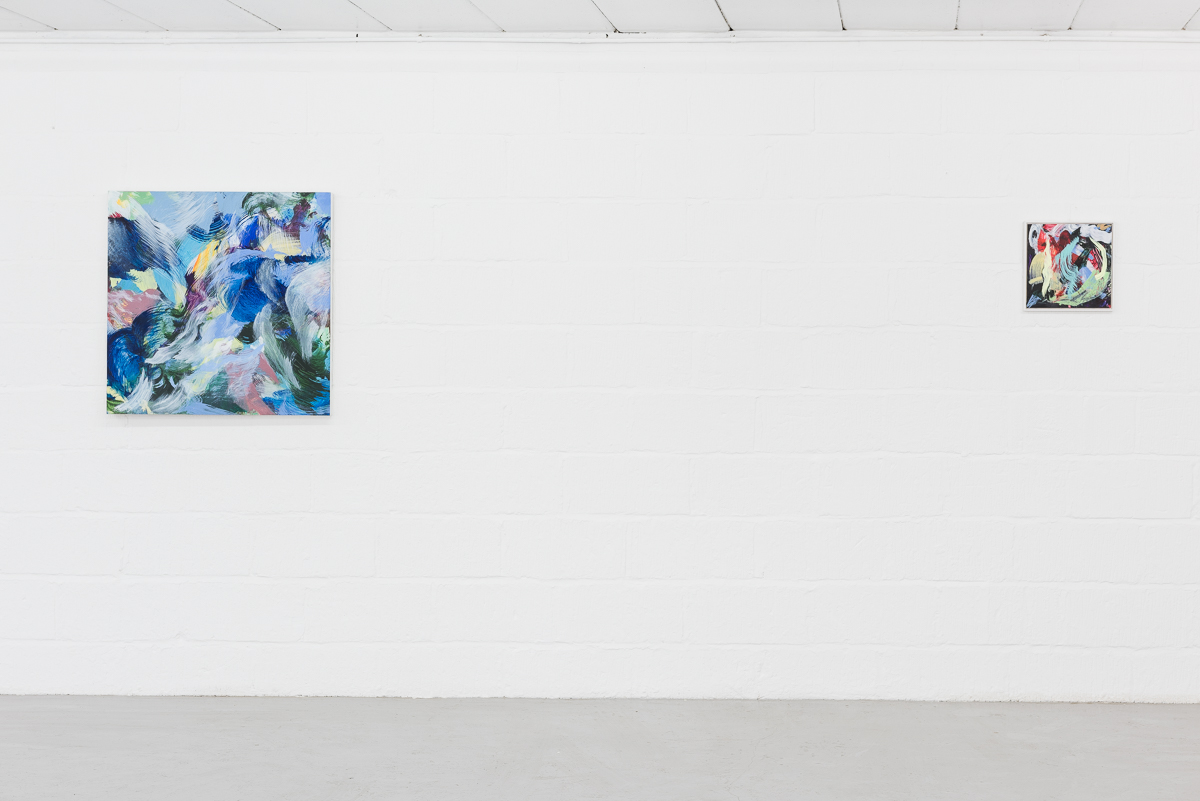
"Perhaps the studio is silent, other times classical music sounds out as I get lost and, sometimes, found in passages of paint"
Your paintings are a confetti of colour, beautifully complex with an abundance of movement. Would you describe your process of applying paint akin to dance or music?
Oh thank you. Layering independent marks to create a “whole” could be compared with structures of music. At times I’m obsessed with bassoon or recorder concertos by Vivaldi. I like “allegro ma non troppo” from Dvorak’s 8th symphony, it starts off regal and with pretence of respect but struggles to hold back the excitement of conquest and tyranny, much like capitalism
Could you tell us a bit about yourself. How long have you been a practicing artist and where did you study?
I studied at Reigate School of Art and Design then BA Fine Art New Media at Chelsea, I began exhibiting soon after graduating.
Navigator – new paintings from the studio in Redhill, Hannah Barry Gallery (upstairs), 2016
Both you and James Capper currently have a two person show at Hannah Barry Gallery, could you tell us about the show and how you, James and Hannah met?
I met Hannah at Chelsea Space in 2006, after that we would spend time with other artists at Lyndhurst Way where we worked on a program of exhibitions. That period was particularly exciting. Peckham was cheap/free for us to live or squat in and as we strove to create something together the sense of commitment and potential was strong. Before our first exhibition at Lyndhurst Way I was walking through Chelsea College looking for artists to include and saw some kind of wheeled base that was clearly made to support another structure. I could tell that the artist understood their craft and more importantly, I liked what they were doing with it. I asked who had made the work then left a note for James Capper asking him to contact me. The Hannah Barry gallery evolved out of Lyndhurst Way and over the years myself, James and Hannah have enjoyed camaraderie with the other artists. We come from different backgrounds and our practices are very different... but that’s exciting, the current shows are a good juxtaposition.
The work is very expressive, would you say you are somewhat of a romantic?
Sure on this shining night
Of star made shadows round,
Kindness must watch for me
This side the ground.
The late year lies down the north.
All is healed, all is health.
High summer holds the earth.
Hearts all whole.
Sure on this shining night I weep for wonder wand'ring far
alone
Of shadows on the stars.
- James Agee
Navigator – new paintings from the studio in Redhill, Hannah Barry Gallery (upstairs), 2016
Tell us a bit about how you spend your day/studio routine, what is your studio like?
My studio in Redhill is very large but it’s very full. I have many panels which I work on at the same time. Perhaps the studio is silent, other times classical music sounds out as I get lost and, sometimes, found in passages of paint.
What artwork have you seen recently that has resonated with you?
Triton by J.A. Harkins, nice object.
What do you hope the viewer gains/reacts from looking at your work?
Maybe the viewer will understand their ownership of a work of art, maybe not.
What does the future hold for you as an artist? Is there anything new and exciting in the pipeline you would like to tell us about?
I hope to be making new works while travelling in 2017. My next solo show opens 12th January at Titanic Belfast. Belfast is full of potential.
Shaun's work is currently on show at the Hannah Barry Gallery, alongside sculpture James Capper. Ends 30th November.
Publish date: 25/11/16
All images courtesy of Hannah Barry Gallery
Andrew Salgado
"THE SUBJECTS HERE RAISE QUESTIONS: THEY ARE BLACK, TRANS, WOMEN, GAYS. IT'S ALL MY FREAKS AND GEEKS JAMMING OUT TOGETHER."
Could you tell us a bit about yourself. How long have you been a practicing artist and where did you study?
I tend to run the opposite direction from this question because the more I answer it, I fear the more pedestrian the answer becomes. I'm 33, a Canadian born and raised, half-Mexican artist who has lived in London for almost 10 years. I studied at Chelsea College of art and they told me to stop painting, strip my clothes off, and make videos. I think every decent artist goes through that naked-performance art stage. I've been working "professionally" (I hate this terminology) for ten years. We are releasing my first monograph, appropriately titled TEN, and its this spectacular 300 page archive of my work. There are various texts and a section at the back with macro details. Shameless plug warning: you can purchase it now off my website.
Your more recent work pushes the figure towards the background, adding shapes and marks on top, almost like you are trying to erase or cover up the original painting. Could you tell us about this change in direction?
I think I have a certain encroaching desire to run from my figurative foundation. Or at least pull the wool over its proverbial eyes. Yes the new works have a...sort of... need to push the figure into some other terrain. For some time I've felt unsatisfied as a conventional figurative artist. I mean, god forbid I get the dreaded 'portrait artist' label. The works want to explore new areas but I still have some perplexing, almost debilitating need to include the figure. Is that my strength or my weakness? I dont know. I think a painting like Echo Chamber, for instance, treats the figure like an abstract landscape. There are psychological explorations happening that are more important than the accuracy of the figure. For me, a piece like Orlando is a glowing success. I don't say that often. But when psychology and message and technique all tend to unravel into an ugly little pile on the floor, I've succeeded.
Orlando, 2016
Echo Chamber, 2016
Is there a biographical narrative to your work?
There was. I mean...the impetus for all my work - well, for my whole career, really - has been the 2008 hate-crime assault. So since then the work has kind of inhabited this political bent. I'm not going to tell you that I'm trying to change the world, but I'm decidedly vocal about my work, its LGBT background, and its message. The entire Snake exhibition (opening Nov 11 at Beers London) is based on on the Orlando massacre: the single largest mass murder in US history and effectively the largest hate-crime ever. That says something about where we are as people and as a society. I would wake up each morning to horrific hate-related crimes happening all over the world - to Jews, Syrians, gays, women, blacks, and on and on and on. I had no choice but to respond to how it made me feel. I don't believe in prejudice; I can't stand for hatred on any level. Suddenly, we have Brexit, and the looming threat of Trump - the world's most powerful bigot since Hitler. I met a new subject named Bari and he was a young Muslim raised gay boy and everything clicked: the resulting painting is included in this show and its called Lets Start a War. I had to talk about these things. I was compelled to talk about hatred. I've done this topic before, 2012's The Misanthrope, et cetera. But now it was turned outward. Is that autobiographical? I guess it is, inasmuch as universal misanthropy affects us all. The subjects here raise questions: they are black, trans, women, gays. Its all my freaks and geeks jamming out together.
What do you hope the viewer gains/reacts from looking at your work?
I like to create a complicated relationship with the viewer. I don't want the works to be easy to consume. I want them to be challenging. If I didn't, I wouldn't grow as an artist. And I think my work has had significant and substantial growth since I started gaining a bit of attention. Ideally, the viewer leaves feeling challenged. Maybe even a bit confused. I remember the first time I saw Peter Doig's work in person and the sheer texture and dimensionality of the paintings forced me to reconsider them in a way I previously hadn't (while looking at works in books or on a computer screen). I want the viewer to ask the pertinent questions. Lets bring kids into the show and have them ask their parents about acceptance. I'm not pretending to be some sort of social justice crusader; I just feel strongly about these things. Plus I want people to be a bit scared by the work. The gallery is being transformed: we've carpeted the floor with grass and painted the walls and ceiling dark green. The lights are dim...its an experience. I want it to be meditative, seductive, almost dangerous. I want the viewer to lose themselves in this poetic space and really think about what it is they're seeing. I think the works are a bit wacky this time around.
The Festival in Hell, 2016
What artwork have you seen recently that has resonated with you?
I buy lots of art. I recently bought a Peter Matthews drawing. I love Tal R. There was a piece at Artissima that I wanted to buy but I didn't have 78,000Euro kicking around. Bummer. I've been looking at some Peter Linde Busk and Gauguin. Sverre Bjertnes is a total dude and he's opening next year at Beers, which is amazing to think I share a gallery with someone I respect so profoundly.
Tell us a bit about how you spend your day/studio routine? What is your studio like?
I work all the time. Its where I belong. My studio is in London Fields and its nearly 1,000 sq feet. I'm quite fortunate. But I believe as artists we need to have highly functional creative spaces. My studio is always a mess. I have pet mice.
The Snake, installation shot, Beers London, 2016
How do you go about naming your work?
I used to name them really simply and didactically. That itself was a response to these longwinded sort of wanky titles we use as young wanky artists. So titles were like, suggestive and basic. Subject, Cinema, Prussian Blue, Scheveningen Grey, Hommage, Notes, Birdy, The Joke. Blah blah blah. The new works are a little more telling: Chrysalis (Portrait of a Girl) is a painting of a trans friend. I've stuck butterflies onto the painting which might be a bit naff but it made sense to me at the time. Warmask; Afterlife; Lazarus (In the Temple of Giotto). I dunno, working titles stick. let people think what they want to think. I'm not here to tell you what a painting is about. You're entitled to take your own reading so long as you're not an asshole and your reading is against what I stand for as a human being. haha. I'm trying to come up with a title for my forthcoming exhibition in Croatia but Kurt (Beers, from Beers London) doesn't want me to call it Contemporary Pleasure Island Time Waster.
What does the future hold for you as an artist? Is there anything new and exciting in the pipeline you would like to tell us about?
This January the Gallery of the Canadian High Commission in Trafalgar Square in London is hosting a survey exhibition to coincide with the launch of my monograph, both titled TEN. It is curated by David Liss, curator of the Museum of Contemporary Art in Toronto. That's really exciting for me. The works range from 2006-2016. Well if I get my way, Contemporary Pleasure Island Time Waster will open middle of May at Lauba Contemporary Art Institute in Zagreb Croatia; I've invited artist Rhys Lee to make new sculpture to accompany my paintings and we are doing an install that is going to blow people's minds. Lauba is enormous and my mind runs amok with the possibilities. My first show back in my native Canada, Back to the Country, will open October 13 at Angell Gallery in Toronto, Canada. Jamie Angell has been around for 20 years and he's a veritable legend on the Canadian art scene. I'm planning something sensational for an art fair in NYC in 2018 that will be a really next level install.
You can see Salgado's solo show "The Snake" at BEERS London, ends 17th December.
Publish date: 25/11/16
All images courtesy of Beers London and Andrew Salgado