Steven Lowe/Harry Adams/L-13
"The plus side of this collaborative approach is that you’ve always got someone to remind you that you’re not a fucking genius."
Harry Adams is the pseudonym used to present the collaborative paintings of artists Steve Lowe and Adam Wood. Steven Lowe is also the founder of L-13 Light Industrial Workshop, working with artists like Billy Childish, Neal Jones and Jimmy Cauty.
Could you talk about the beginnings of L-13 Light Industrial Workshop, what is L-13? Is it something you have always wanted to do?
I can’t say that running L-13 is something I’ve always wanted to do as that would imply some kind of forethought or plan. I guess it has evolved out of me always trying to find ways of doing the things I do want to do. That also involves doing things I’m not so keen on such as working with artists, dealing with the mechanics of running a business and other such unpleasant things.
It all happened because I’ve always been proactively creative and am someone who always needs to be busy. I drew and painted as a kid, went to art school, dropped out a month before the finishing an MA stating ‘I hated all art, artists and anyone involved in art’ as my reason. Then I was in bands for years, dealt in rare books (with a focus on counter-culture and radical literature) to earn money, ended up with a shop in Euston that I turned into what could be described as a ‘gallery’ on the eve of the war with Iraq.
I never wanted to run a gallery though and never called it one. Back then we were known as the aquarium & I would correct people if they called it the aquarium gallery. I still claimed to hate art and had an idea there was something tainted about a regular gallery – something I’d be embarrassed to be associated with. So I wanted to skirt the orthodox role as a gallerist and do something with a bit more flavour & involved - a space where creativity happened rather than one that just displayed and sold it. I still had no real desire to reconnect with the art world; it was more a matter of me pursuing things I was interested in. Our first show was called The SI and After: What is Living and What is Dead in the Situationist International’, and for that I made a limited edition artists book. Something I hadn’t done since art school. Then we did a show with Billy Childish. I was familiar with his writing and music, but had never seen any of his paintings. For me that was by the by… I just wasn’t interested in them, but I was interested in Billy’s position in the margins of culture, ploughing his own furrow so to speak. That’s what I admired. For his first show we made a record, a chapbook of poetry, a series of little prints and a box set made out of a painting with all the things we’d published sealed in the back.
Neal Jones:'I am Not Painting' L-13 Light Industrial Workshop, London 2012
'Storm of Defence: What is Art Hate and Other Cuntish Questions' 2011
Billy Childish, Neuer Aachener Kunstverein Gallery, 2014
Billy Childish: Edge of the Forest, Lehmann Maupin, Hong Kong 2014
We just hit it off in terms of making and doing things + we also managed to make a bit of money, which was a bit of a surprise to us all. So that kind of kicked things off in terms of the nature of what I wanted to do & we’ve just never let up on it since. Following Billy’s first show we then did an exhibition of art against war in aid of the Stop The War Coalition. Jimmy Cauty and Jamie Reid lent us work for that & I ended up doing print projects and exhibitions with them, so that sealed the deal. At that point I decided that rather than take on more and more artists I’d just focus on these 3 to facilitate what they did and work with them in a surreptitiously collaborative way. When I was at art school I worked for Matts Gallery occasionally and I always admired Robin Klassnik's collaborative approach with the artists he showed so I thought I’d try something similar but on a completely different level. I worked with a few other artists along the way, but Billy, Jamie and Jimmy always remained the defining trio. At the time someone told me they thought the choice to bring them together was genius, but I didn’t know what they were talking about. I seemed to just fall into place without anyone really making any decisions. By the end of 2005 we’d outgrown the small shop near Euston and we moved to a much bigger space on Farringdon Road to a building that had been bombed by a Zeppelin in 1915.
Billy did some research on this and found that the airship that bombed us was Zeppelin L-13, which was like some glorious gift to us, so we became THE AQUARIUM L-13. That lasted a couple of years, but as we became more successful I began to really dislike running the business… it was just too full on all the time and I felt we were having to do things to keep everything running rather than doing them because we wanted to. I’d also started making art again in collaboration with my old friend Adam (first as STOT21stCplanB then when we got seriously into painting as Harry Adams) and just thought something drastic had to happen to shake things up.
So I decided to close everything down for a major rethink and the rethink ended up with us downscaling and moving just around the corner to our basement HQ to start again as the L-13 Light Industrial Workshop and Private Ladies and Gentlemen’s Club for Art Leisure and the Disruptive Betterment of Culture. I came up with the name first and thought with a name like that everything else would just fall into place. And it did! The closing down and moving and change of name confused a lot of people and probably wasn’t good for business, but it put a spring back into my step.
Pete Bennet: Pigeons in a Topiary Cut Bush, L-13 Light Industrial Workshop, London 2012
Harry Adams: A Short History of Our Progress Part 3, L-13 Light Industrial Workshop, London 2012
What does L-13 mean to you now? How has it changed over the last couple of years?
L-13 is my home from home. It’s the Harry Adams studio and HQ for the artists I still work with – primarily Billy and more recently with Jimmy again. We stopped doing exhibitions in 2013 but still make lots of editions and facilitate the needs of the artists in a very proactive way. The biggest change has been me trying to give time to my own practice, but I still spend a lot of time on Billy and Jimmy business. I’d describe them both as full time jobs. The other big change has been what Billy describes as his ‘overnight success’. In 2010 neugerriemschneider, a big gallery in Berlin, took him on and through that now has a gallery in New York – Lehmann Maupin, and Carl Freedman here in London.
That means I don’t have to worry about selling his paintings any more, something I didn’t enjoy and wasn’t good at anyway. But I do now get to help curate his shows and tend to travel with him when he has exhibitions. It’s an odd relationship, because even though we both have towering egos, mine works in a different way from his and we have a good, productive and friendly working relationship. It means I have to rub up with the mainstream Art World quite a bit, but I’m more mature now and am more at ease with my conflicts. Billy’s the same… we don’t expect anything from it, so it’s easy. I think I’m considered a necessary & useful sidekick by the galleries but like to made it clear early on that I’m not his “assistant”. My joke is that Billy works for me & not me for him. My other joke is that he’s merely a projection of my own creative being… with the emphasis on the merely. We have a lot of fun at L-13… we’re all irreverent and there’s always lots of laughter.
Harry Adams studio, L-13 Light Industrial Workshop, 2016
Yourself and Adam Wood collaborate to make paintings under the name Harry Adams, could you tell us how this partnership started? What are the obstacles and benefits with this method of working? For instance: who lands the first paint stroke?
Adam and me were at art school together. Adam tried to get a college band together and I turned up with a 4 stringed beaten up guitar and made an awful racket whilst the other were trying to do more regular songs. Within a couple of weeks Adam had joined me in the noise making and the others left. So our first collaborations were doing ‘noise performances’ that I described as like Einsturzende Neubauten without the tunes. It was quite extreme but our aim was to always to create intense sonic experiences of great beauty. We’d get into college really early to practice before anyone else turned up, but still managed to piss so many people off. After that we were in more regular bands, the last one of which was called STOT21stCplanB. This was our zero ambition band where we didn’t play gigs and would only release CDRs through the aquarium. This is also how we started making visual art again – we’d made an LP ‘Satan’s Rat Trap and the Mouse that Wound Up Dead’ and as we were releasing it as an aquarium Ltd Edition we decided to have a launch and make an exhibition around it. So we turned the space into our art lab and made a whole exhibition's worth of work on-site in 5 days. It was all a bit shit, but that suited us fine.
We then continued making work as STOT21stCplanB, described by a magazine at the time as “ranging from sublime genius to unmitigated shit”. We’d always say “you work out which is which”. This was all pretty easy and fun but very adolescent, so at some point we decided we should grow up and take up painting to cure ourselves. So we then needed a painters name and settled on Harry Adams as it sounded good & solid and also began with A so if we were in any group shows we’d be at the top of the list. And so in 2007 we began to learn to paint again. I’d gone to art college as a painter, but whilst there discovered I didn’t like other painters… generally too rarified and bourgeois for my angry young man act at the time, so I stopped that first… then found out I didn’t like any other artists either. But through working with Billy I learnt that I didn’t need to worry about that and that painting, with all its faults manifested and amplified in the art world, was still probably the most difficult and rewarding of the art forms… and we wanted some of that.
The weird thing is that it never even occurred to us that we should paint separately. We’d been working together for so long we just assumed we’d continue with the paintings. In that way the collaboration isn’t a construct or a gimmick.
It’s perfectly natural. We don’t have any rules of engagement other than that we decide to present our work under one name. I always describe it as like having two singer songwriters in a band. Adam & me are like the Lennon/McCartney of the painting world. Sometimes we’ll both work on the same painting, rarely at the same time unless it’s big, and sometimes it’s all one person's work.
But there’s lots of discussion around what we do and have a tag team style process, where we respond to or even try to copy something the other has done. If it works out it’s a Harry Adams. If not it goes in the recycling pile. Our egos are also very compatible for this with neither of us being too precious about what we do. We don’t mind ruining each others work or having our efforts ruined or improved by the other. The plus side of this collaborative approach is that you’ve always got someone to remind you that you’re not a fucking genius. I can’t think of a downside, other than I have to put up with Adam and he has to put up with me.
Harry Adams, Weed at the Foot of the Wall
Imperfect Constructions: God and the Forbidden Fruit Tree (circa 1280)
Harry Adams, Sound Mirrors
Harry Adams paintings often depict flowers and garden landscapes, are you both a romantic at heart?
We haven’t done too many flowers and the garden paintings are based on a Roman fresco from 20BC & not our most “romantic” work, but we do make lots of English landscapes featuring oak trees and most of our work has a kind of apocalyptic feel to it which is ultimately in the tradition of Romantic Painting. So yes, we’re quite romantic at heart - I think you have to be to be a painter in this day and age - but we’re not fooled by the romance or any kind of romantic vision. We’re too aware of the constructs and fallacies of art to con ourselves or anyone else. In this way we’re interested in the history, culture and codes of painting & making use of the various identifying traditions, trying to find the sublime points of tension between our concerns and interests & how they may be perceived or identified. It’s all construction and deconstruction… trying to discover what a good painting might look like through a variety of subjects and to see how all the themes could be linked. It’s tricky stuff – a balancing act made difficult because the centre of gravity is constantly shifting. To an untrained eye it may look chaotic, but it’s really a highly controlled poetic outpouring!
Do you feel working under a pseudonym, gives you a sort of freedom that you wouldn’t get if you were working under your own name?
Probably. I think we’re both quite shy by nature so having an alter ego that can take responsibility for the work releases us from that a bit. I really can’t imagine making work under my own name; it would just seem odd and a bit dull. Doing this interview under my name feels a bit awkward to me. I like pseudonyms. They just add flavour and yes, an element of freedom. One of my favourite authors is Flann O’Brien who also made good use of the pseudonym. This was partly because he worked for the Irish Civil Service and as a result was forbidden from writing for newspapers as himself but I always thought him having the different names was quite playful and good fun. It also has a lot to the music side of things. When you start a band the name is always an important aspect. We’ve just transferred that over into an art world context.
Harry Adams: Mortal and Perishing Substances, Paolo Curti / Annamaria Gambuzzi, Milan, 2014
Harry Adams: The Perpetual Here and Now
L-13 has helped support artists like: Billy Childish, Neal Jones, Jimmy Cauty and of course Harry Adams, do you think it's important for artists to stick together? How do you think being in a group changes/helps you as an artist?
I never at any point had the idea of creating a community of artists. If anything I find the idea abhorrent and always tried to keep them apart. Neal and Billy would just bait each other when they did meet, but I suppose Jimmy and Billy get on OK - but only because their work is so different … I’m sure it wouldn’t last if they were left together in a room for too long though. Artists don’t want to stick together, their rampant egos, narcissism and arrested development means they’d kick they’re own mum out of the nest if it gave them some of the attention they crave. That said, and joking apart, I think L-13 has been able to provide a platform for these artists to allow them develop their work within a sense of community – a sense of being part of something. It’s helpful and fulfilling for all involved. But they’re all individual artists with differing concerns… and a few overlaps, so I suppose I’m the unifying factor. However, I decided early on not apply value judgments on the work itself or impose my ego in terms of what I think the group identity should be. I admire and trust the artists I work with so try to listen carefully to what they want to do and help them do it. In that way I really do work with them individually but that in turn has created a spirit of co-operation between us all. Mind you, it was very tiring applying this approach to 5 or 6 artists so I'm glad I've been able to reduce it so I can allow Harry Adams a bit more time.
Could you talk about the recent project "ADP Riot Tour" by one of your artists: Jimmy Cauty. The logistics of this tour must have been a huge challenge?
Jimmy’s Aftermath Dislocation Principle is a vast model made in miniature 1:87 scale of a post-apocalyptic landscape (set somewhere in a mythical Bedfordshire) housed in a 40 ft shipping container and viewed through observation ports in the side. The scene inside is the aftermath of some kind of cataclysmic upheaval that some people think may have been a mass riot, but all that remain now are about 3000 tiny policemen and media crews, all standing looking a bit lost, or starting to misbehave. This container is currently on a pilgrimage to 38 historic riot sites around the country on a nationwide tour that ends in Bedford at the Garden of Eden on Christmas day. Everything about the tour is amazing, from the detail, quality and artistry of the actual model, to the way the container is being hosted by various groups around the country. The container itself is also turning into a great piece of folk art as it gets covered in graffiti along the way.
Yes, it’s been a big challenge, hugely costly and time consuming. But all worth it. I strongly advise everyone to follow the tour’s progress on the L-13 website and go to see it as soon as you can. Also, everyone should come to Bedford on Christmas Day. You’re all invited!
Jimmy Cauty: ADP Riot Tour, 2016
Jimmy Cauty: ADP Riot Tour, 2016 (detail)
Your project Art Hate is often politically motivated; with recent events there is untold material for you to play with I’m sure. Has it always been political? Or has it changed over the years from when you first started?
The recent “politically motivated” posters are a bit of an anomaly as far as Art Hate is concerned. ART HATE is a polemic and not political with a big P. Firstly, I should clarify that Art Hate, and the ‘political posters’ are Billy Childish led projects but Harry Adams has been instrumental in various aspects, and like all good collaborative projects, there are significant blurrings as to who brings what to the table. Billy brings the focal thrust of all the design and content though. He is the Art Hate Fuhrer. The origins are in a non-group Billy started called The British Art Resistance. For that he made a number of placards and posters with text and his hangman gallows symbol in the middle. One of these stated ART WAR. Then he came up with ART HATE and put a hung swastika between the two words. He then suggested putting the words ‘National’ and ‘Week’ into the equation and we ended up with a poster that said ‘National Art Hate Week’. I then suggested some dates for this week and proposed we design more posters that promoted events, protests and activities during that week – a tactic I’d used before with in a campaign for an imaginary candidate for Mayor of London called The Assistant.
Soon we had lots of posters and proposed events that some people hoped or feared were real, and Art Hate was born. We then decided the first wave of posters were a bit too satirical and jokey, so we started making them more brutal and confusing. There’s a huge body of work we’ve made for this project known as the ART HATE Archive. One day we will make a book to reveal it all.
Anyway, the ‘politically motivated’ posters you refer to first came about as ‘New Coalition Directive Considered Response Posters’ which weren’t ART HATE but used a similar aesthetic and were in the same family as polemic statements. Their job was to short-circuit any sensible political argument and just call David Cameron a cunt in a way that made us laugh. The recent ones brought out for the Tory’s post Brexit referendum leadership battle are a continuation from that and for some reason we decided to call them Art Hate posters. Probably because we haven’t done any pure ART HATE for some time. Pure ART HATE wouldn’t worry itself with such banalities as current political nonsense. It concerns itself with more universal idiocy.
Art Hate: Tory Challenge, 2016
Art Hate: Storm of Defence 2, Paolo Curti / Annamaria Gambuzzi, Milan, 2012
History Will Start Again, Art Hate, L-13 Light Industrial Workshop, London, 2011
What’s next for Harry Adams and L-13? Any shows/projects lined up?
Harry Adams is currently on a residency in Italy for a month. We’re making paintings at an old monastery - Eremo S. Maria Maddalenna, that’s built into the side of Monteluco a ‘sacred mountain’ just outside Spoleto where St Francis used to come and pray. Alessandra Bonomo who runs the residency and has also shown us at her gallery in Rome has invited us here. Sol Lewitt used to spend time here and made his first pencil wall drawings in the 1970s. Since then many other artists have come to make work, mostly site specific, so it’s a very potent place to come and make paintings.
After that we have a solo show in October at the Eagle Gallery, just around the corner from our studio in Clerkenwell. We’re also publishing a book to coincide with that.
Not necessarily an exhibition catalogue, but something that can stand-alone as an intrinsic part of our ongoing practice. I’ve always loved making books, whether hand made, special limited editions or ones for the mass market. They have always been part of L-13 and as an artist I think they can add depth and breadth to what we do.
As for L-13 we’ll be full-on with Jimmy’s tour until Christmas followed by a book for that + we have a few Billy Childish books in the pipeline + a bronze, silver and gold Auroch to present to the world. I’m sure there will also be many other things to do along the way that no one’s even thought of yet. The main thing about L-13 is to never put the brakes on.
L-13 Light Industrial Workshop
Paolo Curti / Annamaria Gambuzzi
Publishing date of this interview: 12/08/16
J Price
"The process is an act of love; like swaddling a child. In a way I hope I am the object, the side with substance."
Could you tell us a bit about yourself. How long have you been a practicing artist and where did you study?
I graduated from my BA at the University for the Creative Arts, then took a few years out doing residencies around the world for four years. I applied for the Masters course at the Royal College of Art for THREE YEARS, before in the third interview asking them, “What do I have to do to get in here?!” They let me in, and I received a full scholarship from Queen Elizabeth Scholarship Trust to be able to accept the offer. I graduated from the RCA in 2015.
To speak about my work I will have to give you a little back-story. I am a schizophrenic. I have had the wonderful, terrifying and tragic experiences of psychosis; from watching electric lights drip into shadows and being more than the sum of my body, to holding professional conversations while being violently stabbed by hallucinations, or watching friends die when care budgets were cut or due to a lack of clinical staff ‘s understanding and patients/friends societal treatment as beneath human. And I have mourned greatly and in isolation for the loss of my own personal [imaginary] comrades and for a state of mind elegantly tormented when I decided to medicate.
My artwork explores my own questions about where my personality and experiences begin and where schizophrenia and hallucinations ends. I am objectively intrigued about elements of my personality being diagnostic criteria of a disorder; it is both fascinating and disorientating considering characteristics of my individuality or consciousness is a result of a disease.
During psychotic episodes, hallucinations and personality changes I could not help but rationally question whether I was the original: if I the initial personality, or had I appropriated the body and was I in fact a by-product or hallucination. When I medicated was that ‘me’, or the powerful anti-psychotics placing me in a chemical straightjacket where my brain chemistry, personality, and everything that made me who I was, was eradicated? These seem like ridiculous, self indulgent, or even spiritual questions but they weren’t – they were logical, practical questions for me to consider and evaluate.
Yet, moving from the unavoidable prejudiced narcissism of self-portraiture to the notion of the unheard community lead me to revisit activism and collaboration. I am driven to confront the ignorance surrounding psychosis and my impotent frustration with the historical and present day societal treatment of psychotic people.
The invisible have no history, and the indomitable effort to ignore or deny the existence of the insane throughout history has robbed those people of a past, present and future. The diagnosis they were given limited their ability to communicate and the lessons and truths in all they said were cast away. Their work was devalued, as they were as people, and an art sensitive to a viewpoint and experience few will have the chance to know was and is being lost.
I can’t accept that. I have to contribute something honest and real to counteract the Hollywood movies and sensationalized newspaper articles; to enable empathy to challenge imposed dogma.
Soixante-neuf, 2008-9, [borrowed] trolley, ink, curtain lining, 472cm x 238cm
The prints have a ghostly appearance, they remind us of the so called miracle/image of Christ, The Turin Shroud. Could you talk about the technique of placing fabric onto inked objects? How did this first come about?
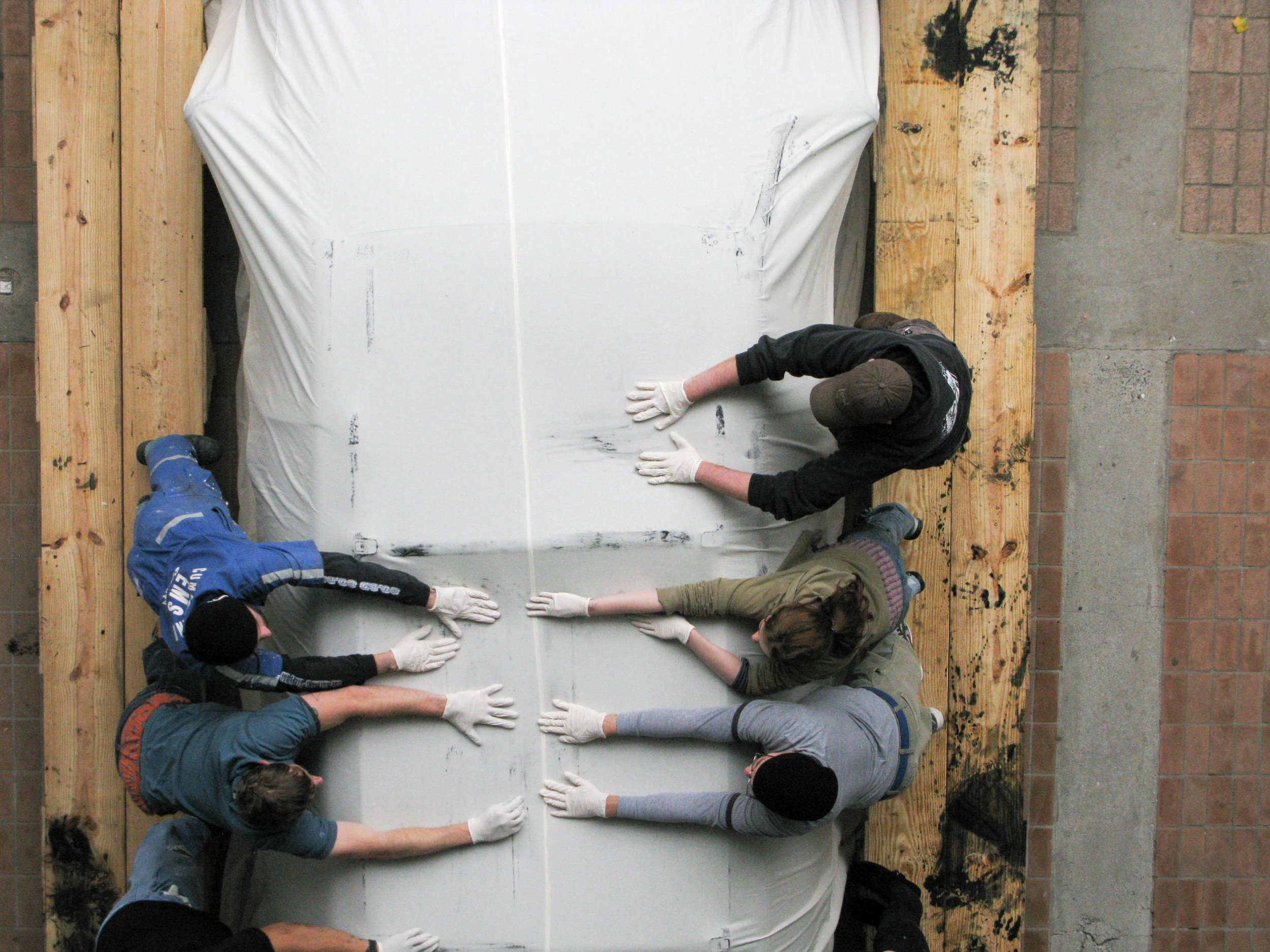
This style of work first came about because my tv exploded and between myself and two friends we carried it through snow to my studio, where I looked at it for a while. Prior to this moment I had been a predominantly figurative, traditional printmaker, but I had just been through a rather public and embarrassing psychotic break and I could no longer reconcile my work and process with my experiences. I wanted to explore a process that would address some of the questions I had at that time. I ripped down my curtains and stripped out the lining, inked up the television and wrapped the fabric around it, removing it to see the impression left.
I ripped down my curtains and stripped out the lining, inked up the television and wrapped the fabric around it, removing it to see the impression left.
The process is an act of love; like swaddling a child. In a way I hope I am the object, the side with substance. When I strip that impression from the object I want that to be the other people who reside in me. By putting that out for display as an inkblot I am asking the audience what it is, and how to fix it.
I still work with curtain lining to reference this moment and these decisions, though my process has adapted and developed to new questions and later experiences.
The Insides/Appassionata, 2008-9, object, ink, curtain lining, 167.4cm x 238cm
Cars, shopping trolleys and pairs of glasses are used for these prints, Is there a story behind the objects? What are the reasons for choosing these items?
After my initial encounter with an exploded television, the objects I use have a relationship to me that I select for a specific purpose.
One example is working with spectacles. I had recently lost a few members of my family, and when clearing out my uncle and nan’s council flat I found that my uncle had kept every pair of glasses he had ever owned. He had hoarded a variety of things but these seemed important to me in relation to him, as he was a shy, quiet man who was just content to watch life and not necessarily take part. I kept the preserved frames feeling there was something else in them. At the time I was exploring my own states of mind in segments at the time from sanity to psychosis – trying to break the stages into objects. When considering paranoia I thought about being watched, scrutinized and assessing your own, and everyone else’s’, every move. Through print I wanted to create a crucible of eyes watching so I used my uncle’s glasses: through from tiny glasses of a little boy, to a brand new pair with the label still attached that he hadn’t had the chance to wear yet, though he thought he would.
It is awkward to have relationships with the objects I use because it is easy to become too attached and precious as my process destroys the original item. But it is imperative to me that the work I make is painful and problematic, to be able to reflect the experiences it represents.
Obsession and pain through process are vital. There are no shortcuts to content when it comes to my work. I work hard. That is the foundation of my practice. When I take an easy route the work suffers and the message has no backbone to travel on. The process is arduous and begins as physically uncomfortable, pushing through to agony, because it has to be. This is not art therapy. This is not cathartic. It is painful. From a past of discrimination, violence and prejudice if I exposed my diagnosis this is a risk, and the process has to reflect that. Art therapy? Pah! My work pushes me to the brink of my hard won sanity, and my mind plays excruciating games with me to seduce me back to madness. My artwork will never be enjoyable because it can’t be. It shouldn’t be.
meat is touched [pt1], 2015, hand cut and varnished letters printed one at a time onto curtain lining, aprox 290cm x 120cm
declarationandmanifesto, 2014, hand carved letters printed one at a time onto curtain lining, 126cm x 240cm
Your large text based pieces are full of messages/thoughts or slogans like “I am not a poet”. Could you talk about these works and what these words mean to you?
Working with text has only emerged in the last three years, although the texts I use can often be much older. I work with extracts from books I have kept during a decade of psychotic episodes. The texts aren’t diaries so much as mindful mutterings and a way to excrete thoughts from a confused cacophony of sounds and images. I never wanted anyone to see them. I never thought to expose myself to ridicule. But I read them. I remind myself when I am tempted to go back what it is really like; I remind myself when I am happy I am out, what I have lost.
I’m not exactly sure when I felt brave enough to actually use them. In fact, I’m still not sure I am brave enough, due to the anxiety it produces to see anyone near them, let alone trying to read them. But if I had to give a moment for the choice to expose them it was being challenged about my work by a peer. They remarked that they couldn’t see the vulnerable quality in my art. This statement kept me up at night and had me pacing to keep up with my own thoughts. A few weeks later I was pulling out boxes of notebooks, loose papers and documents from a hiding place and ripping out pages here and there.
The first text piece was “declarationandmanifesto”. I hand carved letters and printed them one at a time onto curtain lining. In grey text is printed the unfinished “manifesto” I began writing during, what would be characterised as, a [resplendent] period/delusion of grandeur. The manifesto was to state that schizophrenics were the next stage in human evolution, and that those without the condition, the “norms”, were no more than monkeys controlled by impulse and emotion. I intended to have it published and to push for the rule of the schitzo. Black text hand printed over the top of the grey is taken from a document written a few months later: the decision on whether to medicate or not. Having realised I had separated from my emotions and that my reaction to family or strangers was equal I had to logically debate this state of affairs. Realising that family community, in evolutionary and survival terms, was a critical factor, and knowing how my condition was perceived by society, it seemed dangerous for my freedom and independence to continue down this route. But the cost! The loss of all the beauty I could see, escaping the confines of a skull into an interconnection with all events and life simultaneously, the loss of one specific visual and auditory hallucination that offered me kinship and affinity I would never know again within my terror of her, it was a high price, and a difficult choice to trade it all for a mental straightjacket.
In the final work there are no capital letters, no spaces, no punctuation – the nerves I felt creating it and relationship to the words was too urgent for that. There was no hierarchy in the sentences, no word that was due any greater emphasis than any other, it reflected the emotionless yet passionate tone it was written in. The grey and black words are printed over the top of one another to recreate the confusion of having more than your own inner voice, the urgency of getting this information out within such a slow and cumbersome process, and perhaps a small amount of personal protection and unease.
Text works since these pieces have taken many forms from books to banners. I AM NOT A POET was a banner created during a period of paranoia, where after barricading my apartment doors every evening I would sit in the densest corner of my fortification and try an think of a single sentence that could summarise every area of my life and keep my mind off the impending doom that awaited me. After months of tests and assessments “I AM NOT A POET” was the sentence. It worked in every context and became my self-portrait.
I find the way people discover their own metaphors and attractiveness in my work intriguing. In-depth metaphors are often associated with schizophrenics and their artwork but my personal experience of the disorder doesn’t correlate to this assumption. “he pierces my chest with holes like I am a microwaveable ready-meal” – I have been told this is a beautiful sentence describing love, or passion, even sex. I wrote it after watching a hallucination stab me: the careless and nonchalant manner of the attacker, the speed of the assaulting penetrations, the pops and slight resistance of my clothes and skin, and the lack of emotion accompanying the experience meant that this was exactly what it looked like to me. “meat is touched. grunts are made”. This is not a comment on sex, this was watching “norms” shake hands. I had felt for a long time that the meat (flesh/skin) encapsulating me was constrictive and repulsive; as such people’s actions with their bodies were simplified into slabs and groans in my perception.
My intrigue into watching or hearing a viewer’s reactions and thoughts lead me into my practice of endurance performances.
sheets and pages (3,4 & 6), 2014-15 , hand carved letters printed one at a time onto curtain lining
What do you hope the viewer gains/reacts from looking at your work?
I can no longer try to guide every/any viewer’s reactions or predict their responses as they always surprise me, and they captivate me. In fact my fascination with the viewer provoked a new medium into my practice that I’ll mention in a minute. However, I try to provide the unease of being able to unwillingly relate to a psychotic. I’m interested in the concept of ‘the circular spectrum’ and the cross over points between sanity and insanity. I believe the divide between the two is frail and pregnable, like laddered tights. Osmosis is certainly a pleasant threat.
My collaborations extend beyond the art world in search of human relationships that influence and enlighten new perspectives and ideas. Removing agenda and offering pure unaffected experience allows a viewer to take the perspective to do with what they will. It is an oxymoron of bringing social activism into a work while abandoning judgement or leading opinions – this allows for enabling empathy to challenge imposed dogma.
My communication is precarious between the viewer and myself. It is sadistic vulnerability-taking risks with identity, exposing intimate histories, loss of self, and presentation that provokes judgement–and fear of that judgement. A range of responses have emanated from viewers, from being laughed and shouted at, threatened, exposed to aggressive psychical responses, being confessed to, to being posed with for selfies.
I am perplexed by viewers’ reactions and their reasons for them. I wanted to find a way to watch the audience closer. My work is already self-portraiture and pushes my sanity into questionable states, so what if I could be the artwork itself and push my mind and body to it’s limits to be able to watch an audience from a privileged location. During endurance performances I stand completely still for set durations (up to 80 hours) with one or two items that I hold for the audience to figure out how to interact or activate it/me. I become "object", and the interactions that follow intrigue me. Social regulations break down solely between each individual viewer and myself. I am physically engaged with, I become a curiosity, I am ignored, and I become part of conversations people had no intention for me to hear. The mental masochism and voyeuristic element on both the side of the audience and my own becomes comfortable. When I stop and walk away it is unsettling for the viewer as I revert back from object and my humanity is restored to them; and myself.
Tell us a bit about how you spend your day/studio routine? What is your studio like?
At present my studio was previously an office in a former NHS disability rehabilitation and mental health service building. I both enjoy and detest the irony of spending my life to date avoiding these units, to then voluntarily move into one (and paying for the privilege). Formerly I would make my studio wherever I could find a space – a driveway, a loaned garage or shed, or a residency somewhere in the world. But for my new series of work I needed the time and space to be able to work on artworks for a long time, and develop the emerging ideas with both walls and a ceiling from the elements.
My day-to-day routine is not glamorous. I begin very early to get admin out of the way and then I will usually be found doing a repetitive, uncomfortable task and occasionally swearing to break the silence. I don’t listen to music or have anything around that can distract me. I have to be strict with my studio and myself and I won’t come out of my compulsive tasks or look at a clock until I’m so hungry or thirsty I can’t ignore it anymore. I am not able to work on more than one work at a time as obsession is so tied into my work that I cannot put an artwork aside until it is completed. Works that haven’t yet satisfied my obsessive needs after completion are currently being ripped up and fed to new works. This can be tough if they are frequently requested for exhibits, but if I cannot accept that I took them to their limits then they have to go back to ‘process’ for another work. I’ve realized over the past few years that if I am not confident in the piece’s process and its content then I can’t let it out to represent my experiences, and as such me.
How do you go about naming your work?
Titles are an element/skill I am still working at. I feel disappointed if I am interested in a piece of work enough to go and read the title it saying “untitled”. I spent a long time using “untitled”, or asking other people their responses to name the work, or just naming it after the objects used. None of these methods worked for me. At present I am trying and testing new methods and ideas to name them. Damien Hirst could always give a title that made the work better than it was without it, and Andres Serrano’s “Piss Christ” used a title to turn the divine into the profane, there is a huge history of strong titles (and a source of envy for me). But the current piece I have been working on for the past 11 months has hope… or at least a shortlist of concepts to approach a title with. Doh.
Coming Soon, endurance performance, 6 hours duration, 2016 (photographs courtesy of Meike Brunkhorst and Lorraine Fossi)
LABELS, experiential video and sound installation, 6 hours, 2015
Community Project: Recession Impressions (Car Print), 2010, UNCC USA (photograph courtesy of Ken Lambla)
Dodge White I, 2010, printed dodge minivan onto fabric, 1219cm x 609cm
What artwork have you seen recently that has resonated with you?
Henry Hussey’s embroidered tapestries, Christopher Gray’s puppetry videos, Mona Hatoum’s performance notes and a lot of political and military propaganda from around the world throughout history.
Henry Hussey’s work interests me for the free flowing thoughts and images that cross politics to the very personal versus the time consuming medium. The exceptional textile craftsmanship he employs satiates the trained printmaker in me, while the texts he writes and uses challenge my own practice and force me to place myself into the contemporary context and figure out where I am succeeding and lacking. The artist and artwork raises my game, rouses me to try something new and take a risk. I appreciate that after and beyond my admiration of the work.
Christopher Gray I have no doubt is going to be the next art world superstar. I was lucky enough to exhibit with his at Griffin Gallery and Charlie Smith London, and I’ve followed his work through to winning the Catlin Art Prize. His recent video torture scenes involve creating puppets from chicken carcasses, cracking bones and sewing up skin; studying movement so that his hands can bring his silent (when not screaming) characters to life; creating intricate sets where his face is always visible when he forces his hands to commit atrocious acts on one another; to knowing he asked his daughter to do the filming.
The violence and gore creates palpable tension in a room, and I’ve watched audience members have to walk away in horror and disgust from the violence, even though it is evident from the puppeteers face and hands in shot that it is fictional, almost playful. To have that sort of contradictory impact is remarkable.
Mona Hatoum’s solo show at the Tate Modern was a highlight this year to be able to see works in real life that I have looked at on a computer screen for the past five years. I hadn’t realised prior to the exhibition that she had also been a performance artist, and reading the plans, documentation and transcribed events opened up a deeper understanding of such an influential artist. It is easy to enjoy but be underwhelmed by retrospectives of artists who are so famous and artworks that have been highly reproduced, but the additions of test pieces, sketchbooks, written performance plans and notes added a reality to the polished public image distributed by galleries and the Internet.
Finally, propaganda. I am exploring empathy at present through multiple routes: neuroscience, philosophy, theory, sociology and affective technology. As such my paths have crossed with propaganda, and campaigns that have sought to impose their opinions on the collective, rally the masses to a ‘shared’ cause, gain power or achieve specific outcome through other peoples’ action. The spin off achievements of advertising or present day media is no less interesting or terrifying. With a project I am leading working with with a drug compound scientist, anthropologist, inventor and some fellow psychotic voyagers, I am pondering what this knowledge might assist us to achieve.
Young Gods, Griffin Gallery, 2016 (photograph courtesy of Griffin Gallery)
What does the future hold for you as an artist? Is there anything new and exciting in the pipeline you would like to tell us about?
Studio time and some upcoming exhibitions are on the cards. My work is currently in the final stages of consideration for Neo Print Prize and summer studio visits are in full swing. I’m working to complete my current art piece and body of research that I began eleven months ago that explores if psychotic and sane individuals are the same during sleep. I have had nightmares every night since I was a child; with two of my three earliest memories being nightmares. When looking into historical diagnostic tools for psychosis when researching a paper on the history of “insane art” and its segregation I found that constant nightmares were often an indicative factor.
When I chose to medicate my nightmares never stopped, even though my waking hours were altered dramatically. Am I still a schizophrenic in the dark, and are you too?
As for further in the future I couldn’t say yet. Some investigations into inventing a new affective technology are being drawn up and scribbled down in notes, I have a set of chisels that are distracting me, and I would like to revisit my tape-recorded for some sound work, but I think the culmination of my current art piece will spark enough new questions to provoke a new work. I have a tendency to act very quickly once a dominant idea emerges.
Publishing date of this interview: 12/08/16
Florian Heinke
"I see my paintings like songs. They give commentaries. My lines are imbedded in a composition of sounds which reinforce them."
Could you tell us a bit about yourself. How long have you been a practicing artist and where did it all begin?
The very few first years as a child I drew a lot. There were the first drawings of reclusive places. Houses underground and rain outside. I was a quiet kid and did mostly things on my own after kindergarten and school. It was not what I wanted, but friends were just missing. So that encouraged me to learn to get along by myself.
My parents wanted to see me in a ‘good’ job that brings money and that society respects. I never wanted that and never understood why doing a job just for the money should be a reason to be accepted by others.
Around 12 I started graffiti and discovered music as an escape from the daily grind. That kept me awake and at arm's length from those that felt like dull sheep. At 17 I moved out and had a social worker from time to time that looked after at me. From there on I changed flats every year, and broke school to start an apprenticeship as an insurance salesman. But I quit that after 1-2 months. That couldn´t be the life I had to live, it was such a terrible idea. Thank god my father saw that and supported me to keep finding my way by showing his sympathy.
In these years, since I started school, there wasn't any art in my life. Graffiti was just the valve to show my fury, incomprehension and sadness. That was never art. Silver-Black, here I am.
Once I got arrested and they put me into a programme in a workshop. They offered me an alternative punishment: to work in their painting studio. I did my first canvas there with brushes and colour.
One year later I started upper school, had fast changing flats and girlfriends etc. That kept going on until the end of academic studies. My last art teacher in school told me that there's the possibility to study art. I didn’t know that because there was never any knowledge in my family and circle of friends about the arts.
Then I started my studies with my big advantage: I had no idea about what art is or not. From there on I put all my power, time and life into my paintings. I called them Wütende Bilder (Raging Pictures). They were huge, aggressive, loud and extremely colourful. Two years later that changed into just black for the best possible expression of what I have to say. Words and symbols.
War loves us 01, 2013
Dazzle, 2014
Most of your subject matter seems to be celebrity/pop culture and some paintings have text. Could you talk about the images and slogans in your work and what your intentions are?
There was a clear reason to flip into just black. To show most effectively any feelings, black and white seemed to be the best solution. My paintings were always a straight critique of systems and society. And it still is. I called it BLACK POP. For me it´s the complete flipside of pop-art. Classical Pop Art broaches the issue of daily products: consumer goods, mass music, etc. and just uses them as themselves in the artwork. Black Pop broaches the issue of feelings, problems, reasons and circumstances behind social and economic concerns. I think the only decent and sustainable way to criticise something is to plant bombs right in the heart of it.
That´s the reason why I started to make my paintings look like big posters, like advertising. To be at eye level with those flat things that represent what I want to criticize.
The reason there seems to be a focus on celebrity is maybe this: to get more attention. It´s helpful to show things that people already know. For me it doesn’t matter whether it´s Kate Moss when I use her as a symbolic part of a painting. It´s helpful to get more attention, but it wouldn’t work if she wasn’t used in the right context within the painting.
I see my paintings like songs. They give commentaries. My lines are imbedded in a composition of sounds which reinforce them. That's it.
I prefer using English in my work, so more people are able to understand the text. And, again, to use the language of that you want to criticize. And English is the leading language in that business.
Some of your works depict nude/semi nude women in various poses and backgrounds. These remind me of over sexualised advertising/fashion scenes and/or film posters, are you heavily influenced by advertising?
No. I am not really influenced by advertising. I started to deal with that subject as the necessity of my step into Black Pop. To bring the best result, you need to research.
The nude women thing…well, in the beginning it was a strong part of my life. Changing girlfriends and these things, but I saw it more as a way to critique the impossibility of cooperation in society. I just used my private life as an example for this. Using contrary elements to make the point gives it much more intensity. Somewhere between sarcasm and irony.
The nude women in recent paintings symbolise the wish for beauty, hope and something that you have lost and wish to get back in life. But you are right, as in advertising, I also use these elements to create a perfect world.
The essential difference is that advertising arouses a false desire and covetousness. And it gives the answer and the promise. So, you think you need that product. My paintings do the opposite. They neither give any promise nor any solution or answer. They aim at your feelings, the pure ego with its base thoughts.
The obviously critical works appeal to the unconscious, unpleasant knowledge about yourself. The more appealing paintings show a pure, true paradise and tease you into thinking everything is gonna be alright, but…
So, it´s all about the beholder himself.
Bataclan, 2016
Grace, 2016
Punkfees, 2016
You have a raw technique to your painting, monochrome and stripped down to one colour, would you say German Expressionism is an influence? Could you also talk about your process, how do you start a new painting?
No. Expressionism and German Expressionism haven't influenced my work. Expressionism is still not a favourite art direction for me. My work is Symbolism. I deal with reasons, and question what circumstances lead to a situation, and why. I am not a fan of having fun on the canvas with nice colour passages, testing all those nice brushes, testing materials etc.
The painting just gives the formulated thought a voice and the possibility to catch that thought. It's the last step of that specific idea. Words wouldn't be able to do that. That´s also the process. It´s based on philosophy. I'm always trying to find a better or different way to grab a thought. There is an ongoing process of discussions, talks with friends, and research via the internet, film etc. I make sketches, notes, drawings, collage, photographs or whatever to take the next steps. It takes a lot of time to get an idea fixed. Sketches for the works take months upon months. Usually a few works arise in parallel. As soon as the sketch is ready and size of the work determined I go into the studio and paint.
The Great War, Harold de Bree, Florian Heinke, Eric Manigaud, Hugh Mendes, CHARLIE SMITH LONDON, 2014
Tell us a bit about how you spend your day/studio routine, what is your studio like?
Hehe, easy life I’d say. Living famous dreams. Daily things like bills and stuff. But the rest is…getting up. Taking my dog for a walk. Mostly in the woods or fields on the verge of the city. That means a relaxed start to the day. Quiet, peaceful. Breakfast around midday with my wife. At home or in a nearby café. First talks about current affairs. Politics, economy, society, terror shit (actually that´s been an ongoing topic over the last years as we know). Homewards and to my Mac. Listening to music and trying to finish sketches. In the best case, I go to my studio in the afternoon until evening. Dinner and back into the studio until late night.
My studio is in the attic of our house. It looks like Carl Spitzweg’s painting ‘Der arme Poet’ (The Poor Poet). In the winter it´s really cold. You need a cap and a warm coat. In the summer, it´s extremely hot there. Swimming trunks situation. I like that raw idea of a poor poet’s studio. Its the place where time really sleeps.
What do you hope the viewer gains/reacts from looking at your work?
As I mentioned before, it´s all about the unconscious, unappealing knowledge about yourself. I hope I can give mind to an impulse and can give some peace to those that see themselves in the paintings.
How do you go about naming your work?
Idea. Painting. Title.
Usually it´s that way. I try to use the title as another level, as an expansion for the meaning of the picture. Sometimes it works, sometimes…well…
War Loves Us 03, 2016
When Time Sleeps 25, 2016
What artwork have you seen recently that has resonated with you?
To be honest, I´m not that much into the fine arts scene these last years. I love music and film. I´m a fan of Neo Rauch, the sculptures of Jonathan Meese, Monet´s waterlily pieces, Raymond Pettibon. Generally, for my taste, most artworks are missing intensity, because they are ill-conceived and not sophisticated.
I miss the earnestness, but that doesn’t mean that works can´t be funny and guileless.
But there are some new and great works out there, and that’s fantastic and very inspiring. Thank you guys for this.
Vice and virtue, 2016
We'll laugh when it falls, 2016
What does the future hold for you as an artist? Is there anything new and exciting in the pipeline you would like to tell us about?
I love books and I also love to make books. I made my first one, the Black Bible, after the first 5 years of my black paintings. The second is in the pipeline at the moment. I guess it will be finished and published at the end of this year or beginning of next. Dunno yet. So, the book will be presented with an exclusive small exhibition in Frankfurt I think. I’m thinking about a series of portraits. I’ve started already in secrecy and time will tell. I’m deep into a lot of work for my first London solo show at CHARLIE SMITH LONDON in September, and art fairs.
There are many ongoing projects with my galleries CHARLIE SMITH LONDON and my hometown Galerie Heike Strelow. Both are very close, it´s a gorgeous team. A good feeling, entering war with strong partners besides.
There is one other really great project in the pipeline, but I can't say more at this point. Another artist is involved and it´s not only in my hands. But the magic word is music. X fingers that we can make that.
Heinke's Solo show at CHARLIE SMITH LONDON is titled: ALLES WIRD GUT. Exhibition dates: Friday 09 September – Saturday 08 October 2016. PV: Thursday 08 September 6.30-8.30pm
Publishing date of this interview: 12/08/16
Zavier Ellis/Charlie Smith London
"I understand what it’s like to be an artist and what challenges lie therein. I also emphasise the critical as well as the commercial, and don’t consciously follow trends or try to second guess the market. We do what we do, take it or leave it. "
Our interview with the Founder of CHARLIE SMITH LONDON & THE FUTURE CAN WAIT: Zavier Ellis
Could you talk about your background? What made you become a gallery owner, is it something you have always wanted to do?
I did make that call pretty early. I was seduced by art at a very early age, and it’s been a lifelong passion since being a small boy. I was a practicing art student with an interest in the art historical, and made the decision to study History of Modern Art at Manchester University rather than go to art school.
The way I saw it then, I didn’t want to limit myself by taking the practical route, and wanted to learn directly from the masters.
In the background I had also always been motivated to organise things, from our end of school ball to my first curated show at 18, to club nights when I was at Manchester. When it came to the end of my degree I saw two options – art history / criticism or the gallery world – and the latter was the logical and instinctive thing to do. In the meantime, I continued to make work, and took a part time MA in Fine Art at City & Guilds while I was running my first gallery. I guess I’ve always thought like an artist and a curator, and continue to do so.
Young Gods, curated by Zavier Ellis, CHARLIE SMITH LONDON, 2011
Gallery Artists: Directors Selection, CHARLIE SMITH LONDON, 2013
Could you talk about the space you have in Old Street and the journey that got you there?
I began gallery work by interning for a day a week at a little gallery in Clapham when I was around 24. It got to the point where we needed to step things up and the director asked me if I wanted to go into partnership. We rebranded it entirely, devised a different exhibition programme, and began representing artists. The gallery became very successful and we took a bigger space and continued to evolve. Eventually I became involved with a different set of artists, simultaneous to doing the MA, and decided that I wanted to go it alone. I was in a developmental phase where I wanted to evolve critically and intellectually.
I launched CHARLIE SMITH LONDON as a curatorial project with the view of eventually taking a gallery space again. We participated in a number of art fairs and began to build a new collector base, and after a couple of years I and the artists started feeling the need for a space. In 2009 I launched the gallery in Shoreditch and developed a really strong, consistent exhibition programme. Alongside all of this I also established THE FUTURE CAN WAIT in 2007 with film maker Simon Rumley. That’s a very ambitious, unique, large scale curatorial project that has developed beside the gallery.
THE FUTURE CAN WAIT, curated by Zavier Ellis & Simon Rumley, Victoria House, London, 2013
THE FUTURE CAN WAIT (Chris Jones), curated by Zavier Ellis & Simon Rumley, Victoria House, London, 2011
THE FUTURE CAN WAIT, curated by Zavier Ellis & Simon Rumley, Victoria House, London, 2012
Young Gods, curated by Zavier Ellis, Griffin Gallery, London, 2016 (Featuring J.Price)
How do you feel the art world is changing? Do you think art fairs are becoming the life blood for most galleries?
It always changes and stays the same. Throughout my career gallerists have always discussed whether or not they need a physical space. I think it’s essential to have a full time programme that encourages the artists and gallerist to continue to develop. Art fairs are very important. They provide the environment where we get to meet collectors and build a relationship with them. Its undeniable that most galleries need art fairs, but it can’t be just art fairs. Online platforms appear to be maturing now. Like most things, when online selling platforms began it was probably too early for them. But sites like Artsy seem to be realising the potential.
What has been your biggest obstacle and greatest achievement as a gallery owner?
I love to make deals, big or small, and to take the news to the artists. Placing work with prominent collectors such as Charles Saatchi is always gratifying, as beyond the financial side I know this is going to be beneficial to the artist’s career. We all remember the crash well, and there will be obstacles such as this in anyone’s career. But it also provides a challenge, and one has to be guerrilla to overcome it.
John Stark’s DoL Po, CHARLIE SMITH LONDON, 2016
What do you look for in an artist?
I trust my instinct 100% and it always begins with my inherent response. Undoubtedly I look for technique but I also require some kind of emotional or psychological response. I like to be challenged and then to challenge our audience. And personality and trustworthiness are also important to me. Artist and gallerist need to work together towards shared goals, and to be able to trust each other implicitly.
How do you differentiate yourself from other galleries?
I have a distinctive, collaborative and curatorial approach, and a coherent programme and stable of artists. I understand what it’s like to be an artist and what challenges lie therein. I also emphasise the critical as well as the commercial, and don’t consciously follow trends or try to second guess the market. We do what we do, take it or leave it.
Hugh Mendes, Obituary Ellsworth Kelly, 2016
Zavier Ellis, Director of CHARLIE SMITH LONDON (Image credit: Lana Vanzetta)
What advice can you give to young artists?
Since launching our open call show Anthology I’ve realised that these can be superb vehicles for getting seen and making relationships. An artist friend once said to me, ‘it’s all very well serving up a fine dinner, but you have to have people to eat it’. Be decisive. Work hard. And everything is about context.
What's the future for CHARLIE SMITH LONDON? Any exciting new shows lined up?
I’m looking forward to our post-summer programme. Two artists who have recently joined the stable will have solo shows – Florian Heinke in September and Hugh Mendes in October. Florian’s will be his debut London solo so that’s exciting for all concerned. There are some other things in development. So, I guess watch this space…
Publishing date of this interview: 12/08/16
Adam Holmes-Davies
"Simply put I am trying to express my experiences of life, sometimes quite literally I feel like I’m attempting to paint the experience of being sat in a little room trying to make sense of the world."
Could you tell us a bit about yourself. How long have you been a practicing artist and where did you study?
I was born in Croydon and fostered at an early age, because of this I lived in a number of homes across London and the South East. I eventually ended up living with my grandparents in a small rural village in Sussex and remember this being a real change in environment from estates in inner London and suburbs, to suddenly living in the countryside. Because of this I’m not sure as a kid I had a sense of place and didn’t really feel that I was from anywhere in particular.
I wouldn’t say that I’d always wanted to be an artist. At the time I suppose I didn’t even know what an artist was, though looking back I do remember enjoying spending my lunch breaks in the art room at school. One of the advantages to my upbringing and probably the reason why I’m an artists today is that there was really no one to tell me that I couldn’t.
After finishing school I went on to do a foundation course and then a BA in Fine Art at the Surrey Institute of Art and Design. After graduating in 1996 I still didn’t really know what I wanted to do, so decided to go traveling, I ended up living in Prague then Toronto and then in Halifax, Nova Scotia. After moving back to London a number of years later I decided that maybe I should start taking art a bit more seriously, so got myself a studio and started to make work. A couple of years after that I was offered a place at Chelsea College of Art and Design on the MA Fine Art course and since graduating in 2006 have continued to make work.
Compared to your earlier works your more recent paintings are freer with loose brush marks. Could you talk about this progression and what this change brings to your work?
Yes I used to make detailed paintings from observation of still life arrangements on my windowsill and self-portraits in the studio. A couple of years ago I decided that I wanted to make a change to the way I approached my paintings. At the time I remember feeling frustrated with how ordered the process of making my work was. I remember being preoccupied with how long it took to make a painting and wished that I could be more spontaneous. I also wanted to work on a number of different canvases at a time instead of having such strict starting and finishing points in the painting. I suppose I had adopted rules for making my work without really understanding why and so decided to make a change.
I started by making paintings and drawings on paper, which I still do, these works have helped me to develop new ideas and images and create a more gestural attitude towards the work. I feel that my paintings can now skip between abstracted or figurative forms, observed or imagined spaces. I’m seeking a quality within my paintings rather than having to be descriptive of subjects. I now work on a number of canvases and surfaces at a time with ideas shared throughout multiple works. Ideas and subjects for my paintings can emerge and disappear with the starting and finishing points fluid.
Girl, 2016
Untitled, 2016
Do you dwell less on subject matter and focus more on the craft/act/ritual of painting itself?
I am interested in painting as an intuitive act I enjoy its labour and sense of history and time. Subjects for my work are influenced by my everyday experiences, emotional and personal histories. I am interested in the history of painting and historical genres, in particular portraiture and still life painting, which I use as entry points into making my own paintings.
I try not to get hung up about what I’m painting or what ‘they mean’, whether that be painted from observation or imagined. I suppose without trying to sound to corny I’m more interested in trying to find a reality, an attitude and power to the image. Simply put I am trying to express my experiences of life, sometimes quite literally I feel like I’m attempting to paint the experience of being sat in a little room trying to make sense of the world.
There is plenty of humour in your work, with the smiley faces and use of colour. Is this your intention and if so could you talk about the thoughts behind it?
I’d like to think that I’m a funny person but I don’t personally see that in the work. In fact I would say that my work is actually quite deadpan and melancholy. As you have mentioned I have painted people with smiley faces and used strong primary colours but I suppose these come more from an anxiety than humour, I always see it like a dumb anxiety, a bit like when someone takes an awkward photo of you. If there is humour in my work it is more than likely self-depreciating.
Head, 2016
Waiting Room, 2016
Tell us a bit about how you spend your day/studio routine? What is your studio like?
My studio is pretty simple really, an old victoria warehouse with lots of cast iron windows and wooden floors. I have a small space on the top floor, which overlooks lots of people’s gardens. Since being in this studio I’ve become quite familiar with all the coming and goings of people around. There’s karate guitar man, a man who plays guitar in his garden and sometimes does karate. Pigeon man, his a guy who has homing pigeons which fly in unison around the studio. He’ll call them back in a repeated tone “come in, come in, come in”, which I always think is a bit like calling a sheep dog ‘come-by, come-by’. Other than that its pretty quiet, I usually spend long hours in the studio and some times feel like I’m a bit to obsessed. I have a chair and a big long pallet with wheels on it and two plans chests for drawings and paintings on paper. I have a few stacks of paintings, which are in various stages of completion, usually facing away as not to confuse me.
When I arrive in the studio I don’t usually have a particular plan, I tend to just start with what ever feels right. I make my own paint from pigment and tube it up, which I started doing a year ago. So sometimes if I don’t feel like painting or just want to be distracted I’ll mix up a cadmium yellow just so I can feel engaged with the material. I paint over a lot of my work and so the surfaces of my canvases are usually quite built up, so sometimes it does just feel like I’m in the studio adding paint to a surface and then taking it off.
What do you hope the viewer gains/reacts from looking at your work?
I don’t usually think about the viewer when I make my work. I suppose I’m far more interested with my own selfish desire in making it. Though I imagine a viewer would gain some insight into the attributes that I admire and value in other artworks, such as a sense of time, place and emotional fragility.
I know it’s probably an overly romanticized view but I’ve always been interested in understanding an artist through their work and see the act of making as a reflection of an artists attitude and approach to life and hope that this also translates through my work.
How do you go about naming your work?
Titles or names for my work usually arrive while I’m making the painting. My titles are pretty descriptive and tend not to have any particular meaning in the work. For example I’’ve been painting a lot of portraits or heads, of late which I kind of see as being different versions of me. I’ll title this ‘Head’ or ‘Portrait’. I am always wary of overblown or pompous posturing in art, particularly in painting and so try to keep my titles simple and to the point.
Reflection, 2016
Untitled, 2016
Black Sun, 2016
Window, 2016
What artwork have you seen recently that has resonated with you?
I recently went to see Carlo Carrà, Metaphysical Spaces at Blain Southern, which I really enjoyed. I was surprised by the stillness of these pictures, particularly the landscapes and remember wondering if these were imagined spaces or places where he would have visited. I was also interested in the surfaces of his paintings as a lot were quite heavily painted and though probably not intended had started to seriously crack. It seemed as if the image and the physical qualities of the paintings were indivisible.
The other thing that sparked my imagination was that none of these works had been presented together in over 50 years; in the world of images that we live in today this seemed special.
What does the future hold for you as an artist? Is there anything new and exciting in the pipeline you would like to tell us about?
As I have changed my work in the last two years I suppose it is still relatively new to me and as such I haven’t actively searched out opportunities to exhibit. I suppose I still feel like it’s important for me to focus on developing my work in the studio and trying to build up a greater body of work. There are a few opportunities coming up that I’m pursuing, though nothing confirmed yet, but hopeful I’ll see this being developed further in the next couple of months.
Publishing date of this interview: 12/08/16
Henry Hussey
"I come to textiles from a masculine perspective and the Workers Union Banners are a cornerstone to this."
Could you tell us a bit about yourself. How long have you been a practicing artist and where did you study?
I studied at the Royal College of Art and graduated in 2013. This was a formative experience and laid the foundations of my practice. Specialising in textiles I explored the dramatic and powerful narratives which could be expressed in the medium.
I had been making stylized work so at the RCA I sought to break out of this cycle by making deeply personal work that I hoped resonated with the viewer. Over the past three years I have sought to get to the core facets which define my character and the aspects that cause me turbulence - coming to the conclusion that work purely about myself will become monotonous so choose to broaden my perspective to focus on wider social and political unrest.
Reliquaries, Coates & Scarry Gallery, 2016
Your tapestries remind us of old Worker’s Union banners, full of symbolism and history. Could you explain some of the symbolism in your work, have you created your own world with a cult/religion/history?
I come to textiles from a masculine perspective and the Workers Union Banners are a cornerstone to this. They carry the weighted heritage and integrity of the past generations who carried these enigmatic symbols proudly. Each element within these banners has an entrenched significance and this coveted quality has directly inspired my own compositions.
Equally the banners that appeared during the Miners Strikes are some of the most passionate and unrefined objects I have ever seen as they were made hastily without any notion of artistic merit. Distilling the message down to the purest form to be as direct and confrontational as possible. I endeavour to remove as many barriers between the viewer and myself by having my imagery instantly striking.
Could you talk about the use of digital tapestry? Do you feel working digitally has given you more freedom to work on a larger scale?
I define my pieces as contemporary tapestries as they utilise modern techniques and are a combination of weaving, dyeing, embroidery, screen-printing and digital-printing. The incorporation of digital processes into my practice has been hugely liberating. This is most apparent with digital printing onto fabrics, as I am able to create imagery on paper then scan and manipulate this into whatever fashion suits my purpose. This exchange of processes gives the works an internal dialogue - the traditional and contemporary techniques amplify each other to create an arresting and tactile visual. A key part of my practice now is working with artisans. I am invigorated by how their interpretation of my imagery and the mark making is transformed by their hands, giving it a new lease of life.
Solidarity, 2016, 110x210cm
The North, 2016, 110x210cm
What do you hope the viewer gains/reacts from looking at your work?
As a society we are connected by common traits and sentiments so when delving into my own experiences it is my intention that the viewer equally can draw their own parallels and have the work envelope them. Even when the works focus on my innermost struggles I strive that there is room for interpretation and encourage the viewer to find their own thoughts and feelings in the events unfolding. Practicing in a static medium I acknowledge the fact that the viewer can simply bypass my work so I make the conscious decision to build a sense of spectacle into the pieces so they are cannot be ignored. Instead they force a reaction from the viewer as it challenges them to engage with the narrative and bring their own memories to the forefront.
Could you talk about your process?
In the initial phases of my works I stage performance pieces between actors and myself in order to capture genuine emotion and the pathos expressed between the both of us. I create skeleton scripts which act as a guideline for the topics we will discuss in order to get us to a heightened state in which we can access the emotions that I want us to explore. This gives me the raw and unbridled material that underpins the pieces created, as all of the imagery and dialogue is instinctive, revealing the thoughts and responses we never knew existed. From this I create the paintings and drawings of these intense encounters then constructing the compositional elements around these to give gravitas and momentum to the work.
Lamentation, 2016, 155x155cm
Purging, 2016, 155x155cm
Tell us a bit about how you spend your day/studio routine, what is your studio like?
The works I create are labour-intensive pieces that consume a great deal of time. I would liken my method to that of a production manager, as each day I will orchestrate the tasks that need to be completed in order to get closer to the finished work. Whether this is dyeing fabrics, creating imagery or meeting with technicians, these all accumulate and give shape to my artistic practice. How a work is originally envisioned is rarely set in stone as the undertaking and experimenting with processes is what ultimately comes to define the piece. There are days though that are surges of creativity which verge on sanctification and it is in these moments I get to the purest incarnation of my work and what I endeavour to capture.
How do you go about naming your work?
Most frequently it is a word or a term that continuously reoccurs throughout the making of a piece, which then comes to define the work and would seem unnatural to title it anything differently. There is the sensation of an epiphany when the perfect name for a work strikes you and all the thoughts you encountered at each pivotal moment crystallises and the piece projects a newfound presence. I give the majority of my works one-word titles as they are heavily text orientated and it would seem perplexing to then add more content. The name then encapsulates all of the revelations unveiled giving it a defined form and an identity that exists to an extent is removed from me.
The Last Breath, 2016, 85x60cm
The Last Breath (detail)
What artwork have you seen recently that has resonated with you?
As opposed to a single artwork the last exhibition to have me completely enthralled was Rory Menage at The Averard Hotel, which is an incredible space and their best use of it to date. The show was themed on the poem Ozymandias and focused on the demise of kings and lost empires. The sculptures throughout the space were reminiscent of fallen icons and the disintegrating figureheads of dead monarchs. The space is a decaying structure and falling apart so the dialogue between this and the works was flawless, creating an utterly engrossing experience. This to an extent is where I would like to pursue my own work down the avenue of installation based pieces, so the surroundings play a far more significant part in how the work is perceived.
What does the future hold for you as an artist? Is there anything new and exciting in the pipeline you would like to tell us about?
In December I am exhibiting at Context Art Miami with Coates and Scarry where I will be in a presentation with the Australian artist Penny Byrne. Moving forward I think the growing politicised nature of my own work will become a key focus of mine. I recently went to a production of Richard III with Ralph Fiennes playing the lead and saw him as a manifestation of the worst parts of England being this crooked, corrupt and malevolent creature. I would be fascinated to explore the mistrust and perpetual frustration we have for our leaders. In conjunction with this I plan to explore sculptural forms and installation based mediums further in order to achieve increasingly atmospheric and imposing work.
Publishing date of this interview: 12/08/16
Peter Matthews
"My work, through time, connects with something beyond myself and that is important to me."
Could you tell us a bit about yourself. How long have you been a practicing artist and where did you study?
Since studying my BA and MA in Fine Art at the Nottingham Trent University, I ran into challenges and hardships as most emerging artists do, and I remember doing a whole range of jobs from street cleaning in Exeter to working night shifts cleaning mechanical equipment at a quarry near Leicester just to make some bread you know. But I’ve always felt that motivation to be an artist so whatever I went through I just went through it, because that’s what you have to do, just do it as they say. I have always been deeply drawn to nature, the sense of curiosity, beauty, wonder, those things draw me to nature and never cease to amaze me.
Some of my earliest memories growing up in England were climbing trees and pushing Tonka trucks around in my sand pit, listening to talking book stories on my portable cassette player in the garden…and now I find myself collaborating and working with ocean scientists to gain a deeper awareness of my subject matter, the ocean. I am though, deep down, an artist who seeks to be alone when I work, and that pursuit to be out there in the wild, alone, nomadic, solitary is at the core of my practice. I work in the Pacific and Atlantic Oceans and have taken my work to place such as Hawaii, Mexico, Costa Rica, Brazil and Taiwan.
In Search of the Sublime, solo show at Beers London, 2016 (Image credit: Damian Griffiths courtesy of Beers London)
Do you feel the physical act of being in/by the ocean when painting/drawing gives the work multiple layers? With the time/residue/evidence/movement that it creates.
Yes very much. My working relationship when I draw and paint, as I do this while immersed in the ocean, free diving to the bottom of the ocean or working along the intertidal zones on the beach is one of being direct and physically in touch with the ocean and environment. I don’t work in the studio. There is, by the nature of how I work in the ocean, a whole set of forces at play when I work, so although I work in solitude for days and days on end, I am never alone in that sense of working because for me there is always this beautiful relationship of working ‘with’ nature, through observation, experiencing it, being in it, learning from it, surviving with it, and so on.
My work, through time, connects with something beyond myself and that is important to me. As much as the work is a time worn relic of my experience out there in nature, there is always a trace and narrative of the ocean and universe writing and drawing itself onto and through the works and I am very open and inviting to that, often channelling those happenings through lighting a fire, leaving paintings out there in rock pool or sea caves for weeks.
In every work there exists a slippage point between the object and subject, sometimes it happens an hour after being in the ocean drawing in the waves, or sometimes a few minutes after starting to paint on a canvas and it begins to rain heavily.
This beautiful and more often than not unpredictable but sensed slippage point happens when the object, the drawing for instance slips over into the subject, where the object becomes the subject and the subject becomes the object.
I often write on works while I am making them, I don’t know why really, it just comes to me and I do it, notating something I see or sense. But there is a constant stream of the ocean and the forces and actions of nature writing themselves onto the work that I am very much intoxicated to watch and follow.
Drying the painting beside a driftwood fire on the Pacific coast of Taiwan, 2016
Free diving to the bottom of the ocean to paint in a place and space and time different to that found and experienced on dry, Pacific coast of Taiwan, 2016
Drawing while immersed in the Atlantic Ocean, 2016
Atlantic coast of England, Cornwall, July 2016
Could you talk about the process of your mark making? Are you responding to the forms and shapes around you, or do you slip into an automatic mediative writing/drawing like state?
Well, in terms of drawing… it’s all about the succession and layering of marks on paper by using pen. I drift with the paper nailed to a wooden board while in the ocean and I do this for as long as I can, either in one long experience of several hours of being out there, or sometimes till sunset, then I crawl out of the ocean, legs and feet numb, I sleep wild on the beach in a tent and then continue again at first light. I’ll leave the drawing in a rock pool most times so it is in a continuum with the ocean and that time and spatial dimension which is unlike any I know on dry land. That’s how I work but in terms of what am I responding to, well it’s all about a live and experienced relationship of sensing nature, seeing the world and reaching out into the universe. I follow whatever I see happening in real time with my pen, simply floating and drifting along, sometimes passively sometime actively, just drawing what I see, that’s it.
I don’t really know when it will arrive each time I am out there in the ocean drawing, but there is always a set of experiences that flood over me, surround me, take me somewhere, and it’s when my body and inner self go through an experience of what some people might call ex-stasis, or in nature an experience of transmigration I suppose. Across the drawing plain, after I work an look back at the drawing, as sometimes I can’t see the paper due to the glare of the sun of the watery surface, the paper being just under the surface or just observing what I see unfolding in the cosmic fields out all around me than worrying what the drawing looks like.
A mysterious experience happens throughout the making of each drawing and that is the sense of knowing what is coming from a future time to cross over in my recent time, perhaps that is because a lot of what I see in the ocean ad it unfolds in real time is like a pattern, a wild pattern but a pattern in a sense, so this does elicit and stimulate a sense of being hypnotised or sedated, being cast into a meditative state yes.
I just journey through these channels until I cross over with something I see happening which comes out of nowhere. I remember once drawing in the Atlantic in Cornwall and a small dark object landed very close to me, caused a splash and then vanished into the ocean.
My thoughts are it was a meteorite fragment reaching earth, or reaching the salty skin of a parallel world. How to visualise such observations and experiences – I just make it up, a line, a mark on paper, it is a primal response, felt deep from within but as fresh and fleeting as a rainbow spreading over the open ocean.
12 Hours In and With the Atlantic Ocean, 2016, pen, rust and earth on paper, 56 cm x 97cm
It Came from a Long Way Out There, film still image, 2015, documentary photo from the project on the Pacific coast of Taiwan
You work across variable mediums, from paintings to sculpture and video installations. Could you talk about your videos, like the piece “Double Negative”?
I work fluidly across different mediums all the time. It’s not that I ever get bored or stuck in drawing or painting, but I just feel that some mediums can take me places that others can’t and can allow me to explore and discover, visualise and transmit ideas and experiences in more effective or different ways. I always carry in my backpack a simple waterproof camera which doubles up as a video camera. I’m on my second camera now as over time the salty water, occasional drops while rock hopping tide pools and travelling long distances had taken its toll. Typically I use this tool as a way to document the process of working, but now and then I’ll make a video work which becomes a work in itself. The film ‘Double Negative’ was a short film I made in the Pacific Ocean while working along the east coast of Taiwan earlier this year.
It’s a film made by layering one film onto another film at the editing stage, a process and approach I am really intrigued by when working with moving image. I was curious about how to visualise the impossibility of a boat passing over the horizon, which is a very mysterious line and presence on the ocean which we can never grasp hold of and touch because the closer we travel to the horizon the more elusive it becomes and recedes into a future time which we can perceive but not be in, if that makes sense. At that time too, I was painting very long hours each day in the winter rains which came from way our far in the Pacific, after a while of this physical exhaustion painting I began to see things which were not real, but what it real after all – so the film was a way to visualise that sense of being disoriented and disconnected with reality and place but at the same time being closer to it.
Double Negative, video installation, 2016
What do you hope the viewer gains/reacts from looking at your work?
I don’t really think about this when I work. Some people say they are reminded of old sea maps when they look at my drawings after being immersed in the ocean. And recently someone commented how my paintings from the Pacific and Atlantic Oceans brought a deep sense of calm to them. I’m interested in the space in which the work is shown and enjoy working with curators who can take the viewer/visitor along a meandering narrative and journey, because after all, my work is about the journey, the going out there in the wild, into nature, at the fringes of where human civilisation reaches that vast void of space and nothingness and I cross over into it and begin that search and coexistence with having a human relationship out there. But then I bring back something tangible and visual from that lived experience and then at that point the work lives on its own to a large degree.
I feel strongly that the painting/drawing should have a life of its own, and that thought and approach extends to how the work could be seen. I would like that a viewer gains and shares a sense of what the work and I experienced while we made it together out-there. There is a whole raft of human emotions attached to the work’s history and individual odysseys, from elation and enlightenment to loss and exhaustion, a deep sense of rootedness to the universe to a trembling sense of vulnerability, from a reawakening again of being a sensitive living organism to being simple lost and hurtling through the universe not knowing at all what is coming next. Last summer I worked with a wonderful architect in France, Alvaro Siza, and he reflected to me that we should try and sense and see the beauty in the world which is already around us, and if possible, leave the place in a more beautiful way. I really like those sentiments a lot.
In Search of the Sublime, solo show at Beers London, 2016 (Image credit: Damian Griffiths courtesy of Beers London)
Tell us a bit about how you spend your day/studio routine? Do even have a studio or is the ocean your studio?
The last studio space I used was at the Scripps Institution of Oceanography in California last November while I was an artist in residence collaborating with oceanographers, biologists, technical engineers, etc. I remember that studio time really well. I was super intense painting four large canvases on the floor with a nano-engineered paint that the University California San Diego had been producing. This paint is one of the blackest in the world and used in solar technologies and water boiling as a way to generate sustainable power. I travelled with the jet black paintings to the Anza Borrego desert and painted on them using raw sunlight, aided by the profound light absorption yield on the surface of the canvas painted in this incredibly dense black.
I see the ocean as my studio though. I have no electrical points to charge my phone, no roof to keep dry, no four legged chair or table or wall. I’ve learnt to adapt to the places I find though. If it rains, I get wet or sometimes I take refuge in a sea cave, or quickly install a makeshift shelter under the canvas I’m working with – as I never stretch the canvas until the painting has reached that time when I feel it has gone far enough and so on. When I’m tired I just lie down in the sand or move a few rocks slightly to find a place of temporary rest. For food, as I often use a lot of energy to hike to the places I work and then the making of the work over hours and hours, sometimes working into the night after sun down takes a lot of energy, I simply eat fruit, nuts or open a can of beans and heat them up on my camp stove. Occasionally, in the autumn for example, I will collect berries and fruits on the trek to the place I work, enjoying the simplicity and honesty of living off and with the land.
My practice evolves continuously and is adaptive to the places I work. I spend vast amounts of time just looking, thinking, being, wondering, dreaming, sleeping and reflecting when I am on the coast.
And there’s quite a lot of rituals and practices that I go through too, some of them go back to previous experiences of meeting and learning about ceremonial rituals before drumming with Native American tribes. I take practices from them and make up my own practice as a way to start the making of work and being thankful and respectful to the ocean and spirits and so on which resonate and coexist in the places I work, in nature in general you know. This is important to me. Over the last year or so I have learnt more about the practice of Tai Chi while travelling and working in Taiwan, so I incorporate what I remember and make up new moves too as a way to keep warm, relax, keep awake and alert, etc. This has influenced me a lot because I see the canvas as extension of my body, or more so a body in its own right, and one thing about that I’ve gained more insight in is that energy needs a space to move and flow.
I will sometimes start painting by drinking a small amount of Coca-Cola, remembering my time with the Tzoltzil indigenous people in the Chiapas highlands in southern Mexico. These beautiful and earthy people drink the beverage as the consumed gassy liquid makes them burb and thus release any bad energy lingering inside their body. When I finish making work, I touch the earth with my fingers, pluck a hair from my head and give this to the earth along with my thankfulness for the time to make, to be, to live, to learn and this is what I remember after drumming in a fire circle with Abenaki Indians in North America several years ago. Most times when I travel far to make my work I suffer jet lag and sometimes tropical illness, so those affect my working relationships. I remember so clearly all the places I’ve worked to date, I remember their unique sense of space and time, the smells, light, textures, character, voice, colours. My studio is always expanding and that’s an exciting thing to let happen.
In Search of the Sublime, solo show at Beers London, 2016 (Image credit: Damian Griffiths courtesy of Beers London)
How do you go about naming your work?
The core body of the drawings since 2007 working in the Pacific Ocean in Mexico are simply named as how many hours the drawing embodied and spent in direct touch with the ocean while being drawn, then the ocean and the country. That has been ongoing and evolves to where the work takes me.
For the paintings over the last year, the names comes to me in various ways, either before, more times than not when I am painting or shortly after and I have travelled away from the ocean. Some names come to me while in a dream state. Some are poetic and lyrical spins of an experience, such as ‘Whole Nothing’, which was when I saw and followed a whale in the Pacific in Taiwan and I was following it northwards with my binoculars as it journeyed out along the coast, so the word whale and whole and north and nothing merging as a double barrel name to a profound experience which informed the painting.
The names of the paintings recently have all associations in some way to the notion of taking a journey or the rawness and primal calling that I feel when I am making them, ‘Hobo’, ‘Passage’, etc. ‘White Rain’ came to me in a lucid dream on the Pacific coast when I was exhausted and I slept on the beach to restore my energy, and I remember a beautiful white rain over the ocean. I woke up with the rain on my face shortly after and the name felt right to what I was getting more into while painting on that work at the time.
What artwork have you seen recently that has resonated with you?
A few weeks ago, wondering around the Tate Modern, I passed by and was tremendously drawn into the aura and presence of a painting by Agnes Martin called ‘Faraway Love’ (1999). Such a beautiful painting painted in her late life when she suffered mental health challenges. I am not sure what it is which draws me to that painting, and it had to be in the flesh, something immeasurable and undefinable, something beyond language you know, just a really beautiful painting and portal into the world.
Outside of the gallery, I free climbed this huge boulder on the Atlantic coast in Cornwall last week, and when I got to the top and sat upon the boulder looking out to the open ocean I saw five white shells and white stains on the rock. I didn’t move them as they looked perfectly placed in the universe. The shells and white stain had been left by a sea bird who had brought the shells to the boulder to open up the shell, consume the contents and then leave its mark after that exchange and interaction. It reminded me of the balance of life, the fragility of where we are, that everything is in a continuous state of flux, and had this primal visual language which was beyond written language but spoke of the cosmos, the heavens and earth, life and death.
Hobo, 2016, Oil, Acrylic, Chinese Ink, Enamel, Pencil, Oilstick, Pen and Earth on Canvas, 172cm x 193cm
Distant Sunrise Over Pacific Ocean, 2016, Chinese Ink, Oil, Acrylic, Enamel, Pen, Sand, Earth and Found Object on Canvas, 171cm x 185cm
What does the future hold for you as an artist? Is there anything new and exciting in the pipeline you would like to tell us about?
I’m busy at the moment working on some new paintings that I’ll show in a solo show at the Artissima art fair in Torino, Italy with Beers London, that will be early November. Later this year in the Autumn I’ll be showing some drawings alongside works by Bill Viola, Richard Hughes and Marina Abramovic and others in an exciting group show at the Ferenczy Museum Center in Hungary.
I’m showing some drawings from the Atlantic in this year’s Wirksworth Art Festival, curated by Geoff Diego Litherland which is happening in September. Last week a major new touring show opened in Plymouth at Peninsula Arts, curated by Lara Goodband called Sea Swim: Head Above Water. I’ve got a selection of works in the show which will travel to Folkestone and Scarborough later in the year.
Publishing date of this interview: 12/08/16
Bella Easton
"This fragmenting and re-assembling of the image pulls the viewer in and out of the surfaces, absorbing them into its layered history."
Could you tell us a bit about yourself. How long have you been a practicing artist and where did your study?
I grew up in a creative family in Suffolk: my father is a painter and mother an oil painting restorer, who met each other at art school. For as long as I can remember I knew I would also go to Art College. The earliest memory I have of making art is around five years old when I did a drawing inspired from the mosaics I had seen in Pompeii. My mother relays how it was impossible to get the pencil out my hand and how I was very persistent about perfecting everything I made and that if the end result wasn’t as perfect as I had intended, would start again. When I was six years old I produced my first oil painting. My father sat me in front of one of the paintings my mother happened to be restoring at the time and set me the task of transcribing it. I remember the subject was a very green landscape with many trees and was excited about the challenge it presented. I was taught how to colour match and make glazes. Throughout my childhood I rarely watched TV and rather spent most of my free time making art. I have always found creating a private and therapeutic practice, full of possibility. If I don’t have my fix for the day, I don’t feel a whole person.
At ten I was designing and making my own clothes thinking I might go into theatrical costume design, at sixteen I left school to begin a BTEC in Art and Design. At eighteen I began my training as a painter at Winchester School of Art and then the Royal Academy Schools, graduating in 2000. After I went on to do a two year printmaking fellowship at City and Guilds of London Art School. I have since continued to exhibit and curate shows home and abroad.
I remember feeling lucky that I had a head start in the art world because of my creative background. By the time I was beginning my BA I had already a good understanding of materials having had the conservation implications drilled into me. Henry Moore talks about “Truth to materials”, I had become a bit too preoccupied by this to the point that it was beginning to hamper my ideas and creative flow. Through a frustrated and destructive period, which I now see was a very positive time, I began breaking my work down into small components, distancing myself away from its source and figuring out new and alternative methods, embracing and bastardising my understanding of the more traditional techniques. I am interested in making something positive happen through unorthodox means and I like artwork that questions and challenges how it is made.
MYRIORAMA ROOM SERIES, 2014, Graphite on 400gsm Velin Arches, 21 x 29cm
MYRIORAMA ROOM SERIES - FIREPLACE I, 2015. 88 copper plate etchings on 400 gsm Velin Arches, 97 x 110cm
MYRIORAMA ROOM SERIES - ARMCHAIR, 2016, 88 copper plate etchings on 400 gsm Velin Arches, 97 x 110cm, Edition 10
Your artworks are fragmented, with subtle differences to shade and colour within each square. Could you talk about this way of working and how it effects the overall image?
I make large architectural paintings and installations formed from small-scale drawings of real places, reconfigured into immersive fabrications made from a geometric framework of hundreds of panels. Each section is made by applying thin layers of colour over a long period of time, during which the panels are pinned to the studio wall. Pressure and touch are used to offset the marks between them to create mirror images. These symmetrical dissections are equals and rely on each other to co-exist. My method is a kind of controlled spontaneity generating abstract effects into a figurative ground. Each section has its own personality, so that when the panels are spliced together, harmonies and dissonances arise, forming relationships.
This fragmenting and re-assembling of the image pulls the viewer in and out of the surfaces, absorbing them into its layered history. For me, the creative process is a journey of complementary opposites. I employ actions that are contradicted or opposed until equilibrium is reached. That system may be set up to seek perfection but is interrupted by an interference of incongruous glitches and borrowed light. A scratched, disturbed space begins to emerge, giving clues to some other memory, time and place.
Some of your works depict symmetrical views of doorways and furniture, can you discuss these works and the thoughts behind the subject matter?
Yes, you are talking about my Myriorama Room Series which is based on a 19th Century picture card game, where picture cards of individual landscapes link to the next and can be placed in any order forming a myriad of different compositional panoramas.
‘Passageways’, currently showing in the John Moores 2016, is one of a series of large paintings and etchings formed from small-scale drawings of symmetrical dissections from around my home, it is made from a grid of 88 painted linen panels scaled up to almost life size. Thus the real and familiar becomes curious and esoteric. Other works are Lamp, Armchair, Fireplace I and II each constructed from 44 copper plate etchings offset to form the other half of those objects’ symmetry. In these works the intimacy of this domestic interior is fragmented, and the process applies a further distorting and distancing.
PASSAGEWAYS, 2015, oil on 88 pieces of linen, 230 x 168cm
PASSAGEWAYS (detail)
The 2011 major piece called “Dog Kennel Hill” is a house like structure made from around 3000 hand coloured copper plate etchings. Can you talk about this installation and the idea behind it?
DKH is my first installation, which is a walk through structure based on a familiar place now transformed into a mysterious, immersive space. The timber frame, house-like structure stands 240cm high at its center and the inside is lined with thousands of individually hand drawn, coloured and printed etchings, layered like feathers into an arch like structure from the bottom corners at its entrance up to far end apex. The viewer enters an inverted world where the outside comes in, or as if peering out of a glass walled structure onto the glowing night-lit street beyond. However, once inside it becomes apparent that you are surrounded by an illuminated image of a night-lit box junction on Dog Kennel Hill, South London, that is a mirroring of itself and filling the gallery wall ahead. This seemingly familiar, ordinary urban space, takes on a heightened, uncanny quality where car lights meet in ‘ritualistic procession’. Expressionistic and visceral marks combine with hard-edged geometry and symmetry to form an ethereal, Rorschach-like portal where demonic gestures appear and fade. This is a place where opposite meet and elements conflict and collide.
The installation took six months to make from scale models, plan drawings, etching hundreds of copper plates, hand inking and colouring them multiple times, to then cutting each section into their mathematical plan in order to transform the image into its arch onto prefabricated panels. The ambitious work has only been shown once and didn’t receive the exposure it deserves.
A more recent installation is ‘BLEED’, shown in May this year to an audience of 30,000 at Art Athina, Athens. The 56 hand coloured copper plate etchings dominated 7metres of wall space with a spectrum of reds. Graded light forms across its surface from the darkest point at bottom left to lightest, top right. It is based on a body of work called chiral, (meaning ‘hand’ in Greek)
The work investigates enantiomorphism through a single motif referenced from the urban landscape, flipped to form its mirror counterpart. The piece has been produced combining watercolour and etching, where each section uses the same copper plate multiple times, thus forming further mirroring which alters in palette and tone as it repeats and is flipped across the surface. Identical circular shapes are cut from each and swapped over and replaced for their dissymmetric twin. Although these shapes appear surprisingly settled in their new location, it is realised that when they are superimposed it is not possible to symmetrically map them; thus forming chiral symmetry. Using sequence and pattern is a way of controlling and creating order out of chaos!
What do you hope the viewer gains/reacts from looking at your work?
I make my art for myself. I hope that the passion and affection I put in comes across to the viewer. People will take from it what they will. Once I have finished the work my job is done the rest is in the eyes and minds of the audience, whom I hope understand that good art should be good art, and should not need to be pigeon holed.
DOG KENNEL HILL, 2011, Approx 3000 Hand coloured copper plate etchings printed onto 5000 pieces of Velin Arches, mounted onto conservation board on wooden frame support.
H240 x W200 x D280 cm
DOG KENNEL HILL (detail)
BLEED, 2014 -16 , Presented with A Brooks Arts at Art Athina, Athens, 56 hand coloured copper plate etchings printed on watercolour and 400gsm Velin Arches, 720 x 210cm
Tell us a bit about how you spend your day/studio routine, what is your studio like?
I like heavy metal, I mean machinery. My studio has a lot of cast iron equipment in it. A large Rochat press stands dominant in the middle of the studio floor. A series of different size book presses lean against the back wall, along with an enormous board chopper, these are jointly shared with my bookbinder husband. Around surfaces are piles of books, ranging from Japanese screen painting to Joseph Albers’ Interaction of Colour; Van Gogh drawings to Donald Judd’s sculpture. Plate glass lines the surfaces of two plan chests and a long workbench, these are used to mix pigment and oil media. A 5 metre wall is cladded with sheet polystyrene, I work on this surface when making my paintings. The individual panels of linen are pinned to it as the layers of paint are built up over time.
I spend my day making a mess and losing myself in the unconscious!
What artwork have you seen recently that has resonated with you?
Last night I saw Fernando Meirelles, Daniela Thomas and Andrucha Waddington amazing opening show for Rio’s Olympics. The graphics combined with the 6000 performers was completely mesmerizing.
Last week I went to the National Gallery to see Canaletto’s formulaic paintings of evocative and obsessively painted views of Venice.
The week before I went to see the Sickert’s and Sargent’s at the Tate Britain, both amazing painters.
A while back I went to the NFT and saw Gerry, written by Casey Affleck and Matt Damon. The cinematography is incredible; the night scene in it reminded me of a Bill Viola video installation.
'BLIND', 2014, 168 Hand coloured copper plate etchings on graphite, paper & linen, 280 x 240cm
IDENTICAL TWINS, 2013, 48 copper plate etchings printed onto watercolour and graphite on 400gsm Velin Arches, 168 x 121cm
How do you go about naming your work?
The names are often derived in the conception of the work, as this is what informs what it is about. Sometimes I begin with a working title that will change later on. When I am making my work, words pop in to my head and get written down on the studio wall, to then be used at a later date. Sometimes these words will inform titles.
What does the future hold for you as an artist? Is there anything new and exciting in the pipeline you would like to tell us about?
I’ve always got something on the go, which is good I suppose. I am Looking forward to building my new London studio combining project space soon. I also have a solo show in London this September.
These Outer Shells, curated by Paul Carey-Kent will be shown at Gallery Elena Shchukina, 10 Lees Place, W1K 6LL from 25 August – 16 September. I am also working on the fifth Collateral Drawing project. This one is co-curated with Julia Riddiough and will take place 2017 at CRATE in Margate. It should be a big one…
Publishing date of this interview: 12/08/16
Michael Villarreal
"The household items are from a memory that has passed, and the only way I can make them is from the vague details I have retained."
Could you tell us a bit about yourself. How long have you been a practicing artist and where did you study?
Growing up I have always had the tendency to draw, or do anything creative with my hands. This was something my parents noticed early on. My father, whom works at a U-haul, use to bring me computer paper to draw on as a way to show his support. Both my parents were equally supportive. I was an observant child which is something my work relies on heavily today. The way I taught myself to draw was through my curiosity of looking at things as they are, how they function, then go home, and draw whatever it was from memory.
Years later, High School ended and decisions as an adult where in full throttle and my job at a convenient store was underway. After 2 years, I decided to attend community college then transferred to Texas State University until I graduated in 2013 with a Bachelors of Fine Arts. This was something unprecedented in my family. Both my parents never graduated High School and my sibling were already deep into their careers and creating families.
As an undergrad at Texas State University, I began to find clarity in my path towards becoming an artist. The community, friends, and the professors at Texas State were a huge part of it and through their support my paintings developed quickly. Painting a portrait was my main focus, but towards the end of my undergrad career the portraits began to simplify; abstracted forms, shapes, and the materiality of the paint became important in my process.
Currently, I am attending graduate school pursuing an MFA in Studio Art at University of Nebraska- Lincoln. So far, it has been quite the ride. My paintings have changed drastically to a point of not using large amounts of oil paint, or keeping oil paint out of the work completely. I decided to challenge the idea of painting taking myself in a completely different direction by moving a step backwards to work with representation again. Primarily, my work is based on domestic objects derived from memories and past experiences.
I am scheduled to graduate from UNL May, 2017.
Installation view, 2016
No Wiggle Room, Spray paint, primer, joint compound, and insulation foam on wood structure, 2016
Your work is very play-full, they remind us of kids play sets and/or play doe. They are inviting but at the same time uncomfortable and off kilter. Would you say that the subject of childhood is one of the main thoughts behind your work?
Yes, childhood is an important aspect of my work. About a year ago, I was having some issues trying to find clarity as I was making work that intentionally responded to my studio. I was manipulating objects that would accumulate in my studio such as empty cans, containers, boxes, etc. In doing so, the work started to have a child-like aesthetic to it. Changing the objects original function/identity gave me an epiphany. Ever since I was born my family lived rural, about 15 minutes from the nearest town. Living rural gave me a lot of time to look at things like clouds, trees, and patience to study them in detail— it was total boredom.
Taking these observations, I would go home to draw everything from memory to create invented environments. Drawing characters to occupy these environments was also important to me whether they were from Saturday morning cartoons or creations of my own.
My current work takes the idea of an invented environment where I make household items in hopes to resemble a setting. My intention is to give the viewer a sense of place. Instead of putting forth a character to occupy these environments the objects sometimes take on humanized/anthropomorphic qualities of their own which in turn creates a type of psychology. The work can become humorous, or uncomfortable depending on the visual information the viewer wants to pull from it.
Other Ways, 2016, Spray paint, primer, joint compound, and insulation foam on wood structure, 96x22x4cm
Untitled (Window Blinds), 2015, Acrylic, primer, joint compound, and insulation foam on panel, 51x44x3.75in
Untitled (Window Blinds II), 2016, Spray paint, primer, joint compound, and insulation foam on panel, 50x44x9in
A Little Birdie Told Me. 2016, Spray-paint, primer, joint-compound and insulation foam on panel, 31.5x23.5x5in
The sculptures you make depict household items, it has an uncanny feel to them. Could you talk about the use of household objects and the thoughts behind it?
Depicting household items became a part of my work after experimenting with found objects in my studio. Manipulating objects started to remind me of when my father would rummage through the storage units at the U-haul where he works, and bring home items that were a necessity to live comfortably. This would include, beds, couches, window blinds, toys, televisions, and anything else with a functionality.
The household items I do depict all have a type of narrative to give them integrity. At times, the items individually become a portrait of someone in my family based from my childhood. For example, “No Wiggle Room” is a representation of a bunkbed, the top portion to be exact.
When I was a child my two younger siblings and I had to share the bed while my older sister occupied the bottom. This is how we slept for years. My intention was to depict a bed that would hang high as if a child is looking up at it, and make it smaller than a normal twin size mattress. The outcome of the bed became inviting through its bulbous play-full appearance, but looks as though it would be uncomfortable to sleep on and a bit dangerous.
The window blinds I make are in relation to my father. My father was a light sleeper and a protective person. At night the slightest noise outside would wake him up and he’d be quick on his feet looking out between the slats into the night. I wanted the window blinds to have anthropomorphic features, or human characteristics, as if they are the thing taunting him in hopes to gain his attention.
Untitled (Yellow Broom), 2015, Oil paint, insulation foam on panel, 12x15x4.5in
Most of your work plays on the physical melting away, almost like reality disintegrating before our eyes. Could you talk about the reasons for this?
I think the reason you get a sense of the work melting away is from my intention to keep a relationship to painting, but I have done away with that thought so the work is not limited to that type of formality. Although this may be, reality disintegrating is a great analogy toward the memories I conjure up, or even dreams I depict. The household items are from a memory that has passed, and the only way I can make them is from the vague details I have retained.
What do you hope the viewer gains/reacts from looking at your work?
Using household items should give the viewer a sense of familiarity. Although, I create narratives for the work, I am aware the viewer may have their own interpretation about what an individual object means to them. That is what I enjoy about household items, and to hear the relationships people have with them. In the end, I want the work to to be approachable. Looking at the time line of my work, from painting portraits to creating household items, there has always been a visceral response because of its materiality or its appearance. This is something I want to continue as I keep making.
Nebraska Sky (Framed Painting), 2015, Spray paint, primer, joint compound, and insulation foam on panel, 46x33x4.5in
Tell us a bit about how you spend your day/studio routine, what is your studio like?
My studio is a mess. I have a pile of ripped up insulation foam in the corner, unused oil paint under my table, a large glass table top I use as a palette that rarely gets used as a palette. I accumulate objects to potentially change them into something else. It’s a huge mess, but I find that I am comfortable working this way.
When I am creating the sculptures, the majority of my time is spent coating the insulation foam or random objects and sanding in-between coats which I then set to repeat until I am satisfied with the surface. As you can imagine, this process takes time and patience.
What artwork have you seen recently that has resonated with you?
It would be difficult for me to pin-point exact works that resonate with me as I am one who looks at a ton of contemporary art, daily, in person and online. One thing is certain, from all the work I do look at can certainly have a subconscious influence which can visually be seen in my work at times. I like to take when taking is appropriate.
Here is a list of artist I do enjoy: Robert Gober, Tamera Seal, Del Harrow, Devin Troy Strother, Matthew Ronay, Jeff Koons, Claus Oldenburg, Light and Space artist, Betty Woodman, Denise Treizman, Johnathan Lasker, Trudy Benson, Rachel Debuque, Leslie Wayne, Jayson Musson + more.
Installation view
Untitled (Ice Cream) 2015, Spray paint, primer, joint compound on plastic bottle and ceramic cup 16" X 4.5" X 4.5"
How do you go about naming your work?
Ultimately, anything goes when I am in search for titles. They can derive from music to television shows, quotes heard from childhood or the present day. I’m not very good at choosing titles, but I do keep my work open in case a work needs a title or has to change.
What does the future hold for you as an artist? Is there anything new and exciting in the pipeline you would like to tell us about?
At this point of my career I am really focused to just complete the MFA program at University of Nebraska- Lincoln. Teaching may be a possibility in my future after graduation, and exhibiting my work has been at a fast pace for the last few years. I do not intend to slow down.
I was invited to participate in the Alumni Invitational at Texas State University in November and also in a group exhibition at Nebraska Wesleyan University's Elder Gallery in March 2017. My work will also be featured in the West catalog of New American Paintings scheduled for distribution in October.
Publishing date of this interview: 12/08/16
Hyun Kim
"many of the political incidents in Korea worked as a method to hammer in the political power of censorship and oppression to its people, and these have successfully become internalized in me to limit my thoughts and actions."
Could you tell us a bit about yourself. How long have you been a practicing artist and where did you study?
While I began learning art from the age of 11, due to the nature of art education in South Korea, I understood art only as a mere form of acquisition of a technique and was trained accordingly. I never had a chance to practice critical thinking or exchange diverse opinions in discussion settings until I went to university.
I majored in Oriental Painting in Seoul National University as an undergraduate, yet even the school had teachings of traditional techniques and single-sided evaluations on these techniques as its main educational policies. Over the last couple of years, it was a strenuous task of mine to break the uniform, narrow-minded view of art that had grown within me under such an environment. It had not been long since I was able to have an overall understanding of contemporary art and form my own specific critical awareness and practice of art. I now major in sculpture at Royal College of Art.
A Prayer for My Daughters, Performance, 2014
The performance “A Prayer for My Daughters” is a poignant reminder of some of the atrocities under the Japanese imperial regime, could you talk about this project and the ideas behind it?
It is a performance as a ritual for girls being killed as Japan's wartime sex slave during the World War 2. A Buddhist drum in the middle, twenty hangers with traditional cloth of Korean woman, and I are the main parts of this ritual. There are two main ideas lying on this work.
First, I tried to express my condolences to almost two hundred thousand daughters of those days. This is primarily because there is no way I can turn my face away from their horrible pain. So, I beat the drum again and again. Traditionally, beating the Buddhist drum has the meaning of a consolation for the dead and praying them to go to the better world.
Furthermore, I think remembering this brutality of human beings is crucial to not repeat the same tragedy. Through the continuous resonance of the drum, I wanted to imprint this on my and our minds.
Your work often teaches or reminds the viewer of past and present actions by a political system, could you talk about how these actions have affected you and your practice?
A nation’s political system functions as a fundamental force in forming the view of the world of those individuals who belong in it. Especially, while South Korean political system claims to advocate a republican government and liberal democracy, ideological censorship and oppression had been persistent with the particular circumstances of North-and-South confrontation under truce. So far, many of the political incidents in Korea worked as a method to hammer in the political power of censorship and oppression to its people, and these have successfully become internalized in me to limit my thoughts and actions.
Internalized censorship and limitations especially symbolize ‘anti-communist ideology’ to me. I aim to delve into how power of state, anti-communist ideology, functions within each individual and reveal how internalized power of the state is reproduced and expanded by the society and the individuals through my works.
Coming-of-age Ceremony, digital print, 2013
Your more recent works are collage based, with heads cutout to reveal the red paper behind the image, could you talk about these works and what these images mean?
I approached and conveyed internalized power of state in two perspectives. The first is the individual as the receiver of oppression, while the second is the Individual as the agent of the oppression.
<Untitled> is the work focused on the individual as the receiver of oppression. Here, Decoupage reveals an individual’s subconscious or the unconscious by removing the person situated within the photograph, thus showing its other side. Moreover, the collage of red papers under what has been ripped off represents three different meanings of power: (1) they clearly reflect the state power, anti-communistic ideology engraved in the unconscious, (2) they show how the state power had totally eradicated the diverse and specific others into one ideological color, and (3) they contain my rooted and still functioning fear, stemming from the banned questions and reflections facing the government.
Tell us a bit about how you spend your day/studio routine, what is your studio like?
These days, I spend more time reading books than working on projects. Since I recently am working on photomontage and text collages, I read historical data on photography, visual culture and critiques about the system, and discussions regarding contemporary art.
Besides, since data serves as the basis for such art mediums like photomontage, I a lot of times collect photos and documents recording events that had happened in Korea, along with texts with meanings in art history.
Untitled No.2, 2016, Photo decoupage and collage, 29x21cm
Untitled No.3, 2016, Photo decoupage and collage, 29x21cm
Untitled No.4, 2016, Photo decoupage and collage, 29x21cm
Untitled No.5, 2016, Photo decoupage and collage, 29x21cm
What do you hope the viewer gains/reacts from looking at your work?
I think that my work in a way poses a problem to myself and the audience. My hope is that my posing of the problem provides an opportunity for the audience to reconsider and discuss the power of the state and art institutions that very well exists to this day. After all, state power and art institutions also constitute distinct individuals themselves.
How do you go about naming your work?
Because I tend to start the actual work after the critical conscious or the concept of the work becomes concrete, many a time the title of the work is finalized during the conceptualizing stage. Most of my recent works are based on historical data, and therefore, there are a lot of cases where the name of the specific incident is appropriated for the title of my work.
Untitled No.6, 2016, Photo decoupage and collage, 29x21cm
What artwork have you seen recently that has resonated with you?
‘Live and Let Die, or, The Tragic End of Marcel Duchamp,’ co-created by Eduardo Arroyo, Gilles Aillaud, and Antonio Recalcati was very impressive. Even though the work was created quite some time ago – in 1965 – the scene where the three young French artists challenges Duchamp, the master of modern art, to even commit murder is yet well engraved in my memories. It was how the murder had happened not as a mere accident but under meticulous planning that had stroke me the most.
What does the future hold for you as an artist? Is there anything new and exciting in the pipeline you would like to tell us about?
I am currently completely involved in my ongoing work. The tension, density, and my passion from the working process are overflowing. I want to retain and make progress with my urge to express and my intellectual acuity as for now. I will also be involved in a residency in Spain this fall. I have no clue for what future to expect, but I surely am stoked!
Publishing date of this interview: 12/08/16
Paolo Arao
"There’s a playful awkwardness to my paintings, as if they’re dancing (possibly even tipsy) with two left feet and vertigo. I want viewers to feel that."
Could you tell us a bit about yourself. How long have you been a practicing artist and where did you study?
Growing up in Florida and Virginia, I had dreams of becoming a classical concert pianist. I went to a school for the performing arts in junior high and high school. I competed and performed in local and regional piano recitals. I'd spend hours every day hunched over the piano, practicing Bach, Mozart, Chopin, Beethoven. I received a scholarship to study Music Performance at Virginia Commonwealth University in Richmond, Virginia. But after my first semester as a music student, I came to the realization that it was NOT the path for me. I really wanted a change and to pursue something different so I applied to VCU's visual arts program; I was accepted and as a result I lost my music scholarship. Initially my parents weren't too thrilled about that decision!
I received my BFA in Painting at Virginia Commonwealth University (1999) and attended a few artist residencies soon after graduating: Vermont Studio Center (1999), Skowhegan (2000), and The Atlantic Center for the Arts (2002).
I moved to New York in the Fall of 2000. And I have lived and worked in Brooklyn ever since. For the past couple of years, I've been focused entirely on making paintings as well as works on paper.
I'm also currently training for a couple half marathons taking place in the fall; one on Staten Island, the other in Philadelphia.
Sunset Strips, 2016, Acrylic and colored pencil on canvas, 60 x 46 1/2 inches
Hot Corners, 2016, Acrylic and colored pencil on canvas, 60 x 46 1/2 inches
Could you talk about the group of paintings under the name “Yearbook”? Would you say that by giving yourself rules and restrictions, with this time-based project, adds another layer to the work?
Yearbook (2016) is an epic visual diary that consists of one painting every morning for an entire year. I give myself only one hour to complete each painting. I definitely work better under pressure so this self-imposed time restriction allows me to focus on the most essential elements to communicate in each painting in that given moment. Mistakes, failures, successes, and indecisions all share the same space.
I’ve made a habit of texting a photo of each completed painting to my husband every morning. And it’s become somewhat of an extended love letter to him. Besides exhibiting all 366 paintings (it's a leap year) in its entirety, I plan to publish this project as a book.
I think there’s so much freedom in giving yourself restrictions. I’m always curious about the possibilities and directions a painting can go given the strict parameters I’ve established for myself. One hour is not a lot of time to make a painting, but I love the challenge. There are more failures than successes, but that's true in anything. It's slightly uncomfortable allowing people to see these vulnerable and imperfect moments. But it definitely adds another layer to the work.
Your work has a repetitive nature to it, with repeated patterers and even duplicates of the same painting in your series of works called “We Belong Together”. Could you talk about this series of works and the reason behind it?
Felix Gonzalez-Torres is such an important artist for me. His work has had an insurmountable impact on how and why I've come to make my work. His artwork of two wall clocks perfectly in sync with each other titled "Perfect Lovers" is an emotional and conceptual drop-kick to the face. It's poetic, deeply personal and conceptually rigorous - all with such an economy of means.
It's inspired my series of diptych paintings called "We Belong Together." These diptych paintings approach abstraction from a queer perspective. Presented in pairs, these paintings are equally about sameness as they are about difference. They’re also very much about the act of looking and shifting perceptions. And a lot about being in tune with someone you love. I affectionately refer to them as my “same-sex” paintings.
Yearbook (January), 2016, Acrylic and colored pencil on 31 canvases, 12 x 9 inches each
Yearbook (March), 2016, Acrylic and colored pencil on 31 canvases, 12 x 9 inches each
Line of Thinking (Diptych), 2015, Acrylic + colored pencil on linen over panels, 12 x 9 inches each
Two Left Feet and Vertigo (Diptych), 2016, Acrylic + colored pencil on linen over panels, 10 x 8 inches each
What do you hope the viewer gains/reacts from looking at your work?
I make paintings because I LOVE painting. I’m a sucker for skewed geometry, bold patterns and discordant colors. I have a soft spot for hard edges that flirt with imperfectly hand-painted areas. And I get excited when patterns slip or collapse happily into one another to create a dynamic, strange and dizzying space. I love when hues sing slightly off key through chromatically dissonant bands of color. There’s a playful awkwardness to my paintings, as if they’re dancing (possibly even tipsy) with two left feet and vertigo. I want viewers to feel that.
Are your works designed and planned out before the work begins, or do you cut straight to applying paint to canvas, and let the patterns develop through process?
My process involves a bit of both. I'm a planner and I love to make lists, but I can also be very impulsive. Some days, I feel the need to work out a pattern or overall composition or palette out in my sketchbook before moving on to the painting. Other days, I work intuitively and directly on the canvas. It's classical versus jazz. It really depends on what mood I’m in as I’m getting ready to start my work day in the studio.
Crossing Swords, 2016, Acrylic and colored pencil on canvas, 36x28cm
Nervous Nelly, 2016, Acrylic and colored pencil on canvas, 53x46cm
Tell us a bit about how you spend your day/studio routine, what is your studio like?
I'm a creature of habit. I love to make lists. I need a routine otherwise I fell like I can't get anything accomplished. I really think this comes from all those years as an aspiring pianist and the daily routine and discipline of having to practice the piano for hours and hours on end. I often go out for a run in the morning before I head to my studio.. I'll run anywhere from 3 to 6 miles during the week and longer runs on the weekend.
I've found that I tend to work best earlier in the morning. My mind is the clearest in those early hours of the day. My studio is in Clinton Hill, in a huge industrial complex of buildings, located one block away from the Brooklyn Navy Yards. It's conveniently located about 4 blocks from my apartment. I'm very lucky. It’s one of the best and most "professional" studios I’ve had (believe me, I’ve had many!) in my 16 years living in NY. I moved into it when they were being built out so everything was brand new and is still in great condition.
Piles, 2016, Acrylic and colored pencil on canvas, 41x31cm
Stacks, 2016, Acrylic and colored pencil on canvas, 36x28cm
What artwork have you seen recently that has resonated with you?
My husband and I went on our honeymoon in Italy this past June. We visited Florence. Rome, Naples and Positano. And I would have to say that the Duomo in Florence is still as mind blowing today as it was when I first saw it back in 1998 while studying abroad in Florence. The facade of the Cathedral, the patterning of the marble on the exterior and the scale of it is absolutely and quite literally breathtaking.
How do you go about naming your work?
Titling work can sometimes be a process. I try not to make titles too specific, because I want the viewer to have their own associations in relation to the work. That being said, I borrow titles for my work from song lyrics, or poems, or books I’ve read. Often times titles will come to me as I’m out on my morning run or from conversations I've overheard. I think those titles are the best ones!
Tie Breaker (Diptych), 2015, Acrylic + colored pencil on linen over panels, 12 x 9 inches each
What does the future hold for you as an artist? Is there anything new and exciting in the pipeline you would like to tell us about?
I'm currently one of five artists in residence at the Fire Island Artist Residency in Cherry Grove, NY. It’s an amazing and magical residency and the first of it’s kind in the US specifically for LGBTQ artists.
I've got a couple group shows coming up in the fall. The first is in NYC at the Bureau of General Services, Queer Division and it’s an exhibition of the five artists in residence at the Fire Island Artist Residency in NY.
The second is an exhibition called "Common Ground" curated by Vika Dushkina at Triumph Gallery in Moscow which will eventually make it’s way to the US. The details are still being worked out.
Besides these shows, I’ll be working on getting my Yearbook project published as a book. So please stay tuned!
Publishing date of this interview: 12/08/16
Jae Jo
"My impulse to do work involves a desire to advance the notion not only of a post-medium aesthetic encounter with painting but also one that implicates a principle of performativity."
Could you tell us a bit about yourself. How long have you been a practicing artist and where did you study?
[Sic] I graduated with a BA in Fine Artat the Sungkyunkwan University, Seoul in 2014 and achieved an MA in Painting from the Royal College of Art (First Class Honors), London in 2016. During the two years of MA course, I wanted to experience the "real art field" by running more than ten group exhibition and projects. Especially I have tried various works such as collaborating with performances and other fields as an artist. Due to the working environment of the time difference between two countries, I have experienced whole new works. Among them, I took in part of an opening exhibition of Doodle Gallery in Seoul. There my performance was being broadcasted live through the gallery and on YouTube. I feel the joy to work in countries where they have different cultures. This is because the unfamiliar environment affects my work. In the field of art which constantly requires creativity, allows motivation and inspiration contrast to the unstable and unfamiliar working environment.
Some of your more recent works are large scale paintings partnered with objects situated in front of the pieces. Could you talk about the reasons for the objects and how you feel it changes the dynamics of the painting?
[Sic] My impulse to do work involves a desire to advance the notion not only of a post-medium aesthetic encounter with painting but also one that implicates a principle of performativity. It is not so much a question of painting being live as much as the process by which it is able to occur. The painting has a tendency to redrawn from its own generative questions so I see practice has to be the exploration of this edge between it being something and yet being part of a risk of disappearing outside of the elected boundary through which it is named. Based on my notion forwards painting, I have started to do wall-painting and created sculpted landscapes. The wall painting as painting degrades to the background while there are an object and performance with a musical instrument and during the process, it remains painting. The performance is a catalyst between painting and sculpture.
My Little Fountain, mixed media installation, 4x4x1.7m, 2016
Spin A Pinwheel, mixed media installation, 2.5x2.5x2.5m
As well as painting and installation you also create computer generated videos, like the work: “My Little Fountain”. The graphics are very retro/basic giving it a nostalgia value, could you talk about the thoughts behind them and the process of these works?
[Sic] The feature of my work is a mixed media installation. For the pursuit of the perfect landscape, I spend all kinds of passion and effort. The day or even a few hours after, the perfected landscape degrades to incomplete work. The standard for perfection is constantly changing; I was the only one who knew the process and relocating of the object constantly. The situation of repeating work was immensely stressing but it was the source to lead the work into new work. I was satisfied with the result of overcoming the stress into work; The kaleidoscopic scene of working was recreated into animation. It is the media that shows how much effort is being invested for a landscape.
The installation piece “My Little Mountain” seems to depict hills/sand dunes made out of sugar or flour. Could you talk about this piece and the intentions behind it?
[Sic] I have started creating a landscape under the theme of magical landscape. I wanted it to look both manmade and natural scenery; the exotic landscape was created through various scale, colour and texture. I am not fond of explaining the work with defined art terms. Specially my work of object as a sculpture and the object in painting takes apart the boundaries and affects each other. The work "My Little Fountain" is a landscape created by geometrical figure of which best reflects the artist, Jae Jo’s identity.
My Little Fountain, video, 3:30, 2016 (below)
My Little Fountain, mixed media installation, dimensions variable, 2016 (above)
What do you hope the viewer gains/reacts from looking at your work?
I hope they associate and think through my work whatever that may be. I have focused on the feeling of a poem that leaves resonance just like the work which spiritually inspiring. The feeling of excitement and curiosity of a child reading a bedtime story would be the one I am hoping for.
Tell us a bit about how you spend your day/studio routine? What is your studio like?
[Sic] My workspace is no different from home. Abundant food is critical because it helps to feel calm; the comfortable beach chair is essential because it helps to take a nap. It is a lonely life on a foreign soil but the things that comfort me are within two or three meters!
How do you go about naming your work?
[Sic] I enjoy creating new words, sentences and writing a poem. I tend to name my work by thinking each workpiece as a literary work or a diary.
Spin A Pinwheel, mixed media installation, 2016
What artwork have you seen recently that has resonated with you?
[Sic] Anthea Hamilton's work comes to mind. Her choice of material, formative beauty and the colour were impressive. As her work, "Man's buttocks" is direct as her ways of short and direct speech which are enough to attractive me. Even though I had a short tutorial with her I could feel her human aspects; It was the time, she as an Artist, she became an example to me. I congratulate her being nominated for Tuner prize and wishing her the best. I look forward to seeing her deeply moving work.
What does the future hold for you as an artist? Is there anything new and exciting in the pipeline you would like to tell us about?
[Sic] By nature, I like working in a dynamic environments so I was thinking of traveling but for the time being, I am planning to work in London. Creating a perfect view is my goal for the next year or so. I imagine the perfect view, which is the perfect stage, placed in an unusual environment. I too wonder the outcome of the landscape when it escapes the white wall.
Publishing date of this interview: 12/08/16