Guest Artist Frame 61 Guest Artist Frame 61

Billy Childish

Billy kindly invited me to L-13 Light Industrial Workshop in Clerkenwell for a face to face interview: 

Floorr: Tell us about yourself.  How long have you been a practicing artist and where did it all begin?

Childish: I painted from when I was a little boy, as young as I can remember.  My father painted.  He was a commercial artist.  And then my elder brother, who’s four years older than me, painted. So where did it all begin? Oakland’s Infant School, second prize in the County School's Art Competition, I won a picture book of young animals, for doing a painting of Mote Park. I’d never knowingly been there.  They said it’s a park and it’s got ducks. So I thought, all right, I’d do some railings first, then the ducks afterwards and I had to fit them in between the railings.  It got quite complex and it didn't work out very well, but it was good enough apparently.  I’ve still got the book somewhere.

I didn’t do reading and writing very well, I could write creatively but not spell or anything, I didn't read and write properly until I got to about 14, I still can’t spell very well. I applied to Art School when I was sixteen (in 1976) but I was turned down because I didn't have any formal qualifications. I ended up working in Chatham Dockyard as an apprentice stonemason. When I was on block release for my City and Gilds in London I used to stay in a squat in Chalk Farm with my 

elder brother who was studying painting at The Slade, I used to have to come up from Chatham Dockyard and go to Stockwell College of Building so it made sense to stay in town. So I was hanging around The Slade a bit. I walked out of the Dockyard In ’77 and applied to St Martin’s School of Art and was accepted into the foundation year, under what they called 'The Genius Clause - for students who lacked the necessary qualifications but showed exceptional artistic potential. See, I’ve memorised that, and I’ve memorised it because I got in four times that way. 1st time I was not allowed to attend as it was out of the catchment area. This was in the days of grants and Kent County Council wouldn't give you a grant for a student studying in London, only in the local authority area. Also I was too young. 

I wasn’t allowed and had to go for an interview in my local Art School (Medway College). This time they accepted me on the spot - they said, if you can get into St Martin’s, you can get in anywhere. I didn't bring a portfolio and told them I didn't want come to their college but they made me go there. Two weeks after attending I was expelled from 3D and Printmaking and put on probation. I had to attend a review every couple of weeks to see if I’d be expelled or not. At the end of the foundation year it was decided that I hadn’t completed the course so they refused to help me apply to do a degree course. 

Carl Freedman Gallery, London 2016

Carl Freedman Gallery, London 2016

I made a lot of Dada work at that time, as well as still painting figuratively – I even had a bank account under the name of Kurt Schwitters.  I had an old 1940s suit and hat, so I put those on and took my briefcase of collages to St Martin’s, and they accepted me. So I was on the BA painting course. That Dada stuff got me into a lot of trouble at Medway College, I was doing sex collages and all sorts, using hardcore pornography, in those days that could get you thrown out. 

St Martins was full of abstract, expressionist stuff, I hated it, so I walked out after 1/2 a term and painted on my own at home. Then ’79 came round and Thatcher got in and they had a crackdown on dole queue scroungers and I was being forced into finding a job. I took my paintings to St Martin’s and got in again for 1980. This was when I became pals with Peter (Doig), we liked painting and rock and roll. Munch and Van Gogh type stuff wasn’t that popular at the time. Also I was in a group and was away and playing quite a lot. Then my father was arrested for drug smuggling (He'd left home when I was young) but there used to be a small amount of money coming in which my mother syphoned off the odd fiver for me, that stopped when he went inside. These things meant my attendance at college wasn't great, plus I wrote poetry which they said was obscene. Basically they were upset  - I told them I didn't want to become contaminated by painting in their college and that they should come to Chatham if they wanted to see my paintings. 

They said I should get a van and bring the paintings in, but I had no cash. I told them it’d be easier for you to get on the train and come down. And they told me that my attitude was no way about getting a degree and I said, 'What do I want to get a degree for - so I can teach people to get degrees like you do?'  So I was expelled in ’81 for these and other misdemeanors. 

I then started painting quite seriously. That was when I met Tracey Emin who was studying Fashion at Medway and she wanted to become a painter. She knew I was a painter and musician and she’d been round the house where I had all my paintings hung up.

So then Tracey got into painting. I encouraged her to do that, and sort of carried on from there. At that time I only painting once a year - in the summer for about two months, I’d paint 200 or 300 paintings then take a break. Then I decided I couldn't carry on that way and developed my current practice, which is to paint every week. For many years I made between two and five paintings a week. Since 2010, I’ve been painting twice a week but not quite so many.  In between I've always made records, woodcuts, poetry and novels.

Sailish Fisherman, 2015

Fallen Birch Tree, 2016

Fallen Birch Tree, 2016

Floorr: Your studio in Chatham, is that still at your mum’s house?

Childish: No, my small studio is in my mum’s terrace in Whitstable where I paint on Sundays which is where I make the five-foot paintings, I make the eight and ten-foot paintings in the Dockyard in Chatham, this is now a historic dockyard, which is where worked when I left school.

Floorr: How did you come up with the name, Billy Childish?

Childish: In ’77 everyone had a punk rock name. I was a big fan of I Claudius, which had shown the year before so I called myself Gus Claudius, (Gus was one of the names my mother proposed for us kids but my father vetoed it). So I chose Gus Claudius. Then my pal Button Nose Steve said you’re not Gus Claudius, you’re Billy Childish, so I became Billy Childish. When I ended up singing with the Pop Rivets in ’77, the bass player added ‘Wild’ to my name, not because of my behavior as far as I’m aware, just because of Wild Bill Hickok. 

Six years ago,  I asked Button Nose Steve why he named me Billy Childish back then and he said it was because whenever we travelled to London to see the punk shows I would pretending to be a mental retard for hours on end - staggering around as if I was mentally compromised. Apparently that’s the reason. But I never painted under Billy Childish. 

Floorr: Really? 

Childish: I did poetry and lots of things under Billy Childish, but I’ve always painted under my family name, Bill Hamper or William Hamper.  Billy Childish got used in the ’90s when I was doing a lot of exhibitions in Europe, and Germany in particular. These where in cooperatives, and because I was known for playing in groups whenever they put a painting show on they did it under Billy Childish. I told them time and again 'its Billy Childish it’s William Hamper. ' They never listened, I would always end up being Billy Childish. But Billy Childish has never made a painting. He used to make collages and Dada sometimes, but William Hamper paints all the pictures. Finding a painting signed Billy Childish would be very unusual. I’m not aware of doing that. I usually put BH, but now I sign with a picture of a gallows {My small press was called Hangman Books in the ’80s) I got the picture gram idea off of Queequeg (A character from Moby Dick) – his signature was a harpoon because he couldn’t read and write and I can’t read and write great, so I thought it would be nice to have a mark as well.

Floorr: How do you find the best way of starting a painting, what’s your process? 

Childish: I turn up at the studio and I’m not really sure what I’m going to paint but I have piles of Xeroxes and old photos, I just sift through and decide on the spot. Then I draw it very quickly, freehand onto the canvas. No prep, eight-foot canvas in one go and I paint it immediately. Any preparation sketches or studies aren’t preparation or study - they’re made after the original painting, or you could say are final pieces.  

Cave in Winter, 2015

Cave in Winter, 2015

Floorr: Would you say your music and paintings kind of have the similar approach?

Childish: Yes. We record in one or two takes and most songs are not looked at or played again, just released. One of the things that is very similar is that I will refine very specific elements - that nobody would else would notice if I find them out of harmony or balance with the whole. But this also only takes moments, so though spontaneous they're also quite considered.

I really care about what I’m doing but allow the painting to leave me and the music to leave me – this is my processes: always to submit myself to the requirement of the work, so I give myself to the work and I don’t put myself in the work. It’s like being an obedient servant of what’s required. Even if I don’t want to do the painting I will subjugate myself to the work and not force myself into it. This is the secret to creativity and to life. If you listen life will tell you what to do. The painting will tell you what to do, the cooking will tell you what to do. Art is not special, it’s the same as everything else.

Billy busy making a wood cut at L-13, 2016 

Billy busy making a wood cut at L-13, 2016 

Floorr: You recently had a show at the Carl Freedman Gallery.  The House at Grass Valley – could you talk about the title?

Childish: Like all my paintings the painting of the House at Grass Valley is whatever you want it to be.  It’s just a romantic, poetic title, because the house happens to be in Grass Valley. But the particularities of that house in the story are not relevant. You could argue that all my paintings are self-portraits; they're all just one painting made again and again. But as a point of incidental interest, the House at Grass Valley is the house behind my friend Johnny, who was my Best Man at our wedding in Seattle. My wife and me visited the house with Johnny to see his father, who happened to be nearing the end of his life from emphysema. He had built the house, my friend Johnny and his wife, Giselle now own this house and the dog in the picture happens to be their dog. None of this story is in the painting; any interpretation and feeling to the work should be personal to the viewer, because I don’t load any theme or mandate into any of my work. Unless I’m writing a manifesto rock and roll song. 

But as far as painting goes, anything that is to be discerned is to be discerned afterwards by myself also. I don’t have any axe to grind or mandate when I make a picture, anything with any mandate, is made in my anti-art activities, because that is fun and I enjoy it. That’s a bit more directive. For me painting is a very pure form. At Art School they used to try to make me explain what I was doing and why, and I had no idea, and I think their attitude was/is very low-minded. I’ve not thought about this before this moment, it might be one of the things that I don’t like about conceptual work. I don’t like the text, or the low-level poetry to direct my thinking. Without wishing to pick on people this has been employed by artists such as Damien Hirst in their titles, sort adolescent poetry as the excuse for the existence of the 'art'.

Of course I’m quite capable of writing low-level poetry as well, but I like to name it for what it is, I don’t like delusion or confusion I say this with all due regard to Damien, who I think is an incredible phenomena in the world of finance. Those artists are amazing forces and people with determination and insight into how the minds of the masses work, and good luck to them.

Carl Freedman Gallery, London 2016

Carl Freedman Gallery, London 2016

Floorr: Could you talk about "Art Hate" and how it started?

Childish: I was very interested in Dada as a young man, and then insight of Brit art, or 'bankers dada' as I call it. I was trying to think of something that would be good for real anti-art. What I liked about Dada was that it was anti-art, not art, which amused me, and I thought, well, art hate is definitely anti-art, it means the same thing. 

I also didn't like the nationalist sound of ‘Brit Art’, so I formed a thing called The British Art Resistance, and decided they would have a National Art Hate Day, like you have National Poetry Day, etc. Art Hate developed from that. Unfortunately, like a lot of these things, anti-art can become very aesthetic, but that’s the nature of a rebellion, you get sucked up, you know. Anyway, Art Hate is what I do on Thursdays with my pal Steve Lowe. If I wasn’t making this wood cut today I might very well be doing some Art Hate instead. (Billy is making a woodcut as we talk)

Floorr: Does the music you create ever influence the paintings you make?

Childish: Not directly. I used to listen to John Lee Hooker when I painted as a young man, and I have tried painting to Beethoven, but he is too destructive, too mental sounding - one minute beauty, the next all hammers and brimstone. 

Floorr: Do you have any tips for young artists coming out of Art School?

Childish: Attend your life drawing classes, but don’t let your life drawing ruin your painting. And aim high - that means have bigger ambitions than success. Don’t kowtow to galleries, other artists or worry about achieving anything other than doing what the painting asks of you. And be sure that when you have finished your work that it doesn’t matter if no one else likes it, even you. 

To see more of Billy Childish's work please visit the following websites:

Carl Freedman Gallery
Lehmann Maupin
William Hamper
L-13

Publishing date of this interview 24/06/16
Photography: Andy Keate, all installation images copyright and courtesy of the artist and Carl Freedman Gallery, London

Read More
Frame 61 Frame 61

John Stark

Could you tell us a bit about yourself. How long have you been a practicing artist and where did it all begin? 

I always wanted to be the best drawer in the class, that's my problem. Since around six years old, when my mother died, I started drawing, every day after school for hours on end, inventing characters, copying from comics and immersing myself in alternate realities. I find it very difficult not to create images now. Painting came later in my teens. I never looked back and when my dad sent me to work as a builders labourer during school holidays that made me strive to be a painter even more. I also considered the army and passed the physical to join the marines but thankfully decided to go to art foundation instead. I got into art school in Bristol in 97 and then followed on to the 3 year post-grad at the Royal Academy Schools. It took a while after leaving the institutions to find my way.

However, painting is certainly the one constant thread that has run through my life and kept me out of trouble. I like to think about that thread like the weaving of a silkworms cocoon, constructed of strong lustrous fibre containing the subconscious symbols and narratives of my world view. Silk worms though, like bees are farmed for commercial viability to carry out procedures of economic importance, so here is the dilemma that interests me. Out of necessity paintings are reduced to commodity, into an object of exchange which carries a value. The accumulation of time and labour in my painting brings about a sense that something is gestating and decomposing at the same time. I guess I'm harvesting my imagination.  

Beasts of England IV 2016

Beasts of England IV 2016

Your work is full of symbolism, some pieces have text/inscriptions. Could you explain some of the symbolism in your paintings, have you created your own cult/religion/history in a way? 

The double sided painting 'Medium of Exchange'; for example, borrows the format of the pub sign (although it doesn't much look like one, this is where the idea spawned from). On one side the text reads 'Half Moon Inn', and on the other 'Full Moon out'. The moon is represented by a coin, which is half concealed on one side and fully revealed on the other by the magician/beekeepers glove. So here the painting is a 'Medium of Exchange', but its also a painting of a coin, which is being exchanged for the moon, which holds influence over the tides.

I make use of contradictions frequently and try to show that contrary relationships between concepts such as reality and illusion, life and death are deeply connected and difficult to separate although they're often seen as two irreconcilable opposites. The Babylonians believed the universe originated from water and also noticed it contains opposite elements. And so, there is day and night, light and dark, male and female, hot and cold, wet and dry.

There is also good and evil and in principle every feature has an opposite element. It's also believed possible to divide matter into two opposite elements and from these two opposites everything can be generated. The Babylonians are also said to have invented astrology and believed the sun and moon held influence over what happens on earth. The influence of the planets also involves metals, so the sun influences gold, and the moon silver and the other planets control the remaining metals. In this particular work the symbols are applied to the current economic structures in place, the creation of debt out of nothing and the alchemy inherent in such fraudulent transactions. 

So I often draw on existing ancient symbolism and apply it to current situations, and this does in turn create a kind of map I suppose, of cult/religious thinking throughout history, but more so it enables us to see. I couldn't claim it my own system however, its more a conversation with pre-existing imagery and symbolism which I then borrow, hybridise and apply.

Medium of Exchange, 2016 - John Stark x Rebecca & Mike

Workers Hammer, 2016 - John Stark x Rebecca & Mike

Your paintings often depict faceless, autonomous hooded figures, like some sort of labor cult or cell/hive. Could you talk about this and the reasons behind it? 

I was never that good at painting faces, but when I made the first paintings of beekeepers with concealed faces they seemed to hold an enigmatic power. The figures became like shadows or ghosts. Now they take on more political overtones and perhaps they have more of an affinity with the worker bees within the hives they watch over. Or perhaps they are the ruling elite, the puppet masters, the politicians or the gods. The 1st series of beekeepers was originally titled 'We Used to Have Faces' and began as a poetic commentary on society and the values seen to represent it, such as labour and exchange, and the unseen forces that control it. The Honey, like Gold, becomes the symbol of value within the painting and I'm starting to see the bees as a peasantry class, in that they do what they have to do to survive. 

What do you hope the viewer gains/reacts from looking at your work?

Generally I see the paintings like a two way mirror, in which beholder/viewer and artist meet, its an implicit social space in the metaphysical sense. Each work is intended to communicate singularly but is also in dialogue with a whole. The difficulty is in allowing the paint to offer up various types of mimetic spaces that the viewer can question, reflect upon and hopefully gain insights from. My intentions do vary however from work to work so it's a matter of finding the most suitable methods to convey the specific intentions in mind; which is why, on the surface the works can vary in styles and reference points. Throughout a series of paintings there may be two or three lines of enquiry running through it. I understand this can bring difficulties for the viewer, but I enjoy the freedom that comes with painting and it gratifies me to create paintings that surprise me. It's as challenging for me as for the viewer I guess. I'd be happy to remain as consistently inconsistent, but I do worry about this from time to time and hope the viewer can understand my approach and is willing to fill in the gaps. 

Wage War 2016

Wage War 2016

DoL Po Installation shot - Charlie Smith London 2016

DoL Po Installation shot - Charlie Smith London 2016

Tell us a bit about how you spend your day/studio routine?

I'm not sure how interesting this would be to the reader, there's a lot of pacing back and forth and chin stroking involved so I'll spare the details. 

How do you go about naming your work?

Its like the chicken and egg, sometimes the title presents itself before a work is made, but usually it's the other way round. Its an enjoyable process either way as it contextualises the work. The more nondescript the paintings are the more difficult the task of naming. I try to be as literal as the work permits and there are often external literary reference points that feed into the work. 

The recent series of paintings titled, 'Beasts of England' for example, takes its title from the revolutionary theme song featured in Orwell's' Animal Farm.

What is your process, how do you start a new piece of work?

My process is always reflexive, so I begin with an idea, a sketch usually, and generally it communicates back to me and guides the way. No painting is created via the same method. There is a struggle and a period of growth needs to take place before I can fully commit to the work. I need to form a belief in it, and once thats established its a matter of realising ones intentions through the formalities of the making of the painting. 

Invisible Hand 2016

Harvest 2016

Vampyre 2016

What artwork have you seen recently that has resonated with you?

There was an Andrew Grassie painting in the group show El Dorado at Horatio Junior gallery recently, curated by Juan Bolivar. It was a small painting depicting the interior of a gold painted room within which it was hung. A mise en' abyme' that placed the viewer into the abyss. The gold gesso twinkled like a vermeer. 

What does the future hold for you as an artist? Is there anything new and exciting in the pipeline you would like to tell us about?

Hmmm, I'm not entirely sure, I had an intense 12 months culminating in my recent solo show, 'DoL Po' at Charlie Smith London. 

I'm organising a group show of paintings in Suffolk this summer with Graham Crowley entitled 'Various Species', featuring, Ken Kiff, Simon Bill, Lara Viana and Jo Whittle among others. Overall I'm in a good place and looking forward to the possibilities that lie ahead without too much pressure. Currently I'm looking to move to the highlands and set up the dream studio from which I will begin to conspire through the long winter nights with future paintings. 

Click here to see the artist's website

Publishing date of this interview 24/06/16

Read More
Frame 61 Frame 61

Elizabeth McDonald

Could you tell us a bit about yourself. How long have you been a practicing artist and where did it all begin?

As a child I wanted to be an artist, but it faded away slowly especially after taking art classes in high school where I realized I wasn’t particularly good. But after a few years of distraction that led down an international business track in undergrad, I unintentionally came back to it. Through my business studies, I found an opportunity to spend time in a strict language immersion program in Beijing. English was forbidden. It was challenging to say the least, but there was something to speaking, thinking, and — most importantly — writing in this completely new way that rewired my mind to a different understanding of aesthetics, form, and communication.

I hadn’t yet put it together that these would at all be effective tools for my old surrendered passion, but after that very challenging, very engaged travel I tried to “take it easy” by taking what I expected to be relatively simple courses. Life drawing was the top of my list, and when I started I could feel a perfect, somehow unexplainable parallel between

the act of matching the stroke of Chinese characters and accurately rendering the human form in front of me. That combined ureke moment of grasping draftsmanship in a new way and intuitively finding the link between symbol, representation, style and communication sealed the deal for me. I wouldn’t be able to do anything else with my life but mine that connection further.

Later I went to the Glasgow School of Art for my Master’s, and there I felt like my work began connecting with the present moment in a more sincere way. I was surrounded by incredible self-motivated interdisciplinary artists that were really putting a lot of thought into their work. Though painting generally was met with suspicion by these ultra cutting-edge artists,  I feel like because of their influence and rigour, I found myself ahead of the trajectory of painting — though it was hard won, my work was eventually accepted as legitimate to that heady bunch. I found the new territory I’d been craving and I’ve been exploring it ever since. 

Pool Crowd 2016

Pool Crowd 2016

Some of your paintings seem to give the impression of being affected by glitches and/or interference. Could you talk about this and your thoughts behind it?

My brother is a nerd. He’s a brilliant neuro-psychologist, and I guess it helps to be a nerd for that kind of work. In any case, he’s a gamer too. It helps him relax after dealing with way too much of the real world. I was visiting him in Dallas and we had this amazing conversation about virtual worlds and massive multiplayer online games, not exactly my wheelhouse, but I was intrigued. We were talking about screen tears and the increase in visual glitches when there’s too much information for these online worlds to hold, or as players learn tricky unforeseeable ways of breaking boundaries — when they reach just past where the programmers expect them to go.

At the same time, I was chasing down two exciting new leads in my studio: one was research based where I was exploring the psychology and imagery of scapegoating rituals (surprisingly pan-cultural), the other was a more practical, goal-driven process of attempting to paint whatever is impossible to paint well. Glitches and interference became the bridge between these two threads.

I was in the middle of painting this 9 foot by 9 foot canvas of a bonfire when I had this conversation with my brother. Fire is very difficult to paint because it’s immaterial and always changing. There’s a deadness to depictions of fire. So I was grappling with the painting to try to overcome the inherent qualities of the subject, to find a way of characterizing it’s movement and immateriality differently than it had been done before. The MMOG conversation matched the boundary-seeking, boundary-breaking struggles I set for myself, and I got the idea to use the aesthetics of these digital worlds to overcome the static nature of the still image. I used these digital impressions as a sort of found-cubism that I could pull from to convey multiple perspectives from multiple times simultaneously, but unlike the cubists, I have the advantage of working with imagery that now seems plausible thanks to the bizarre occurrences of buffering glitches and digital artifacts.

The MMOG communities became interesting to me from the research side as well, this and social media becoming popular venues for modern day scapegoating. I began to find other glitched out or pixelated subject matter in that search, and the two impulses I had been working with in the studio blended into a strong body of paintings and sculpture that I exhibited in a recent solo show at grayDuck Gallery.

All That Ever Was 2015

All That Ever Was 2015

Could you talk about your sculpture piece “Going Sensibly” and the leap from your painting to this humorous object?

Well, you see, making a show about the horrors of scapegoating, you need some levity where you can get it. In a superstitious moment, I painted this cheery object of industry feeling like if I did it right, the object would just show up in my life. I liked the small painting, and folks who came to my studio liked the painting, and so I spent a lot of time looking at it and talking about it with people. At some point, the dark shadows under the wheels began to look like little high heels.

I was working with scaffolding of a different sort (the kind for public corporal and even capital punishment) through video works at the time, and I began to look at the painting of the scaffolding in heels as slamming together some of those ideas about scapegoating (which remains frequently aimed at women), feminism, punishment, and the ladder as a symbol for economic mobility. I decided to make the piece in the round, and though there’s far more humor than brooding concept in this heavy industrial practical thing sitting atop these very “sensible heels,” there remains a nefarious undercurrent that I think those who linger with it pick up on.

Installation shot at grayDUCK Gallery 2015

Installation shot at grayDUCK Gallery 2015

What is your process, how do you start a new piece of work?

Well at this point, that's sort of like asking how do you load a new color on your brush. Right now I’m working more in bodies of work and exhibition planning than in single discrete self-contained pieces. Starting a new piece is not so hard if it is the natural progression of a series of work, the next development in a research topic, or a needed balance to a nearly completed exhibition grouping like “going sensibly” became for its neighbors. As far as starting a new body of work goes, I frequently look at different facets of human ritual and other unaddressed influencers on social interaction, working from these until a pattern starts to form between a few initial works. Then I start editing and pinning down where I’m headed with this new subject, find more material on it and flesh out the topic until I feel confident of the body of works worth.

Tell us a bit about how you spend your day/studio routine?

I’m in the studio every day for 6-12 hours. I’m good at routine in the broad sense, but hour-by-hour routine is not my strong suit, so I tend to do something different in the studio each day. The important part is for me to just be there. One day I’ll be making make-shift sculptures. The next day I’ll destroy them all. The next I’ll paint all day long. The next I’ll spend a full day harvesting source material. And the next I’ll spend most of the day bouncing on a miniature trampoline, flummoxed. There’s a lot of business nonsense sprinkled in there as well to make sure I keep making a living off of this stuff, but trampolines are a lot more fun than quickbooks, so I’ll just leave it at that.

Take You With Us 2014

Dinner Seance 2016

What do you hope the viewer gains/reacts from looking at your work?

I want to bring the viewer closer to a subject than they would ever otherwise care to get. I want to scrape viewers against the great mysteries they’ve grown numb to through overexposure. I want the viewers to feel or think deeply, to linger, to return, and to connect to the exquisite suffering and joy of our sense filled existence.

That’s not too much to ask, is it?

What artwork have you seen recently that has resonated with you?

A couple months ago I saw Anri Sala’s show at the New Museum. Ravel Ravel was completely mesmerising. TJ Lemanski here in Austin at Pump Project may be some of the best industrial sculpture I’ve seen for a long time. The instagram feed and associated small-audience performance pieces of Sean Ripple (@ripple1213) are consistently intriguing. 

How do you go about naming your work?

The same way people go about naming their children- haphazardly and based off of whim, with some attention to whether it will cause ridicule or weakness. If I’m stumped, all sorts of ways are useful: divinatory means like casting yarrow stalks, bibliomancy, or reading entrails.

Digital Pyre 2015

Enough is Enough 2016

Inky Table 2016

Inky Table 2016

What does the future hold for you as an artist? Is there anything new and exciting in the pipeline you would like to tell us about? 

I’ve been spending all my money on plane tickets so that I can root around New York and get a better handle on the scene there. I’m starting to make some good connections and am continually surprised at the altruistic character of the people in the arts in that town.

It’s not at all what I expected, and it makes me want to sink in more to that scene in a professional sense. I also love Austin, so I’m not planning on a move anytime soon, but my professional weight is definitely shifting to the Northeast. I’ve got nothing sealed down just yet, and I don’t want to jinx it, so let’s just say I’m working towards a 2017 solo show for a brand new audience. 

Click here to see the artist's website

Publishing date of this interview 24/06/16

Read More
Frame 61 Frame 61

Rebecca Molloy

Could you tell us a bit about yourself? How long have you been a practicing artist and where did it all begin? 

Instead of doing A levels after school, I went and got a job. After a couple of years I realised that the world of admin and office work wasn’t for me so I applied for a foundation course. Once I was on the course I remember a tutor saying to me, “You’re a painter”. It was an important moment for me as it felt like there was more clarity in who I was, what I liked doing and what I could do in the future. I think this was the first time that I realised I could be an artist. Before then, although I loved art and made a lot of stuff, I never really saw it as a career. So I guess it began then.

After the foundation I studied my BA at Coventry University, graduating in 2008 and I completed my Masters at Chelsea College of Arts in 2014. I currently have a studio in London.

Your sculptures/installations have a mixture of sickly candy, body parts and gore. Could you talk about the reasons behind it?

I’m really fascinated by the body and it’s polarities. I think it’s quite peculiar that we have this outer shell, one that we groom and preen to present ourselves to the world. It often looks so managed but on the inside there’s all these guts, blood and gore and yet we don’t really visualise it when looking at other people. So whenever I make work, I try to bare this in mind. I want there to be a play between the external and internal, so even though my work may look like a candy store, on closer inspection there’s also references to the internal body to remind us of the reality of it all. 

Diet Coke Break, installed at City and Guilds of London Art School, Artist in Residence 2015

Diet Coke Break, installed at City and Guilds of London Art School, Artist in Residence 2015

There is a lot of humor in your work, do you feel like this is a good way to interact with the viewer? An ice breaker?

Yeah, that’s a really nice way of thinking about it.

In everyday life we use humor as a way to connect with people, it helps us to relate to each other, deal with extreme circumstances and importantly for us to imagine events and scenarios. It’s a way of playing things out. I don't want my work to be alienating so the use of humor and references to popular culture will hopefully give the viewer comfortableness or a familiarity that makes them feel as if they can relate to it.

Perhaps this is similar to the way entertainment works. Popular TV series and Films are often within a format that we recognise; soundtracks and images are composed within a structure that is understandable and follows a narrative. This solid format, enables the directors to deal with issues on a deeper level that are perhaps more uncomfortable, horrifying etc. So I guess the idea is to lure people in with the humor, or the soft and playful palettes and then hopefully they will be able to gain something bigger conceptually from the work when they stay with it for a while. When I’m in the studio I know that my work is more interesting when I let go and don’t take it too seriously, playfulness and humor have a big impact on this and I think it’s only natural that it becomes a part of the final work.

Till Death do us Party installed at Saatchi Gallery, 2015-16

Do you feel that your work has an edible, sexual, fetishised dimension to it?

Yes definitely. When I made Diet Coke Break, I was reading a lot about sugar and the affect that it has on the brain. So for example, after we’ve tasted a doughnut chemicals in our brain our released to tell us that all of the fat and sugar felt good, so we know to do it again. The next time we go to the shops and see a doughnut, dopamine is released in our brain, and this is before we’ve even touched, smelled or tasted it. I love the idea that just by looking at something our physiology changes. So I tried to incorporate this within the work, a giant doughnut was born and sculptures and paintings were lavished in icing. Humans are built for pleasure, so I want to make work that explores that.

There are a lot of sexual and fetishised elements to the work. Fashion advertising is something that I reference quite a lot, and in particular I’m interested in this idea of using body parts to sell products.

This could be for example a hand caressing an object, in a way these images that advertisers provide are very clean and show the body in this smoothed out way but it also treads this fine line between horror, fetish and sexualisation. I try to deconstruct this devise that advertisers use and then reuse it within my own work.

My work is a lot about painting, and in ‘Till Death do us Party’ I had a performance piece where two hands came through holes in a wall and played with glitter, whipped cream, paper mache eyeballs and hundreds and thousands. Firstly I wanted to think about the way painters talk about paint and how they fetishise it. It becomes quite sexual, something alluring, luscious and that ultimately turns them on. You can see painters getting a kick out of mixing the paint on the palette, so I was interested in this fundamental connection to the material and how this might link with our sexual desires. The hands coming through the holes may also reference glory holes, but it is softly wrapped in this aesthetic of the sickly sweet. It’s all a bit too pink to be taken seriously.

Till Death do us Party installed at Saatchi Gallery, 2015-16

Till Death do us Party installed at Saatchi Gallery, 2015-16

Till Death do us Party installed at Saatchi Gallery, 2015-16

What do you hope the viewer gains/reacts from looking at your work?

I hope that the viewer understands that the work is about the body and painting. I think a lot about the human condition, our psychology and our physical aesthetic and the work always has these themes tied up in it. I hope that even when I’m suggesting body parts in a more abstract sense of textures, the subconscious and sensations people can feel that they are positioned in front of some sort of bodily thing.

In terms of the painting side of my practice, even when I’m making sculptures and videos it always comes from a painters perspective. I began by painting portraits and nudes, so my understanding of the body and making art comes from that knowledge.

I recently read an interview with Paul McCarthy and he said that: "I understood all western art in relationship to mirrors, windows and doors. Painting always had a reference to architecture.” I really relate to that and feel that similarly my work has come out of the canvas, or this framed space into the 3D. But even the 3D relates to the world of painting, so when the work is installed in a space, I’m thinking about the framing of the work within the walls, the ceilings and floors and then in the final stage as it gets photographed. For me it constantly goes back to the pictorial space that I was first connected to in the early days of making paintings. 

Diet Coke Break, installed at City and Guilds of London Art School, Artist in Residence 2015

Diet Coke Break, installed at City and Guilds of London Art School, Artist in Residence 2015

Tell us a bit about how you spend your day/studio routine? 

There is usually a soundtrack of sorts, some days it can be quiet and I may listen to podcasts and documentaries. Other days I’ll blast out lots of tunes and the studio will have a party vibe to it. I usually follow my mood into how I want to do it.

My routine changes constantly though, depending on what job I’ve got at the time, what shows I have or whether other things are happening. I think it’s important that it never feels like I have to go, I don’t want the studio to feel like a job. It’s a time for me to explore and play so I try and maintain that element of not knowing which I think helps in keeping the space a sanctuary.

How do you go about naming your work?

The titles come from all sorts of places; research, lines from films, or daft things myself or friends have said. They usually come out of the blue and I’m not really expecting them and then work is formed around that. With ‘Till Death do us Party’ I was reading a lot about human psychology and the way we socialise, why we dance and gather in large groups. The research then went into the darker side of partying and I was reading much more about the self destructive nature of humans. The titles are important as it gives a sense of the wider meaning of the work but it can also be a bit of a playful joke and puns are used a lot!

What is your process, how do you start a new piece of work?

It’s hard to pin-point it because usually when I’m making work, that gives me ideas for other stuff. I think through making, so it becomes a perpetual cycle of making stuff and then thinking oh I’d like to make that. I guess I’m also constantly stimulating myself from the things I watch, to what I read and this has meant that so far I’ve not had to stop and think what I’m going to make next because it comes from this networked process of research and making.

Diet Coke Break, installed at City and Guilds of London Art School, Artist in Residence 2015

What artwork have you seen recently that has resonated with you?

Eddie Peake’s, Forever Loop, at the Barbican earlier on in the year was a great show. I really loved the repetition of the dancers, the fact that they were totally naked apart from wearing Reebok classics and how uncomfortably close they came to the audience. I didn’t really understand the links between some of the archived video footage and the live performances, but what really worked for me was the synchronicity between the dancers and there mimicry of the dancers within the videos. The use of percussion, thrusting and jarring movements was really amazing. There was a really intense moment where one of the dancers held my gaze for what felt like a really long time, I was equally determined to not look the other way, and it was really captivating. I like the fact that it was about sexuality, desire and the way we use our bodies.

Most recently I’ve been watching videos. It ranges from artist videos such as Rachael Maclean to Beyonce and Nicki Minaj music videos and these are probably the ones I keep going back to at the moment, there’s something in the way they sexualise their own bodies that I’m quite interested in and would like to include that in some new work.

What does the future hold for you as an artist? Is there anything new and exciting in the pipeline you would like to tell us about? 

I received a grant last year from the Elizabeth Greenshields Foundation, and I used the funding to make a series of paintings. This was after a period of time of making more abstract, sculptural based work and I wanted to bring ideas of representation back into the work. Now the series is almost finished and I’m planning to show the work at Block 336 Gallery. There will be lots of references to my installations within the paintings, but it’s refreshing to go back to the 2D format with new eyes. There will be lots of limbs, eyeballs, fingers etc to keep the horror vibe going.

I’m also applying for a few things, some residencies and I’d really like to go to America, so we will see what happens!

Click here to see the artist's website

Publishing date of this interview 24/06/16

Read More
Frame 61 Frame 61

Lorraine Fossi

Could you tell us a bit about yourself? How long have you been a practicing artist and where did it all begin?

I grew up in Paris into a family of architects; immersed in floor plans and section plans drawn on tracing paper and sketch models since my early years. My father would explain things to me with little sketches and arrows on napkins and tablecloths in cafes. I saw in the drawing a form of writing, and a direct access to information.

At the age of 7 I made this drawing: it is seen from above, an image and a function, features which survive into my work today.

I studied architecture at the Beaux Arts, and by the end of my studies I was convinced that a building should develop from the inside according to its function, and grow along a network of virtual lines developing in space. My professional practice in architecture offices was not creative at all - it was mostly about tracing (repeating) the projects of others, changing the scales and rendering façades with coloured pencils.

I moved to London in 2000 and went to my first proper painting class run by a traditional painter in 2006. I noticed the nice feeling of being focused and relaxed, and I very soon started to draw sketches for new paintings- in the tube, or in my bed. I remember the day when I said to myself: ‘this is what I want’. I was two metres from my surface, looking at a luminous yet tangible yellow green wall. I had painted this; I had transformed my surface into something entirely new.

In 2008 I was commissioned to make a painting of the sea, from which a whole series of work and exhibitions followed. I somehow knew the sea was not my subject, and beside the commercial success of these paintings I decided to let them go. I enrolled in an MA in Fine Art at City & Guilds in September 2013 and graduated in 2015. By the end of my first year at college I let go completely of the idea of representation to produce an abstract work in which the painting is a function – and in which any part of the world could be caught up. 

Stetched 2016

Laguna 2015

You use skewed shapes and angles instead of the transitional square/rectangle canvas, could you talk about this and the reasons behind it?

My work is shaped by architectural discourse. The floor plan, the section plan, the upturned view, the perspective view –I am continuously moving in between perspectives.  The work starts ‘in experience’: experience of lagoons in Venice, of the game of Pachinko, of the diagram of the street, of things moving along and across limitations. Reality is then undone and transformed in the new territory of the surface support. The shaped canvas embodies the perspective view of someone walking along a street, or flying above the surface. Placed against the wall in a vertical position, it materializes my idea of a surface existing outside the gallery space, in the street, somewhere in the world. 

That is why my surface/territory so often refers in colour and texture to the world’s materiality: it is a fragment of the world.

In ‘Flight of the Storks’, for example, the two skewed trapezoid surfaces meet and separate, one becoming the other, repeating but becoming different. It happens the same way for the arrow/ bird shapes, but perhaps not at the same rhythm or time.  There are two different diagrams interplaying here, one concerns a territorial enclosure, the other a desire of migration. As with real migrations, elements disappear and reappear, slightly transformed by the journey.

In all these works my decision to use the skewed canvases is not a formal one – it has a function. 

Dialogue 2015

Dialogue 2015

Would you say your work is between painting and sculpture? If so, could you talk about this and what attracts you to this way of working?

My work aims to reach a material reality by the use of the diagram: it is a work of assemblage. Sometimes it functions as a sculptural object from a far distance and as a painting from a closer distance.

However, it doesn’t come from a desire to create sculptural pieces but rather from the desire to assemble elements. I choose my materials according to the diagram, from a wide range of materials culled from everyday life and sometimes including ‘found objects’.

In some cases the canvas itself is ‘material’ and the found object becomes the painting’s function. I enjoy objects made to slide, like the T square that I used to push along the edge of the architect’s table in a past life. So a work might embody the shape and the content of the architect’s drawing board, or other times it is a found object that triggers the diagram of a work. The realization of the work comes in experience as a performance in which I re- process reality. It is not a representation of something.

Flight of the Storks (triptych) 2015

Flight of the Storks (triptych) 2015

What is your process, how do you start a new piece of work?

I make huge numbers of sketches, take pictures, and also look at other artists’ work - always in search of new connections and visual attraction. I don’t copy- I consume; I accumulate. From this gathering of information a new work will emerge. My readings of theory by Deleuze and Foucault are immediately translated into diagram form as well as inducing ideas for new works. My practice suggests a body that is expanding with no beginning and no end, and I will start a new piece while already working on something that is ‘becoming’. This way I keep things with a loose fit, with space between the works. Sometimes a pair is created this way, like two lovers getting closer.

At home, in my kitchen, I will draw and reflect on what is in an unformed state at the studio. In the studio, when I make paintings, I usually use unprimed linen and a gesso primer toned with grey or a light ochre. I sometimes add sand, dust and bits found outside the studio if I want to obtain a sense of material reality. I find objects in every sort of context that become part of the work, or the trigger for a new one. Then my work travels from reality to abstraction, constantly pulling and pushing, and back to the real world within which moments, places, memories and desire reappear – and it becomes something that is new. 

Climbing Wall 2016

Climbing Wall 2016

What do you hope the viewer gains/reacts from looking at your work?

There are many points of entry into my work, and many different perspectives from which to see it. I create a space for myself and for the viewer to imagine moving, measuring, stepping back, and also resting. The viewer will not necessarily recognize a place or a feeling, but sense an inherent logic and become curious. Perhaps it is a perspective line that seems familiar, or the grey colour covered with scruffs and imprints and scratched words, or that blue that could be the sky, or perhaps the sea. Looking at several works, I think the viewer will perceive that my paintings are fragments of some vaster territory, like a huge root system. My dream would to hear from viewers that they recognized my painting in the street, in a story, in the bath or on the news on television. 

How do you go about naming your work?

It comes at some point during the making of the work or right after. It tells what the work is (for example ‘Climbing Wall’) or refers to something I have seen or experienced in the past and recognize in the painting. ‘The Flight of the Storks’ refers to the migration of the storks in Alsace in France, yet I think it is obvious that the painting is not about that. It happens that I change title when after some time I understand the work differently. For example the work ‘Sliding’ changed its name to ‘An Instrument of Measurement’. With ‘Block of Memory” it was the act of naming the artwork that helped me to understand what it was.

Drawing Machine 2015

An instrument of measurement 2015

What artwork have you seen recently that has resonated with you?

There is a work made by Finbar Ward that I saw at Fold Gallery. It was composed of 300 small almost identical shaped canvases, displayed all over the wall of the gallery. The gallery space was included in a work of art and the artist was somehow ‘absent’. Here the assemblage work functions and merges architecture with an art practice. There is the sense of a ‘double skin’ expanding from the walls with a clear intention to create an experience for the viewer. It reminded me the architectural promenade of Le Corbusier in which the visitor would enter, walk, look, feel, then turn and see something entirely new. 

Another recently seen work resonates with me, it is a video work made by Mark Wallinger that I saw at Hauser and Wirth. It investigates the notion of repetition and difference using four identical videos running simultaneously. At the center there is a space for the viewer who is watching ‘the same video’ but at a different time. The work has reactivated in me a Deleuzian theory that says that when time is de-compressing, then a difference occurs.

Lastly, I recently went to an inspiring talk with Anna Tallentire at Hollybush Gardens and it brought to the surface all sorts of ideas of work I had somehow forgotten.


Charrette at Turps Gallery 2016

Charrette at Turps Gallery 2016

Charrette at Turps Gallery 2016

Charrette at Turps Gallery 2016

Tell us a bit about how you spend your day/studio routine?

I am lucky to live at walking distance from my studio. On the way to my studio I cross a market that occupies an entire road. It is my place of decompression and separation from home and my family. It feels to me like I really need that space. So I walk, looking at the people, the colours, the strange things for sale, absorb some Reggae music, and that’s it, I am at my studio. I am also lucky because I am not sharing my studio. I could not work with others because I work in total silence, no music, radio, no phone calls, no Internet research. I chose a ground floor in a large unit, the direct access to the outside is something I enjoy, not only for the deliveries of works and materials but also because I can step outside, and breathe when it get too intense inside the studio. In my studio I move around, look for things, find things, make a mess, build structures, paint and assemble, working from above like the cartographer, or from straight on like the viewer. At the end of the day the surface records in itself traces of conflicts and transformations, and also a certain pleasure – while on my side it is a total exhaustion!  I usually spend 6 to 9 hours at the studio with a small pause for lunch. I always bring chocolate because I trust it has a beneficial impact on my mood and my work. I rarely go two days in the row at the studio because after an intense day of work I need to rest, physically and mentally. On the days I am not at the studio I sometimes make small paintings and drawings in my kitchen, and I go to visit exhibitions and meet people.  

What does the future hold for you as an artist? Is there anything new and exciting in the pipeline you would like to tell us about? 

If Britain exits the European Union, well I am not sure it would hold anything good! I’m starting to think what I’ll do; another place I would consider living in is Venice. I want to go make works in Venice anyway and study the wooden pillar’s numerous functions of dividing the surface, directing the boats and creating avenues for the vaporetto. I have another idea for a large body of work that would document the story of a wall that I’ve seen in a small island in Sardinia. The wall divides the town in two distinct territories, holding within it an insidious diagram of control, separation and exclusion. With these, and other projects, I have a lot of work waiting to emerge.

I am presently organizing an Art Salon in my house, having fun with the hanging of a large number of artworks, including work made earlier on, as well as family objects and my own findings. I will not stick to the traditional exhibition format: I am interested in the blurring of art and life!

Otherwise I am waiting for the confirmation of a residency in Taiwan (cross fingers) and will be helping some artist friends with their new gallery and residency space in Putney. 

Click here for artist's website

Publishing date of this interview 24/06/16

Read More
Frame 61 Frame 61

Samual Weinberg

Could you tell us a bit about yourself? How long have you been a practicing artist and where did it all begin?  

I’ve been painting for 6 years, 3 of which have been out of school. I originally went to school to play baseball and was taking art and design courses with no exact future in mind, but after the first year decided to quit baseball and focus on school. While switching majors to studio art I realized I wouldn’t have the chance to enroll in a painting class until I was a junior, so I started painting on my own. And those were some really bad paintings. That’s the inconsequential, but true, account of how it began for me.  

Your work is full of characters and narratives, could you talk about where these narratives come from and what made you paint about them?

Yes. I’ll talk about the Pink Man because he’s sort of been the catalyst for the narratives over the last year and a half. It started out as just wanting to see how a cartoonish figure would get along with a realistic or art historical figure, or just a desire to have these clashing ways of painting. But he ended up being a narrative prompt and I continued to paint him, and the answer to, “how would a cartoonish figure get along with a realistic or art historical figure?”, ended up being, in the case of the pink man, not well (behaviorally)/ he’s going to fuck with them! 

Found Out with Consequent Stabbing 2016

Found Out with Consequent Stabbing 2016

And so then I had this great bad guy. He messed with the other characters, he duped and tricked and gave the runaround to. And even sometimes dragooned them, deviously wearing masks of their friends or themselves. Anyhow, in making the Pink Man a recurring character, which I should mention are actually Pink Men, many other characters continued to reappear as well and it has become this ongoing battle, this ongoing giving the runaround to the other. It was easy to tell good from evil in the first few paintings, with the Pink Man being a jerk and an overall bummer to be around, but the more interactions the Pink Men had with the Realies (is guess I what I’m going to call them) the foggier the distinction became between who’s good and who’s bad. Perhaps to the point where I don’t know anymore if the Pink Men are indeed the bad guys, or I guess I don’t know if they are the worst guys. 

So to answer the last part, I’m painting them to continue to find out what’s going to happen and to continue building the world these characters are in. Will the Man Whose Turning Green indeed turn completely green? What’s the most popular television show there? Does light act the same way as it does here and also, is time messed up there? What’s the deal with the Sad Trippy Smilies? Who will win in the battle between the Pink Men and The Realies? And where is Jacoby Sanders? 

(Man’s voice excitedly exclaiming)

Man’s voice: FIND OUT NEXT TIME!  ON, T- (cut off).

Like how Faulkner continued to set narratives in his fictional county, Yoknapatawpha.  

The Clearing or Sad Trippy Smilies 2015

The Clearing or Sad Trippy Smilies 2015

You present your paintings with objects that are depicted in the work. How do you feel this changes the dynamics of the painting?

Well for one thing, I feel it adds an element of levity and playfulness that compounds the humor in the actual paintings— one could maybe even classify it as enjoyable or maybe, dare I say it, fun? But yeah, I see the objects/ 3D paintings functioning ostensibly as evidence of the painting’s events; as primary sources proving that these things happened and making the fiction more complex. I really think the paintings with the objects act analogously to a well-known episode of The Twilight Zone. It’s the one where the guy sees a monster on the plane’s wing and people think he’s crazy, which he eventually accepts as the truth, except at the end of the episode we see a panel of the wing has been pried up, presumably by the monster. 

So we’re left thinking about this event that we know better than to believe (the speed of the plane alone foils it, I mean he’s like walking around up there on that wing… and they definitely don’t introduce a deus ex machina like sticky boots, and where would a monster get sticky boots anyway? I mean slimy feet MAYBE, but sticky boots??) yet we’re presented evidence that suggests, well, you never know.

Also, I’ve been reading Infinite Jest and I’ve been thinking about how David Foster Wallace uses footnotes. In that he uses a device that is primarily used in non-fiction and roots it within his fiction, creating a really wonderful complexity and fullness. I feel that the artifacts have a similar effect, because artifacts are usually preserved and shown as evidence or documentation of some real thing, while these objects assume that role but in the interest of fiction. In the interest of the paintings’ events and circumstances. 

The Hand or the Arm at the Pink Man's Place 2016

The Hand or the Arm at the Pink Man's Place 2016

What is your process, how do you start a new piece of work? 

I’ll usually have an idea of a gesture or a character or a particular place going into a new painting. If the painting is smaller, it may end up being fairly close to the original idea because you run into your possibilities quickly with small paintings. But with bigger work it’s just a jumping off point, after which, responses to previous moves and decisions, dictate the next moves and decisions as well as where the painting eventually ends up.

What do you hope the viewer gains/reacts from looking at your work?

A big part of why I make these narratives is influenced by wonderful experiences I’ve had with certain novels and films. So I really hope viewers can have the kind of experience that, say, Mulholland Drive gave to me. Which isn’t to say that I hope it’s like actually watching Mulholland Drive and then having people say, “Hey this isn’t Mulholland Drive”. I want it to be a fun experience, but I want it to be challenging and sort of confusing. And I don’t want answers and endings to be forthcoming. 

Tell us a bit about how you spend your day/studio routine? 

I have coffee in the morning and take care of emails or applications or whatever else. Followed by some time to read, but if I’m stressed or worried then no reading. Then I mix paint or just get painting depending on what the circumstances are, and I usually do that until 7pm, or I guess in between 6pm and 8pm. I also work nights at a bar, which I do more often or less often depending on how much I absolutely have to. 

The Hand or the Arm at the Pink Man's Place 2016

Donning of the Ceremonial Death Shirt 2016

How do you go about naming your work?

I usually just sit with it for a while and try to give it a title that doesn’t distract the narrative. Since there is a lot happening in them already, austerity is best, just something to sort of brace them.

What artwork have you seen recently that has resonated with you?

I was really excited to see that Tynan Kerr and Andie Mazorol have a show coming up in NY. Their work was what made me want to start painting and I already know their new work will blow us all away, cant wait to see it. Jordan Kasey is like a master of light, her work has been on my mind. Joan Cornella’s hilarious cartoons. I’ve been looking at a lot of medieval paintings especially Giotto. But in general, the way the painters during that time dealt with perspective and how warped some of the work ends up, as well as scale distortions, there’s something continually curious about them. And, oddly, a couple Raphael paintings and a couple Masaccio paintings.    

What does the future hold for you as an artist? Is there anything new and exciting in the pipeline you would like to tell us about?  

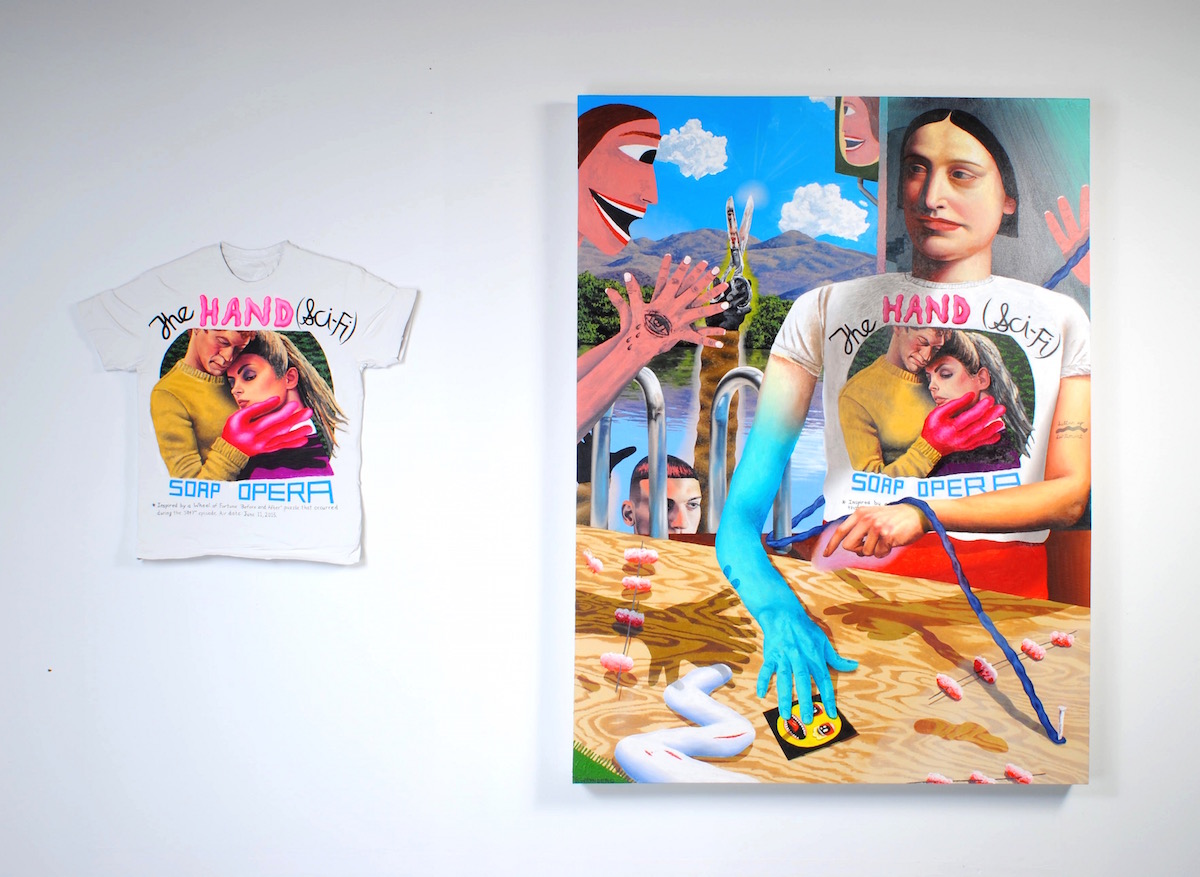
There’sis a shirt that I painted on a character that’s advertising a show called The Hand Soap Opera, it’s suppose to be this show that’s popular in this world and was inspired by a Wheel of Fortune ‘before and after’ puzzle. Anyway, I painted a physical iteration of the shirt and also wrote a script for one episode of The Hand Soap Opera, which I’m hoping to shoot later this summer. I’ll stop there, but I’m excited for it. I also received a Jerome Foundation fellowship this year and will have a show with the four other awesome recipients at the Minneapolis College of Art and Design this fall. 

Click here to see the artist's website


Publishing date of this interview 24/06/16

Read More
Frame 61 Frame 61

Elise

Could you tell us a bit about yourself. How long have you been a practicing artist and where did it all begin? 

I’m an artist based in London. I create sculptural works that employ a wide range of different materials and mediums. My pieces are often large scale and complex, though I would like to think that, in essence, they’re composed from an innately reductive approach to structure and form. 

I studied at Chelsea School of Art, which provided a valuable nurturing environment for me as a young fine artist, while also instilling much of the artistic rigour and self-reliance needed for the world beyond. I work from my studio in the Borough, London, and am fortunate to have received commissions that have helped to support my full time commitment to my practice over the last decade.

Pink Love 2015

Pink Love 2015 (detail)

Your sculptures have a playfulness about them, like kids toys. Is this intentional and if so could you talk about this and the reasons behind it?

Playfulness is important in my practice. On one level, there is a sense in the work of formal play with shapes, forms, materials and colours. On another level, I aim to disrupt and refigure the forms and materials I employ. I investigate the gaps within the everyday language of things: in the unobserved; overlooked; marginalised; in the fragment; and in the banal.

There is extraordinary beauty in a tiny curve of discarded packaging, the repeated ducting on an office rooftop, and in the linear twists of a playground climbing frame. When these forms are extracted from their original context, then manipulated through a process of distortion and repurpose, a spatial tension is created between the tangible and the abstract. I like to consider the language of the everyday as a site of imaginative possibility. Borrowing from the vernacular and the industrially mass-produced, my work seeks to create new, spatial totalities from disparate elements: immersive landscapes oscillating between association and ambiguity.

Metamorphosis 2015

In The Morning 2016

There is a conflict between weight, weightlessness and balance in your work, could you talk about this?

My sculptures are often precariously positioned in space, teetering between a kind of bubbling, weightless effervescence and imminent collapse. I enjoy pushing my materials against the edges of spatial, physical possibility, questioning the boundaries of their sculptural space. Heavy, hard-edged materials often appear as though they might float off, defying gravity; light, frothy materials communicate a sense of spatial temporariness and inevitable change. I try to inject a sense of duration into my sculptural forms, not just through the act of making, but in their physical construction and display. They perhaps conjure a sense of being suspended in a surreal, three dimensional moment before their transition into something else. This strange, rather uncanny relationship between volume, time and space fascinates me. I try to create a slippage in my forms between physicality and unreality, between material and immateriality.

What draws you to the materials you use? 

I use a wide range of materials in my practice, from plaster, clay, plastics and aluminium to low grade materials like plywood, polystyrene and cement, as well as found objects. I mix diverse textures, shapes and densities; intricate fragments combine with oversized, obscure forms; organic contours fold into sharp, machine-cut lines. Inspired by the idea of a ‘memory’ of referents, there is also a soft, semi-transparent layering of associations to other forms. I’m interested in contrasts between absence and presence, considering the absent referent in the construction of present form.

Similarly, there is an internal historical dialogue in the work between materials, forms and colours. I often repeat sculptural and colour motifs, utilising recurring or similar shapes and materials to subtly connect or mirror sculptural spaces. I also use colour as a communication of my form, as a persistent, tactile presence across the work.

Catena 2015

Catena 2015

Bisque Blush 2016

Catena 2015

Citric Blush Detail 2016

What is your process, how do you start a new piece of work?

Process and material have occupied me conceptually in my practice for as long as I can remember. I mix handmade, carefully crafted studio processes with machined perfectionism. Industrial and digital processes provide my forms with a highly precise, flawless quality in contrast with the variable outcomes of the hand, activating the space in very different ways. Digitally drawn pre-planning lends the work a sense of exact calculation, which can then be twisted by the creative, eye-to-hand intuition of making elements manually. This said, I generally also follow pre-determined systems when working by hand in the studio. I’m interested in the way they leave a physicalised trace of the time and space involved in the act of making: a sense of internal memory that binds me as the artist to the space of the work. 

Tell us a bit about how you spend your day/studio routine?

My studio routine varies depending on the piece of work I’m making and the specific materials, tasks and processes it involves. Although I tend to focus on one sculpture at any one time, I carry out smaller tasks towards a number of further sculptures, conceived in advance. I tend to plan my work through a series of detailed drawings on my computer, considering all elements in terms of shape, scale and material. This is also the case for all machined construction, so the work mixes digital planning and machine process with work I produce by hand. My studio is full of half-completed sculptural elements, materials of all description, found objects, and endless tools. As I’m always in the midst of making, the space is continually in creative transition. 

How do you go about naming your work?

My sculptures often take their titles from commercial paint charts. Mixing paint swatch names together randomly, new titles are formed with a slippery ambiguity, which I hope simultaneously evoke and confuse associations within the work. 

Hubble Bubble 2015

Hubble Bubble 2015

Ruin 2014

Ruin 2014 (detail)

What artwork have you seen recently that has resonated with you?

Ettore Spalletti’s use of colour and volume within space has extraordinary dimensionality (Marian Goodman Gallery), Louise Nevelson, on show at Pace, has been an important influence on my sculptural practice since I first saw her work in New York. Andreas Schmitten at Blain Southern last year, for his shared engagement with perfected forms. Phillip King’s Sun’s Roots II at Cass, Jannis Kounellis at Sprovieri, Gaston Bachelard’s ‘The Poetics of Space’, which I’ve just re-read, and can never read enough times.

Click here to see the artist's website

What does the future hold for you as an artist? Is there anything new and exciting in the pipeline you would like to tell us about? 

I’m about to begin a new series of large scale sculptural works, that, although planned to be created in a chronological order, are nonetheless envisaged to work together as one singular sculpture. In this new series, the spatial relationships between the sculptures will be interplayed with their chronology. The works will form one unified space, their elements similar, yet always subtly different: self-reflective in subtly mutating new arrangements, like a ‘repeat and transform’ computerised action or a manufacturing process, gone awry. The sculptural outcome will hopefully be strange and disorientating: a giddying immersive landscape of twisting, evolving forms.

Publishing date of this interview 24/06/16

Read More
Frame 61 Frame 61

Issa Salliander

Could you tell us a bit about yourself. How long have you been a practicing artist and where did it all begin? 

I was probably always a 'practicing' artist. The moment I understood it is a lifelong commitment was in Oxford as a young teenager when I started working with my mentor and friend forever Paul Saville.

You talk about your work having a narrative of light and dark, life and death. Could you talk about this and the reasons behind it?

I'm interested in life's ambiguities and the daily battle us humans have between being good and evil, and what is what.

Freebird III 2010 (left) Till Our Shadows Meet 2010 (right)

You are heavily influenced by music, mainly 60-70s psychedelic rock music, could you talk about this? Do you listen to music as you work and does this change the way you paint?

Yes, there's a lot of 'Love' in my studio. Music helps me think, and psychedelia was a progression from the more classic genres blues, rock, folk, which I also enjoy. It was intended to replicate or enhance mind altering experiences. Just like that music I like to draw inspiration from different sources and so creating something ambiguous which tells a different story depending on the viewer.

When I do the actual paint work I do prefer something a little heavier. Led Zep, Alice in Chains. It's about the drums. Drumming the paint onto the canvas. A good song can influence a painting.

What is your process, how do you start a new piece of work?

Photography either my own or found is my starting point. I build collages. There's a lot of rephotographing going on before satisfaction. The image becomes slightly more soft and grainy with each interaction. I like the contradiction with that and my slightly 'harder' painting style.

What do you hope the viewer gains/reacts from looking at your work? 

A personal experience.

Tell us a bit about how you spend your day/studio routine?

Children have routines, and some adults. 

B&W Cowboy 2010

Installation shot, OSL Contemporary

Study for Fallen Monkeys 2013

Freebird III 2010

How do you go about naming your work?

It's a game, I like word plays and titles that are visual. Sometimes after eliminating all the boring options something wild or more poetic drops in. I see so many crap titles around it really baffles me people get away with it. Guess there's no app for these things.

What artwork have you seen recently that has resonated with you?

Can't remember the title nor the artist, but a friend posted a history painting to my FB wall after a certain bbq at mine of a rather gruesome scene. I liked that. Timing. 

What does the future hold for you as an artist? Is there anything new and exciting in the pipeline you would like to tell us about? 

Yes, New York in the spring of 2017 to be announced shortly.

Click here for artist's website

Publishing date of this interview 24/06/16
Installation shots courtesy of
OSL Contemporary and Lisabird Contemporary Gallery

Read More
Frame 61 Frame 61

Zanny Mellor

Could you tell us a bit about yourself. How long have you been a practicing artist and where did it all begin?

Growing up in the English countryside has informed my interest in transience and transformative process. I studied art in Brighton and Bristol which are both cities close to the sea and informed by tidal action and this meeting of natural and urban has been very affective on my interest in place. The cyclical and seasonal rhythms and changes that are often imperceptible in nature also translate into my experience of a city too and I’m interested in how to make this visible and tangible

Moving to London in 2010, I was making work that visualised the collective movement of people, transport systems and architectural change; a multiplicity of concurrent sensory experiences.  My strong interest in natural geography however meant that time away from the city was needed. Travels to geologically rich areas of Patagonia and Iceland, have been particularly influential on my practice and I began to make comparisons between the processes of painting and the forces that shape the landscape. I completed a Masters in Fine Art at City & Guilds of London Art School in 2015, which helped to develop the shift in my practice towards the current body of work.

Blind Light 25, unique photogram 2015

Blind Light 8, unique photogram 2015

Your minimalist paintings loan themselves to the physical act of painting, could you talk about this?

The physicality of the painting process allows me to explore a sense of presence rather than remembrance. I found that using imagery of places I had travelled meant I was always led back to the past, so moving away from it was a challenge but meant that the physical, material and temporal aspects of painting became a focus. I am interested in imperceptible yet transformative actions such as erosion, calcification and deposition of fine rock

particles, seeing pigment as sediment that is suspended in a medium and transported away from it’s source. I began using erasure as a way to challenge the potential reading of an image by covering up what was there, to deny visual memory but also to preserve it, as if mentally archiving places of interest in order to move forward from them. The process of erasure is now very relevant for my studio practice, exploring this tension between presence and remembrance. Once I have applied a set of gestures, you have to be very attuned to the state of the paint and act on it just as it is about to set and dry, so creating a very active and alert way of working.

The actual and perceived speeds of materials and places is also of interest. I have come to see the body as a barometer, a way to measure a stream of conflicting experiences and of course using a fluid material such as paint, it is about finding a balance between control and chance. I am interested in the unpredictability of things, a sense of unsteadiness, flux and perpetual change and although my work is rooted in discussions of place and a certain physicality, it is also an observation of something boundless, un-measurable and sensory. 

Real Time, emulsion and aluminium paint on wall 2016

Real Time, emulsion and aluminium paint on wall 2016

Expose 2015, acrylic and aluminium paint on board, 165 x 122 cm

Swipe 2015, acrylic and aluminium paint on board, 165 x 122 cm

You create your own tools to paint with, could you talk about this and how this has effected your practice?

This has really come about through reductive methods of painting, needing to remove what I had just applied with brush. I often use squeegees and things lying around the studio with hard edges to erase and scrape away paint. In works like the Afterimage series, nearly all the paint is removed and this means that the process is often mistaken for screenprint. In April I made a wall based work with a large hand made ‘squeegee’ that was related to my own height. This way of working is always reliant on the pressure that you can apply, so there is a lot of chance involved and trying to be comfortable with the fact that you’re not in control.

I use a lot of rags also with the acrylic works. In works like Swipe, the erasure is never a total removal, as with a squeegee. They leave directional removal ‘trails’, smearing and redistributing the paint elsewhere which creates quite an atmospheric and hazy aesthetic. This is exactly what I want because in these sorts of works, I want your eye to continue to move all around the canvas, to never rest and be carried from mark to mark.

What is your process, how do you start a new piece of work?

As I am working across three slightly different approaches, they aren’t all happening at the same time and the processes are different. Sometimes a particular set of ideas and material research for a body of work will sit fallow for a while other things take precedence.

For the more minimal, binary works I have recently returned to compositional sketches. The variables are endless so I have to work across a series of drawings or small paper studies, which seems like visually problem solving. Although some of my mark making is quick and instantaneous, the layering has been carefully considered. I might 'warm up' by working across a series of small studies before I am ready to work on a bigger piece.

The photograms are always made in series during short dark room sessions and they often feed back into the studio painting. They are explorative in a different way because you cannot tell how the layers of shadows will interact until they go into the chemicals, so you work blind in that process. In the ‘out-of-focus’ studio works however they grow through a slower layering, oscillating between adding and removing paint, exploring how a colour or tone might affect the next. In these works each layer of paint asks a different set of questions from you and readjusts your course, so these are brought into resolution at different stages.

Blind Light 11, unique photogram 2015

Blind Light 22, unique photogram 2015

Blind Light 12, unique photogram 2015

What do you hope the viewer gains/reacts from looking at your work?

When in Iceland, I began manually un-focussing my camera and realised that I found the process of seeing (or unseeing) was more interesting than the actual capturing of the image. In works like Swipe and Dejavu I want to create this out-of-focus aesthetic to invite an active, unstable viewing experience. The thin and interspersed application of layers of matt and semi reflective paint keeps you perceptually engaged and questioning the process.  

The photograms are also particularly interesting because they are both painting and photography yet they challenge the normal assumption of both mediums. You can read them as paintings but you are denied the material experience of paint, yet they are not quite photography as you cannot access an image. The cacophony of layered marks means the visual response is unfixed and active, even if the photogram itself is chemically fixed.  I want them to be sensorily ambiguous, for a viewer to float within a questioning and somewhat sublime state. 

The more minimal paintings such as Expose have a different agenda however. They seem to create a very embodied viewing experience, to anchor you to a physical, bodily expression or movement. They are contained within the boundaries of the paintings edges and you measure your own sense of verticality against them. In a way they contradict my other bodies of work but I like to bounce between these binaries.

Tell us a bit about how you spend your day/studio routine?

For painting, I’m an afternoon person. Spending a few hours in the studio in the morning around other works or experiments, writing notes, phrases and research allows for the dust to settle and connections to be made, so I tend to mentally warm up during the day and exciting things usually happen in the afternoon/evening.

I will often have a number of things on the go at once, where small works are dotted all over the studio at varying stages of drying or resolution and layering experiments might be pinned to the wall for a while before they inform a painting. I move works around a lot, hanging them in different combinations to see how they react to each other.

It’s only the last few years I’ve realised how important music is to my studio practice. I used to use it as a way to block out the exterior world and focus on what I’m doing. Now I use it to set a mood and to carry me into a headspace. I’d really like to explore the connection between music and painting, a synaesthesia of sorts, as I see so many parallels between the movement, rhythms and speeds that are integral to both. The music I listen to sits somewhere between minimal electronic, jazz and cinematic classical.

Unearthed 1 and 2, unique photogram 2015

Unearthed 1 and 2, unique photogram 2015

How do you go about naming your work?

I am really interested in the relationship between language and painting and I write down a lot of phrases and combinations of words, sticking them up on the studio wall and in sketchbooks.  Some titles come very easily as they might be an inherent part of the process. Some are more elusive or the work will need to sit in the studio a while longer and be positioned next to other works in order to join the conversation. Some of my works are getting trickier to name as diptychs are appearing in my practice as gestures seemingly leap from one canvas to another.

What art work have you seen recently that has resonated with you?

I’m always drawn to process driven and quite minimal work. Recently I loved Gabriel de la Mora at Timothy Taylor Gallery and Michael Joo at Blain Southern. I think what intrigued me about these solo shows was the works lie on the fringes of mediums. De la Mora’s work owes so much to painting yet they are essentially collages of the materials used in printmaking. Michael Joo also seems to work in an exciting intersection between the processes and chemistry of painting and photography. I love this cross pollination between mediums and an ambiguity that keeps you questioning.

What does the future hold for you as an artist? Is there anything new and exciting in the pipeline you would like to tell us about?

After a number of shows at the beginning of the year I’m now excited to get back into an intensive making phrase and explore my materials in a more literal sense, using both natural and synthetic surfaces and pigments.  The growing comparison between photography and painting in my practice has been inviting deeper research into the possibilities of using light through projection and installation and I’m also excited to push into using other alternative photographic processes and chemistry.

I am really excited to return to Iceland this summer having been granted an arts travel bursary from a-n.  I am returning to engage with the rich geology, to explore the material connections between painting and earth science and to explore the length of the near arctic summer light. I’ll be working with cameras again to explore long and multi exposures, and hopefully some other experimental processes. This is going to be interesting to go back into using imagery again but I think this will challenge me and invite a new set of limits and questions.  

Click here to visit the artist's website

Publishing date of this interview 24/06/16

Read More
Frame 61 Frame 61

Antonio Marguet

Could you tell us a bit about yourself. How long have you been a practicing artist and where did it all begin? 

After studying fine art and sculpture in Spain, I came to London wanting to learn more about photography. I worked as a professional photographer and ended up doing editorials and front covers for art and fashion magazines, including an international gay magazine called AXM. I was always fascinated with the power of imagery in relation to fiction and desire and so I suppose that’s where all this began. After a while and studying an MA, I became more interested in moving away from the logic of photography back into the fine art context. 

The sculptures you create are photographed and then destroyed, could you talk about the reasons behind this decision to present your work in this way?

Is physical presence a condition for something to impose its authority? I think the immediacy of an image has a lot of power, and I think an image could tell more than the actual thing. This is not because of its descriptive quality but because it adds a kind of density. This density is what I have been exploring. On the other hand I’m interested in how materiality can reach another dimension beyond its physical gravity, and by using images I am making emphasis on their social element. I don’t believe in the notion of raw material which is more of a myth, and by using images their significant value as cultural matter come across more directly. 

Postmodern Affair, C-type print on aluminium and wood 2014

Postmodern Affair, C-type print on aluminium and wood 2014

What is your process, how do you start a new piece of work?

I certainly don’t have a formula and my mind wanders a lot. My process is probably not very different from most artists, although often slow as involves a lot of making before the photo-shoot stage. I think I always need to feel excited and get absorbed in experimentation. Although I part from a general idea and get involved in a body of work and research, when working on a particular piece I hold myself in a non-logical activity as this favours experimentation. I examine what the material can do and work on it, trying not impose any preconceived idea over the material. For me the work has to be able to tell something standing on his own. Quite often, I make quick mock up before I get involved in the production of a final piece, but even when it’s almost finished I always feel relaxed if I need to make any changes in order to get enthusiastic about it.

What do you hope the viewer gains/reacts from looking at your work?

I am not against having fun in front of a work of Art, but it would be nice if I could generate some awareness of the different levels in which materiality can be presented, their role and how we could relate to them. To what extent do we project an immense spiritual power into the inanimate? 

Ultimately, to stir the imagination and the mind upon questions relating to understanding non-rational dimensions deep in our mind, which are significant residue of the unconscious that has survived in history. I think my work is not about the devaluation of our direct experience, but maybe about the unnecessary relation between what we might experience as real and reality, and the questioning of any absolute.

You talk about objects and images being fetishised and/or worshiped, could you talk about this and your thoughts behind it?

Isn’t the absence of the stand-in what gives the special qualities to any fetish? I think the gap that an image leaves when replacing something has a lot of potential. My practice engages with that potential, and the way of turning ‘passive’ material into active subject of worship. This is to do with an irrational element in the way we relate to images.

Exotic Juicy Tutti Frutti C-type Print 2011

Silly Citrus Sunset in the Pacific C-type Print 2011

Tell us a bit about how you spend your day/studio routine?

I try to be surrounded by stuff that stimulates me and I spend my time in the studio as a playground, like a big child trying to solve a five-thousand-year-old puzzle ....I spend a lot of time observing how things behave in relation to each other, and maybe fighting against the natural order of things. 

A bit like the horrible vision that’s conjured in your mind when you think about the refugee who nearly drowned in a vat of chocolate when crossing the border into the UK. In a tank of melting chocolate, he had to keep moving to keep from getting totally trapped in the chocolate. 

How do you go about naming your work?

This is the most enjoyable part of my process. The names are very important notes. Sometimes basically they brings clues into the work, about what’s going on. And sometimes it’s nothing to do with the work and they help you as the viewer to get more lost and find your own answers.

What artwork have you seen recently that has resonated with you?

A video called Even Pricks by Ed Atkins with a talking chimpanzee. It was very engaging and I loved his straightforward and direct aesthetic. 

Pending Marshmallow in a Seascape, C-type print 2013

Phantom Limb I, C-type print 2013

Summer of Love Aftermath, C-type print 2015

The Encounter, C-type print 2015

89 Rave’s Ride, C-type print 2015

Drum’s Court, C-type print 2015

What does the future hold for you as an artist? Is there anything new and exciting in the pipeline you would like to tell us about? 

I am really enjoying my process and development. I’ve been excited since a recent show I had at Gallery Vasli Souza in Malmo, in how to engage the space around the works, from the walls to the floors by using wall-objects. 

My last project, ‘Skin of Shark’s Teeth’ connects the Marchioness Disaster with the Summer of Love in 1998 and the idea of loss and memorial. I am waiting for the perfect opportunity to show this as well as work on my latest series which is exploring our relationship with a sense of touch.

Click here to visit artist's website

Publishing date of this interview 24/06/16

Read More
Frame 61 Frame 61

Mark Jackson

Could you tell us a bit about yourself? How long have you been a practicing artist and where did it all begin?

I’ve always known I was an artist so beginnings are difficult to identify, but I have a vivid early memory of sunlight falling through net curtains on a dusty, abstract album cover. That definitely has something to do with the quality of light in my work. I felt my voice could be best expressed through art since an early age, and have made work all my life.

My professional career took off in 2003 whilst I was part of Jackson Webb, a collaboration with artist Charlotte Webb. We did a collaborative MA at Chelsea College of Art and worked together for seven years. After a great run working as a ‘third mind’, we decided to work independently and I’ve been concentrating on painting since 2010.

Minor Head - The Fall 2016

sddn blndng 2016

Your mysterious figures have an autonomous feel about them, could you talk about these figures/characters that you have created, how were they born? 

It’s interesting that you distinguish ‘figures’ and ‘characters’. I definitely see them as figures rather than characters or portraits, as they don’t represent any particular individuals. They are born out of my imagination, emerging in a tangle of ideas, processes and material transformations. This creates their ‘autonomous’ feel, allowing them to remain mysteriously mute and totemic.

The world of images is so congested that to have a voice you need a degree of autonomy, but this is complicated. Autonomy and the art object was a heavily contested subject during Modernism, a period when the possibility of art’s autonomy was taken more seriously than it is today. I side with Adorno, who says there is a political dimension to autonomy – what might at first look like indifference to the world transforms into total engagement. I want my figures to inhabit this tense space between indifference and engagement.

Post-Internment - All-Over-Type 2015

Knowing Nothing 2015

What is your process, how do you start a new piece of work, you say you use digital tools like Photoshop?

Although the finished paintings are end points in my process, it’s hard to determine their exact beginnings. I continuously work on images in charcoal, oil pastel, paint, and digital files, which form the under-layers for new pieces. Sometimes, multiple works share the same original image, which means that you see a repetition of forms and ideas across the body of works.

Photoshop digitally conditions many of the works, introducing qualities such as screen luminescence, though not all of them are developed in a digital environment. Image processing is just one of many approaches that integrates with drawing, collage and painting. Particularly fascinating for me is that digitally, I’m dealing with the light-emitting screen, but in paint it’s the other way round, the light source being external. So sometimes I’m trying to paint with light, like Monet did so well. 

What do you hope the viewer gains/reacts from looking at your work?

I hope my paintings create encounters that unfold slowly over time. In making them I’m constantly playing with my own visual perception, using colours that confuse how edges register, making paint appear as if it has light shining through it, combining careful renderings of gestural marks with their original incarnations, and all sorts of other experiments. So I hope that the viewer too is engaged in this game of unfolding the image through their perception.

I revel in the openness of how the work gets interpreted. One reading of my work that struck me recently was that its strength lies in the combination of ‘digitality’ with its specific form of address - the face. Another studio visitor spoke about my constant recycling of fragmented content over time, and how these recurrences relate to the idea of the ‘after-image’ in perception after exposure to a strong light source.

Your work has an on going battle between abstract and figurative painting, could you talk about the reasons for this and what attracts you to working this way?

I love this type of painting. In my work it’s more a deliberate hovering than a battle between abstraction and figuration. I like the way abstraction takes the figure apart; the way a painting can contain distinctive signifying elements, such as clearly defined eyes or lips, as well as sections that defy our perceptual capacity to rationalise what we’re seeing into a tangible form. It’s at the outer limits where things are breaking down, or in the process of formation, that there is so much possibility for new forms and ideas to arise. Ultimately this way of working liberates the viewer by not over-determining meaning. It also lets the image be something indescribable by any other means.

 
T.O.X. - The Peer 2016

T.O.X. - The Peer 2016


Tell us a bit about how you spend your day/studio routine?

I’ve never started and finished a work in one sitting. My process is quite fragmented, and I work on individual images in short bursts. I find it’s easy to overwork things, so I often force myself to leave an image just as it gets interesting to get some distance and encounter it afresh a few times before resolving it. Typically in a day I’ll do an oil painting on paper, work on a separate digital file, and maybe prepare some panels, which are time-consuming as they are gessoed to a very smooth surface. I’m lucky to have a studio in the building where I live so I’m in there as much as possible, for long stretches, but also in short sessions, between the day-to-day goings on of life.

How do you go about naming your work?

I don’t’ ‘think’ in titles but I do enjoy them and am not an ‘Untitled’ person. I see them as opportunities to twist the work - obfuscate, highlight, play with or divert meaning.

What artwork have you seen recently that has resonated with you? 

Cecily Brown at Thomas Dane is fantastic. I love the way she plays with how we perceive images and how we make sense of the visible world. She really puts you on the spot, asking how much of what you’re seeing is in your imagination and how much of it she is knowingly in control of and delivering to you with intent. It’s expertly done and brilliantly confrontational. Barry Schwabsky’s curated show Tightrope Walk at White Cube was excellent too. I’ve also been looking at the seminar and catalogue for Painting 2.0, which is interesting in terms of expression. It presents a challenge to the notion that expanded practices of painting are just performing critiques of expressionist modes and that they don’t ‘express’ in themselves. In the end they do. You really just can’t suppress it.

 
Fallen Files - Mystic Transportation 2015

Fallen Files - Mystic Transportation 2015


What does the future hold for you as an artist? Is there anything new and exciting in the pipeline you would like to tell us about?

Since curating Everything Wants To Run, a large-scale group exhibition at Block 336 Gallery in London, I’ve been completely focused on studio work.

I’m building up this current series of figures and I see them as a long-term project, working in the lineage of non-narrative figurative painting and the space between abstraction and figuration. The field is exciting and open and I hope to contribute to the debate and the production of new work in this respect.

There are a couple of group projects I’m working on – it’s a little bit too early on to describe them here, but I’m also excited about working with curators and galleries towards a solo exhibition of this new work.

Click here for artist's website

Publishing date of this interview 24/06/16

Read More
Frame 61 Frame 61

Sessa Englund

Could you tell us a bit about yourself. How long have you been a practicing artist and where did it all begin? 

I grew up in a household where the people around me worked professionally with fine arts, textile works or architectural design, so the idea of art being a viable career choice was present from an early age. I also saw how difficult it could be raising a family with these careers though. 

I think that kind of put a slightly cynical outlook of art in my mind, so it wasn't until my college years that I actually started to consider really committing to working with art as a long-term career. I’ve always been making things however, so that was always something that I spent a lot of time doing, but it took me a while to kind of build the courage and confidence, and identity as an artist separate from my family to actually consider it as something I would really allow myself to commit to. 

Accessorized Performance Peak 2015

Come See Me 2015

You talk about your use of materials associated with the “masculine” through the lense of traditionally feminine labour, could you talk about this and the reasons behind it?

Most of my work comes from a very personal place, and a lot of it comes directly from my upbringing, and the traditions that were taught to me through the home. I started wanting to make pieces that spoke towards my identity, and the assumptions and gendered traditions of artistic work as a “masculine labor” (versus creative labor viewed as domestic work) through an art historical context. I started thinking about the connections of taking certain signifiers and putting that through a traditional process that wasn't considered conceptual, or intellectual in order to attempt to invert that hierarchical structure.

That drove me into sculptural work, which drove me towards textile arts as an entry point, with techniques that had been taught to me outside of an academic setting. Working with denim became a very direct entry point because of its historical connection with masculine labor, the macho, “Americana” and masculine sexual availability. By putting this through the process of ripping, tearing, dying and crocheting I hoped to create something that was highly specific in execution and style, but still direct enough in signaling that it did speak toward to limited dichotomy of the feme/masc ideals. This then extended to becoming the entry point into exploring the ideals of emotional labor, and how that enacts certain assumptions in an art-world and art-market. 

A True Promise 2015

Relax 2015

You mentioned your interest in the relationship between creativity and commerce, could you explain what this means exactly?

My interest in creativity and commerce is quite direct, and goes back into my interest in emotional labor as connected to the art-market and “femininity”. Working in NYC you do see a lot of spaces and resources go directly towards the art-market versus less commercialized spaces, which takes something that is for me very personal and very removed from a commercial setting (such as working in the studio) and places that every concretely in a commercial setting. At the same time as there is a lot of language around that trying to mask that relationship between the sales and the artistic practice. Seeing how this relationship is propped up by this language of the artist persona being of this great monetary value, I wanted to see how direct and absurd I could make this connection. This is where my pieces such as the “Sad Mug, $12.99” series and “@sessasessasessa” keyring projects come from. I believe that there’s humour in making that connection very direct in that way, to see how much of my vulnerability I can put on sale and how fast and how cheap. 

What is your process, how do you start a new piece of work?

In the past years I’ve found myself very interested in the ideas that I just spoke towards, and these interests have crystallized in the past years. Once I get into a new piece of work it’s still this ghost of this older piece of work, so it’s usually just a process of jumping into it and I know what I need to do and produce. I enjoy being in that place at this moment, eventually I do expect this this to merge into something else, or to fall out of that space, but I do enjoy being in this place at the moment where I do have quite a clear idea of what I want to do and to go about making that. Usually new piece start with sketching, to some degree, I don't spend  lot of time on that, and then my time goes towards producing these pieces. My work is pretty slow and labor intensive, I don't really get to see the results until a month later, which is why I enjoy having a lot of pieces going at the same time. I also spend time trying things that I don't really have a clear plan for the outcome, I find this important to do as a way of working through new ideas. My work usually takes a lot of twists and turns anyway while working on it, so it's more the idea of just getting started on it, and then the work will tell you what it needs as you’re progressing with it. 

@sessasessasessa 2016

@sessasessasessa 2016

Tell us a bit about how you spend your day/studio routine?

My days to just be in the studio I usually have a schedule written down before the day starts so I know what to do. I wake up at 9.00 am, drink coffee answer emails, go start on the first thing on my list of things to do. That could be whatever piece I'm trying to finish, or a meeting. I usually try to toggle between working on pieces where I have a clear idea of what I'm working towards, with piece where I am more feeling things out so that i don’t get too caught up in any particular piece. I also find that switching between pieces ia  good way for me to solve for certain issues as I'm going about my day. I’ll either be in my home studio or my out of home studio, depending on what kind of materials I’m work with that day. Then towards the end of the day I will usually try to do some reading and some writing, then around 7pm there are usually art openings which is a good way to get me out of the studio. Usually by 8pm I feel like I'm out of my studio mode, unless there is a deadline I’m working towards or if I get caught up in something that I want to finish. 

What do you hope the viewer gains/reacts from looking at your work?

I hope they find something in it that hold their interest, more than just a visual play. I hope that it's a level of being uncomfortable around my work. I do enjoy that and I do enjoy that as a viewer of other people’s work, a certain push and pull of being attracted by the piece and also being pushed away by it. I do hope that people pick up on the humor in my work. When people pick up on the humor and the aggression in my work I get excited. 

How do you go about naming your work?

If the work brings about certain aspects that could benefit from a name then I will title it. However I don't always feel like this is necessary. Usually if there is something personal which is connected to the visual narrative that I’d like to share with the viewer then that will grow out of the piece quite organically. I think it is also a space where I am able to bring some of my writing into my visual work, which is quite fun so usually I try to be quite fluid in it and let my mind kind of go where it wants to go. 

Sad Mugs,  2009 - 2016 on going series

Presence 2014

What artwork have you seen recently that has resonated with you?

I recently saw a group show at Off Vendome gallery in the city, it had some pieces by Rochelle Goldberg in it that really resonated with me. She is also showing at the Whitney Museum right now, another artist Elizabeth Jaeger, whose work I love, is also showing in that same show. I’m always really excited about seeing Elizabeth's work: her take on vulnerability, aggression and humour really resonates with me and it is something that I look to exploring in my own work. Her work is really great. I also saw a solo show by artist Xinran Yuan at Roomservice Gallery in Brooklyn a few months back that really spoke to me. I really enjoyed how she had the confidence in her work to let moments take their time to rest. Christopher Thompson is an artists working in London who I’ve been seeing some really interesting work come through recently. I really resonate with how form is allowed to take center stage in a vulnerable sense in his recent sculptural pieces.

What does the future hold for you as an artist? Is there anything new and exciting in the pipeline you would like to tell us about? 

Yes this summer/fall seems like it’s shaping up to be quite busy. Alongside planning for the third iteration for a curatorial project titled “Cura” that I’ve been working on for a long time, I also recently started working with “Disclaimer Gallery” as a curator. We have an opening for Salome Asega June 14th, who is a great artists who I’m very excited to be working with. I’m also part of an upcoming performance series called “Haunted Matter” curated by Gabrielle Jensen and Helen Hazelwood opening June 30th, they have a great line up with myself, Bunny Michael, Dorothy Lam, Laura Cadena, and Rin Johnson, and I think Andrea Crespo. I am leaving next week to spend some time in Sweden to work on a project connected to this, so that is exciting. Then July 7th a group show curated by Marie Tomanova titled “Youth Explosion” is opening at the Czech Center up in UES with Michael Bailey-Gates, Claire Christerson, Maya

Fuhr, Ethan James Green, Maria Jose, Alexandra Marzella, India Salvor Menuez, Grace Miceli, Nicky Ottav, Go!Push Pops and Rafia Santana. Rafia is also part of a project of mine which was just launched called “Worse 4 Wear” @worsefourwear, shot by Elizabeth Renstrom which I am very excited to see launched. Then I’m also working on a show for Miami art Basel with Sarah Wang, Shaina Yang and Dava Wing, which I can't say too much about at the moment but I am very happy to be working with Sarah, Shaina and Dava on this, so I am looking forward to seeing that realized this winter. Outside of that I am looking forward to finishing some new work and spending more time in the studio. 

Click here to visit the artist's website

Publishing date of this interview 24/06/16

Read More