Jon Burgerman
“I certainly need a hug right now but a hug never lasts as long as I need it to. Take me back to the womb, shield me from all the chaos and nightmares!”
In our interview with Jon Burgerman, we step inside the bright, fuzzy, slightly frazzled world of his first New York solo exhibition, Hold On, It Won’t Last Long, on view at A Hug From The Art World Gallery (Ends 7th March 2026). Known for his squishy, wide-eyed characters that wobble between joy and existential dread, Burgerman reflects on humour as emotional survival and why even the most playful paintings can carry a quiet ache. He also speaks about letting art escape the gallery and run loose in the real world, whether on canvas, a hotdog float, or somewhere in between.
Could you tell us a bit about yourself and your background?
I grew up in the middle of the UK, studied fine art in Nottingham and then moved to live in New York in 2010.
As a child I drew my own comics and dreamed of animating them. The fascination of character design, mascots, motifs, all kinds of anthropomorphism, of saying something human through non-human forms, has held a tight grip on my imagination as my practice has developed.
For my graduating degree show I created pastiche commercial objects, that riffed on the kind of items you might find in the gift shop at the end of museum exhibition, but displayed as if they were the artworks. One such piece shown in a glass display case featured a Pepsi can, with a printed character sticker held with a rubber band around its middle. I added a small plastic conquering flag on top. As much as it may have toyed with the notion of a mass produced product as artwork it also celebrated it as a readymade collaboration.
This back and forth, art x product, high x low oscillation has typified my career (exhibitions, album covers, apparel, animations, public artworks, swag and merch). The joke landed firmly back on me when in 2008 I was invited by Pepsi to design a can for them to mass produce, which I of course accepted.
In Hold On, It Won’t Last Long at A Hug From The Art World Gallery, your first New York solo exhibition, the paintings are filled with figures embracing, stacking, and leaning into one another. Do you think the world needs a hug right now, and how did that feeling shape this body of work?
I certainly need a hug right now but a hug never lasts as long as I need it to. Take me back to the womb, shield me from all the chaos and nightmares!
I don’t know about the whole world (there’s some who deserve a punch to the guts) but I do sense a lot of people are feeling extremely anxious, not just about the future but about our day-to-day present. Headlines regularly feel like they will be reproduced in history books (should books survive) for future generations (should humans survive) to tut over and to make them feel relieved that they were born into a different era. It’s impossible to not feel these things and have them affect your work (unless you’re a bit of a sociopath). I did not set out to make paintings of hugging characters, or praying characters or characters looking off into the distance in search of something to hang some hope on. I had been painting isolated characters for a good few years (lockdown?) and wanted to see how adding more characters into the pieces might work. What else could they do together if not offer each other some comfort and consolation?
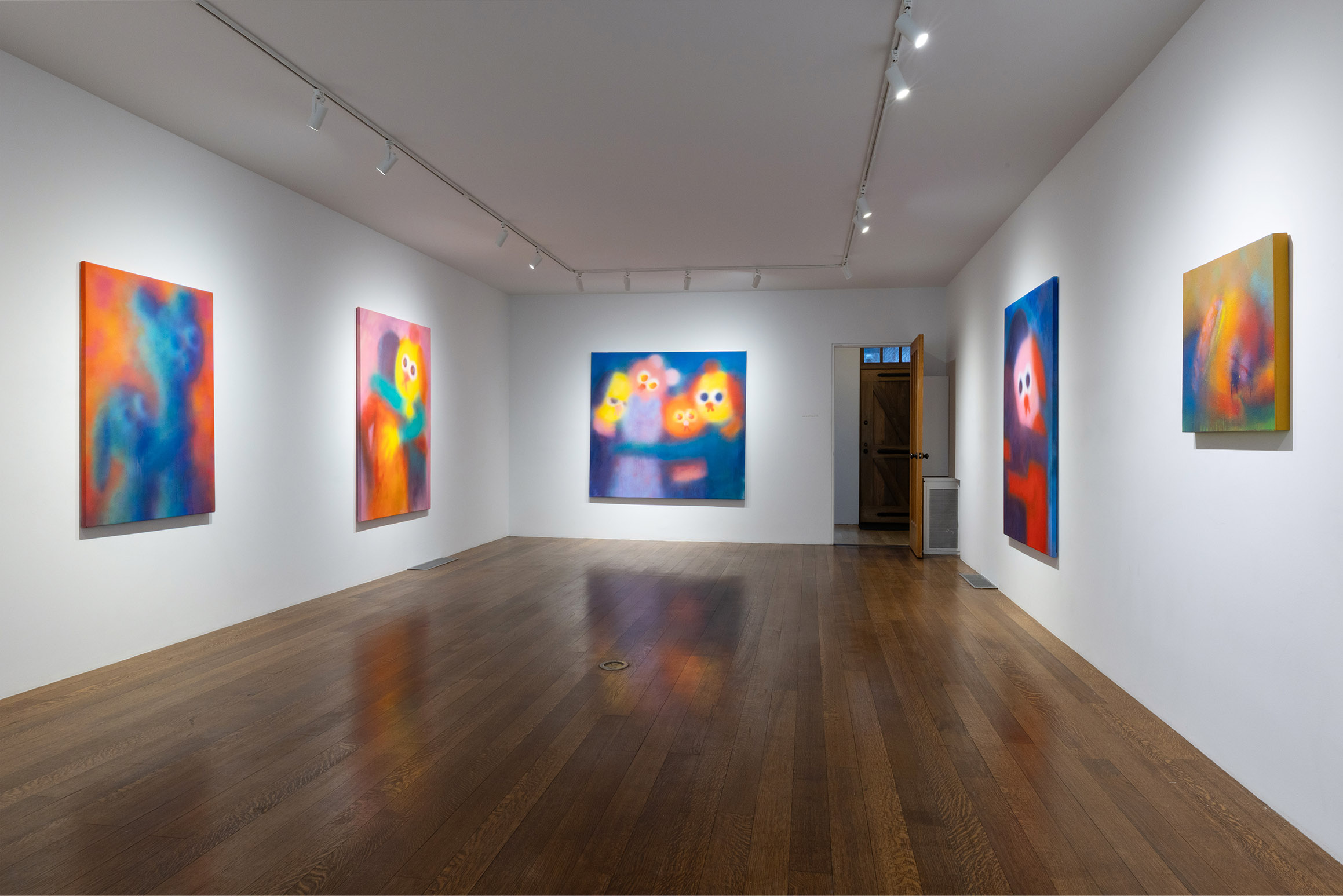
Hold On, It Won’t Last Long, at A Hug From The Art World, installation view, 2026. Photos by Jenny Gorman and A Hug From The Art World
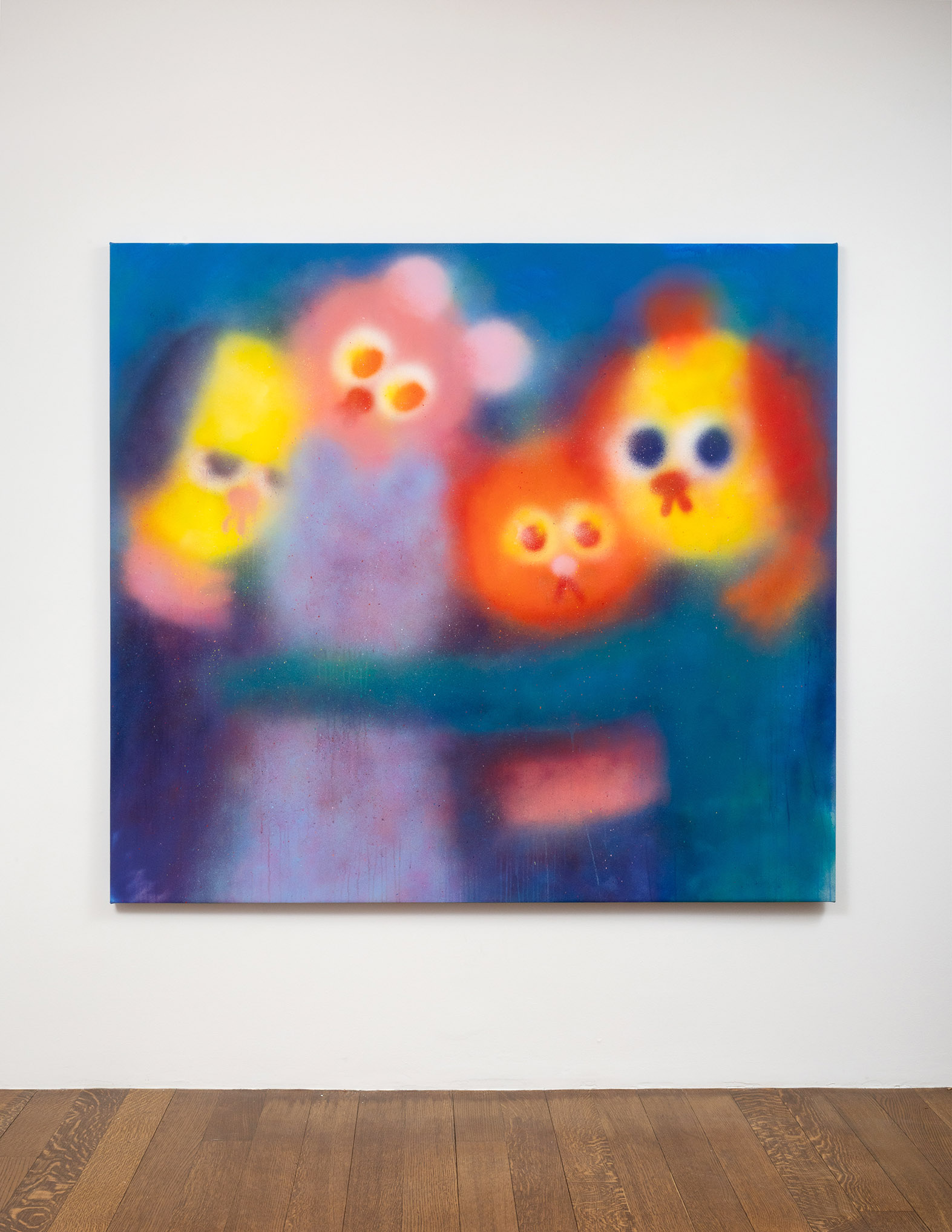
Huddle, 2024. Photos by Jenny Gorman and A Hug From The Art World
Humour has always been central to your work, and your characters often feel playful, awkward, or slightly off-balance. How do you use humour as a way into more complicated emotions, and what role do these characters play in expressing things that might be harder to say directly?
I often think of that idiom ‘If we don’t laugh we cry.’ Perhaps my Jewish background has a lot to do with how humour surfaces in my work. Growing up everyone in my family were funny (not always intensionally). I think it’s just a natural coping mechanism for dealing with an unimaginable amount of trauma, right? And then passing that along the gene pool.
Characters can get away with things it might be harder to express as a human. I also think my paintings allow me to express feelings my Britishness would trigger the emotion surge-break on.
I do think it’s kind of funny to be making paintings of fuzzy creatures but these non human characters allow for a greater amount of people to seriously connect to them emotionally without distractions of race, gender, age etc.
They become placeholders for anyone. For example Art Spiegelman’s seminal Maus is about a very specific piece of history but I think it’s use of cats and mice actually allows a wider audience to be able to connect and relate to its themes than if it was illustrated with human characters.
Now that I have a bit of distance from my paintings, I can see how desperate a lot of the characters are for connection. Even the characters who are embracing feel forlorn and distanced. As was pointed out to me by Adam Cohen, the gallery owner, none of the characters are even making eye contact with each other. It’s an unbearable lightness of feeling.
Your practice moves fluidly between paintings, large-scale installations, and objects that exist beyond the gallery. How important is it to you that your work lives in the world and becomes part of everyday life, rather than staying contained within art spaces?
Life is it! These inert objects and works and tchotchkes need a someone to engage with them, to give their being purpose. It’s vital they move out of my studio (or head) and go off and exist in the world. That’s the real glory of making anything; it leaving the nest and becoming its own.
I don’t differentiate too heavily between art spaces and non art spaces. Actually I’m not really sure what those spaces are, don’t we just make them up? This room is an art space now. This warehouse is an art space. This UHAUL truck is an art space. Any space can be an art space. If you buy one of my giant inflatable hotdogs and put it in your azure blue holiday home swimming pool, well then, by the powers vested in my imagination, that’s an art space now as well.
I think the art is activated wherever the transcendentalism occurs. Galleries are good for this, as climate controlled curated environments. But it’s not exclusive. I’m really happy for my work to exist across formats and media and disciplines. Not everyone is looking for art but it’s great that they might accidentally stumble into some, even if it’s outside some giant shopping centre.
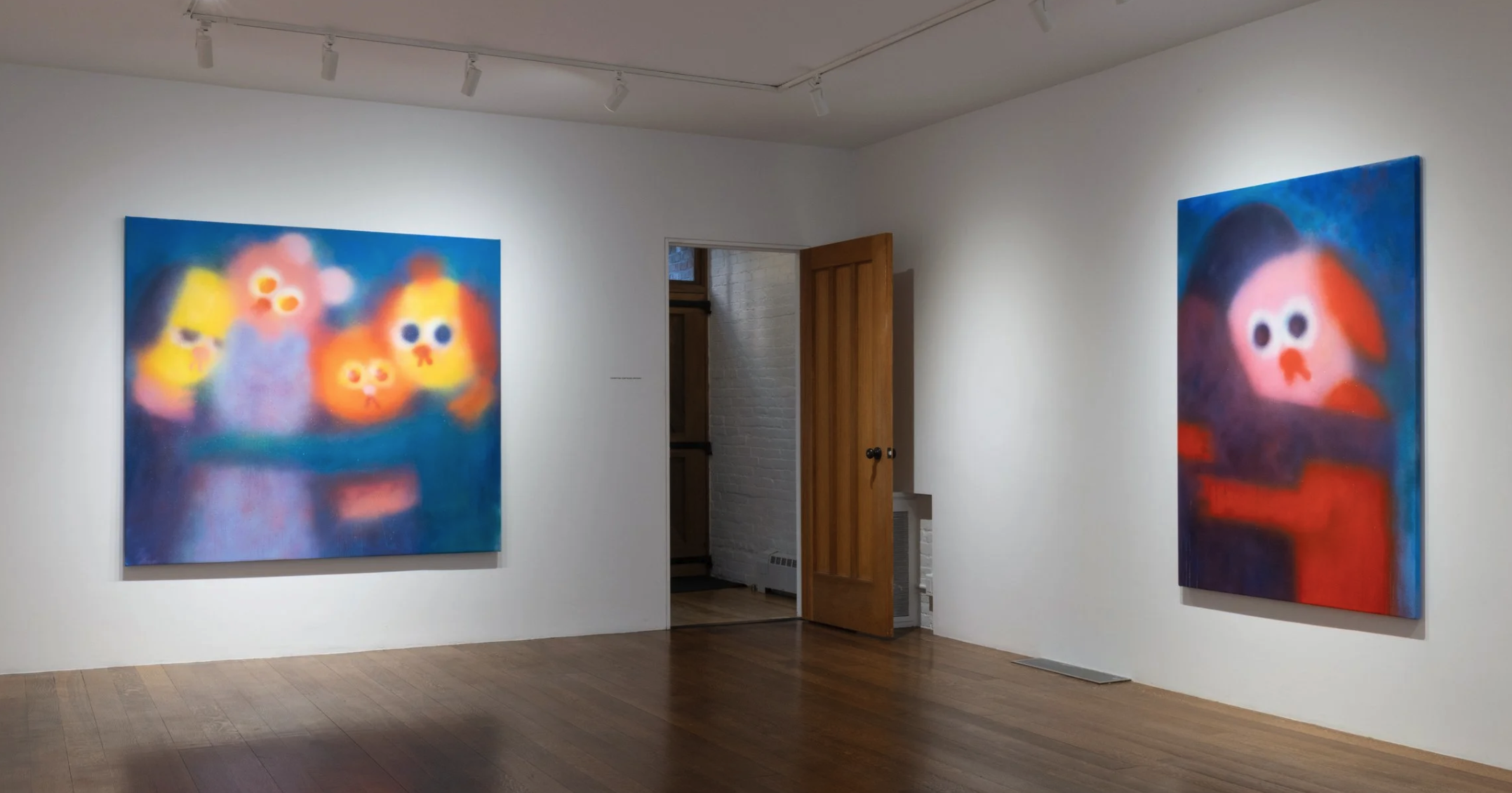
Hold On, It Won’t Last Long, at A Hug From The Art World, installation view, 2026. Photos by Jenny Gorman and A Hug From The Art World
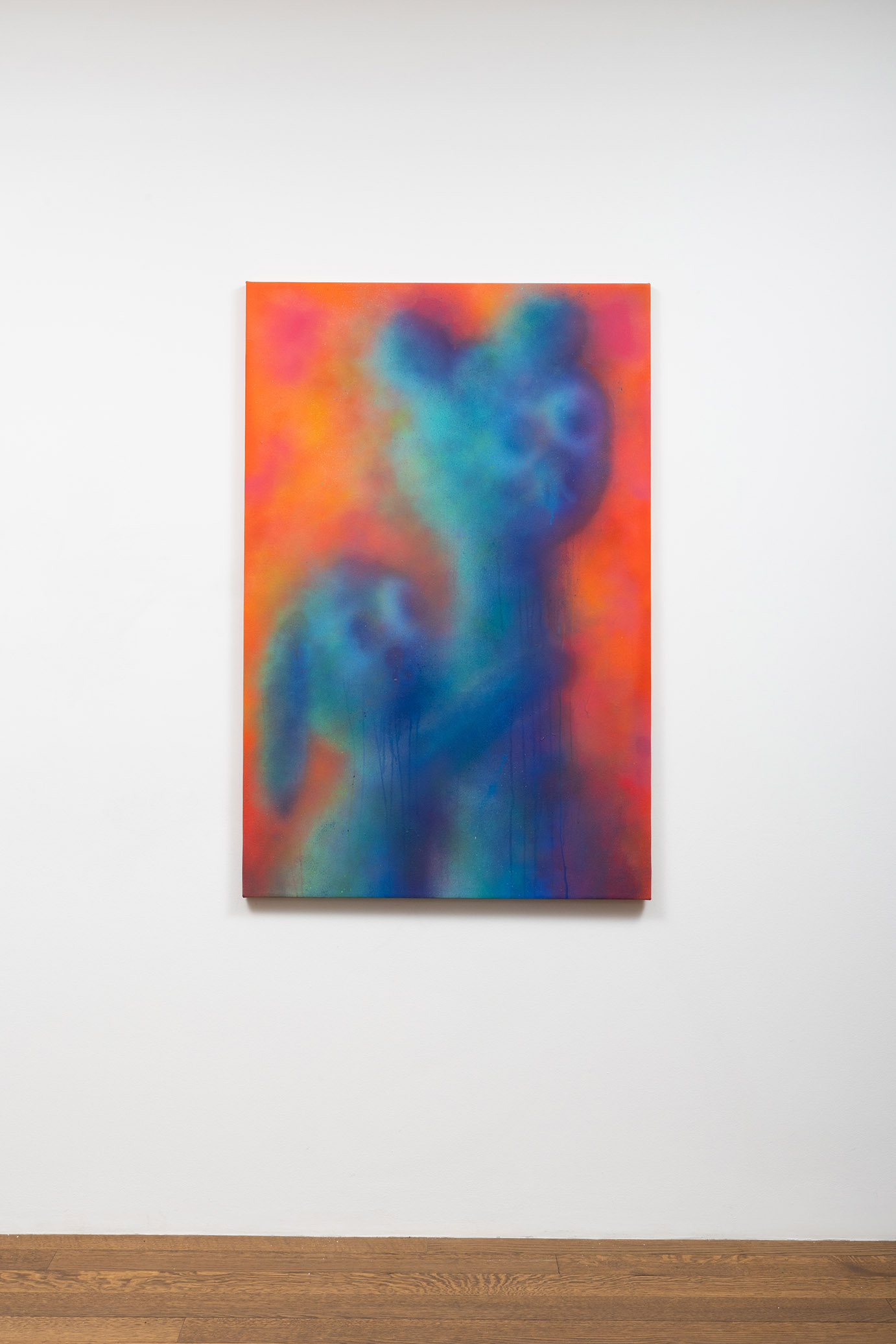
Passages, 2025. Photos by Jenny Gorman and A Hug From The Art World
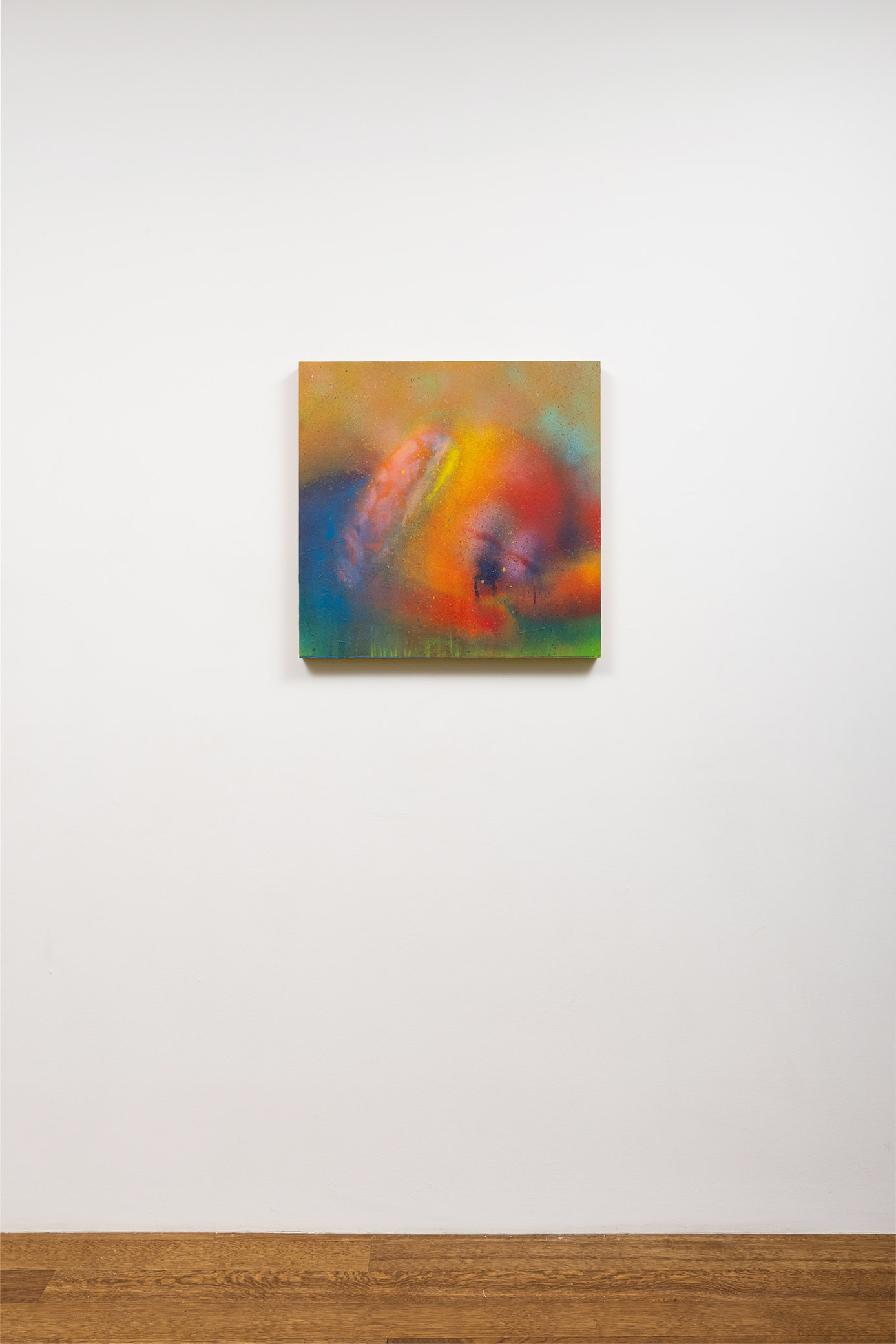
Asleep in a field, 2024. Photos by Jenny Gorman and A Hug From The Art World
Tell us a bit about how you spend your day / studio routine? What is your studio like?
My painting studio is a dust bowl. Luckily I have two separate rooms, one being a sort of office space which is relatively clean and the other, which has the New York luxury of a window (though natural light seems beyond it’s remit), is where I paint.
My routine on an average day is to wake up and assess the likelihood of the day being shit or not. If I calculate the likelihood of minimal mental damage, I will get up, stretch and stuff and then get to work on my laptop, answering emails and that kind of thing. If I figure there’s nothing but doom ahead I might lie in bed and read for a bit (which feels like a rebellious fuck you to the working day), or if I’m feeling particularly weak and self-destructive, I might muck about on my phone.
Due to the massive amount of emails and DMs we masochistically deign to ping pong to each other I rarely leave my apt before lunch. In which case I will make lunch at home and then trundle along to my studio in Gowanus.
Once inside my little studio bunker almost all electronic communication is curtailed and I set about fretting over my work. It can take me a long time to get in the mode but once I’m good to go I work with zeal and focus. After an hour or so of that I’ll be a spent force. I’ll either then waddle home dreaming of dinner or disappear on the F train to the city for some larks.
What artwork have you seen recently that has resonated with you?
I just had a visit to Melissa Stern’s Manhattan studio and felt very inspired by all the weird little freaks she’s created in her grotto. There’s a hint of Pee Wee and Tim Burton and the bastardised toys from the neighbours attic in Toy Story in some of her sculptures, which are equally discerning, vulnerable and innocent. They’re funny and dark, I really liked them and can’t wait for her solo show in NYC in a few months time.
Is there anything new and exciting in the pipeline you would like to tell us about?
Here’s a few things currently in play - I have a new picture book out in March, a story about story telling titled ‘Beginning, Middle and End’. Also in March I will be running a storytelling with art workshop for teens at the Morgan Library and Museum in March in conjunction with their new excellent exhibition ‘Come Together: 3,000 Years of Stories and Storytelling’.
I am part of a two person show with Ria Bosman at Tatjana Pieters in Belgium in April. I am working on two light-box ‘sculptures’ with a homeware company that will come out later this year.
I have a new collection of cases and travel luggage being released by Casetify in a month or so. I’ll be performing a spoken word piece (which I haven’t even started writing yet) at an event at Joes Pub at the end of March, but I’m more anxious than excited about that to be honest.
All images courtesy of the artists and A Hug From The Art World Gallery
Interview publish date: 24/02/2026
Interview by Richard Starbuck