Joan Horrach
“the action of walking is removed from its usual function. It is left suspended in an absurd repetition without progression.”
Our interview with Joan Horrach explores a practice rooted in performance, repetition, and the distortion of everyday actions. Emerging from a background in choreography, Horrach works across shifting contexts, using simple gestures such as walking to examine behaviour, perception, and the structures that shape contemporary life. The conversation addresses the development of ‘Somehow, Elsewhere’, the role of context in altering meaning, and an ongoing exploration of the body under conditions of repetition, detachment, and mechanisation.
Could you tell us a bit about yourself and your background?
I come from a dance background, for a long time I moved around the idea of being a choreographer and was making pieces with dancers and so on… I had this constant dilemma that the only reference I looked up to from that context was Pina Bausch the rest were artists like Nan Goldin, Lawrence Weiner, Sophie Calle, contemporary artists most of them not even working in the realm of performance. At some point I started questioning how I could combine choreographic tools and ideas with performative works within a contemporary art context, and this exploration eventually led me to ‘Somehow, Elsewhere’. Along the way, I began to understand that the art world is simply a system with its own rules. Eventually I realized that, for some reason, it suited me more to play the game of that system than that of the traditional dance world. I changed my passport to “artist,” and that was a turning point for me because I realised it allowed me to do whatever I wanted. The introduction of that identification really set me free from any constrictive thought of what I could or could not do.
Much of your work explores what you describe as the “distortion of the everyday.” What interests you about taking a simple action like walking and stripping it of its usual purpose?
If we go with the idea that art is a tool that allows people to see themselves and, through that, question the world we inhabit and our relationship to one another, then it aligns closely with what I refer to as the “distortion of the everyday.” I think clarity is actually quite boring. We are surrounded by it all the time. In fact, we live in a moment where everything appears clear: we see what is happening around us constantly, yet because of that saturation we gradually stop noticing it. So the question becomes: how do we make it visible again? For me, the answer lies in distortion. This is not a personal invention; I believe it is at the core of how art making functions. In the walking piece ‘Somehow, Elsewhere’, the action of walking is removed from its usual function. It is left suspended in an absurd repetition without progression. The result is a group of individuals who appear detached, caught in a repetitive glitch. Because of art’s history, a particular thought process is already embedded in the viewer: the instinct to make sense of what lies in front of them, to seek its meaning. Distortion simply gives that instinct something to work with.

SOMEHOW, ELSEWHERE’ No.1, Joan Horrach, 2024, Turbine Hall, Tate Modern, London, Photography; Callum Hansen.
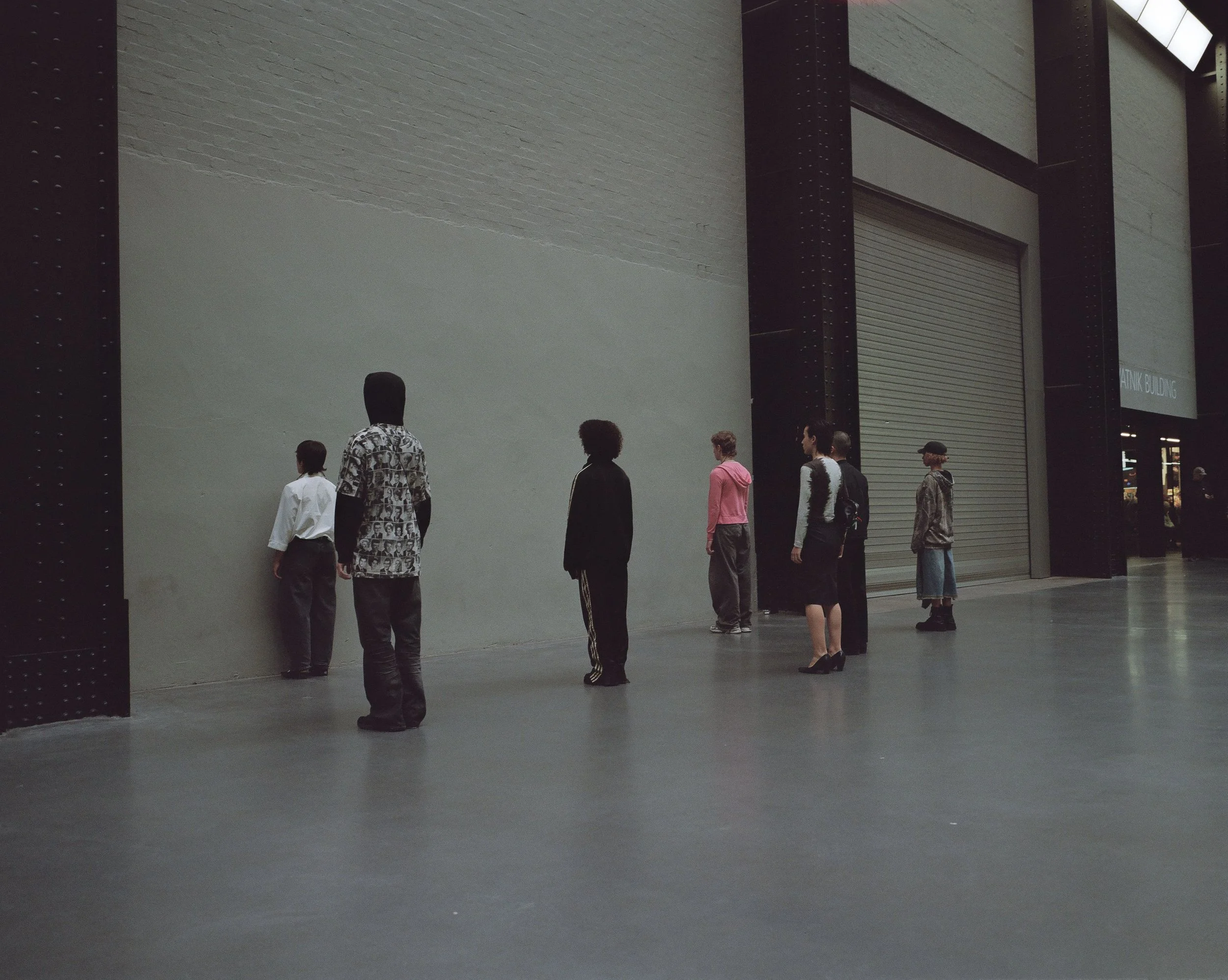
SOMEHOW, ELSEWHERE’ No.1, Joan Horrach, 2024, Turbine Hall, Tate Modern, London, Photography; Callum Hansen.
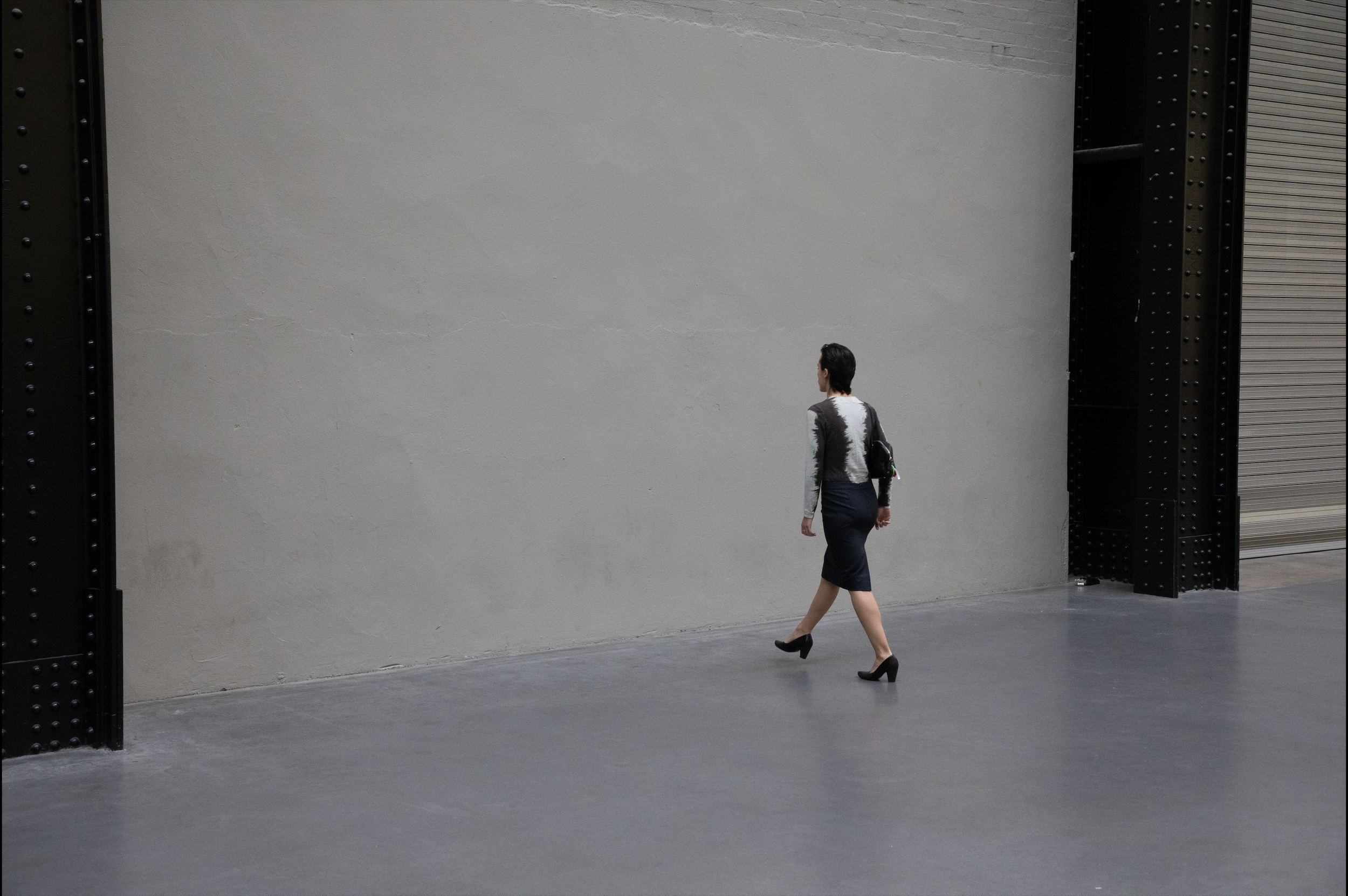
SOMEHOW, ELSEWHERE’ No.1, Joan Horrach, 2024, Turbine Hall, Tate Modern, London, Photography; Callum Hansen.
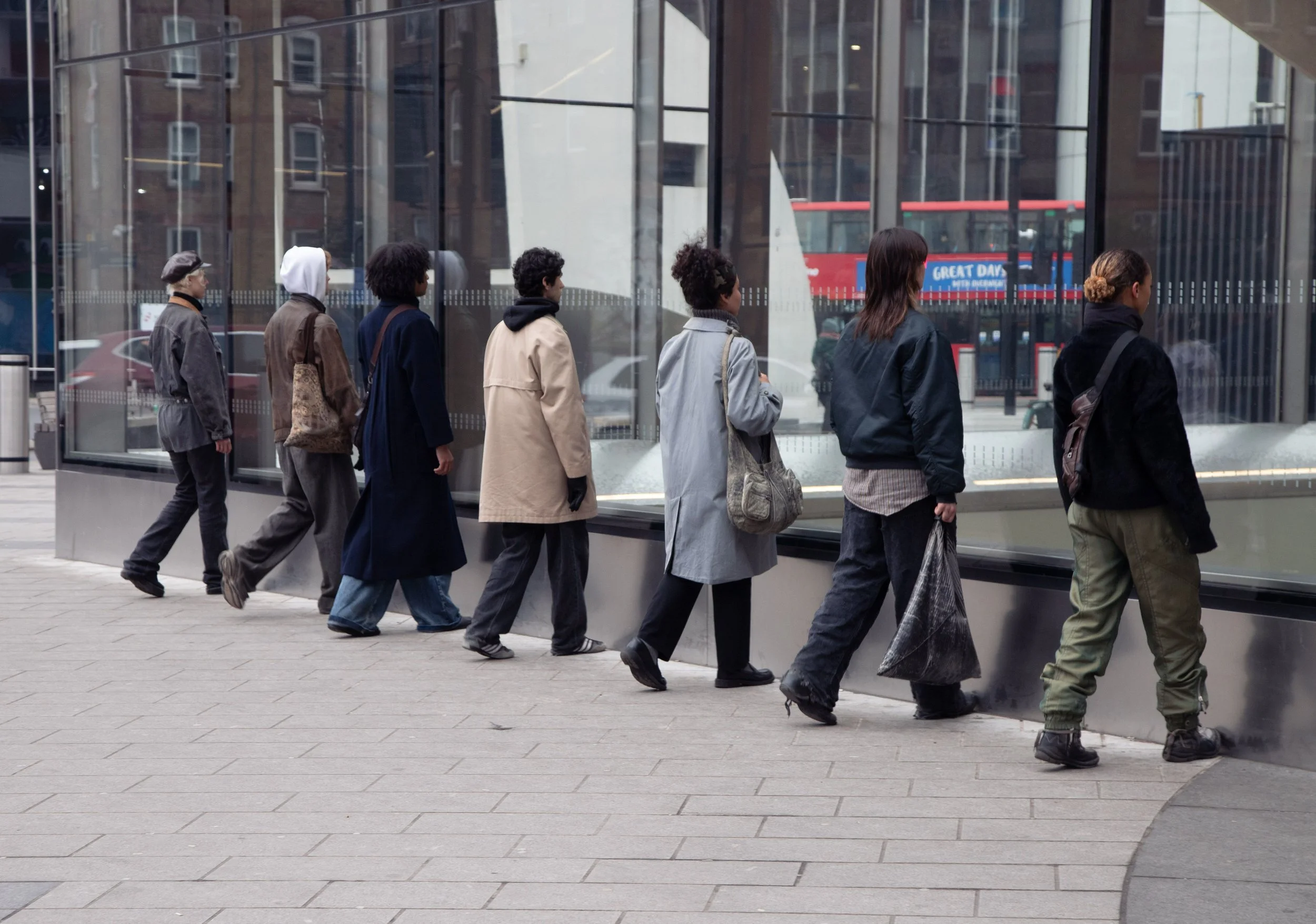
‘SOMEHOW, ELSEWHERE’ No.3, Joan Horrach, 2025, Old Street Station, London, Photography; Maciej Knas
‘Somehow, Elsewhere’ has been performed in very different environments, from the Turbine Hall at Tate Modern to offices and public spaces. How does the meaning of the work shift depending on the context in which it appears?
That was the main question I tried to explore during the two years in which I kept producing different iterations of the same work. It felt important for me to place the work at Tate Modern, partly to gain a kind of seat at the table. Yet a few months later I remember walking through the park with my friend Josef, who rather critically told me that he didn’t actually find art institutions that interesting. That conversation, combined with Claes Oldenburg’s famous line, “I am for an art that does something other than sit on its ass in a museum,” made me go home and decide to create seven different iterations of the work in different environments, to see how the context would introduce new narratives. The answer appeared almost immediately once the work was placed in new situations. When Somehow, Elsewhere was performed in front of a station, it seemed to connect vividly with people on their way to work. When it was presented inside an office, it began to address themes of labour and the mechanisation of the body. Even changing the number of performers altered its meaning. When only two people performed it, viewers often began to read the piece as something about lovers. I have always enjoyed pushing things as far as they can go, like repeating the same mistake until it finally exhausts itself.
As the performers repeat the same movement over time, their behaviour begins to appear almost robotic. What interests you about this transformation, and what does it reveal about how larger systems and structures shape human behaviour today?
When I made this piece, I was interested in creating a sort of temporary condition that would recreate certain behaviours which, for me, replicate or even mimic attributes that I feel best represent 21st-century human behaviour: detachment, mechanisation, robotisation, and emptiness. The piece delves deeply into technology and the navigation of the body and the mind through technological systems. When you are thirty minutes into the piece, something beautiful occurs: you no longer think about the movement. The body starts doing it by itself because it enters a sort of trance, and suddenly you acknowledge that there is a separation between what the body has, in this case, been conditioned to do and where the mind is. That is what the title Somehow, Elsewhere is trying to insinuate. I talk about these things not always with the desire to change them, but to acknowledge them. What the piece, of course through dramatisation, is trying to ask is: is this what we might look like from above? What are we becoming? What is our relationship to one another?
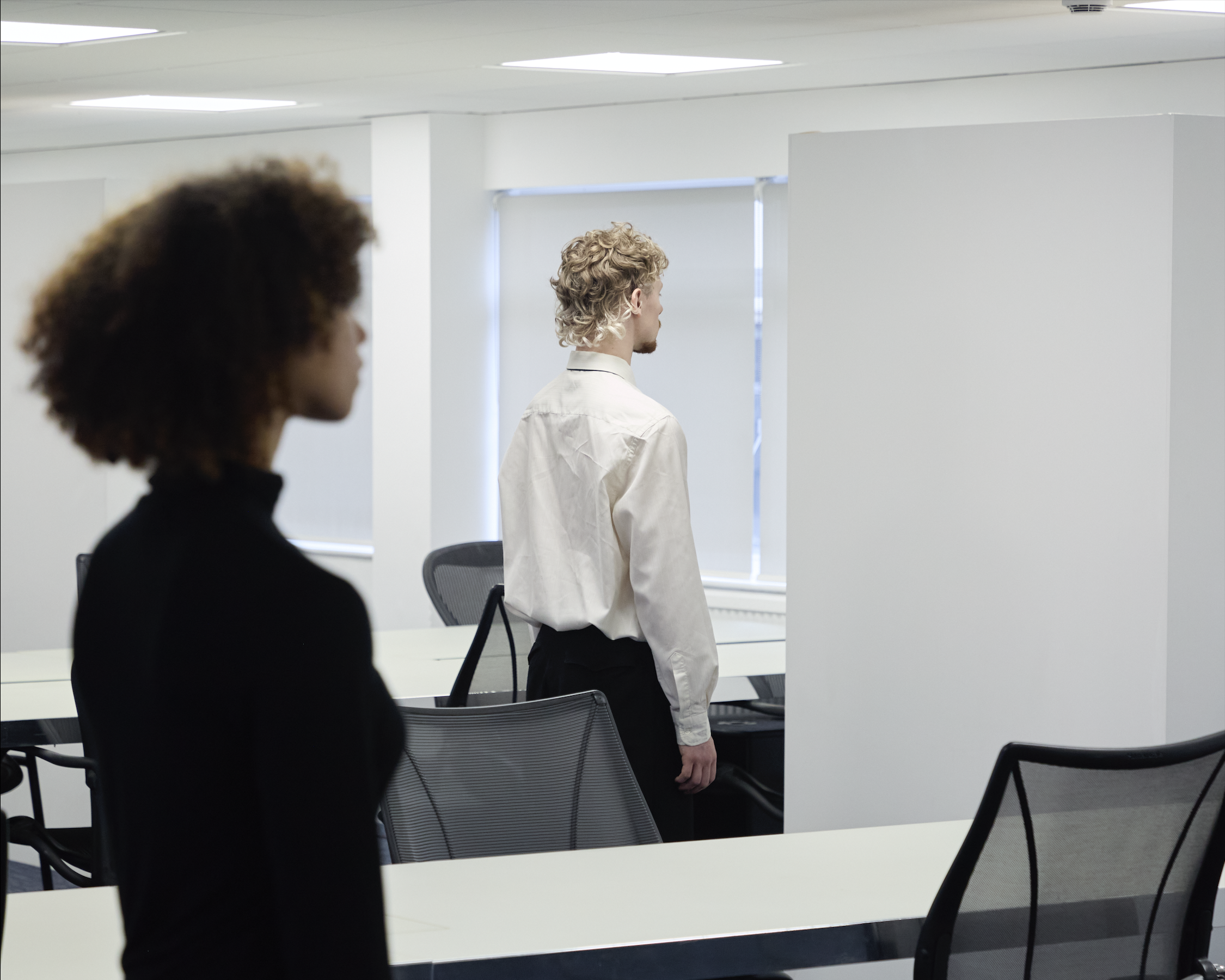
‘SOMEHOW, ELSEWHERE’ No.4, Joan Horrach, 2025, Office Building, London, Photography; Maciej Knas
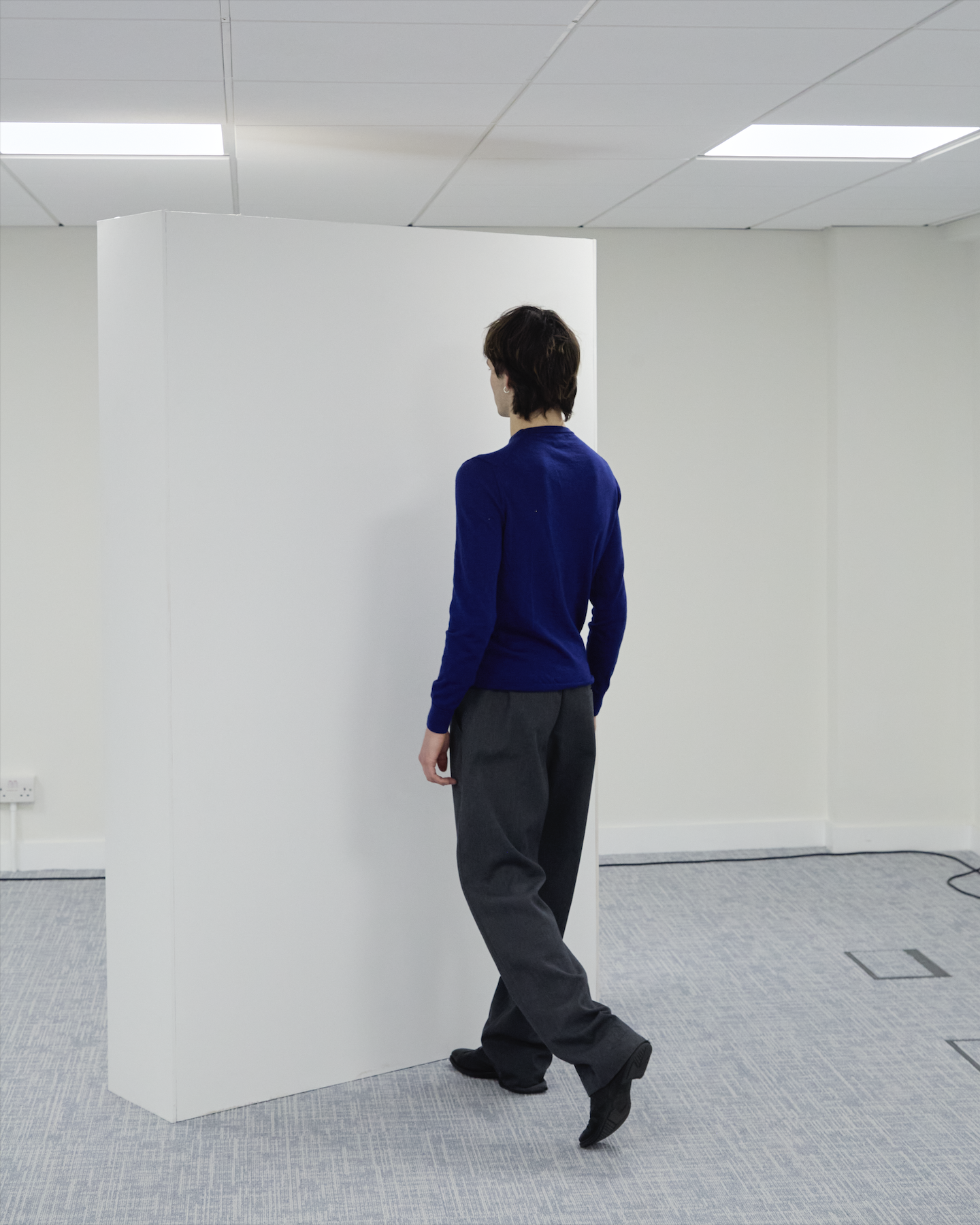
‘SOMEHOW, ELSEWHERE’ No.4, Joan Horrach, 2025, Office Building, London, Photography; Maciej Knas
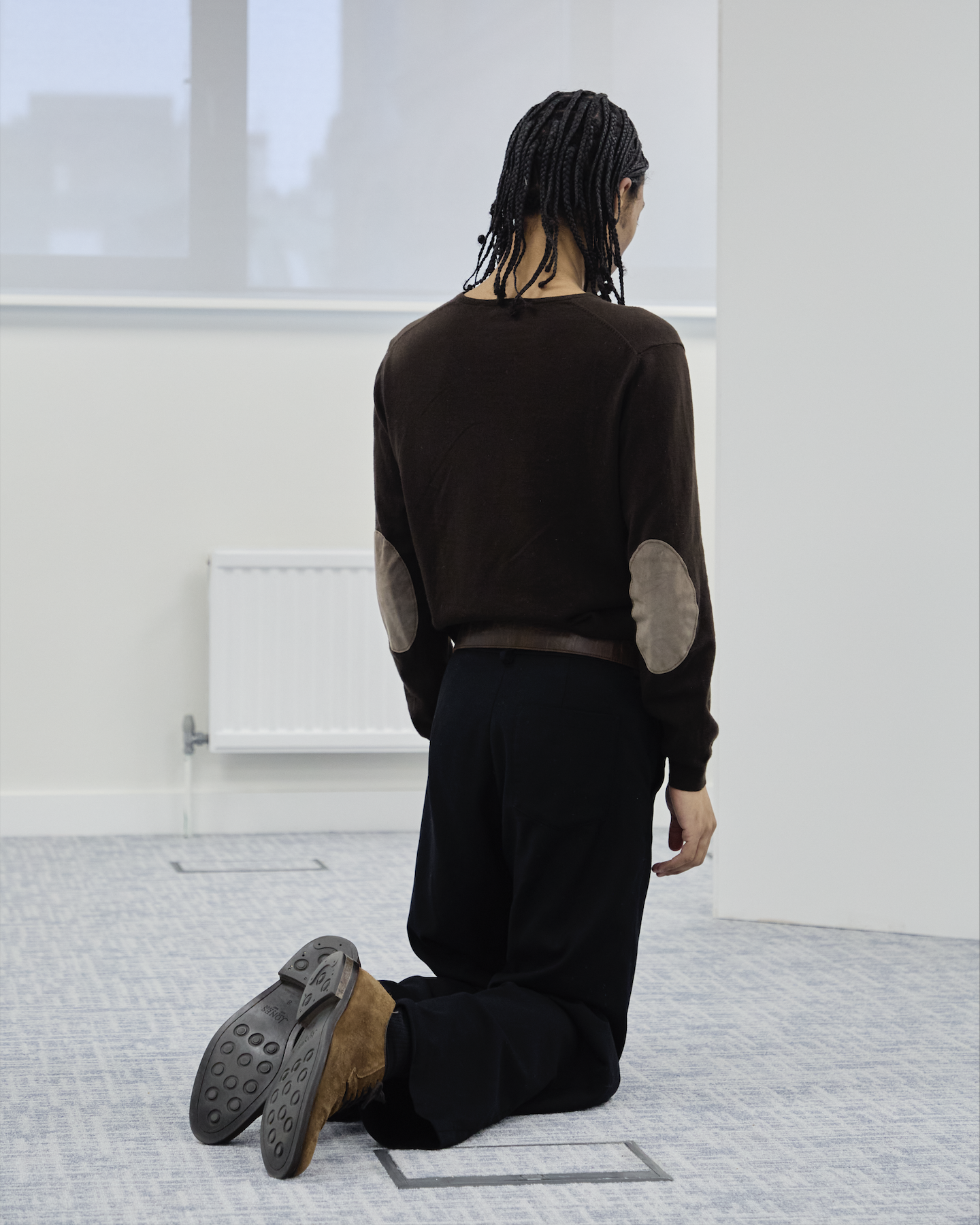
‘SOMEHOW, ELSEWHERE’ No.4, Joan Horrach, 2025, Office Building, London, Photography; Maciej Knas
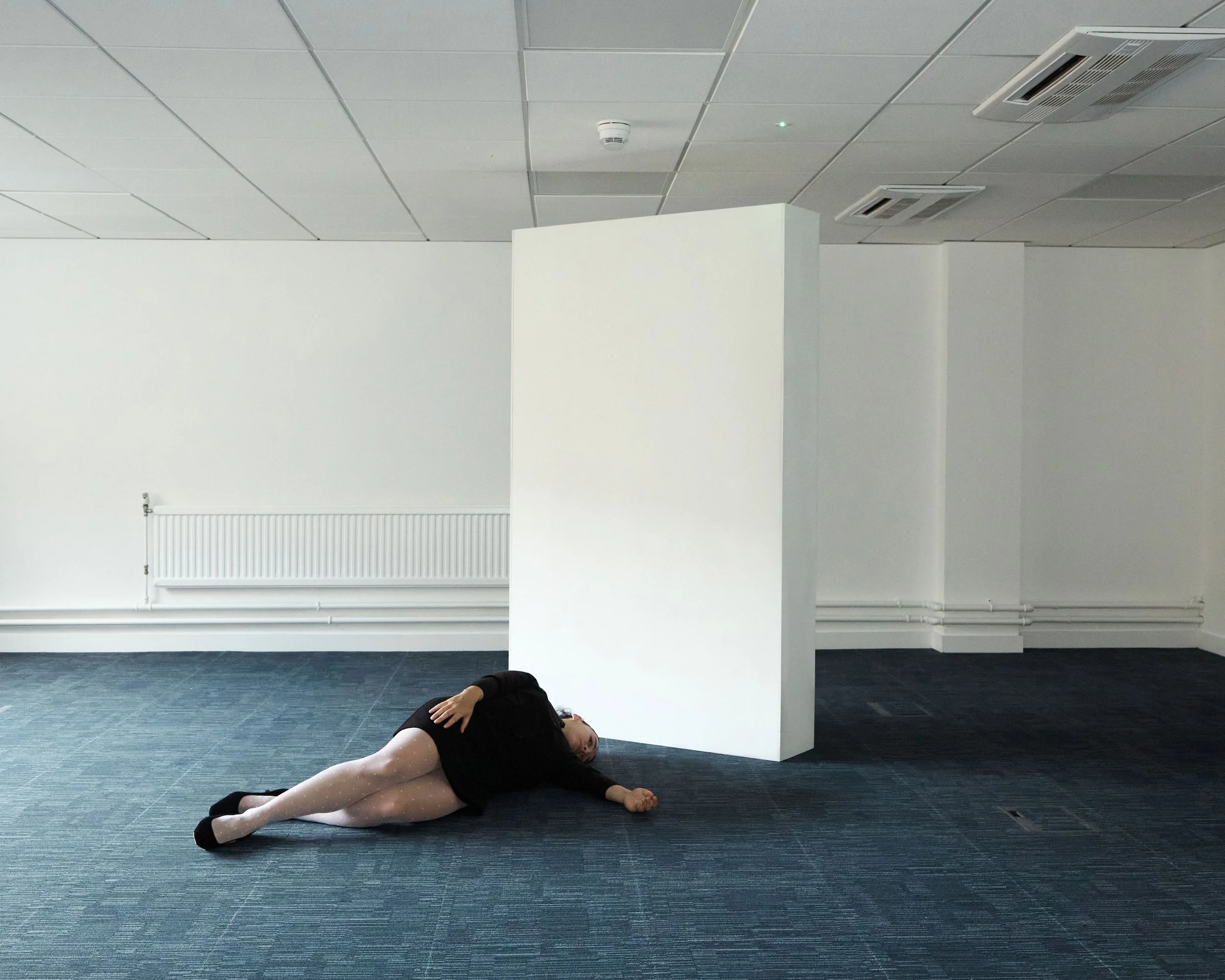
‘Untitled Portrait’ ‘SOMEHOW, ELSEWHERE’ No.4, Joan Horrach, 2025, Office Building, London, Photography; Maciej Knas
Tell us a bit about how you spend your day / studio routine? What is your studio like?
I love this question because, as a kid, my idea of an “artist” was always someone alone in their studio, probably covered in paint, making things all day. I think I somewhat pretentiously tried to live that fantasy when I was in New York and rented a studio for three months. The truth is that nothing came out of it. I don’t actually have a studio now. My work is mostly performance and event-based, so there often isn’t much to “see” until the moment it actually happens. Over the past few years, though, I’ve been lucky enough to build a team around me of set designers, editors, and producers who help bring the projects to life. So my days are often spent on calls with them, coordinating ideas and, quite often, trying to bring prices down for things.
What artwork have you seen recently that has resonated with you?
Four months ago I was walking back home drunk in New York and I bumped into Agnes Questionmark. If we allow ourselves to think, following traditions and theories from performance and body art, that the artist and the artwork can collapse into one another, then that encounter might be the most recent artwork that has resonated with me.
Is there anything new and exciting in the pipeline you would like to tell us about?
As I am writing this, I am seeing my new exhibition Distorted Scenarios No.1 being installed. The project will be showing from the 22nd of March until the 18th of April at SpazioSERRA in Milan. It is a new project with many layers, as it is an installation that replicates a waiting room where people will be able to see a series of films made in 2025 in London, in which a group of individuals were subjected to different long durational tasks of waiting, alongside a performance developed with a choir based in Milan that will unfold within the space every weekend of the exhibition. The project delves into the physiological and physical processes of waiting in contemporary spaces, which the philosopher Marc Augé refers to as “non-places.” The work is connected to my previous practice, an ongoing analysis of the physical body and the condition of the contemporary body under contemporary systems and situations. I haven't seen the final result yet but everything seems to be falling into place.
All images courtesy of the artist
Interview publish date: 26/03/2026
Interview by Richard Starbuck