Ragnar Kjartansson
"I was lucky to be raised in the darkness of the theatre."
Our interview with Icelandic performance artist Ragnar Kjartansson
Could you tell us a bit about yourself and your background? Your parents are both actors, right? Where did you study art?
Yes, they're both actors, I was lucky to be raised in the darkness of the theatre. And to be around chain-smoking people in costumes and makeup, its a pretty cool memory. I studied art at the Iceland Academy of the Arts, which is a school here in Reykjavík. I graduated in 2001.
You have an exciting new performance at the National Museum in Cardiff, with a series of revolving organists performing the 1959 hit song, "The Sky in a Room". Can you tell us a bit about this piece? And why you chose that song?
It's basically a song I've really, really loved for years. It's a beautiful Italian song by Gino Paoli, It's a love song and it's about how space transforms when you're in love. Visual art has always been about transformation of space and this is the only song I know that addresses this concept directly.
He wrote it in 1959, in bed with a prostitute, feeling the love in this weird space, in a brothel. And he starts thinking, you are here with me, the walls, the endless woods, the violet ceiling becomes a starry sky. And the harmonica, I hear, sounds like an organ. Reality changes and space transforms. There's this beautiful version of the song which he recorded, where it's just an organ. And when I was doing Artes Mundi in Cardiff a few years ago, I thought, how cool it would be to do a performance in that space with just that song and being performed on repeat. I think the idea for this piece just came from always having this song in my subconsciousness and listening to it a lot. And then just coming into this space in Cardiff with its– light blue, velvety– damask wallpaper, with light's coming in from the ceiling with this 18th-century gorgeous organ in the middle of the floor. I've always said– The space just asked for this performance to happen. And now weirdly it's happening, and I'm crazy excited about that.
"The Sky in a Room", National Museum Cardiff 2018 (c) Hugo Glendinning
1774 Sir Watkin Williams Wynn chamber organ at National Museum Cardiff (c) National Museum Wales
"The Sky in a Room" National Museum Cardiff 2018 (c) Polly Thomas
The gallery is full of 18th-century British paintings but all the works will be removed, leaving the room empty. Could you tell us what's behind that decision?
When you take the paintings out of the room, it just becomes a space with that song in it. If you have the paintings there, then the song will be accompanying you watching the paintings. I think it's also great for people who love these paintings and love this place. It's like when the paintings go away for a bit, you start missing them and you become really happy when they come back. But the main reason is if you have the paintings in there then the piece would not work.
Your ongoing piece called "Me and My Mother", is a video of your mum spitting on you for several minutes. You both do this every five years. Can you tell us a bit about this work, and has it affected your relationship with your mother at all?
Its become a really nice kind of gory family thing to do. It tells a mysterious story about our bond and about parent-child relationships too. And yes, I think it is actually good for our relationship, to do this every five years. I mean, it's a piece that my mother has become really proud of, and that makes me very happy. It's crafted out of an art school thing and it's just grown with time, and by repeating it, it becomes more and more important for us. It kind of gains weight as a work of art, I think.
Me and My Mother (2015)
There's a lot of repetition in your work. Do you feel by repeating something enough times it can change its meaning and also, with repetition it can be quite comforting as well?
Yes, I think it can be singularly, weirdly comforting. That's why we like habits, traditions, and comforting repetitions. Also by repeating something enough times can change its meaning. This idea of repetition makes a narrative or performative thing something that you can really look at, and I really like that. I like this idea of a song like Il Cielo In Una Stanza becoming a portrait of the song. Suddenly, it's "look at that song. Is that song as an art piece. A sculpture" But then it's a song also that can just come and go. I find that fascinating. I've worked a lot with repetition, I look at it as a tool of artistic expression, like yellow. It is like drawing something and when you draw it again and again and again, this kind of repetition of the drawing somehow gives it some weight and becomes interesting to look at.
Has there been any artwork you've seen recently that has resonated with you?
Yes, I'm always seeing something that I really like. All the time. One of my favorite pieces I've seen recently was in a show here in Reykjavík by this artist called Huginn Þór Arason. It was a great piece. It was called "Current". It's just a video of him and a really beautiful young man Posing like Brooke Shields in that famous Calvin Klein ad. They were reading Icelandic mid 20th-century poetry. This piece sort of blew my mind. The most recent one to blow my mind anyway.
"The Visitors" (still) 2012
"God" (still) 2007
Ragnar Kjartansson by Elisabet Davids
Could you tell us a bit about how you spend your day? Like studio routine? What's your studio like?
My studio is a concrete bunker by the sea where they used to store fishing nets and equipment. I work here with my studio manager Lilja and my wife Ingibjörg. We collaborate a lot. As for studio routine, I'm not one of those artists who just go to the studio at o'clock, has a cigarette and watches the empty canvas. It's more just like the life and art mix into each other constantly. So like today I did not go to the studio, I went to the swimming pool and was just chatting with people. The swimming pools in Iceland are sort of like a pub in England. You just meet people and chat. But chatting and socoalizing is really important for my practice.
Apart from the Cardiff show, is there anything new and exciting in the pipeline you would like to tell us about?
In the fall there will be a performance in San Francisco called "Romantic Songs of the Patriarchy" which I'm quite excited about. And then I'm doing a sad awful epic opera here in Reykjavík called "War" with the composer Kjartan Sveinsson.
Ragnar's "The Sky in a Room" will be on show from 3 February–11 March 2018 at the National Museum Cardiff.
Banner image: "The Sky in a Room" by Ragnar Kjartansson (c) Polly Thomas
All images courtesy of the artist, National Museum Cardiff and Artes Mundi
Interview publish date: 15/02/2018
Jules de Balincourt
"I am not sure how the Trump phenomenon will manifest in my work but I do know it is impossible for anyone to negate it and its ability to submerge into our subconscious.."
Could you tell us a bit about yourself and your background. Where did you study?
I was born in Paris France in 1972 and between then and 1980 had brief stints living in different places in Europe from France to Switzerland and Ibiza before permanently settling in Los Angeles in 1980. I spent my childhood following my mother’s impulses to chase love or shelter in different parts of the world, never really settling into one place until 5th and 6th grade, the first two consecutive years I spent in one school. I was constantly adapting to different settings and perpetually experiencing the new kid or outsider experience especially coming to American public school after having had a formative Waldorf school experience in France.
I spent most of my adolescence being a Southern California surf rat and it wasn't until taking classes at SBCC that I rediscovered art and a conviction of that being what I wanted to do. I then proceeded to spend 1995-2000 studying at CCAC majoring in ceramics studying with the legendary Viola Frey and making a side income building (beat legend) Michael McClure’s studio. I then headed east to NYC in 2000 in my little pick-up truck and sleeping bag, some tools, cooking and art supplies and dreams of the big city.
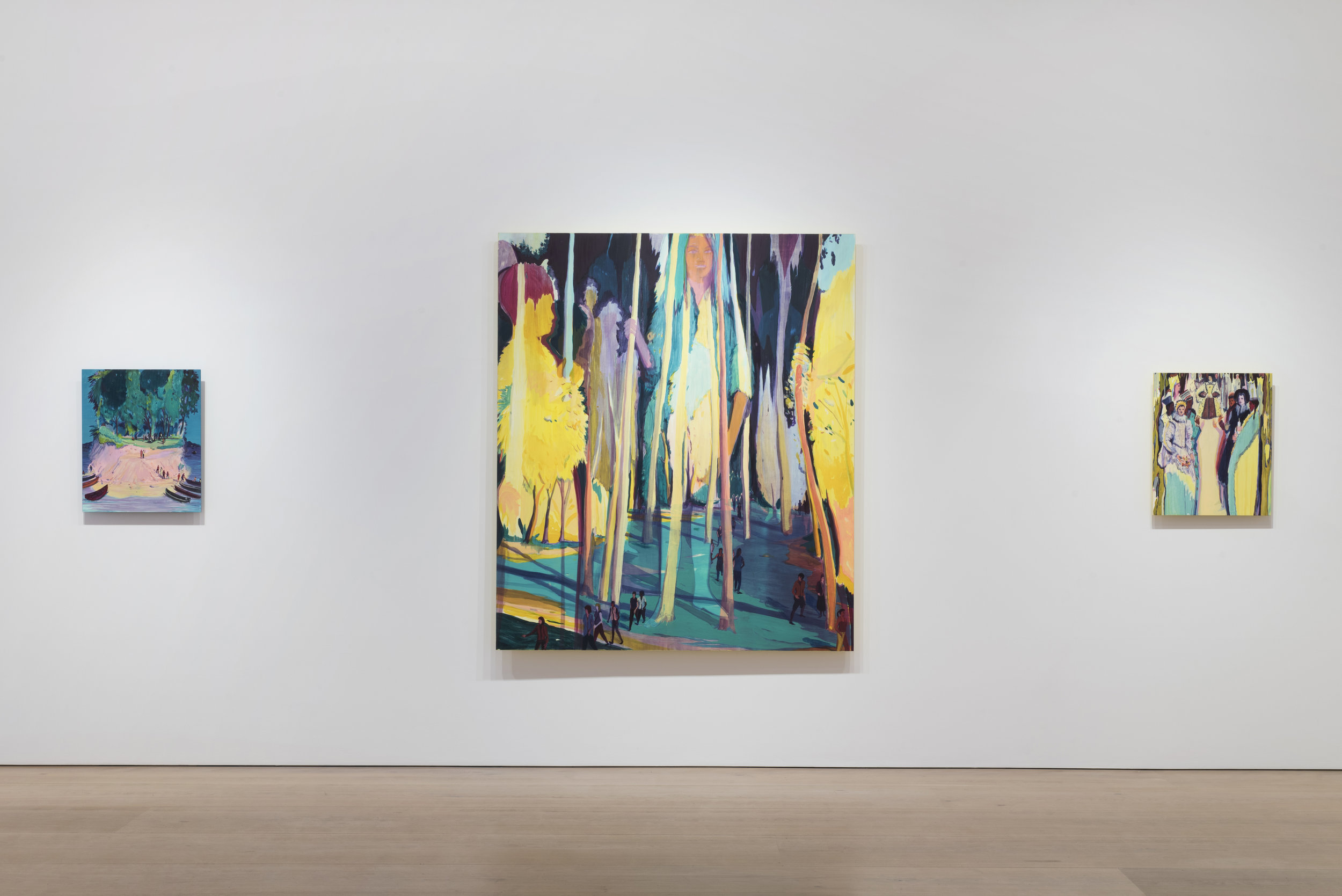
"They Cast Long Shadows " Install shot Victoria Miro Mayfair 2018
You are quoted saying: "Currently, making work and living in America is beyond words, but maybe not beyond images.” With 20 January 2018 being the one year anniversary of Trump’s inauguration, how do you feel being an artist in Trump's America? Has this affected your work?
"They Cast Long Shadows" is in a sense about this binary of opposing forces we are currently witnessing in America. They being either the Trump freaks or the anti-Trump camp because essentially it has become that simplified or divisive now, you are either 100 percent for or against him and there is no middle ground, no negotiating the extremes. Never since the Civil War has America been on such a profound brink of ideological rupture.
Whether its the neo-fascist Trump ideologue or the left fighting for equality, environmental sustainability and all the other causes that are under serious threat, historical moments like these leave big shadows as different ideologies clash for the light. I am not sure how the Trump phenomenon will manifest in my work but I do know it is impossible for anyone to negate it and its ability to submerge into our subconscious and how it manifests will unfold accordingly....either as act of resistant cooperation or complacency. The long shadows symbolize the trails or the remnants, the positive or negative effects of people’s actions or beliefs.
"They Cast Long Shadows " Install shot Victoria Miro Mayfair 2018
"Cave Country", 2017
"If Queens Ruled", 2017
Tell us a bit about how you spend your day/studio routine? What is your studio like?
Studio routine is not so routine – it has in past either been nocturnal or from 10-6 but there is no real schedule aside from a day or two with my studio manager in the office and one studio helper. For the most part I have kept it a small operation, still making my own paintings but facilitated by my two wonderful assistants. I like the idea of still being able to maintain a nomadic transient element. I think routine as an artist can kill creativity, one still needs to explore, wander, delve into the unknown, be surprised and awed. I sometimes attribute this to my first ten years living out of a suitcase but nonetheless I know it fuels me to travel and discover alternative realities. In that sense part of my routine is occasionally traveling, most of which at the moment is based in Costa Rica where I am currently building a studio and small residency to invite friends, artists, dreamers, whoever it may be that is seeking escape to come and visit. I spent so much time painting these Edenic spaces of escape, now I am going to seek and live it.
How do you begin a painting? I hear you don’t use images as a reference, could you tell us more about this?
This is true I very rarely begin with an initial image, since my work is essentially representation/narratively based. I prefer to begin the painting from a purely abstract intuitive process strictly based on color and form delving into a subconscious process before eventually finding, or "mining out" in a sense, the figurative elements. I like this process of seeking or searching through painting and layering of color in order to construct a narrative based both in primitive abstract space as well as a logical narrative painting space and how these two states of mind can cohabit.
"Troubled Eden", 2017
"Big Little Monsters", 2017
How do you go about naming your work?
That process is as intuitive as my process of working. Sometimes the titles precede the painting and then a painting is made in relationship to the title. Other times the title surfaces when a work is near completion. Very rarely some pieces take up to a year to title.
Is there anything new and exciting in the pipeline you would like to tell us about?
I am working on building my jungle art studio residence in Costa Rica and preparing a solo exhibition this October in Copenhagen at Galerie Bo Bjerggaard, in addition to participating in several group exhibitions that are in the works.
Jules de Balincourt, They Cast Long Shadows at Victoria Miro Mayfair, until 24 March 2o18
www.victoria-miro.com
All images courtesy of the artist and Victoria Miro Gallery
Interview publish date: 15/02/2018
Sofia Stevi
"One can tell if a painting is happy or sad."
Interviewed by artist Keanu Arcadio, you can visit Keanu's website here: artist's website
I think it would be good to begin this interview by asking how did you come across using cotton as a material and what began as the routine of using cotton as a material?
I always was interested in fabric and had a collection of different kinds of fabrics from a young age. Painting in cotton came through appreciating a nice cotton shirt but not liking it enough to wear it. So instead, I painted on it with black ink. Then I decided to do it more formally and started researching all kinds of different qualities of cotton fabrics to use.
Where did the themes of materializing psychedelic and sexual symbols derive from? Were there any particular books, movies, theory that cemented your interests?
My themes just come from my mind, myself and my moods and feelings (and probably all the visual information that has been stored in my brain since birth). One can tell if a painting is happy or sad. I like reading the news, I like comic books, I don't watch tv. I think pop culture is terrible nowadays, I don't feel I can relate. I would also like to slowly quit the internet. Right now I am reading a poetry collection by CAConrad called While Standing in Line for Death and it is affecting and wonderful.
(Installation shot) Baltic
Did you have any dreams that you documented as potential material and would say that your dreams alter depending on your daily diet? Or would this be a superstitious question?
I know in England they say that cheese makes you have wild dreams or something similar. We don't have this in Greece and I like cheese (even for dinner!) and it has never affected me. I don't write down my dreams but I remember a lot of them since my childhood. I still visit the same places in my dreams as when I was a child. I don't edit my life or my dreams to use in my work, I think it just comes up anyway. Two nights ago I had a dream that made me very sad, it was about my mother not liking me and/or my dog anymore. Perhaps it is going to come up in a work, perhaps the sadness is going to come up. I like to invent new stories for my works and I think these new stories can also be dreams.
In terms of naming your work, is this something you do as soon as you finish a piece?
Most of the times yes, and sometimes I am so slow to decide. But I really love it when I have the name earlier on!
The colours you use in your painting have a Sigmar Polke, Louise Bourgeois feel, could you tell us how you came to use this colour palette?
I think my colour palette came naturally through work. The colours I use are colours I am comfortable with and are chosen because they can convey certain ideas and feelings that I want to work on. Also sometimes I just feel like using them. These days I am working with black and white though, a bit more.
(Installation shot) Baltic
"lizzie & laura" 2017
"Set for Play" 2017
Sofia Stevi, Newcastle Journal
Do you have any rituals or exercises before beginning a painting?
The space must be clean and uncluttered, I have to be clean and warm and comfortable. Need my smokes and my coffee around.
Tell us a bit about your studio?
My studio is two rooms on the third floor in a 60s/70s building that used to house leather shoe makers' works.
All images are courtesy of the artist and Baltic
Interview publish date: 15/02/2018
Gordon Cheung
"The rise of the internet and availability of mobile phones were signs of an increasingly technologised era where perceptions of time and space are in a state of perpetual flux."
Interviewed by artist Keanu Arcadio, you can visit Keanu's website here: artist's website
Let's open up this interview by telling us your morning routine and if you use any technology to plan any works beforehand?
Wake, coffee, food, emails, studio. Every new work starts on the computer where research takes place before working out the composition of an idea in usually Photoshop. Colours and image are worked through before committing to printing, collaging and painting in the studio.
Have you seen any paintings or films that have drawn your nose in a new direction?
There have been many films but notable ones that I seem to keep going back to are the Director’s cut of Bladerunner, Bladerunner 2049, Stanley Kubirck’s 2001 and Apocalypse Now. There are so many paintings that I would be hard pressed to name but the National Gallery and Tate Museums are always inspiring places.
The paintings you have executed share similar compositions and elements from 16th century medieval paintings, when executing your paintings do you have any images up when working in the studio?
I think you must be referring to the glitch works that I have made that are high resolution photos of paintings from the Rijksmusem. An algorithm is used to re-order the pixels without destruction or duplication that result in what I think of as a digital sands of time effect. These are then either converted into animations, prints or giclees on canvas. In the studio I have images of the work I have planned out on the computer for reference. At home I have a mix of my own images and others on my wall in front of the computer.
"Eelke Jelles Eelkema mres"
"Still Life Abraham Hendricksz van Beyeren c.1640-1680"
Would you say you have taken the syntax of how the screen moves into the language of painting and would do you foresee yourself executing your paintings into the digital format?
I already work with digital formats if that means using computers and printing them onto surfaces and collaging them onto canvasses or printing directly onto canvasses. Moreover I make animations now and then. When I was at central Saint Martins from 1994-98 I wanted to paint without paint to question the medium itself but also to side-step the dominant discourse of ‘The Death of Western Painting’ by adopting the language of abstraction and substitute paint for collage. Why? Because I wanted to reflect the digital and communications revolution in my art. The newspaper represented the globalised space of Capitalism and was a good starting point that has remained in my work for over 20 years.
The rise of the internet and availability of mobile phones were signs of an increasingly technologised era where perceptions of time and space are in a state of perpetual flux. To me the landscapes of zeroes and ones were flowing through us and the metaphor I chose to use was the Financial Times newspaper and especially the lists of the stock market. So what does the screen mean? I grew up with the first home computers and when I first played games on the TV I was blown away by how you could control something on the screen that felt like as though it was in an alternate reality beyond the screen which was and is a world constructed by zeroes and ones. It makes sense to me to try to visualise the languages of our times and to use them in our chosen mediums to capture something about our human condition. Future works will involve 3d printing and hopefully some work made for VR.
"Here be Dragons" Video installation
Following from the last question, how much influence would you say you allow from the screen? Are there times where you take ideas from the T.V or browsing the web?
I’m uncertain of what is meant by the ‘influence’ of the screen as if it somehow innately has quantitive coercive power. I definitely take ideas from TV or browsing the web. I try to keep mind open in a place where inspiration can be found and the internet is for me a massive library. So whatever form or shape that takes whether its looking at art from around the world, David Lynch’s Twin Peaks, Game of Thrones, Masterchef, a youtuber analysing a film script or David Attenborough’s recent Planet Earth there is always something incredible to learn and be inspired from.
The Minotaur series is very much different from your other compositions of flowers, fruit and static objects. What was your incentive for creating this series?
The Minotaur series came from searching for a mythical sign of our global times. The stock market is called the bull and the bear market apparently due to the way how they attack. A bear strikes down and a bull thrusts up to describe the movements of the stock market. I found it fascinating that one of the most important spaces of our modern lives should use attack metaphors and animals for what is one of the most artificial spaces we as a humanity have created.
So the Minotaur came into my mind as a symbol within a labyrinthine matrix of numbers. A cursed creature of man and beast and also a symbol of our relationship to nature. The still life compositions are based on the Dutch Golden Age Still Life which was a period considered to be the birth of Modern Capitalism with the first recorded economic bubble over the surreal speculation of tulip bulbs and the rise of the first global company with militarised trade routes, colonisation and slavery. The still life paintings were a way of looking at what is now considered to be a benign genre and reframing it to question the histories that are written by victors and therefore those that are hidden. It was a response to the 2008 Financial crisis that led me to finding out about the first bubble in history.
"Great Wall of Sand" Unknown Knowns at Edel Assanti 2017
Unknown Knowns at Edel Assanti 2017
"Here be Dragons" Installation
Do you see yourself revisiting depicting animals or moving objects in your work?
I am frequently making work depicting animals but I haven’t yet made a work with moving objects yet. I certainly make moving image based works.
Finally, what can we expect to see from you this 2018?
I currently have a group show at Alan Cristea with 3 Turner Prize artists and also have an ongoing solo show at the Ann Norton Sculpture Gardens in West Palm Beach. Forthcoming is a group exhibition at Galerie Huit in March and a solo show toward the end of the year at the same gallery in Hong Kong. In between will be other group shows in London and a chance to see my work at Art Basel Hong Kong.
All images courtesy of the artist and Edel Assanti
Interview publish date: 15/02/2018