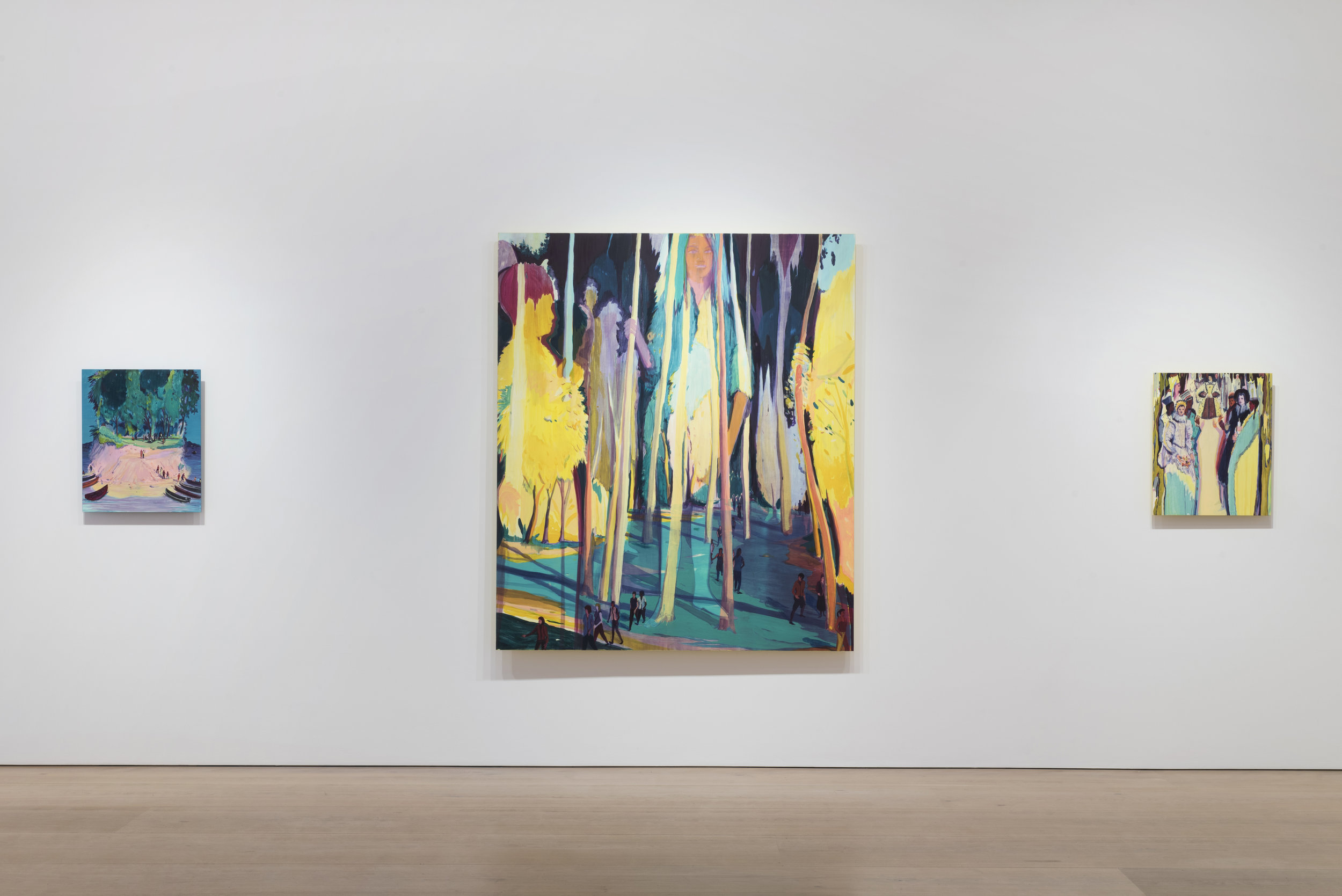
Guest Artist Frame 61 Guest Artist Frame 61

Ragnar Kjartansson


"I was lucky to be raised in the darkness of the theatre."


Our interview with Icelandic performance artist Ragnar Kjartansson

Could you tell us a bit about yourself and your background? Your parents are both actors, right? Where did you study art?

Yes, they're both actors, I was lucky to be raised in the darkness of the theatre. And to be around chain-smoking people in costumes and makeup, its a pretty cool memory. I studied art at the Iceland Academy of the Arts, which is a school here in Reykjavík. I graduated in 2001.

You have an exciting new performance at the National Museum in Cardiff, with a series of revolving organists performing the 1959 hit song, "The Sky in a Room". Can you tell us a bit about this piece? And why you chose that song?

It's basically a song I've really, really loved for years. It's a beautiful Italian song by Gino Paoli,  It's a love song and it's about how space transforms when you're in love. Visual art has always been about transformation of space and this is the only song I know that addresses this concept directly. 

He wrote it in 1959, in bed with a prostitute, feeling the love in this weird space, in a brothel. And he starts thinking, you are here with me, the walls, the endless woods, the violet ceiling becomes a starry sky. And the harmonica, I hear, sounds like an organ. Reality changes and space transforms. There's this beautiful version of the song which he recorded, where it's just an organ. And when I was doing Artes Mundi in Cardiff a few years ago, I thought, how cool it would be to do a performance in that space with just that song and being performed on repeat. I think the idea for this piece just came from always having this song in my subconsciousness and listening to it a lot. And then just coming into this space in Cardiff with its– light blue, velvety– damask wallpaper, with light's coming in from the ceiling with this 18th-century gorgeous organ in the middle of the floor. I've always said– The space just asked for this performance to happen. And now weirdly it's happening, and I'm crazy excited about that.

"The Sky in a Room", National Museum Cardiff 2018 (c) Hugo Glendinning

1774 Sir Watkin Williams Wynn chamber organ at National Museum Cardiff (c) National Museum Wales

"The Sky in a Room" National Museum Cardiff 2018 (c) Polly Thomas

"The Sky in a Room" National Museum Cardiff 2018 (c) Polly Thomas

The gallery is full of 18th-century British paintings but all the works will be removed, leaving the room empty. Could you tell us what's behind that decision?

When you take the paintings out of the room, it just becomes a space with that song in it. If you have the paintings there, then the song will be accompanying you watching the paintings. I think it's also great for people who love these paintings and love this place. It's like when the paintings go away for a bit,  you start missing them and you become really happy when they come back. But the main reason is if you have the paintings in there then the piece would not work. 

Your ongoing piece called "Me and My Mother", is a video of your mum spitting on you for several minutes. You both do this every five years. Can you tell us a bit about this work, and has it affected your relationship with your mother at all?

Its become a really nice kind of gory family thing to do. It tells a mysterious story about our bond and about parent-child relationships too. And yes, I think it is actually good for our relationship, to do this every five years. I mean, it's a piece that my mother has become really proud of, and that makes me very happy. It's crafted out of an art school thing and it's just grown with time, and by repeating it, it becomes more and more important for us. It kind of gains weight as a work of art, I think.

Me and My Mother (2015)

There's a lot of repetition in your work. Do you feel by repeating something enough times it can change its meaning and also, with repetition it can be quite comforting as well?

Yes, I think it can be singularly, weirdly comforting. That's why we like habits, traditions, and comforting repetitions. Also by repeating something enough times can change its meaning. This idea of repetition makes a narrative or performative thing something that you can really look at, and I really like that. I like this idea of a song like Il Cielo In Una Stanza becoming a portrait of the song. Suddenly, it's "look at that song. Is that song as an art piece. A sculpture" But then it's a song also that can just come and go. I find that fascinating. I've worked a lot with repetition, I look at it as a tool of artistic expression, like yellow. It is like drawing something and when you draw it again and again and again, this kind of repetition of the drawing somehow gives it some weight and becomes interesting to look at.

Has there been any artwork you've seen recently that has resonated with you?

Yes, I'm always seeing something that I really like. All the time. One of my favorite pieces I've seen recently was in a show here in Reykjavík by this artist called Huginn Þór Arason. It was a great piece. It was called "Current". It's just a video of him and a really beautiful young man Posing like Brooke Shields in that famous Calvin Klein ad. They were reading Icelandic mid 20th-century poetry. This piece sort of blew my mind. The most recent one to blow my mind anyway.

"The Visitors" (still) 2012

"The Visitors" (still) 2012

"God" (still) 2007

Ragnar Kjartansson by Elisabet Davids

Could you tell us a bit about how you spend your day? Like studio routine? What's your studio like?

My studio is a concrete bunker by the sea where they used to store fishing nets and equipment. I work here with my studio manager Lilja and my wife Ingibjörg. We collaborate a lot. As for studio routine, I'm not one of those artists who just go to the studio at o'clock, has a cigarette and watches the empty canvas. It's more just like the life and art mix into each other constantly. So like today I did not go to the studio, I went to the swimming pool and was just chatting with people. The swimming pools in Iceland are sort of like a pub in England. You just meet people and chat. But chatting and socoalizing is really important for my practice. 

Apart from the Cardiff show, is there anything new and exciting in the pipeline you would like to tell us about?

In the fall there will be a performance in San Francisco called "Romantic Songs of the Patriarchy" which I'm quite excited about. And then I'm doing a sad awful epic opera here in Reykjavík called "War" with the composer Kjartan Sveinsson. 

Ragnar's "The Sky in a Room" will be on show from 3 February–11 March 2018 at the National Museum Cardiff.

National Museum Cardiff

Artes Mundi

Banner image: "The Sky in a Room" by Ragnar Kjartansson (c) Polly Thomas
All images courtesy of the artist, National Museum Cardiff and Artes Mundi
Interview publish date: 15/02/2018

Read More
Guest Artist Frame 61 Guest Artist Frame 61

Jules de Balincourt


"I am not sure how the Trump phenomenon will manifest in my work but I do know it is impossible for anyone to negate it and its ability to submerge into our subconscious.." 


Could you tell us a bit about yourself and your background. Where did you study?

I was born in Paris France in 1972 and between then and 1980 had brief stints living in different places in Europe from France to Switzerland and Ibiza before permanently settling in Los Angeles in 1980.  I spent my childhood following my mother’s impulses to chase love or shelter in different parts of the world, never really settling into one place until 5th and 6th grade, the first two consecutive years I spent in one school. I was constantly adapting to different settings and perpetually experiencing the new kid or outsider experience especially coming to American public school after having had a formative Waldorf school experience in France.

I spent most of my adolescence being a Southern California surf rat and it wasn't until taking classes at SBCC that I rediscovered art and a conviction of that being what I wanted to do. I then proceeded to spend 1995-2000 studying at CCAC majoring in ceramics studying with the legendary Viola Frey and making a side income building (beat legend) Michael McClure’s studio.  I then headed east to NYC in 2000 in my little pick-up truck and sleeping bag, some tools, cooking and art supplies and dreams of the big city.  

"They Cast Long Shadows " Install shot Victoria Miro Mayfair 2018

"They Cast Long Shadows " Install shot Victoria Miro Mayfair 2018

You are quoted saying: "Currently, making work and living in America is beyond words, but maybe not beyond images.” With 20 January 2018 being the one year anniversary of Trump’s inauguration, how do you feel being an artist in Trump's America? Has this affected your work?

"They Cast Long Shadows" is in a sense about this binary of opposing forces we are currently witnessing in America.  They being either the Trump freaks or the anti-Trump camp because essentially it has become that simplified or divisive now, you are either 100 percent for or against him and there is no middle ground, no negotiating the extremes.  Never since the Civil War has America been on such a profound brink of ideological rupture.  

Whether its the neo-fascist Trump ideologue or the left fighting for equality, environmental sustainability and all the other causes that are under serious threat, historical moments like these leave big shadows as different ideologies clash for the light. I am not sure how the Trump phenomenon will manifest in my work but I do know it is impossible for anyone to negate it and its ability to submerge into our subconscious and how it manifests will unfold accordingly....either as act of resistant cooperation or complacency.  The long shadows symbolize the trails or the remnants, the positive or negative effects of people’s actions or beliefs.

"They Cast Long Shadows " Install shot Victoria Miro Mayfair 2018  

"They Cast Long Shadows " Install shot Victoria Miro Mayfair 2018
 

"Cave Country", 2017

"If Queens Ruled", 2017

Tell us a bit about how you spend your day/studio routine? What is your studio like?

Studio routine is not so routine – it has in past either been nocturnal or from 10-6 but there is no real schedule aside from a day or two with my studio manager in the office and one studio helper. For the most part I have kept it a small operation, still making my own paintings but facilitated by my two wonderful assistants.  I like the idea of still being able to maintain a nomadic transient element.  I think routine as an artist can kill creativity, one still needs to explore, wander, delve into the unknown, be surprised and awed. I sometimes attribute this to my first ten years living out of a suitcase but nonetheless I know it fuels me to travel and discover alternative realities. In that sense part of my routine is occasionally traveling, most of which at the moment is based in Costa Rica where I am currently building a studio and small residency to invite friends, artists, dreamers, whoever it may be that is seeking escape to come and visit.  I spent so much time painting these Edenic spaces of escape, now I am going to seek and live it.

How do you begin a painting? I hear you don’t use images as a reference, could you tell us more about this?

This is true I very rarely begin with an initial image, since my work is essentially representation/narratively based. I prefer to begin the painting from a purely abstract intuitive process strictly based on color and form delving into a subconscious process before eventually finding, or "mining out" in a sense, the figurative elements.  I like this process of seeking or searching through painting and layering of color in order to construct a narrative based both in primitive abstract space as well as a logical narrative painting space and how these two states of mind can cohabit.  

"Troubled Eden", 2017

"Big Little Monsters", 2017

How do you go about naming your work?

That process is as intuitive as my process of working. Sometimes the titles precede the painting and then a painting is made in relationship to the title. Other times the title surfaces when a work is near completion. Very rarely some pieces take up to a year to title.

Is there anything new and exciting in the pipeline you would like to tell us about?  

I am working on building my jungle art studio residence in Costa Rica and preparing a solo exhibition this October in Copenhagen at Galerie Bo Bjerggaard, in addition to participating in several group exhibitions that are in the works.

Jules de Balincourt, They Cast Long Shadows at Victoria Miro Mayfair, until 24 March 2o18

www.victoria-miro.com

All images courtesy of the artist and Victoria Miro Gallery
Interview publish date: 15/02/2018

Read More
Guest Artist Frame 61 Guest Artist Frame 61

Sofia Stevi

"One can tell if a painting is happy or sad."

Interviewed by artist Keanu Arcadio, you can visit Keanu's website here: artist's website

I think it would be good to begin this interview by asking how did you come across using cotton as a material and what began as the routine of using cotton as a material? 

I always was interested in fabric and had a collection of different kinds of fabrics from a young age. Painting in cotton came through appreciating a nice cotton shirt but not liking it enough to wear it. So instead, I painted on it with black ink. Then I decided to do it more formally and started researching all kinds of different qualities of cotton fabrics to use.

Where did the themes of materializing psychedelic and sexual symbols derive from? Were there any particular books, movies, theory that cemented your interests? 

My themes just come from my mind, myself and my moods and feelings (and probably all the visual information that has been stored in my brain since birth). One can tell if a painting is happy or sad. I like reading the news, I like comic books, I don't watch tv. I think pop culture is terrible nowadays, I don't feel I can relate. I would also like to slowly quit the internet. Right now I am reading a poetry collection by CAConrad called While Standing in Line for Death and it is affecting and wonderful.

(Installation shot) Baltic

(Installation shot) Baltic

Did you have any dreams that you documented as potential material and would say that your dreams alter depending on your daily diet? Or would this be a superstitious question? 

I know in England they say that cheese makes you have wild dreams or something similar. We don't have this in Greece and I like cheese (even for dinner!) and it has never affected me. I don't write down my dreams but I remember a lot of them since my childhood. I still visit the same places in my dreams as when I was a child. I don't edit my life or my dreams to use in my work, I think it just comes up anyway. Two nights ago I had a dream that made me very sad, it was about my mother not liking me and/or my dog anymore. Perhaps it is going to come up in a work, perhaps the sadness is going to come up. I like to invent new stories for my works and I think these new stories can also be dreams.

In terms of naming your work, is this something you do as soon as you finish a piece? 

Most of the times yes, and sometimes I am so slow to decide. But I really love it when I have the name earlier on!

The colours you use in your painting have a Sigmar Polke, Louise Bourgeois feel, could you tell us how you came to use this colour palette? 

I think my colour palette came naturally through work. The colours I use are colours I am comfortable with and are chosen because they can convey certain ideas and feelings that I want to work on. Also sometimes I just feel like using them. These days I am working with black and white though, a bit more. 

(Installation shot) Baltic

(Installation shot) Baltic

"lizzie & laura" 2017

 "Set for Play" 2017

Sofia Stevi, Newcastle Journal

Sofia Stevi, Newcastle Journal

Do you have any rituals or exercises before beginning a painting? 

The space must be clean and uncluttered, I have to be clean and warm and comfortable. Need my smokes and my coffee around. 

Tell us a bit about your studio?

My studio is two rooms on the third floor in a 60s/70s building that used to house leather shoe makers' works.

Baltic

All images are courtesy of the artist and Baltic
Interview publish date: 15/02/2018

Read More
Frame 61 Frame 61

SV Randall


"I often gravitate toward objects which have outlived their intended utility and have become the mere remnants of human activity."


Could you tell us a bit about yourself and your background. Where did you study?

I grew up in New York and studied painting. After finishing my BFA at Alfred University, I moved around the east coast working as a screen printer, an art educator, and held various positions in a number of museums and galleries including the Albright-Knox Art Gallery in Buffalo and the Metropolitan Museum of Art. I took four years off between my BFA and MFA so that I could save up money and get some experience outside of academia.

I obtained my MFA from the Sculpture + Extended Media Department at VCU. Since graduating - I’ve been living nomadically for the last two years – bouncing between residencies, exhibition opportunities, and visiting artist positions. I currently live and work in New Mexico.

Often your work and the objects you use have a feeling of something that has been lost, cast away and even an apocalyptic edge to it. Could you talk about the objects you choose and what you do to them?

I’m drawn to the overlooked and forgotten. I often gravitate toward objects which have outlived their intended utility and have become the mere remnants of human activity. I think these types of obsolescent objects exist in a liminal space between familiarity and unknowability.

Although each body of work is fueled by a different set of questions, the common thread through these diverse projects has been a drive to reactivate materials in an attempt to coalesce object, site, and narrative in physical form. 

Reverse Arrival,2015

Reverse Arrival,2015

Reverse Arrival,2015
 

Reverse Arrival,2015
 

Reverse Arrival,2015

Reverse Arrival,2015

Your major installation titled "Reverse Arrival" is situated in a large abandoned grocery store, consisting of bright yellow brick walls, wooden partitions and paintings of blinds. Could you tell us about this installation and your thoughts behind it?

I made Reverse Arrival, in the spring of my first year at grad. school. At the time I was learning 3D rendering software and quickly became enamored with the ability to manifest very real and very physical objects based off of nonphysical virtual data sets using 3D printers and CNC machines. I knew early on in the project that I wanted the installation to have a primary object which would embody a kind of circular logic between digital and physical. This core object was an anvil made from an amalgam of melted down aluminum tools such as the backs of iPhone 1s, CPU heat sinks from computers, and parts from automobiles melted down and poured into a digitally fabricated mold. I liked this conflation of the archaic anvil and contemporary technologies merged together into one form. I also loved that the anvil (a tool traditionally used to make other tools), is a cartoon symbol we’ve come to associate with impending catastrophe.

For the installation, a 10,000 sq. ft. abandoned grocery store was gutted out, white washed, and compartmentalized into various smaller “rooms”. The anvil rested on its own reflection in one room. A projected video looped in one of the smaller rooms in which a 3D rendering of the anvil infinitely falls past wisps of white clouds through the sky – never reaching land. In another section a wool baseball hat was slowly being digested by moth larvae inside of a vitrine made of yellow plexiglas and two way mirrors. Across from the hat, I displayed a store shelving unit that I carved out of wood. On the shelving unit were “paper bags” and “plastic bags” actually made of metal along with hyper realistic resin casts of rotting bananas. Throughout the installation - several large, bright yellow brick walls (again created entirely from digital files and carved by CNC machines) were displayed amongst exposed wooden studs, and paintings of window blinds were rendered hovering above a gradient of yellow.

This has been one of my most ambitious projects to date weaving together a complex web of ideas and objects.

Embers to Ashes, 2017

Embers to Ashes, 2017
 

Embers to Ashes, 2017

Embers to Ashes, 2017

How do you go about naming your work?

Sometimes the title of a piece comes before I even make the work. Other times it takes months after I’ve finished a piece for a title to really stick. In general, I’m interested in utilizing titles as a means of linking the piece to the research I’m engaged with. For example, I had a show at Ditch Projects last spring titled Javelin in which many of the works are titled after patents and news articles.

When I moved from New York to the dessert, I began noticing these cell phone towers in the form of faux palm trees around Texas and New Mexico. They are such absurd objects – not at all convincing but oddly beautiful in their attempt to mask these technological devices. I knew I wanted to learn more about them. In the process of learning more about them, I stumbled upon a local news article detailing the story of how one of the faux palm fronds had fallen from the fake metal tree and shattered through someone’s car nearly impaling the driver. The caption under the image in the article reads “The faux palm frond became an unwelcomed javelin as it sliced through the windshield of a motorist’s car in El Paso, TX”. I ended up painting images of the accident, recreating the palm frond, making drawings of the patents for that particular type of fake palm tree cellular tower, and I even remade a custom version of the newspaper. The entire exhibition grew out of that caption and image.

Tell us a bit about how you spend your day / studio routine? What is your studio like?

I’m a total morning person! I love to wake up while its still dark and get out of the house and into the studio as early as possible. The sun dictates my day, so I definitely get more work done in the warmer months.

The studio is like a multifunctional laboratory for me. Some days I am purely brainstorming with a sketchbook, some days I’m getting lost down rabbit holes online while researching and some days are spent handling emails and logistics for exhibitions. Other days I’m experimenting with materials and of course there are the countless days when I’m working toward fabricating sculptures and objects.

The studio I’m working in shifts depending on where I’m living. Last year, I spent several months abroad and worked primarily from my computer on a video/performance project. This year I’m working as a visiting artist in the sculpture departments at the University of Texas in El Paso and New Mexico State University where I’m fortunate to have a studio and access to all of the facilities. This summer onward – I’ll be back on the road and traveling for a few different residencies.

Javelin, 2017

Javelin, 2017

Leaf Study, 2017

Chainmail, 2017

Curiosity of Con, Petrified Breath, and an Accident known as Blue, 2016

Curiosity of Con, Petrified Breath, and an Accident known as Blue, 2016

What artwork have you seen recently that has resonated with you?

This is tough! I would have to say the work of one of my students this past semester – Ruben Rodriguez. He recently made a sculpture in the form of a chandelier which he constructed out of specific articles of clothing and organic matter from the dessert – it was stunning. Ruben’s studio practice revolves around a poetic engagement with found materials and performative gestures working to subvert conceived notions of masculinity while unpacking issues of labor, race, and sexuality. The work feels courageous in its honesty and vulnerability - its some of the most exciting work I’ve seen!

Is there anything new and exciting in the pipeline you would like to tell us about?

Yes! I just completed a new installation at the Rubin Center, which opened last week in El Paso, TX. This new piece is part of a much larger project revolving around “the mirage as a taunting illusion.

It takes the form of something which does not exist in an environment when the viewer might need it most. The mirage can not be obtained, it can not offer sustenance in the form of water, and it can not be reached. I’m working to create a connection between the mirage and concepts of “the virtual”. Both are immaterial, unknowable, and beyond our ability to touch. There will be a performance component to the project this spring, where I’ll be working with hundreds of community members to make our own mirage.

I’m also preparing for a solo exhibition at 1708 Gallery in Richmond, VA opening on March 23. The exhibition, titled In The Purple, will unpack the historical significance of the color purple specifically tracing the ancient dye – tyrian purple – (which was made by crushing up sea snails). I’m really interested in unpacking how we ascribe value to arbitrary and often subjective resources.

I have an upcoming article being published in issue 8 of Peripheral Vision this spring. This summer - I’ll be collaborating with visual anthropologist, Kim Craig on a project at Wavepool in Cincinnati, OH. In the fall I’ll be traveling abroad to Seoul where I’ve been invited as an international artist in residence at the Seoul Museum of Modern Art and then I’ll travel to Finland for the winter where I will be a resident artist at the Serlachius Museum. While abroad I’m embarking on a long term project that I’m really excited about – exploring archive systems.

www.svrandall.com

All images courtesy of the artist
Interview publish date: 15/02/2018

Read More
Frame 61 Frame 61

Jorge Dieguez


"Vast spaces transport us into that intimate space, the threshold settles while contemplating an immense space, that contemplation of the immensity determines a pure state that takes us to a parallel world..."


Could you tell us a bit about yourself and your background? Where did you study?

I always describe and consider myself an architectural passionate and a techno lover, two things that definitely structure and define my practice. I am not obsess about architectural projects or iconic practices, however, I spend many hours of the day observing what surrounds us in order to understand how buildings or structures work and relate with us.  This process brings up ideas that I can’t find anywhere else, I have a need to research the outside world 1st to then develop an idea in the studio. My work in commercial photography allows me to travel constantly and even I don’t have time to photograph as I want or focus in develop a project during those trips, I constantly use my phone to record any small detail or vast view that later will trigger a project or idea at the studio. On the other hand, techno music wraps up the aesthetics aims of my work, like: be repetitive, linear, clean, geometrical, consistent or methodical.

I studied architect in Peru and cinematography in Spain, then worked in ad campaigns for 6 years in Barcelona before moved to London, where I moved 6 years ago in order to concentrate in my work as visual artist, in 2016 I finished with honours an MA in photographic studies at Westminster University in London, under the tuition of Professor David Bate. My time during the MA was priceless, I had the opportunity to explore photography in a complete different way spending many days per week in the colour darkroom in order to understand the photographic process to later experiment with it. That time definitely fascinated me, as is very personal and independent. -I love photography because the process it involves and the possibilities it triggers during it. On the other hand, the course was quite theoretical, aspect that blended perfect with my practical interests; I think read and write about our own practice is as important as to make the work. 

Co-existence - installation view

Co-existence - installation view

Co-existence - Composition-002

Co-existence - Composition-007

Your piece titled: "Stability & Construcivity" consists of large printed photographs draped over a metal frame, could you tell us about this piece? What are your thoughts behind displaying your photography in this way?

I fragmented the photograph in three different sections -3 strips-, each with its own dimensions, where from a unique viewer position shows a correct view of the landscape represented on the photograph. The sections rest on what should be a frame, suggesting that instead of the photograph be contented in the frame, it is resting on it. For that reason, the lower part of the metal frame it’s broken in half, each part become a leg of the piece that each go in a different ways, suggesting that the frame is open and the photograph it’s free from its conventional way of presentation. Also, that aspect enhance the concept that the piece doesn’t have front or back. Each side of the piece has its on way to present the photograph where together make a single piece that has many details and concepts working around. 

I intent to give the viewer the freedom she/he deserve of how to experience the work and where she/he feels more comfortable for it, -I consider that as a very valuable aspect-. I feel that the work success if it allows the viewer to make their own decisions without losing its integrity.

There are many concepts around this piece and I work very hard to put all of them together, but that is the less important, because it is the dialogue between the work and viewer that prioritises over the rest.

Much of your photography is of vast vistas, often baron and lifeless. Could you tell us about these images?

Vast spaces both, populated or empty are things that always attracted me, contemplate them from a high point of view is a therapeutic process for me. I started my project Vastness after read Bachelard Gaston book, The Poetics of the Space, where he describes the existence of an intimate threshold that separates the known and unknown space. 

Vast spaces transport us into that intimate space, the threshold settles while contemplating an immense space, that contemplation of the immensity determines a pure state that takes us to a parallel world, for that reason, be present in a great space is a personal moment constantly repressed by the everyday life. 

Therefore, I feel that a vast space could positions us inside a dream and that is the reason why I have an internal need to walk to high points of view in order to photograph landscapes, empty or not, but the importance relies in an isolate personal moment that conjugated with technical aspects as large format photography, composition, colour, etc…makes the image. And I try to represent that in my work.

Stability and Constructivity

Stability and Constructivity

Stability and Constructivity (detail)

Stability and Constructivity (detail)

Stability and Constructivity

Stability and Constructivity

Tell us a bit about how you spend your day / studio routine? What is your studio like?

I share a studio with 2 other photographers, our work is very different between each other and that makes my studio days very pleasant, due the discussions that can be generated. I prefer not to research or reference others photographers work while I develop mine, however, I do much appreciate interactions and dialogues with fellow photographers whatever their practice is based on. 

Within the studio I normally work in 2-3 things at the same time, it is important for me not to be immerse in only one project in order to find a balance and link concepts. Also, due the nature of my work, where I develop projects based on more pure photographic aspects and techniques as Vastness or Sur Chico and others where I use photography mixed with other medias as Co-existence and Stability & Constructivity.

I also work in commercial photography and film, for that reason my studio time is a combination between both worlds. However, my practice at the studio develops mainly in experiment with photography and to processes work untiringly as I normally work one image in many ways and re-use them several times -there is a personal necessity in bring value to all and never discard-. 

How do you go about naming your work?

During the MA naming work was a big thing, where many tutors suggested that naming our work will complete it and we have to definitely do it in order to have a proper qualification/grade.

Personally, I think there is work that have to be named for maybe help the audience to engage with the work and there are artists that need to name their work in order to give a meaning to their work, but I certainly think there is work that doesn’t have that need. I consider important to title an exhibition, which conduct or support an statement, than name each piece for example.

However, I have to say that literature helps me to understand and opens many doors of how to name my work, I keep a list of words, phrases or even names that I find while reading that I could use later to name my work, that is my starting point at the time to name my work, the list also helps me as English is not my mother language and translate from Spanish to English frequently doesn’t work.

Sur Chico - Puente San Bartolo, 2012

Sur Chico - Puente San Bartolo, 2012

Sur-Chico---Pucusana, 2014

Vastness---Desierto-Sur---Canâete

What artwork have you seen recently that has resonated with you?

Last year I visited Ashely Bickerton show at Newport Gallery in London, which fascinated me, I hardly new his work until I visited the show. To confront all this mixture of techniques, materials, colours and concepts impressed me massively. There were many aspects that caught my attention, from his very complex and very technical way his work is displayed and presented to an unexpected and real manner  to work concepts as consumerism, like uncomfortable to see but at the same time pleasant to contemplate. 

Is there anything new and exciting in the pipeline you would like to tell us about?

I just came back from a 2 months trip with my baby daughter and my girlfriend, I hardly did any work during our trip, however read lots, be in contact with the nature and got time to think and recap old ideas. I have 3 more pieces to present from my project Stability and Constructivity before summer.

And also I will be presenting my long term project Sur Chico in London and probably Peru this year, along with a book. A project that have taken me 6 years to complete.

www.jdieguez.com

All images are courtesy of the artist
Interview publish date: 15/02/2018

Read More
Guest Artist Frame 61 Guest Artist Frame 61

Gordon Cheung


"The rise of the internet and availability of mobile phones were signs of an increasingly technologised era where perceptions of time and space are in a state of perpetual flux."

Interviewed by artist Keanu Arcadio, you can visit Keanu's website here: artist's website


Let's open up this interview by telling us your morning routine and if you use any technology to plan any works beforehand? 

Wake, coffee, food, emails, studio. Every new work starts on the computer where research takes place before working out the composition of an idea in usually Photoshop. Colours and image are worked through before committing to printing, collaging and painting in the studio.

Have you seen any paintings or films that have drawn your nose in a new direction? 

There have been many films but notable ones that I seem to keep going back to are the Director’s cut of Bladerunner, Bladerunner 2049, Stanley Kubirck’s 2001 and Apocalypse Now. There are so many paintings that I would be hard pressed to name but the National Gallery and Tate Museums are always inspiring places.

The paintings you have executed share similar compositions and elements from 16th century medieval paintings, when executing your paintings do you have any images up when working in the studio? 

I think you must be referring to the glitch works that I have made that are high resolution photos of paintings from the Rijksmusem. An algorithm is used to re-order the pixels without destruction or duplication that result in what I think of as a digital sands of time effect. These are then either converted into animations, prints or giclees on canvas. In the studio I have images of the work I have planned out on the computer for reference. At home I have a mix of my own images and others on my wall in front of the computer.

"Eelke Jelles Eelkema mres"

"Still Life Abraham Hendricksz van Beyeren c.1640-1680"

Would you say you have taken the syntax of how the screen moves into the language of painting and would do you foresee yourself executing your paintings into the digital format? 

I already work with digital formats if that means using computers and printing them onto surfaces and collaging them onto canvasses or printing directly onto canvasses. Moreover I make animations now and then. When I was at central Saint Martins from 1994-98 I wanted to paint without paint to question the medium itself but also to side-step the dominant discourse of ‘The Death of Western Painting’ by adopting the language of abstraction and substitute paint for collage. Why? Because I wanted to reflect the digital and communications revolution in my art. The newspaper represented the globalised space of Capitalism and was a good starting point that has remained in my work for over 20 years.

The rise of the internet and availability of mobile phones were signs of an increasingly technologised era where perceptions of time and space are in a state of perpetual flux. To me the landscapes of zeroes and ones were flowing through us and the metaphor I chose to use was the Financial Times newspaper and especially the lists of the stock market. So what does the screen mean? I grew up with the first home computers and when I first played games on the TV I was blown away by how you could control something on the screen that felt like as though it was in an alternate reality beyond the screen which was and is a world constructed by zeroes and ones. It makes sense to me to try to visualise the languages of our times and to use them in our chosen mediums to capture something about our human condition. Future works will involve 3d printing and hopefully some work made for VR.

"Here be Dragons" Video installation

"Here be Dragons" Video installation

Following from the last question, how much influence would you say you allow from the screen? Are there times where you take ideas from the T.V or browsing the web?

I’m uncertain of what is meant by the ‘influence’ of the screen as if it somehow innately has quantitive coercive power. I definitely take ideas from TV or browsing the web. I try to keep mind open in a place where inspiration can be found and the internet is for me a massive library. So whatever form or shape that takes whether its looking at art from around the world, David Lynch’s Twin Peaks, Game of Thrones, Masterchef, a youtuber analysing a film script or David Attenborough’s recent Planet Earth there is always something incredible to learn and be inspired from.

The Minotaur series is very much different from your other compositions of flowers, fruit and static objects. What was your incentive for creating this series? 

The Minotaur series came from searching for a mythical sign of our global times. The stock market is called the bull and the bear market apparently due to the way how they attack. A bear strikes down and a bull thrusts up to describe the movements of the stock market. I found it fascinating that one of the most important spaces of our modern lives should use attack metaphors and animals for what is one of the most artificial spaces we as a humanity have created.

So the Minotaur came into my mind as a symbol within a labyrinthine matrix of numbers. A cursed creature of man and beast and also a symbol of our relationship to nature. The still life compositions are based on the Dutch Golden Age Still Life which was a period considered to be the birth of Modern Capitalism with the first recorded economic bubble over the surreal speculation of tulip bulbs and the rise of the first global company with militarised trade routes, colonisation and slavery. The still life paintings were a way of looking at what is now considered to be a benign genre and reframing it to question the histories that are written by victors and therefore those that are hidden. It was a response to the 2008 Financial crisis that led me to finding out about the first bubble in history.

"Great Wall of Sand" Unknown Knowns at Edel Assanti 2017

"Great Wall of Sand" Unknown Knowns at Edel Assanti 2017

Unknown Knowns at Edel Assanti 2017

"Here be Dragons" Installation

Do you see yourself revisiting depicting animals or moving objects in your work?

I am frequently making work depicting animals but I haven’t yet made a work with moving objects yet. I certainly make moving image based works.

Finally, what can we expect to see from you this 2018?

I currently have a group show at Alan Cristea with 3 Turner Prize artists and also have an ongoing solo show at the Ann Norton Sculpture Gardens in West Palm Beach. Forthcoming is a group exhibition at Galerie Huit in March and a solo show toward the end of the year at the same gallery in Hong Kong. In between will be other group shows in London and a chance to see my work at Art Basel Hong Kong. 

www.gordoncheung.com

All images courtesy of the artist and Edel Assanti
Interview publish date: 15/02/2018

Read More
Frame 61 Frame 61

Augustine Carr


"sitting somewhere between myth and fantasy."


Could you tell us a bit about yourself and your background? Where did you study?

I graduated with a Fine Art BA from Central Saint Martins in 2011 and with MA in Painting from the Royal College of Art in 2016. I spent my mid twenties and early thirties editing television programmes and making my own films. My films grew simpler and sparer. I felt compelled to move beyond the captured image. My father came from a Calvinist background, where art was discouraged and seen as decadent. I shared that view for some time and had no real interest in fine art until I started making drawn transcriptions in the National Gallery in my thirties to try and understand what picture making might entail.

I enrolled at Central Saint Martins where I had an exciting time as a painter – in the last year of my BA, a van driver failed to indicate and knocked me off my bicycle leaving me with a shattered right elbow and neuralgia in both hands, temporarily unable to hold a brush.

But after a while, I found that I could make rudimentary objects in plasticine and clay with my left hand. As a result, my painting practice began to broaden in to sculpture and film.

After graduating from St Martins, I began to make assemblages of modelled sculpture and found objects. A conversation with the artist John Stezaker sparked an interest in the possibility of collage for me. John believes that a conceptual practice is a kind of cul-de-sac and that image making is all.

I went to the RCA to be taught by one of my favourite painters, Ansel Krut, and he did not disappoint. His picture making is not unlike his company, full of playful wit and generosity. He shared with me his penchant for a full English breakfast before starting a new canvas and I have been getting rounder ever since.

Under Water Exploration 2017

Under Water Exploration 2017

Tricks and Magic (Blindfold) 2017

Rocks and Minerals 2017

Your major piece titled "Glanz" is a large black morphic looking object. Could you tell us about this piece? How was it made?

At the RCA I wanted to give the quick, intimate works I made in my left hand currency and move them beyond a domestic scale, so I had work remade by precise machines. Small maquettes were 3D scanned, enlarged in CAD and CNC milled at a greater scale that exaggerated the work’s expediency.

So, Glanz was modelled with one hand in plasticine, in a minute or so, and then digitally enlarged, so the asymmetry is amplified and takes on a life of its own, sitting somewhere between myth and fantasy. The lumpen character of the cup is both brutish and gigantic so I like its title 'Glanz auf der Nase’ (in English ‘glance at the nose’), which came about after an accident in my studio, where the oil of the original plasticine maquette seeped into a Freud text on the fetish. 

In the northern medieval church, what was seen as the greatest poverty in society was given virtuality in its masonry. Glanz was first shown in the knave of the Asylum Chapel in Peckham for a Frieze event, where its new scale reveals both a sensitivity and a brutalism. It seemed to speak of something overgrown and lumpen, yet innocent and playful.

You have an ongoing series of works that depict painted-over books. Could you tell us about these works? They are digital prints, right?

Yes. I paint on found books. I see the painting not as an intervention but as a re-writing of the book; painting as embellishment rather than defacement. This practice is directly informed by my research into medieval marginalia, where pictorial additions to a text open up new readings and ideas. While thinking about how to situate and present the work, I became interested in archiving them.

To photograph these books, I black out the room and turn a scanner into a camera. The book is pressed against glass, weighed down with a brick, photographed at a high resolution, enlarged and printed. The immense detail contained within the photograph creates a kind of a paradox – as the print is enlarged, it seems to become more intimate. Yet the book and the painting are not there of course, only their image. Some people have read this work as a tromp l’oeil. These prints were the first photographs ever to have been selected for the RCA painting collection. Some of the more traditional painting staff at the RCA were resistant to discussing the painting within the image at first, but would then find themselves hooked into a conversation by some small detail in the photograph that took them by surprise. It made for interesting crits on the layers within layers in the work.

Glanz 2017

Glanz 2017
 

The Telephone and Lost at the Fair 2017

The Telephone and Lost at the Fair 2017

Summa Theologica VI 2017

Summa Theologica VI 2017

What artwork have you seen recently that has resonated with you?

For me, it’s my peers’ work that resonates with me most. Work that is a part of my own dialogue in some way. For example, I walked into the Dot Project in Chelsea on Friday and saw these fantastic ultramarine blue pigmented works which I loved . . . then, on the following Monday the fashion designer Genevieve Sweeney, whom I am working with, told me about her sister covering her grandparents’ house in blue pigment while they were on holiday . . . And sure enough, the works were by Gen’s sister Florence! The London art world is just small enough for us to feel ourselves spinning around conversations with in it, many of these conversations are one way, of course, but not as many as you may think.

My children and I were bowled over by Giorgio Griffa’s show at the Camden Arts Centre; his gentle line and chromatic economy left us all singing and humming as we followed his trail of pinned, folded hessian through the galleries.

My daughter Rose is named after Rose Wylie who bounced into my studio at the RCA one day in her Air Jordans and dragged the palm of her hand across an expensive print of mine, wiping away the pigment, without realizing it was a photograph of a painting rather than a canvas. I last saw her at a talk she gave with Ben Rivers at the Tate in the autumn about their films and paintings; it was an electric evening that swept me straight back into the studio.

Seeing shows online and reading catalogues makes one hungry too, of course. Artists have always been comforted by images of their peers’ studios. And Instagram has replaced, for me, the early morning stroll around the college works-in-progress. Now we can root for our friends and colleagues, who are generous enough to open up their practices on Instagram. I have been rooting for the fantastically impossible sculpture that Hugo Wilson has been making over the last couple of months. And have discovered a predilection for the artists shown by Peter Ibsen in his beautifully documented exhibitions and travels with his Sunday Gallery in Copenhagen.

Tell us a bit about how you spend your day / studio routine? What is your studio like?

My studio is a couple of minutes walk from my house, so after breakfast with the family and getting the children off to school, I play a Ramones song for the short commute. When I arrive, I look at the work I have made the day before and put on a less frenetic album on repeat. The music acts as a kind of buffer to the world. I draw or paint until the neuralgia in my hands acts up and then I begin to model the three-dimensional elements of my practice, mostly in my left hand.

I have a small north facing studio, in an old film studio in Islington that has been partitioned up. Here the maquettes and paintings are made on a small table. I make many paintings and maquettes and edit a lot back. I spend a lot of time looking and turning the paintings and models around in my hand before having them scanned or photographed for fabrication.

The large sculptures where initially made in the vehicle design department at the RCA on a 5-axis CNC mill and were finished like cars. The sculptures are now milled by a Kuka Robot in a factory that supplies parts to the aeronautical industry. The photographs because of their scale are also printed, mounted and framed off site. And of late I have found myself doing shows where I only see the finished work just before their installation, due to the small size of my studio.

How do you go about naming your work?

With the book works, titles are taken from the title of the book or a text within the work. The sculptures are also named after book titles or lines of text because the maquettes are often used in assemblages with books before they are chosen to be enlarged. Or sometimes the titles are the result of some meaningful accident as with ‘Glanz’.

Is there anything new and exciting in the pipeline you would like to tell us about?

I have just begun tests in digital embroidery . . . Simple drawings in chalk and oil stick become something quite other after they have been photographed, enlarged and stitched. I would love to make some sort of collaboration in fashion. It is such a privilege to work with people with such a wealth of knowledge in their field.

augustinecarr.com

All images courtesy of the artist
Interview publish date: 15/02/2018

Read More
Guest Frame 61 Guest Frame 61

Jemma Hickman / Bo.Lee Gallery


"Peckham has a thriving, creative community and it felt like the right time to open a gallery here." 


Our interview with founder and Director of Bo.Lee Gallery: Jemma Hickman

Could you tell us a bit about yourself and your background?

I’m originally from Devon and spent my childhood climbing trees, hunting for slow worms and collecting dead insects - memories that often inspire my exhibitions. I moved to Bath to study Fine Art and starting working for a commercial art gallery while studying.

The art market has always fascinated me and my final year of university was spent delving into the psychology of buying and looking at art as a commodity.

I found myself more interested in other people’s work than making work of my own and quickly realised that curating and gallery management was the direction I wanted to head in.

After working for two galleries in Bath, I decided that I wanted to pursue my own vision and embarked on launching bo.lee in 2009 at the age of 25. My decision to set up the gallery at such a young age (and without financial backing) was met with a great deal of scepticism and I faced many challenges early on. This only drove me further, and following 5 successful (although at times difficult) years in my Bath gallery, I moved to London in 2013 to take bo.lee to the next level.

After years of running the gallery from your own home in Dulwich, you decided to open your first permanent gallery in Peckham, London. How did this come about and why Peckham?

Since leaving my gallery space in Bath it had always been a dream to open a space in London but rent, rates and a busy schedule meant that the journey to opening a space took a little longer than I had planned,

When I moved to London I rented a townhouse in Islington before buying a house with my husband in East Dulwich which doubled up as a viewing room for the gallery.  I initially wanted to know the market before committing to a space, which I felt could be restricting, but I discovered that my clients liked viewing work in a more domestic environment and so having a viewing space in the house was a perfect stepping-stone and forced me to think more creatively. It also allowed me time to travel to international art fairs, and to spend more time on artist studio visits.

Having explored multiple areas of London and several pop-up spaces, I found myself drawn to the area that was right on my doorstep. Peckham has a thriving, creative community  and it felt like the right time to open a gallery here.  When this space came on the market I saw the opportunity and went for it. I’ve always gone with a gut feeling, and this just felt right.

Bo Lee Gallery, 2017

Bo Lee Gallery, 2017

How do you differentiate yourself from other galleries?

I try not to compare myself too much with other galleries as it can be distracting, and I think although from the outside we look different, we are all still trying to do the same thing and on a similar journey.

I’d like to place myself somewhere in between a project space and a quality commercial gallery. I choose work that I love, and I try not to get too caught up with fashion or choosing work for its commercial appeal. My ritual has always been to stay true to myself and if I like the work surely other people will!? I pride myself on getting to know my artists, the gallery is as much about them as it is about the space. To really understand their work and to be able to communicate their passion to collectors I need to know what makes them tick. I never want to feel like a production line, I want each work of art that comes through the gallery to be special and unique.

Why bo.lee? Is there a story/meaning behind the name?

Bo is my nickname and Lee Anne is my middle name. It often surprises people when they first meet me, in fact when I first started I had an 8 page feature in China Contemporary Magazine!

What do you look for in an artist?

This is always such a hard question for me to answer. I don’t always know what attracts me to an artist, and often people will introduce me to work expecting me to like it, but I don’t.

I guess it needs to speak to me in some way and to make me think. Even if it makes me feel sad I need to feel it is doing its job. I particularly like work where I can see the craft, skill and some depth but sometimes work that I don’t typically show can strike a chord but I don’t always know why, or at least not initially. I am often surprised by the subconscious reaction that people have towards a work, and I try to follow my instinct when selecting work and choosing to work with an artist.  Consequently I very rarely take work by submission as it is as much about getting to know the artist as it is about appreciating the work.

An artist/gallery relationship is very important and I work hard to establish trust and loyalty. If we are both committed to building something together, it can be a very fruitful and exciting journey.

Bo Lee Gallery, with Jemma Hickman, 2017

Bo Lee Gallery, with Jemma Hickman, 2017

What has been your biggest obstacle and greatest achievement as a gallery so far?

Moving to London from Bath felt like I was starting all over again. I had a great network of loyal artists, collectors and visitors, and I have worked hard at trying to keep these relationships while making new contacts in London.

Moving to London opened up the doors to so many more opportunities such as working with exciting artists, travelling to overseas fairs and now opening my first London gallery. After seeing so many galleries close their doors over the last few years I never take what I have managed to achieve for granted, and it certainly hasn’t been short of obstacles along the way!

The gallery world is full of smoke and mirrors, it is extremely competitive and my challenge has always been to not get sucked into the politics and focus on my artists and the reasons I started the business in the first place. First and foremost It is a business, and I have had to work hard get the right balance between the commercial side and my passion.

How do you feel the art world is changing? Do you think art fairs are becoming the lifeblood for most galleries?

Art fairs are very important, but there is a very high risk attached to them and identifying the ‘best ones’ that suit your work can be challenging. Art fairs are the gateway to a wider audience, but artists want gallery shows, and collectors/buyers still like to visit galleries and experience the work in the flesh without distractions.

Social media and buying online is increasingly important and it can work well however there is no substitution for seeing work in a gallery setting.

The best advice I was given when I first opened bo.lee was to find my recipe, and ultimately for me it is a combination of good art fairs, a slick social media presence AND an attractive gallery programme which has taken me a number of years to develop and will continue to evolve.  

Bo Lee Gallery (front)

Bo Lee Gallery (front)

Jemma Hickman

Jemma Hickman

What advice can you give to young artists?

Make work that you love, don’t follow anything, or expect fame and fortune. A true artist doesn’t create work just out of choice, it is an inert feeling, something to nourish and build on.

Take time to really work out what drives you, what inspires you and stick to it. Dig deep and stay true to yourself.

On a practical level, really think about your material, the quality of your canvases, brushes and how you want your work to be displayed. Don’t get knocked back too much by a bad response from a gallery. The right gallery/dealer/curator is out there, you just need to find them.

What's the future for bo.lee Gallery? Any exciting new shows lined up?

In the short term we have an exciting exhibitions programme which includes two mixed shows, Mindscapes and As The Crow Flies. Both will include gallery artists alongside some more well known ‘ names’ such as David Hockney, David Mach and Cornelia Parker. 

We are also working on developing bo.lee projects, which launched in Bath in 2013 as a platform for working outside of the gallery setting. Previous shows have included exhibitions in churches and historical buildings, and I have my eye on a number of sites in South London for a large sculpture show.

A big space and busy schedule means that the bo.lee team is growing too, and we are also looking forward to working with guest curators who will add a different vision to the gallery programme.

In the long term, my aim is for bo.lee to become a destination for good quality well curated exhibitions. I look forward to building on the relationships I already have with my gallery artists, giving them the opportunity to flourish with solo shows, and also getting to know new artists that I have wanted to work with for some time but not had the space to develop these relationships.

We celebrate ten years in January 2019, which is an amazing achievement that I am very proud of, and no doubt there will be a very big party to toast the next ten!

www.bo-lee.co.uk

All images courtesy of bo.lee Gallery
Interview publish date: 15/02/2018

Read More
Frame 61 Frame 61

Hun Kyu Kim


"I try to express my political ideas, through fairy tales with beautiful and subtle images comprised of human like hybrid animals, as a form of satire"


Could you tell us a bit about yourself and your background? Where did you study?

I am a Korean artist who studied Oriental painting BA and double majored in Aesthetics at Seoul National University of South Korea. I currently live in London after graduating from an MA at Royal College of Art. During my BA, I was trained as a restorer for ancient religious Korea painting, and I was so interested in traditional images of ancient oriental painting that I have trained myself the special technique over a decade during my school years.

Although my works are based on traditional technique, narratives in my painting share a contemporary pop culture in a harmonious manner. Through the cultural eclecticism bringing extra-ordinary experience, I make strange but subtle and beautiful stories about an imaginary world, combining a beautiful aura from traditional oriental painting and contemporary political discussion to bridge between the past and the contemporary.

"Don't be afraid my love" 2016

"You are always welcomed", 2017

Your paintings are full of characters/beasts/scenarios. Could you tell us about these works? What is your inspiration?

Much of my adolescence was unhappy because of the strict Korea education system. Severe child abuse happened, so frequently, that nobody might believe it. I was also forced to join the army when I was 22, which was one of the most traumatic events of my life. Fortunately, the horrible experiences make me actively research social and political issues of South Korea, because I believe that my personal experience is closely connected with both Korean history and global politics. For your information, Korea's society was under a strong control of Japanese imperialism for 36 years and experienced over 40 years of dictatorship. Numberless Korean intellectuals who tried to overcome these historical tragedies were tortured and killed in 80’s, which lead some artists to protest against the political power directly, unlike others who gave up fighting back.

Due to the historical situation, some protests in South Korea looked aggressive and graphic as a description of the horrible history of South Korea. Fortunately, noble sacrifice from some activists made Korea government stop exercising physical violence to its public after late 80’s. Nowadays, Korea people believe that they have overcome their historical tragedies and seem to forget the ages of madness at some point, which allows artists to express their thoughts in moderate ways, compared with the past. Likewise, I try to express my political ideas, through fairy tales with beautiful and subtle images comprised of human like hybrid animals, as a form of satire to bring more attention from contemporary audience in a bright and humorous atmosphere. I personally believe that the cute and innocent images of my art works are able to act as a pivotal role in the spirit of Candle light revolution, evaluated as the most peaceful and successful contemporary political movement.

"Bad morning", 2016

"Pigdog", 2016

"The fertile land", 2016

Your works are both beautiful and chaotic, brimming with symbolism. Would you say that some of your works have a political message?

Most works of mine are closely connected with not only Korea political situation but also global politics because I strongly believe that Korea, the small peninsular country actively carries out exchanges with other contemporary nations and its political situation can act as a fragmented blueprint, where people worldwide are able to predict the near future of our contemporary world. Therefore, I try to hide national identity on purpose to make my story understandable in a universal manner despite of the fact that I got strong influence from Korea's history. In my last project, I made a triptych painting named “Over the barricade”. The work is about a village where mice and frogs live. One day, a big snake starts to threaten the villagers and the villagers decide to devote their daughter to the snake. A few years later, heroes manage to kill the snake but then decided to pretend to be like a snake. Left panel is the birth of the snake and right panel is about another revolution after the existence of snake is forgotten.

The story was inspired by traditional folk tales and Korea's recent political situation as well. In 2017, the Korean public made the first female president of South Korea resign through peaceful political movement. Through the painting, I wanted to suggest some fragmented images of after the revolution rather than celebrating the catharsis of revolution.

Tell us a bit about how you spend your day / studio routine? What is your studio like?

I work almost every day, holding a tiny brush and sitting on a floor for over 10 hours a day. Due to the nature of traditional oriental painting, my practice is painstakingly time and labor consuming, which makes my work special, I think. Moreover, my painting is also unrecoverable when I made a mistake. Although I trained myself over a decade, I need to be very careful with lots concentration and patience, so not to make any critical mistakes. Ancient religious painters of South Korea used to take a bath before drawing their painting, to make their body spiritually cleaned, likewise, I did a special ritual ceremony before starting my painting to pray for its successful completion without accident.

How do you go about naming your work?

I got large amount of inspiration from contemporary pop culture such as cartoons, movies, and computer games. Thus, I would borrow some ideas from them or a parody to make my work and titles harmoniously resonate each other. Sometimes, I use a form of conversation to deliver my message to audiences directly. For instance, “Don’t be afraid, my love” is one of my favourite works because I think overcoming fear deep inside of a mind is a key factor for people to step forward and make huge changes, as history proves its authenticity. Therefore, every time I have a lecture for student artists, I quoted the painting in my last lecture to encourage them to speak out their voice and faithfully conduct artist’s social role without fear.

“Over the barricade”

“Over the barricade”

"Soon, life will become more interesting", 2016

"Soon, life will become more interesting", 2016

What artwork have you seen recently that has resonated with you?

I saw documentary about an animation film named “the wind rises” produced by Zbri studio. It is Miyajaki hayao’s last work. The animation film is about an areoplane engineer during WW2. The engineer has a dream to make a huge plane that makes people happy, but the government of empire of Japan asked him to design a combat plane. He already knew it is wrong but there was no choice and he couldn’t give up his dream. Therefore, he decided to design a battle areoplane. The title of documentary film is “Ages of dream and madness”. Sometimes, there are some gaps between personal dreams and periodical requirement, I mean, ideal and reality. As an artist who makes visually desirable images, I also feel some gaps between the two. 

My final dream is to change our world where every single person feels happy and makes their dreams come true. However I decide to be an artist not a politician.

Some people might think that it is a naive idea that art can change the world. However, I can’t give up my passion towards art as well as my dream to be helpful to our world. Therefore, I want to make beautiful and attractive images as much as I can, and keep interiorizing the right things to do based on humanities, by hiding political narratives to act as a bridge between intellectually difficult contemporary art and the general public.

Is there anything new and exciting in the pipeline you would like to tell us about?

I am preparing a new project for a solo exhibition at The Approach Gallery in November 2018. The project is about 8 parallel universes based on dark fantasies. The story is inspired by contemporary economics, but I am going to reinterpret the complicating theories with a full imagination. I hope many people visit the show, sharing diverse discussion.   

www.hunkyukim.wix.com/painter

All images courtesy of the artist
nterview publish date: 15/02/2018

Read More
Frame 61 Frame 61

Ned Armstrong


"I think that it’s important to get to a point where I’m making moment to moment decisions so that I’m open to the surprises and discoveries"


Could you tell us a bit about yourself and your background? Where did you study?

I completed a foundation course at City and Guilds, and from there went onto the Edinburgh College of Art to complete a BA. I stayed on for one year in Edinburgh working in an art shop and painting, then I moved on down to London at the end of 2016 after some time back at home in Lewes.

You use strips of paper and objects found in your studio to help create these works, could you tell us a bit about your process?

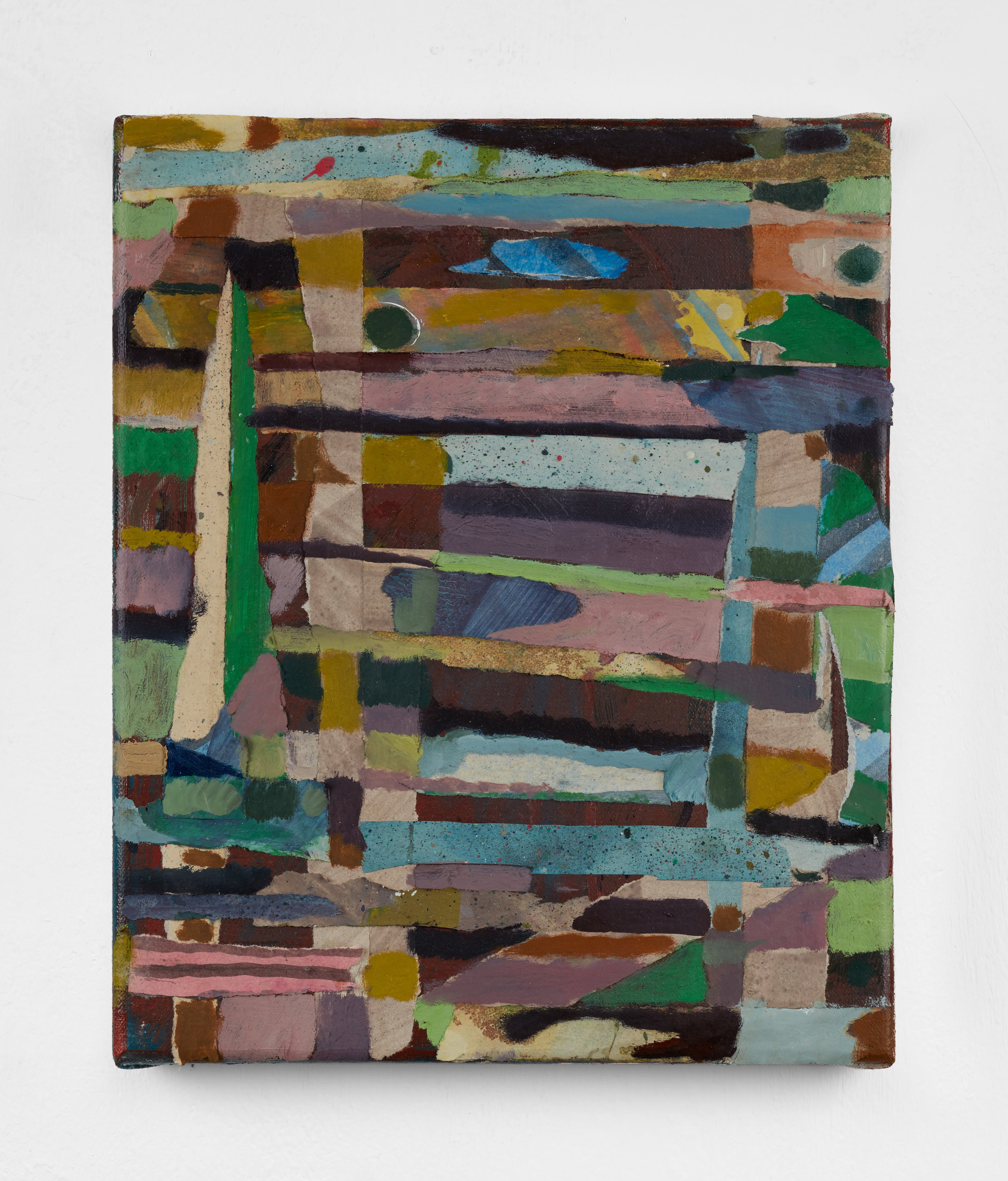
I had this problem with making paintings that somehow, I needed to come at the painting indirectly. I think that it’s important to get to a point where I’m making moment to moment decisions so that I’m open to the surprises and discoveries that are so important to making a picture. So, over time I began to realise that in order to get to this mindset as often as possible, I needed to have different areas of activity where I was making things that I could then put into the paintings, that I wouldn’t otherwise think of putting into the same picture.

So initially, I began painting onto newsprint, I’d draw loosely on one, soak another in paint, make up a pattern and then rip it into strips. This ripping was kind of a way of dealing with form in the paintings. Form had been something that I have struggled with painting abstractly and I knew that I needed to have something to input rather than making up forms as I went along, collage provides a very direct way of doing this. The strips provide two edges that create negative space outside of them whilst also being containers of what I had painted onto them. I keep the strips at the base of the wall that I paint on so they pick up spills and stains from other things that I am working on, and in this way, lots of different areas of practice can coalesce.

This then expanded as I began to put any residual, glue-able objects at the base of the wall, old paint pots, used tea bags, post it notes, old book sleeves. I suppose it’s a way for all these things to be recycled and rethought. They also have resistant qualities, like the circular shape of a coffee cup base throws up some formal problems that you have to resolve in making the picture.

"...twelve..." 10/11/17

"...twelve..." 10/11/17

"...four..." 10/09/2017

"...nine..." 24/11/17

Do you work on many paintings at the same time? Do you feel there is some sort of language between them, like each painting responds to the next?

I do work on a number of things at once, at the moment I have seven paintings on the go.

I don’t think they respond to each other as that feels too straightforward, it’s not as linear as one leading directly to the next. I can stop working on a painting because I have run out of ideas for it, but then pick it up six months later and finish it in 5 minutes, so I think things jump around quite a lot.

Having said this I think that ideas or actions do resonate about the place, or get picked up across the paintings. Especially with collage, there will be parts from the paper that are on multiple canvases and so when seen together one might recognise shared colours and marks. Varda Caivano summed it up well with the idea of a studio being like a head, with the paintings being thoughts. I think this is how the works coexist.

Tell us a bit about how you spend your day / studio routine? What is your studio like?

I work a couple of days a week at a gallery to pay the bills, and the other 3/4 days I paint. I like to get in early and paint for long periods of time. One of the things I love about painting is how direct it is, and that one can go to the studio and just get on with work without having to organise too many different things. It’s like an acoustic instrument, in that you can pick it up and get going.

I share my studio with four other people so I’ve got their stuff around me too, and everyone’s kind of provisionally set up to do what they need to do. I really like this openness that studios have, how they shape themselves to be what you need.

The wall I paint on is covered in residual marks, that I think inform quite a lot of the marks I make in the paintings and I like the muddiness of paint, when it becomes silty and grey so I have lots of old dirtied pots on the floor amongst the rags and collaging materials. I like the idea that paintings are rooms to fill rooms and that there’s this poetic relationship between paintings and the rooms they inhabit. I think that the activity in the studio, of tidying it, it then getting messy, it filling up, it emptying, is pretty much what happens in a painting, they both breathe in the same way.

"...three..." 17/10/2017

"...three..." 17/10/2017

"...six..." 11/10/17

"...eight..." 13/12/17

How do you go about naming your work?

For a long time I felt naming paintings to be the most embarrassing thing possible, and I’d use vaguely poetic one liners or plays on words that I thought resonated with the work somehow. I tried to think of the embarrassment as being a good thing, but nonetheless felt mortified when I heard my titles read back to me. Words always felt misleading in relation to what I was doing, like I was being fleeting or frivolous with the naming and so it always felt like a crass after thought.

I wanted a way to name the work that alluded to an ongoing practice, whilst also stating the singularity of the painting. So, each work is numbered when I start it, with an ellipsis on either side. When I finish the painting I date it, which confuses things, with painting “. . . five. . .” finishing before “. . .three. . .”. I like what this suggests about time getting mixed up when making the paintings, and that the titles and dates quietly articulate an element of how the works are made.

What artwork have you seen recently that has resonated with you?

I went to the Cezanne portraits show and thought it was great. In particular the early paintings of Hortense Fiquet and the delicate paintings of his son.

Is there anything new and exciting in the pipeline you would like to tell us about?

I have a few paintings in a show on the 23rd of February in Manchester at the P.S. Mirabel gallery, curated by Joe O’Rourke. Then I am showing some new works on paper at a rectory that some friends live in and run a crit programme called Spindleshanks. Following that I am heading up to Edinburgh to do a residency at Basic Mountain gallery in April with a collective I’m one ninth of called G.E.L.

cargocollective.com/nedarmstrong

All images are courtesy of the artist
Interview publish date: 15/02/2018

Read More
Frame 61 Frame 61

Chung SooYoung


"It satisfies my voyeuristic desires..."


Could you tell us a bit about yourself and your back ground? Where did you study?

I was born and raised in South Korea. I came to London in 2016 and I lived in Korea before. I received my BA and MFA in Korea, and I am currently studying MA at Royal College of Art in the painting department.

I chose the Art as a major since I was 10 years old. I graduated from art-specific secondary school. But since I came to college, I have tried to quit painting many times because sometimes it was so painful. Even after graduating from MFA in Korea, I stopped painting for a while and received the art psychotherapy certificate and taught children. But I could not stop painting and wanted to start it again in new environment. That’s why I came to London. 

"Untitled" 2018

"Untitled" 2018

Your more recent works depict objects and furniture in a home environment. Could you tell us about these works?

Moving to London was my first time to live alone without family, so I have experienced some very ordinary stuff that I have never done before. I had to choose all things from toothbrush to wardrobe, and I encountered “everyday objects” while filling up the very common elements of my life. I realized that my space was bursting with objects and filling the house with household items is significant as much as making my life. I have constantly contemplated between emptying and filling, function and aesthetic, and universality and personal taste in order to fill my ordinary life. It is not easy to set my domestic space and everyday living. As such, the home environment and objects have become interesting to me.

The space and objects in my paintings are mostly based on my actual life, but also I refer to magazines and personal media that people present their home environment. It satisfies my voyeuristic desires and helps me understand what people enjoy at home, what they hide and what they want to reveal. What I have found from comparing my home with the space in those media is that the house space contains intimate details about personal taste, so its objects allude a person living in it without his or her existence, but it is also a socially reflective space. In other words, the space of the house and objects depicted in my paintings are the intersection of my personal mythology and collective identity.

Do you feel by painting these inanimate everyday objects, you in turn give them meaning? Bringing them to life, so to speak?

There are two kinds of objects in my painting. One is based on reality and the other suggest the impossible existence. The former encompasses all the objects around me from functional mundane to aesthetical items. In my painting, they are rendered variously based on the actual shape. The latter is represented by lines, planes and expressionistic gesture. It is displayed on shelves with other real objects, or placed on the top layer in a whole paining, and it has a shadow like an actual object. The reason I juxtapose these two different kinds of elements in the same space is to create a vague situation that is close to reality but not real. I want the space and objects in the painting to be taken as pictures, a surface with visual fun. If I draw a cup, it does not mean I give the cup any great meaning. Of course, there is some feeling about the subject, but I do not want it to be directly conveyed or explained. I just want that the subject is revealed as the image. It is an “improper metaphor” that the object is presented like a symbolic iconography, but it wants to hide its meaning or not to be.

I explore the ways in which the objects are being rendered in hopes that they are placed between reality and non-reality. I generally ponder between the abstract expression and the figurative representation when I embody something. I think the blending of the two methodologies makes the actual situation reproduced blurred. Presenting a space with a flat colour face, graphically expressing am object, or emphasizing black outlines is also part of presenting the subjects with distance from reality. Also, It is all my fundamental investigation about the language of painting.

Tell us a bit about how you spend your day / studio routine? What is your studio like?

When I was in Korea, I used the studio alone, but now I am using RCA Painting studio with other artists. It is an exciting opportunity to share the studio with a variety of people from other countries. I try to live like an office worker. It is to prevent me starting the day late and ending the day at dawn. My old tutor advised me to go to studio 9am and leave at 6pm. I cannot keep well, but I deeply understand the reason for his advice if considering the artists usually work late. Anyway, I usually go to studio at 10am and mainly work until late at night. Because my work takes a long time, I have a little obsession with the time I spent in the studio.

I really like having a cup of coffee as soon as I get to the studio in the morning. I like a silent morning with coffee. As soon as I have a sip of coffee, I take a brush and start to paint. In the afternoon, when I work, I usually play news, drama, and a show in Korean. In fact, I do not listen to more than half of the contents, but I seem to feel a sense of stability in listening to my native language. It differs from that I listened to music when I was working in Korea. While one painting is going on, I usually put the work just finished before it on the side. It can sometimes interfere with having the new process, but I have often come up with fresh idea in the conversation between two consecutive paintings. Every day before I leave my studio I take a photo of my work in progress. It has the purpose of documenting, but usually has more reasons to review today’s process and plan the next day’s work, seeing photo in bed before bedtime.

"Deja Vu" 2018

"Deja Vu" 2018

"Nameless objects" 2018

"Nameless objects" 2018

"Untitled" 2018

"Man in tropical" 2017

How do you go about naming your work?

When I listen to music, read a book, watch a movie, or even see other media, I make a note of attractive word and phrases. I write down a number of attractive adjectives first, then combine it with the other noun later. Some of them are used as titles if that are well connected with my painting. Most of my paintings with names have got the title in this way. However, overall I find it very difficult to find a great title that work well with my painting, and because I am not good at word and letter, most of my work starts at untitled. Starting with “Untitled” means that it is open until I find a good title.

What artwork have you seen recently that has resonated with you?

I have been seeing the Laura Owen’s painting. I was fascinated by her work at her solo exhibition in Sadie Coles. She runs a diverse range of areas from abstraction to figuration and I am impressed by her sensitive awareness of form, colour and line. Also, l learn a lot from her exploring the language that questions nature of painting through joyful experimentations.

Is there anything new and exciting in the pipeline you would like to tell us about?

I am going to have degree show in a few months. I will spend most of my time preparing for the show. It is not about planning something special for the show, but I just want to make a more satisfying painting before it. Also, I have been thinking about making ceramic objects. 

www.chungsooyoung.com

All images courtesy of the artist
Interview publish date: 15/02/2018

Read More