William Ludwig Lutgens
“They are sexless, zombified, completely exhausted, absent of soul, objects, bodies. But they are my bodies. My fictional family members, in a way. These are the ghosts I take with me.”
Our interview with William Ludwig Lutgens explores a practice shaped by personal mythology, dark humour, and material intensity. Drawing from biographical fragments, corporate environments, and a persistent sense of absence, Lutgens creates works that balance grotesque exaggeration with emotional weight. Through steel drawings, sculptural bodies, and film, the work navigates tension between attraction and repulsion, humour and discomfort, revealing figures and forms that feel both absurd and deeply human.
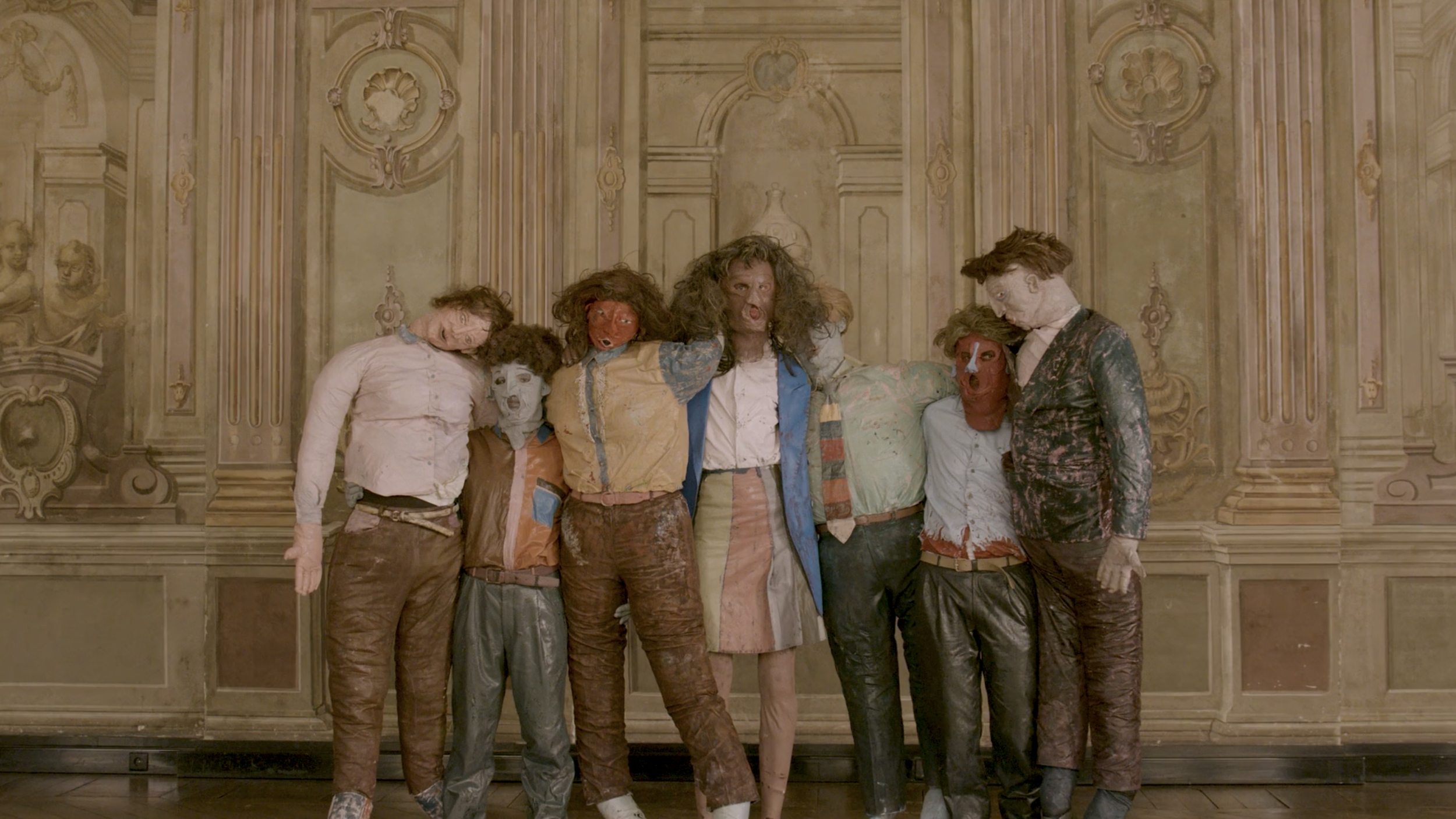
Excerpt of Joy Sauce, 2024
Could you tell us a bit about yourself and your background?
I grew up in a neoliberal family with a ghost. My father was a traveling businessman; my mother handled the accounting and the kids. Two years before I was born, my parents lost their first son. That brother has been a psychological ghost, always present in my conscious life, two universes that never overlapped, yet a presence somehow inserted itself into my psyche. I have this sense that I know him, though I’ve never met him. As a kid, I spent a lot of time in corporate meeting rooms, surrounded by suits and ties. You could say that the subjects and symbolism in my practice are influenced by, or stem from, these biographical anomalies, and that I look for different modalities of ghosts to explore in my work. Fast forward: I studied design first, then completed a second master’s in research in art, and finished with a postgraduate residency at the Higher Institute for Fine Arts (HISK) in Ghent, which started the first developments into my visual art practice as it is today.
The cut-steel pieces are fascinating because the welding bead itself becomes the drawn line, all that grotesque cartoon detail burned permanently into metal. What pulls you toward translating something so loose and irreverent, these horned tricksters and double-faced figures, into a material that is heavy, industrial, and unforgiving? What does steel give your humor that paint or paper cannot?
The roughness, the pain, the toxicity of the process, the grey color, and the burn of the steel give the work a seriousness I couldn’t translate in paint or paper. Yet the humor is still there, there’s no loss of intention. I’d been done with color in my head for years, but in paint and drawing, it kept creeping back in. I couldn’t get rid of it. I wanted to arrive at a point where a simple image could express better some sort of aesthetics of depression or melancholia, something that could withstand time or feel timeless, like a bronze sculpture or symbolic ornamentations from a different era. This way, I was forced to deal with the simplicity of the material and not paint over it. The technique seems impossible to create detailed drawings with, but somehow it works. I don’t really understand how I’m able to make them. I’ve had the idea to melt and draw the line with welding for almost a decade, but I never had the opportunity to do it. The melting kind of feels like adding thick paint to the surface. I was always a bit prude about diving into the harshness, the machismo of welding, carrying around heavy steel and tools, burning the skin and the eyes. It seemed like a major hassle. But now, it’s truly a jouissance, a pleasure in pain. What I also like is that the cut-out creates a depth in the work, where there’s no need for a background. You have to imagine it yourself. The imagery becomes distilled, like a simple black-and-white line sketch on a piece of paper, without the paper. I associate the grey images in steel with ghostly representations of the past that somehow still linger, lost in our future. If that makes any sense. There’s something about making a black-and-white film today that forces you to truly look at the message the scene is bringing, instead of being distracted by easy-to-swallow beauty. But it has always been a tactic of mine: to lure the public in with nice-looking things, only to reveal or hide tougher subjects about the perversities and realities of our world.
There's a wonderful, queasy tenderness to those wall-mounted bodies, pinned up like coats or specimens, sagging in their stained suits and wigs. They read as exhausted office workers, crucified salesmen, casualties of the hustle. What pulls you toward this image of the human figure as something hung up and emptied out, and do you feel affection for these poor creatures, or are you indicting the systems that drained them?
I like that you say queasy and tenderness together. What a marriage. There is a weird Freudian connection. Like most of the puppets were made out of the clothing of past family members, some of them I wasn’t able to attend their funerals. There was an inability to say goodbye. I started accumulating these pieces of clothing for years. They had something out of fashion, something I found ugly or ridiculous but also funny, like I wanted to keep looking at their ridiculousness. The sewn heads, the clumsy hands and feet with no heel bones. All painted in oil paint, by the way, all in textile. I wanted to paint them in color shapes, as if they were abstract paintings hanging on the wall in the shape of bodies. They are sexless, zombified, completely exhausted, absent of soul, objects, bodies. But they are my bodies. My fictional family members, in a way. These are the ghosts I take with me. I was also a little annoyed at the time with the oversaturation of figurative painting, so I wanted these to be literal painted figures. But I also had questions about sexuality and how I looked on the outside, how I was perceived. Strange. The question of identity is present here, with these guys, I think. Like that annoyance when your mother wants to dress you in clothes she wants you to look like, but you don’t resonate with as a teenager, you know that feeling, that identity crisis? How do we represent ourselves? Not only do we choose our clothing, but also our hair, makeup, piercings, tattoos, because we want to see ourselves how we think we are seen by people who see us and how we see ourselves in the mirror. It’s a very strange, fractured perception. We’re all stuck in bodies that come with expectations, demands, and categories we didn’t choose. I made a film as well ( with the support of Vonk) with these puppets, in a mixed media installation, called Joy Sauce in The Belly, featuring a video embedded in a large-scale painting of a surreal domestic scene. The video shows a cast of characters in a historical abbey costumed with masks, wigs, and painted clothing. The characters, which I describe as achievement subjects, are intended to symbolise the state of today’s workers who are trapped in the illusion of freedom and the constant struggle to perform.
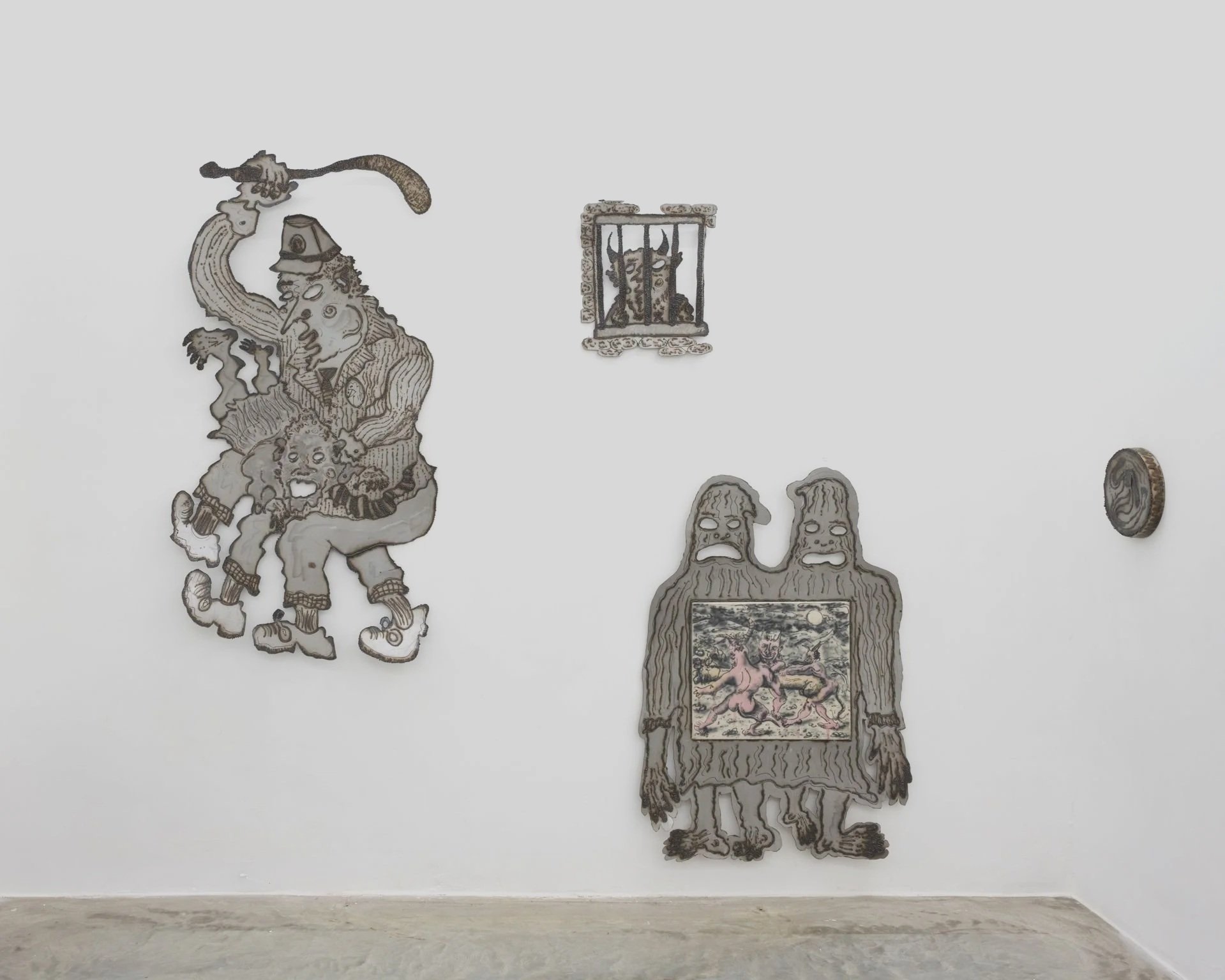
Exhibition view of Siamese Others, 2026, DMW Gallery. Photo: Lina Van Hulle
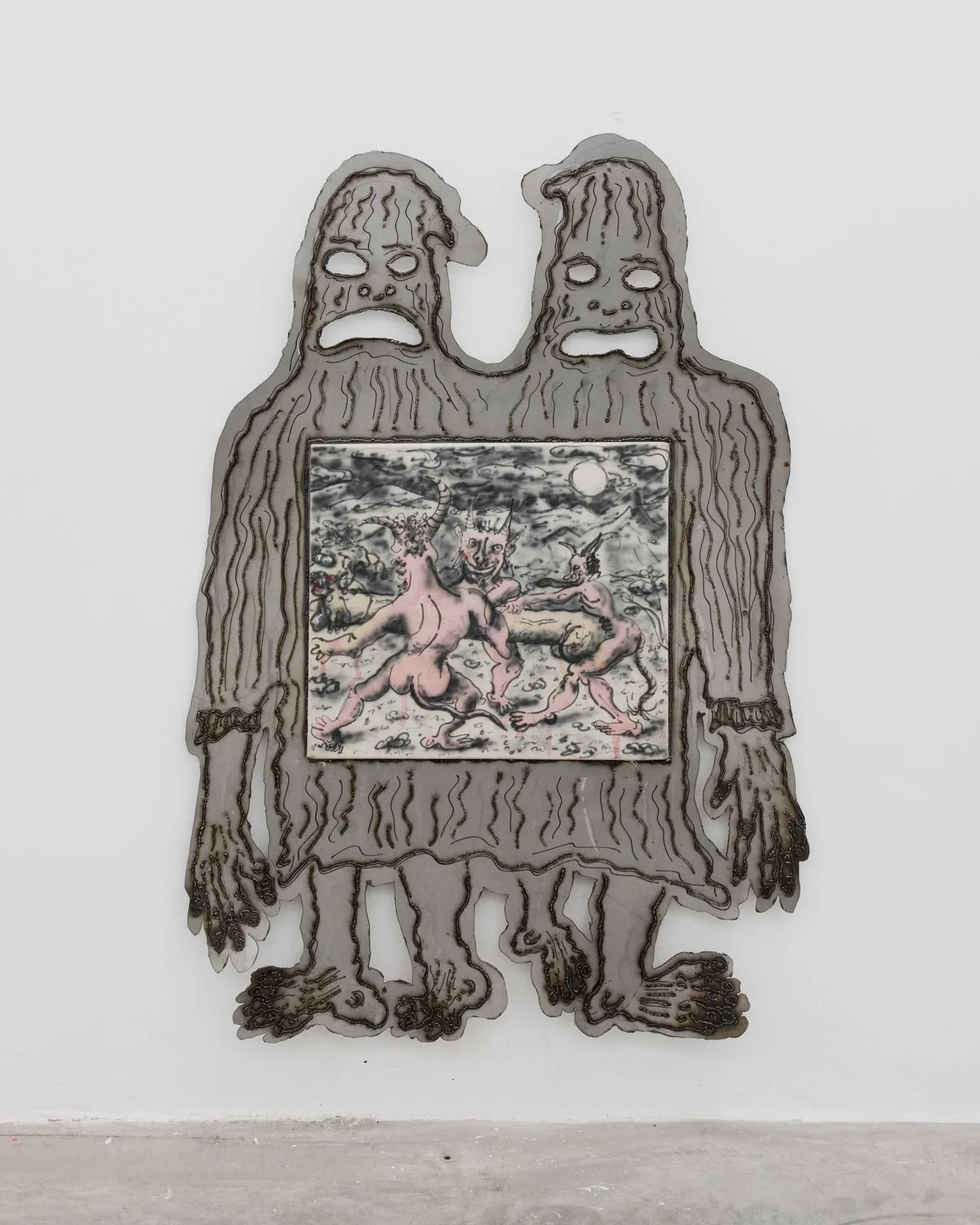
A-somatic Spill 2026. Photo: Lina Van Hulle
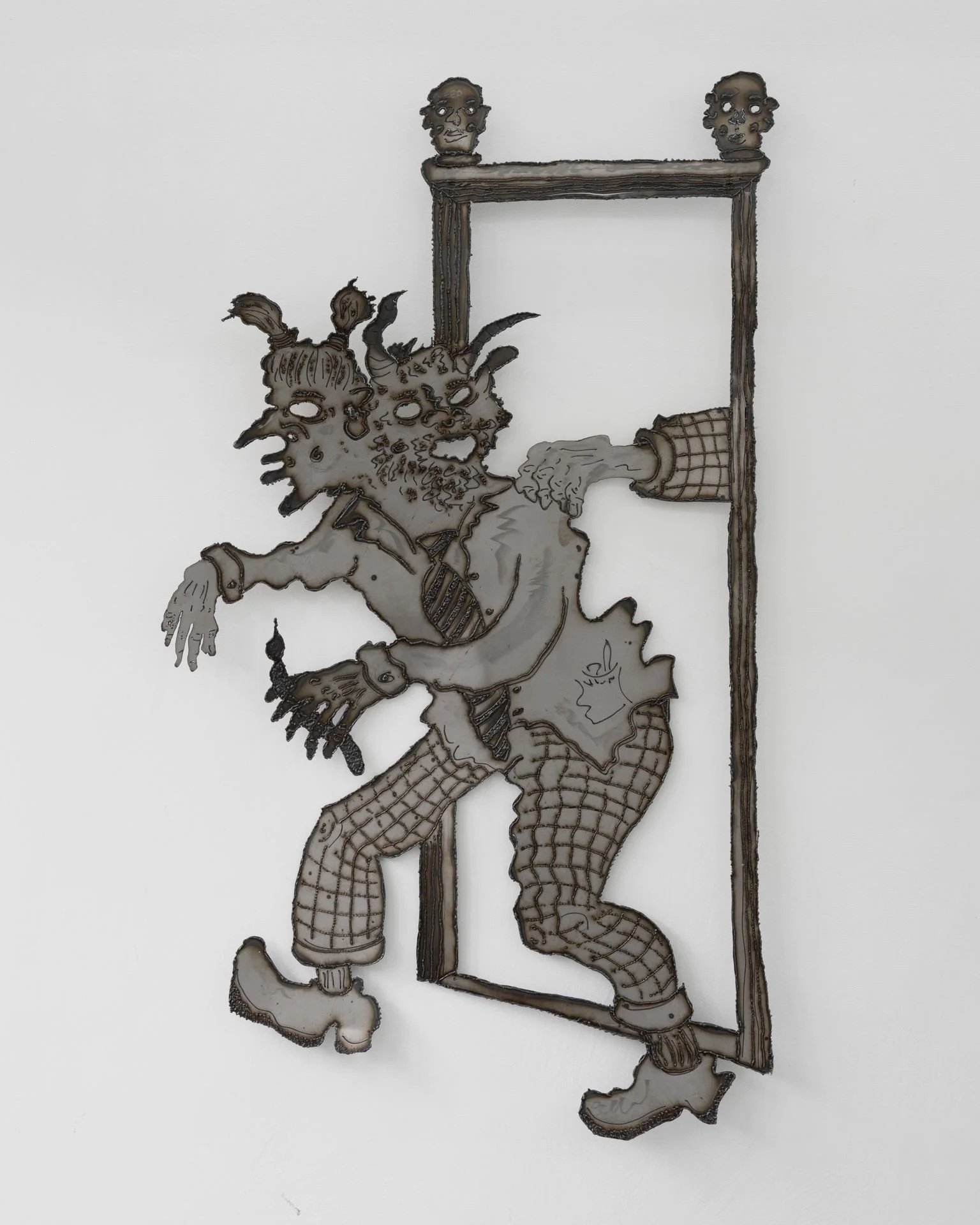
A brother-thief had robbed him while he slept, and gone ashore at some intermediate landing, 2026. Photo: Lina Van Hulle
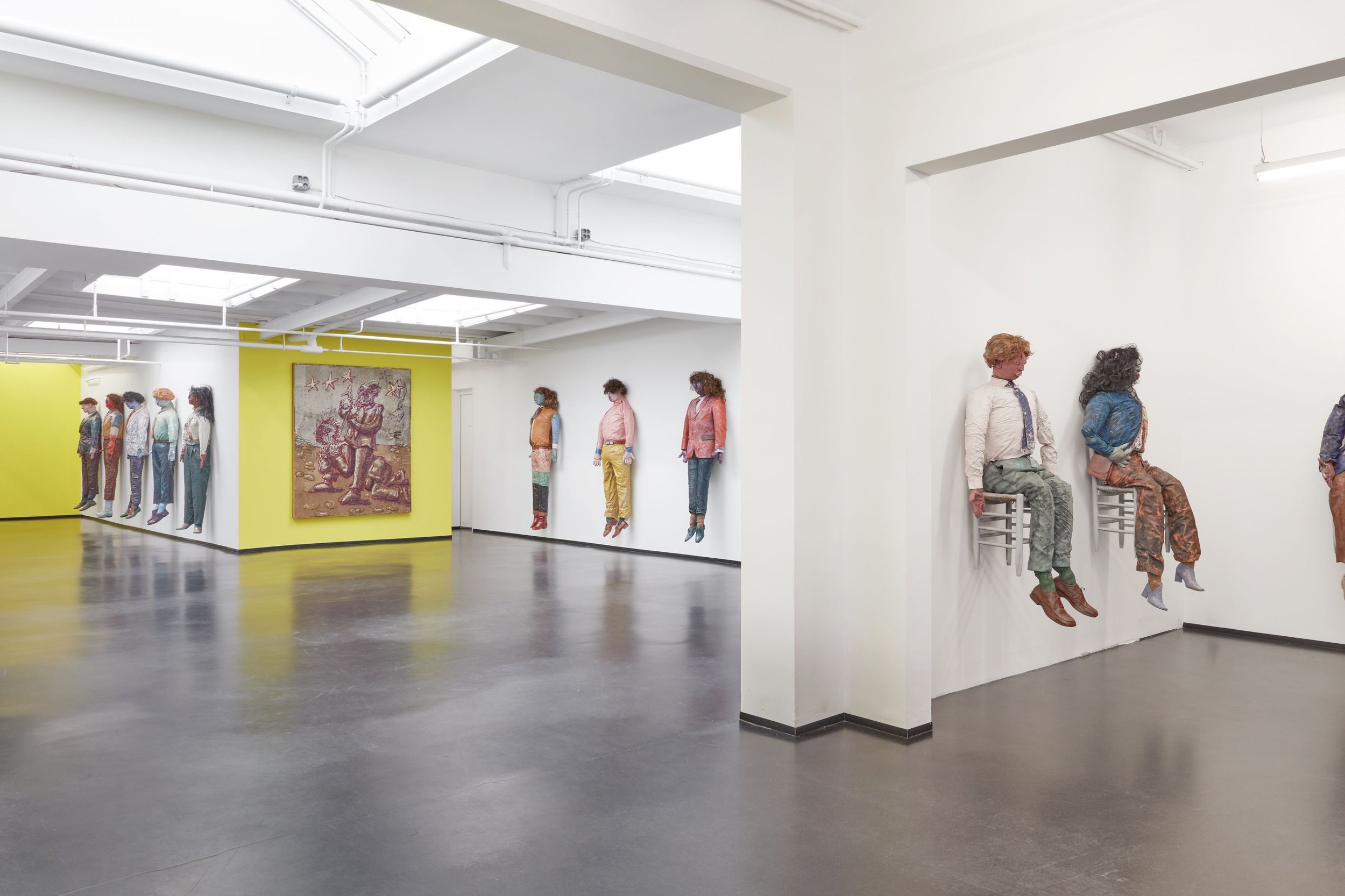
Exhibition views of Happy To Hear You’re Doing Fine, 2023, at 38CC in Delft, The Netherlands Photo: We Document Art
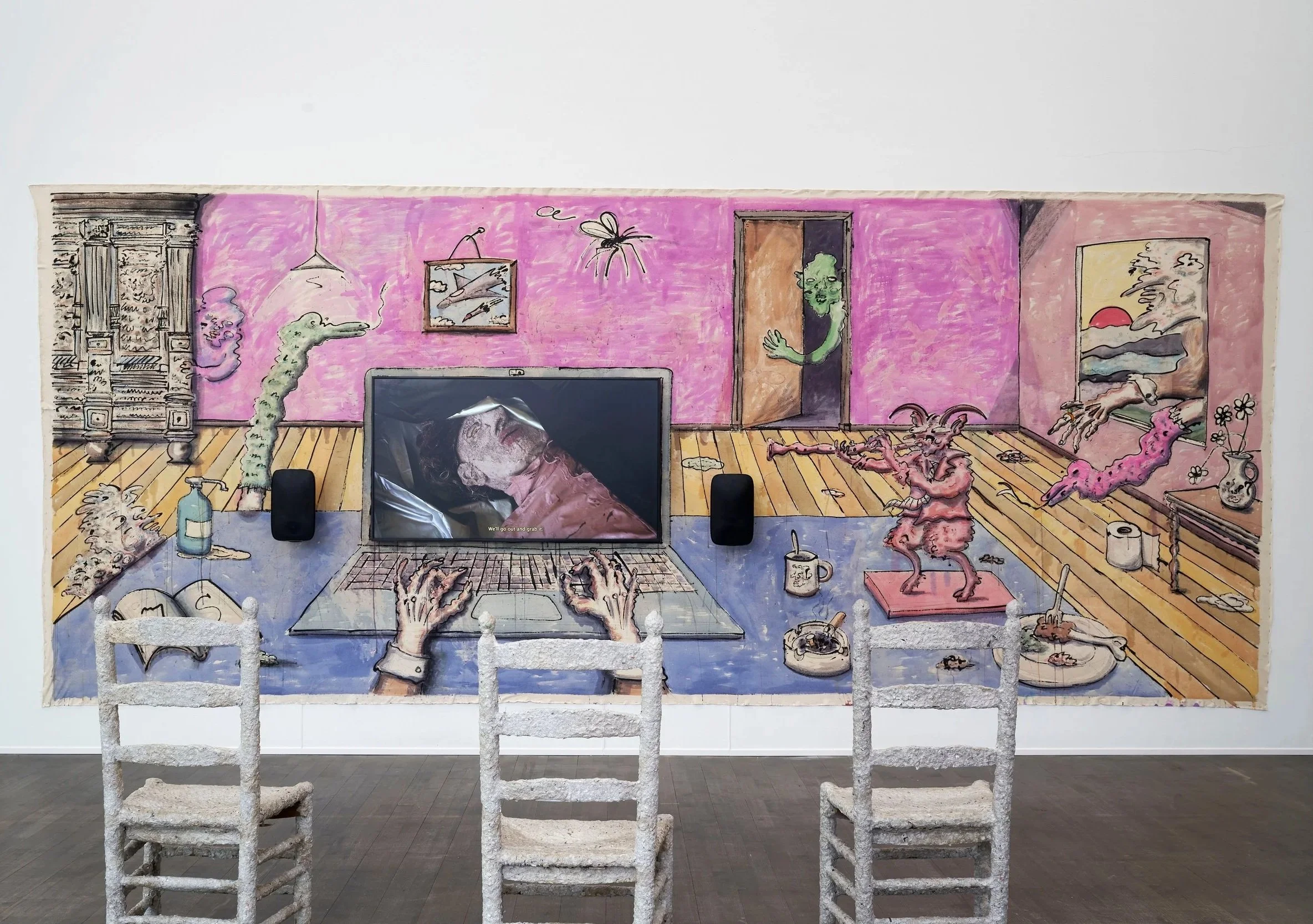
Installation view of Joy Sauce in The Belly 3#, 2025, during Painting after Painting, S.M.A.K., Ghent. Photo: We Document Art
The grotesque in your work keeps landing right on the seam where attraction meets repulsion. And your films collapse the distance between the living and the made-up. How do you know when a character has reached that sweet, uncomfortable spot, and do you ever catch yourself pulling back because something got too horrifying or, maybe worse, too charming?
I frankly don’t know, or I do? For me, there’s a liminal space, a battle perhaps to create, between what’s too cartoonesque or too nice-looking and what’s painful and human. And if one is present too much, or I cringe too much, yes, I either kill the work or try again. But I guess if it goes into the uncomfortable, you can’t be very far off from that sweet spot. My work needs to be somewhat uncomfortable, always. But why? That’s a psychoanalytic question I haven’t been entirely able to answer yet ( I’m into Lacan a lot). Someone recently said I deliberately create cringe. So I’ve been thinking about that a lot now: How cringe could I go and what is cringe? There was this hilarious moment at a duo show I did with Elen Braga at DMW Gallery, where we questioned the idea of being conjoined in society. We made this absurd, grotesque, low-budget film with us as conjoined twins, talking in a split monologue about topics like separation and the European Union, slurping on drinks, vacuum cleaning, while the other reads a book, in very uncomfortable conjoined positions. My mother was there with one of her friends at the opening, and the whole time they were standing, watching the film with disgust. But they couldn’t leave the room. They just kept watching it for like an hour, saying how disturbing it was and questioning why we would make such a thing. Our other individual artworks, the ones that looked “nicer,” were almost completely ignored. It was a brilliant example of repulsion and attraction.
Tell us a bit about how you spend your day / studio routine? What is your studio like?
I have periods of routine, but they are always different depending on the project. I do have periods of complete obsession combined with panic, mostly nearing a deadline. I’ll be completely confined inside my head, and everything else becomes secondary. I will bruise my mental and physical health just to deliver the work as I see it, and I wouldn’t be able to stop until the transport comes to pick it up for the show. Even then, I would doubt it, start a new piece, take it on the train, and deliver it the next day to the venue, just because I thought I could do more. During these times, I can't find the time to send an email or post on social media. The work is more important than the attention and all that. But it’s also a form of self-sabotage. I have this thing where I sometimes sit for hours in my studio just eating nuts or scrolling on my phone (the nuts are a better habit than smoking, eating candy, or scrolling), doubting what to create, until my body feels oversaturated. Then, like a kind of bulimia, I puke all the work out in an instant. There is a need to consume. To disgust the self. It's a very strange habit.
What artwork have you seen recently that has resonated with you?
This question made me think for days. Agnes Scherer. It was such a pleasure to see her work, it’s so elegant, fragile, and wittily scenographic. It looks as though it refers to olden days, folk rituals, but then the puppets are holding contemporary elements like smartphones, without it feeling too kitsch or cringe. The work is playful and well-made at the same time; you can really see a love for the practice. I guess it resonates with me because I have puppets that I’ve shown in installations since 2022, although they lay mostly in body bags these days. Seeing her work makes me want to pick them up, revisit them, and do something entirely new with them.

Installation view of It's a Sickness, 2026, Het Resort, Groningen, The Netherlands Photo: Hanne van der Velde

Installation detail of It's a Sickness, 2026, Het Resort, Groningen, The Netherlands.
Is there anything new and exciting in the pipeline you would like to tell us about?
This year, 2026, has been enormously exciting already, filled with many shows and wonderful collaborations with kind, smart, and passionate people. To name a few: a lot of projects in the Netherlands, like a residency and exhibition on a football field with Het Resort, but also a solo show at Matca Artspace in Cluj-Napoca, Romania, where I showed multiple video pieces simultaneously, so it really felt like being inside my head. Right now, my work is part of the Biennial of Painting exhibition currently running at Museum Mudel. This follows a recent duo show at DMW Gallery with Elen Braga, another at Gallery Fleur & Wouter with Alexandra Phillips, and a collective project with Anna Reutinger, David Bernstein, and Juan Pablo Plazas at Second Room.
I’ve also been performing with my sock puppet and goat suit at various venues, including the Neuer Aachener Kunstverein and Dingen Die Niet Verkopen. Looking ahead to the next season, my next appearance will be at the BUTFF (Belgian Underground Trash & Film Festival) experimental film festival in Breda, alongside an upcoming group show at CC Zwaneberg curated by Tamara Beheydt, and a show at Barbé gallery. I am also taking the first steps into a new fascination: bringing attention back to ornamentation on building facades. This research and its first tests will be part of a fablab run by artist Mathias Mu. Looking even further ahead to 2027, I am likely going to be part of a working residency at Das Leben am Haverkamp in The Hague, a project space focused on research at the intersection of fashion and art, which will culminate in a solo presentation.
All images courtesy of the artist
Interview publish date: 07/07/2026
Interview by Richard Starbuck